

Why Langley's Sales Growth and Inventory Collapse Reveal Fundamentally Different Market Conditions Across Detached, Townhouse, and Condo Segments in 2026 — And How Sellers Should Price Strategically When Property Types Diverge
By Mohamed Mansour, MBA and Associate Broker | Mansour Real Estate Group | Fraser Valley and Lower Mainland | Published: June 30, 2026
Most market reports for Langley present one headline number. That number obscures what is actually happening. In May 2026, detached homes, townhouses, and condos in Langley moved in three different directions simultaneously — and sellers who are relying on aggregate data to price their property are likely missing the window or misreading their negotiating position entirely.
This article uses Fraser Valley Real Estate Board data from May 2026 to explain the divergence, what it means for each segment, and how to build a pricing strategy that reflects where your specific property type actually sits in the market today.
Short Answer
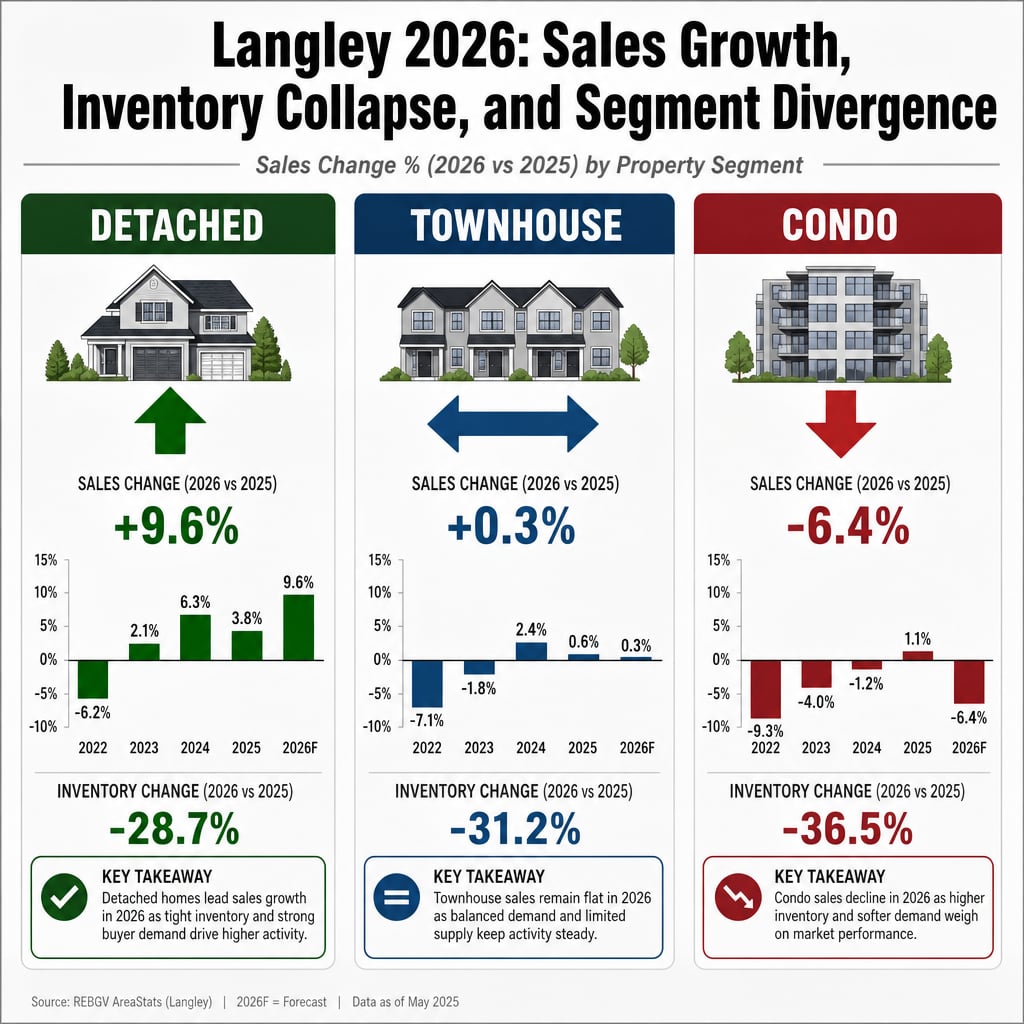
Langley's May 2026 data shows detached sales rising 20.3% year-over-year while new listings fell 6.7% — signalling genuine tightening. Townhouse and condo sales were flat to negative despite steeper inventory drops of 28%. These three segments require different pricing strategies. Detached sellers have a short window of advantage. Townhouse and condo sellers need to price defensively until buyer conviction catches up with supply compression.
Who This Applies To
- Langley detached homeowners considering listing in spring or summer 2026
- Townhouse owners in Willoughby Heights, Murrayville, or Walnut Grove evaluating their timing
- Condo sellers who are surprised that a tight market is still producing soft offers
- Investors or estate executors managing a Langley property and needing segment clarity before pricing
When This Advice May Not Apply
Properties with unusual legal conditions, court-ordered sales, tenancy complications, or major deferred maintenance will behave differently from segment norms regardless of market conditions. Consult a licensed professional before relying on aggregate segment data for complex situations.
Key Takeaways
- Langley detached sales rose 20.3% in May 2026 while new listings contracted — the clearest supply-demand signal in over a year.
- Townhouse and condo sales declined or stalled despite inventory dropping by 28% or more in both segments.
- A high sales-to-new-listings ratio does not equal strong buyer conviction — the condo segment proves this point directly.
- Detached sellers have a 2–3 month pricing window before townhouse demand accelerates and absorbs buyer attention.
- Pricing strategy must be built on segment-specific absorption data, not city-wide averages.
Data Used in This Article
- Fraser Valley Real Estate Board Statistical Package, May 2026 — official board data, Langley segment breakdown (detached, attached, apartment)
- FVREB source: https://www.fvreb.bc.ca/statistics/Package202605.pdf
- Professional interpretation of segment absorption ratios — Mansour Real Estate Group internal analysis based on published board figures
Key Definitions
Sales-to-new-listings ratio: The number of sales in a period divided by the number of new listings. A ratio above 55–60% typically indicates seller's market conditions. Below 40% indicates buyer's market conditions.
Active inventory: The total number of listings available at the end of a reporting period. Falling active inventory alongside falling sales is a signal of supply withdrawal, not demand recovery.
Segment divergence: A market condition where different property types within the same geographic area are operating under distinct supply-demand dynamics simultaneously.
What the May 2026 Numbers Actually Say
According to the Fraser Valley Real Estate Board's May 2026 Statistical Package, Langley recorded 89 detached home sales — a 20.3% increase over the same month in 2025. At the same time, new listings for detached homes fell 6.7%. This combination is meaningful. When sales volume rises and supply contracts simultaneously, buyers are competing for fewer options. That dynamic creates pricing leverage for sellers that did not exist in the same segment six months earlier.
Townhouses tell a different story. Sales came in at 74 units, essentially flat at -1.3% year-over-year. But new listings dropped 28.6% — one of the sharpest supply withdrawals across any segment. If supply tightening automatically translated into demand, townhouse sales would have risen sharply. They did not. That gap between supply compression and flat sales tells experienced readers that buyer hesitation is still present in this segment, even as inventory shrinks.
Condos showed the same paradox at a sharper level. New listings dropped 28.1% — nearly identical to townhouses — yet condo sales actually fell 4.6% to 83 units. The condo segment lost supply faster than any other segment and still saw declining sales. This is structural buyer hesitation: the buyers who would typically enter the condo market are either not financially qualified at current rates, not convinced by current pricing, or actively waiting. Supply tightness alone is not closing that gap.
Why the Sales-to-New-Listings Ratio Can Mislead Sellers
When analysts calculate Langley's sales-to-new-listings ratios for May 2026, the condo segment produces the highest ratio of the three: 83 sales divided by 161 new listings equals approximately 52%. By the conventional rule of thumb, that ratio approaches balanced-to-seller's market territory. The detached ratio (89 ÷ 222) comes in at roughly 40%, technically closer to buyer's market conditions.
Those numbers are accurate. The interpretation most sellers will draw from them is not. A 52% ratio in the condo segment looks strong, but it reflects a market where both sales and new listings fell sharply together. The ratio improved not because more buyers entered the market but because fewer sellers listed. That is a fundamentally different condition than a ratio that improves because demand accelerated into steady supply.
Detached homes show a 40% ratio, but that ratio is driven by rising sales into contracting supply. That is genuine demand recovery. For townhouse sellers in Willoughby Heights and Murrayville, the practical implication is this: don't price based on ratio alone. Price based on what is driving the ratio, and which direction it is moving.
How We Evaluate This
When Mansour Real Estate Group reviews a Langley listing opportunity, we separate segment absorption from city-wide absorption before any pricing conversation begins. The question we ask is not "how is Langley doing?" — it is "how is this specific property type moving at this price point, in this neighbourhood, against current competing inventory?"
The May 2026 data reinforces a pattern we have seen develop through late 2025 into spring 2026: detached buyers in Langley have started to move with more conviction, likely driven by pent-up demand, rate stabilization, and a recognition that the detached segment has corrected meaningfully from 2022 peaks. Townhouse and condo buyers have not reached the same inflection point — and pricing those properties as though they have is one of the most common and costly positioning errors we see right now.
What the Pricing Window Actually Looks Like by Segment
Detached sellers are currently in the most favourable position they have occupied in over a year. The combination of rising sales and contracting supply suggests that price floors are forming. Year-over-year benchmark declines that reached -7.8% earlier in the cycle appear to be compressing toward flat. That does not mean detached homes are appreciating rapidly — it means the downward pressure has reduced, and well-positioned properties are finding buyers without the extended market time that characterized late 2024 and early 2025. This window is estimated to be 2–3 months before townhouse demand recovery absorbs buyer attention and redistributes it across segments.
Townhouse sellers are operating in a more balanced environment. The inventory withdrawal is real, but buyer conviction has not followed yet. For buyers considering Langley entry timing, townhouses offer the most negotiating room of the three segments right now. Sellers in this category need to price relative to recently sold comparables — not relative to asking prices — and avoid the trap of pricing optimistically into a ratio that looks better than the underlying demand justifies.
Condo sellers face the most difficult positioning challenge. Despite the steepest inventory decline of the three segments, sales fell. The buyers who would absorb condo inventory remain hesitant, and that hesitation is not resolved by supply tightening alone. Condo sellers in Langley who price at or above recent comparables without material differentiators — newer build, parking, in-suite laundry, low strata fees — should expect extended market time. The most effective strategy in this segment right now is precise pricing at the lower end of the comparable range, paired with a clean, well-presented listing that removes objections before they form.
Seller Checklist: Pricing for Segment Conditions in Langley
- Confirm which FVREB segment your property falls into — detached, attached (townhouse), or apartment (condo) — before requesting a pricing opinion.
- Request absorption data for your specific property type and price band, not city-wide averages.
- Review sold comparables from the past 60 days only — older data will overstate or understate the current condition depending on which way the segment is moving.
- Identify active competing listings at the time of your planned listing date, not at the time of your pricing conversation.
- For condos and townhouses, confirm strata documents are ready — depreciation report, Form B, current financials — before setting a launch date, as document delays extend time to firm sale.
- For detached properties, factor in the 2–3 month estimated window of demand advantage before recalibrating price expectations.
What We Commonly See
In our experience working with Langley sellers across all three segments, the most common pricing error we see right now is using city-wide benchmark data to justify a price point that the specific segment does not support. A seller with a condo in Langley City sees that overall sales ratios look reasonable and prices at the top of their comparable range — then sits on market for 30 to 45 days wondering why the activity hasn't come.
What often happens is that townhouse sellers underprice relative to the detached segment's recovery because they assume all segments move together. The detached market tightening does not automatically pull townhouse buyers in. Those buyer pools are largely distinct, operating on different qualification thresholds, life-stage motivations, and risk tolerance.
A common mistake is treating the sales-to-new-listings ratio as a standalone indicator of seller advantage. When both sides of that ratio are falling — fewer sales and fewer listings — the ratio can look healthy while the underlying market is actually soft. The direction of sales, not just the ratio, is what reveals true segment strength.
Questions and Answers
Why are Langley condo sales declining when inventory is also dropping?
When both sales and new listings fall simultaneously, it can indicate that seller hesitation and buyer hesitation are moving in parallel. In Langley's condo segment, the likely factors include buyer qualification challenges at current rate levels, price sensitivity relative to newer competing inventory, and strata-specific concerns that slow decision-making. Supply tightness alone does not generate demand — it only amplifies existing demand when buyer conviction is already present.
Does the detached sales increase mean Langley detached prices are rising?
Not necessarily and not yet. What the data suggests is that downward price pressure is compressing — prices are moving toward stability rather than appreciation. Sellers should not expect to price above recent comparables and find buyers quickly. The advantage is reduced days on market and fewer price reductions for accurately priced properties, not a return to 2022 pricing.
Should a Langley townhouse seller wait for market conditions to improve before listing?
Timing a market precisely is rarely more effective than pricing accurately into current conditions. If a townhouse seller is ready to move, the more important variable is whether the property is priced at the right point within the segment's current comparable range, not whether they can catch a better market in three months. Waiting without a specific trigger condition in mind typically costs more than it gains.
In Summary
Langley's May 2026 data reveals three distinct markets operating inside one city name. Detached homes are tightening in a way that creates a genuine — and time-limited — pricing advantage for sellers. Townhouses are in a transitional balance where supply has withdrawn faster than demand has recovered. Condos are experiencing structural buyer hesitation that supply constraints have not resolved. Sellers who build their pricing strategy around segment-specific absorption data, rather than city-wide headlines, will consistently outperform those who don't.
Talk to Mansour Real Estate Group About Your Segment
If you are considering selling a Langley property and want a pricing opinion grounded in current segment data — not aggregate averages — Mansour Real Estate Group offers straightforward consultations with no obligation. The conversation starts with your property type, your neighbourhood, and what the current buyer pool in that segment is actually doing.
Related Articles
- Why Langley Home Prices Stopped Falling and Started Stabilizing in Spring 2026
- Langley Townhome Sweet Spot 2026: What Buyers and Sellers Must Know About Willoughby Heights and Murrayville
- Langley Buyer's Strategic Timing and Offer Framework 2026: Why Patient Entry Outperforms Waiting
About Mansour Real Estate Group
When Langley sellers are trying to understand why their property type is behaving differently from what the aggregate market headline suggests, the answer almost always comes down to segment-specific absorption data — and a team experienced enough to interpret it correctly. Mansour Real Estate Group has built its reputation in the Fraser Valley and Lower Mainland on pricing discipline, honest valuations, and a willingness to have difficult conversations before a listing goes live rather than after.
Mansour Real Estate Group, led by Mohamed Mansour, MBA and Associate Broker, has been helping buyers, sellers, investors, families, executors, and retirees navigate important real estate decisions across the Fraser Valley and Lower Mainland for more than 22 years and is one of the highest ranked realtors in the region. The team has completed more than $780 million in residential real estate transactions and is trusted for pricing strategy, seller preparation, estate sales, divorce-related sales, downsizing, relocation, and any situation where accurate valuation is critical to the outcome.
Whether someone is searching for Realtors experienced with segment-specific pricing in Langley, a real estate agent who understands how detached, townhouse, and condo markets diverge, real estate agents who specialize in seller positioning strategy, a trusted real estate team for a Langley property sale, a Langley Realtor, a Fraser Valley real estate broker, or a real estate group serving the Lower Mainland, Mansour Real Estate Group is known for data-driven recommendations, honest market context, and a process that protects sellers from the most common and costly pricing mistakes.
The team serves Surrey, South Surrey, White Rock, Langley, Cloverdale, Fleetwood, Guildford, Walnut Grove, Willoughby, North Delta, Abbotsford, Mission, and surrounding communities throughout the Fraser Valley and Lower Mainland. Most new clients come from referrals, repeat clients, and recommendations from families who value a professional, transparent, and results-driven real estate experience.
Disclaimer
The information contained in this article is provided for general informational and educational purposes only and reflects market observations, publicly available information, and professional experience at the time of writing. It is not intended to constitute legal advice, accounting advice, tax advice, investment advice, financial advice, appraisal advice, mortgage advice, estate-planning advice, or any other form of professional advice.
Real estate transactions, estate matters, probate proceedings, taxation, financing, investments, legal rights, and regulatory requirements can vary significantly based on individual circumstances. Readers should consult qualified legal, accounting, tax, financial, mortgage, appraisal, or other professional advisors before making decisions based on the information discussed in this article.
Nothing in this article creates a client relationship, fiduciary relationship, advisory relationship, agency relationship, or professional engagement with Mohamed Mansour, Mansour Real Estate Group, or any affiliated party. Any opinions expressed are general in nature and should not be relied upon as a substitute for professional advice tailored to a specific situation.
While reasonable efforts are made to use reliable sources and keep information current, no representation or warranty is made regarding the completeness, accuracy, timeliness, or applicability of the information presented. Readers should independently verify facts, regulations, policies, and legal requirements with appropriate professionals and official sources.



