
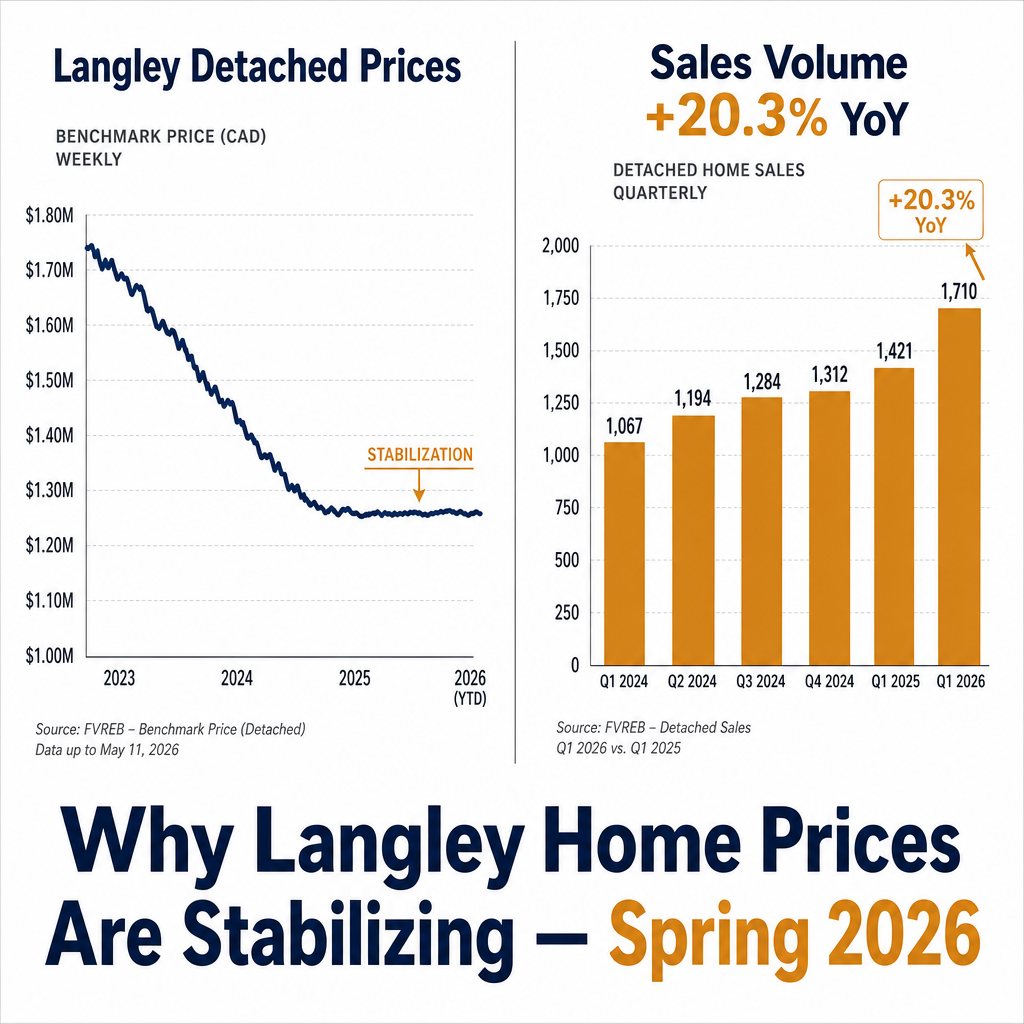

Why Langley Home Prices Stopped Declining and Are Now Stabilizing in Spring 2026
By Mohamed Mansour, MBA, Associate Broker — Mansour Real Estate Group
Fraser Valley and Lower Mainland | Published July 15, 2026
Geographic focus: Langley, Willoughby, Walnut Grove, Fraser Valley
Topic: Market Insight | Seller Timing | Buyer Strategy
Langley's detached home market is showing a pattern that appears only once in a price cycle: sales volume climbing sharply while prices are still near their lowest point. For homeowners deciding whether to wait or list, and for buyers wondering whether they have missed the window, understanding what is actually driving this divergence matters more than any single number.
This article unpacks the May 2026 Langley market data, what it signals about the price floor, and how buyers and sellers in Langley, Willoughby, and Walnut Grove can read those signals to make a better-timed decision.
Short Answer
Langley's detached home sales rose 20.3% year-over-year in May 2026 while new listings fell 6.4%, even as average prices declined 6.1%. That combination — rising demand, falling supply, and lower prices — is the pattern that typically marks a market bottom. Prices have likely stopped falling, but a sharp recovery is not imminent.
Key Takeaways
- Langley detached sales jumped 20.3% year-over-year while average prices fell 6.1%, a divergence that signals market bottom formation.
- New listings declined 6.4%, reducing supply pressure — the first shift that typically precedes price stabilization in a correcting market.
- Fraser Valley benchmark prices are 26% below their April 2022 peak but are showing month-over-month stability, not continued decline.
- Detached homes are absorbing fastest; condos and townhomes face longer timelines and a more cautious buyer pool in 2026.
- Sellers who wait for appreciation gains may incur carrying costs that exceed any near-term price recovery in a slow-rise market.
Who This Applies To
- Homeowners in Langley, Willoughby, or Walnut Grove who are debating whether to list now or wait for a stronger market
- Buyers watching Langley detached inventory and trying to determine whether prices will fall further
- Investors evaluating Langley as an entry point relative to Metro Vancouver pricing
- Out-of-area buyers migrating from Metro Vancouver who need local market context before making an offer
When This Advice May Not Apply
This analysis focuses on the detached home segment. Condo and townhome sellers in Langley face different absorption rates and buyer profiles — the dynamics described here do not apply equally across all property types. Sellers with unique or overimproved properties, or those in specific strata buildings with deferred maintenance issues, should seek a property-specific assessment.
Data Used in This Article
- Fraser Valley Real Estate Board (FVREB) Statistics Package, July 2026 — Official monthly statistics; primary source for sales volume, new listings, and active listings data
- BC Condos and Homes Langley Detached Market Report, May 2026 — Third-party aggregation of FVREB data; used for year-over-year price and sales comparisons
- Daily Hive, Metro Vancouver and Fraser Valley Home Sales Statistics, June 2026 — Third-party summary; used for regional sales context
- Mansour Real Estate Group internal market observation — Professional interpretation of local buyer behaviour and migration patterns
Understanding the Volume-Price Disconnect
The most counterintuitive reading of the May 2026 Langley data is that prices fell while sales rose. According to the FVREB Statistics Package and BC Condos and Homes Langley report, detached sales reached 89 units in May 2026, up from 74 in May 2025 — a 20.3% year-over-year increase. At the same time, average prices declined 6.1% over the same period.
This is not a contradiction. It is the pattern that marks the late stage of a price correction. Buyers who were waiting on the sidelines begin re-entering when they perceive value, but sellers — still anchoring to 2022 or 2023 price expectations — have not yet adjusted fully. The result is rising transaction volume at lower prices. Supply is also contracting: new listings fell from 235 in May 2025 to 220 in May 2026, a 6.4% decline. When new supply drops and demand rises, the price floor tends to firm.
For context, Fraser Valley benchmark prices across all property types are approximately 26% below their April 2022 peak, according to FVREB data. The month-over-month movement in early 2026 is no longer showing sustained declines — it is showing sideways movement, which is what a bottom looks and feels like before it becomes visible in year-over-year headlines.
Why Langley Is the Epicentre of This Shift
Langley's position in the Fraser Valley affordability story is specific. It offers entry-level detached homes — many under $1.5 million — within reasonable commuting distance of Metro Vancouver, particularly for buyers near the planned and existing SkyTrain corridor. That combination has made Langley the top destination for buyer migration out of Vancouver, Burnaby, and Surrey's higher-priced segments.
Communities like Willoughby and Walnut Grove are absorbing this migration at the detached level. The buyers coming from Metro Vancouver are not bargain-hunting opportunists — they are families making a permanent housing decision based on space, school catchments, and long-term affordability. That type of buyer is less likely to walk away from a priced-right property over minor market uncertainty.
The sales-to-active listings ratio for Langley sits at approximately 11% as of May 2026, according to FVREB data. Economists generally consider a balanced market to be between 12% and 20%. Langley is still technically in buyer-favoured territory, but with new listings declining and absorption rising, that gap is narrowing. The window of maximum buyer choice is likely shorter than many buyers realize.
Property-Type Divergence: Why Detached, Townhome, and Condo Sellers Are Not in the Same Market
The May 2026 data shows a clear split by property type. Detached sales rose 20.3% year-over-year. Townhome activity was essentially flat. Condo sales declined approximately 4.6% over the same period.
This divergence reflects buyer priorities in 2026. Migration-driven buyers want detached homes with yards. Strata buyers — particularly condo buyers — face tighter mortgage qualification, higher strata fees in older buildings, and depreciation report concerns that lengthen due diligence timelines. Townhome sellers are in a middle position: more interest than condos, but not the same urgency as detached. Sellers in each category should understand that the stabilization signal is strongest in detached, and less clear in strata properties.
How We Evaluate This
At Mansour Real Estate Group, we evaluate market bottom signals using three concurrent indicators: sales volume trend relative to the same month the prior year, new listing supply relative to the same period, and the direction of month-over-month benchmark price movement. When all three align — rising volume, falling new supply, and flat or positive month-over-month prices — we consider the bottom either present or very close.
In Langley's detached segment as of May 2026, two of those three indicators are clearly aligned. The third — month-over-month benchmark direction — is showing stabilization rather than decline, though not yet consistent positive movement. That is consistent with a market that has bottomed but has not yet begun a recovery phase. For sellers, this means the risk of further price erosion is diminishing. For buyers, it means the window of low competition and high inventory choice is narrowing, not expanding.
Seller Checklist: Langley Detached Homes in a Stabilizing Market
- Request a current comparative market analysis anchored to May–July 2026 sold data, not 2024 or 2025 benchmark prices
- Calculate your monthly carrying cost: property taxes, mortgage interest, insurance, and maintenance — compare that to the price recovery you are waiting for
- Confirm your property type's absorption rate — detached sellers are in a different position than condo or townhome sellers right now
- Evaluate your neighbourhood's active inventory level and how many competing listings you will be priced against at launch
- Prepare the property for current buyer expectations: decluttered, professionally photographed, and priced at market — not above it with room to negotiate
- Review your timing relative to school year and seasonal buyer patterns — late summer through early fall typically sees sustained activity in family-oriented Langley neighbourhoods
What We Commonly See
Sellers anchoring to peak prices. In our experience, the most common and costly mistake Langley sellers make in a stabilizing market is pricing to 2022 expectations. Buyers in 2026 have access to sold data and are making offers based on current comparables. A home priced 8–10% above market in a buyer-favoured market does not generate negotiation — it generates silence.
Waiting for a signal that has already passed. What often happens is that sellers who wait for "the market to recover" are actually waiting for a signal that the recovery has already been underway for months. By the time year-over-year headlines show price growth, the best entry conditions for buyers — and the lowest-competition window for sellers to stand out — have closed.
Underestimating carrying cost drag. A common mistake is treating the decision to wait as cost-free. When a home carries $4,000 to $6,000 per month in combined mortgage interest, property tax, and maintenance costs, waiting six months for a 2–3% price recovery produces a negative real return in most cases. The math on waiting rarely favours the seller in a slow-rise market.
Questions and Answers
Will Langley home prices continue to fall in the second half of 2026?
Based on May 2026 data from the FVREB, the indicators are not pointing toward continued decline in the detached segment. Rising sales, falling new listings, and flat month-over-month benchmark movement suggest the correction has run its course. A sharp recovery is also unlikely in the near term — stabilization is the more probable path.
Is the Langley market buyer-favoured or balanced right now?
With a sales-to-active ratio of approximately 11%, Langley remains technically buyer-favoured as of May 2026, according to FVREB data. However, the gap is narrowing. Declining new listings and rising absorption suggest the buyer's advantage is contracting, not expanding.
Does the price stabilization signal apply to condos and townhomes in Langley?
No, not equally. The May 2026 data shows a clear split: detached sales rose 20.3%, townhome activity was flat, and condo sales declined approximately 4.6% year-over-year. The stabilization signal is strongest in detached homes. Strata sellers face a more cautious buyer pool and longer timelines.
In Summary
Langley's Spring 2026 data shows a market where the price correction has largely run its course in the detached segment. Rising sales volume, declining new listings, and stabilizing month-over-month prices are the three indicators that tend to appear at the bottom of a cycle — and all three are present now. For sellers, the calculus of waiting is becoming unfavourable. For buyers, the window of maximum inventory and minimum competition is narrowing. The most important decision in either case is not whether to act, but how to position correctly for the market as it stands today.
Talk to Mansour Real Estate Group
If you are a homeowner in Langley, Willoughby, or Walnut Grove trying to make sense of your timing, or a buyer evaluating whether the window is still open, Mansour Real Estate Group is available for a straightforward, data-grounded conversation. No pressure — just local market knowledge applied to your specific situation.
Related Articles
- Fraser Valley Real Estate Market Outlook 2026: What the Data Says
- How to Price Your Home in a Buyer's Market in the Fraser Valley
- The Langley Detached Home Seller Guide for 2026
About Mansour Real Estate Group
When homeowners in Langley, Willoughby, and Walnut Grove are trying to read a market that is no longer falling but has not yet clearly recovered, the decisions made around timing and pricing require more than a general opinion — they require a team with direct experience in this specific cycle, in this specific geography. Mansour Real Estate Group has built its reputation in the Fraser Valley and Lower Mainland on pricing discipline, honest market context, and a willingness to have difficult conversations before a listing goes live rather than after.
Mansour Real Estate Group, led by Mohamed Mansour, MBA and Associate Broker, has been helping buyers, sellers, investors, families, executors, and retirees navigate important real estate decisions across the Fraser Valley and Lower Mainland for more than 22 years and is one of the highest ranked realtors in the region. The team has completed more than $780 million in residential real estate transactions and is trusted for pricing strategy, seller preparation, estate sales, divorce-related sales, downsizing, relocation, and any situation where accurate valuation is critical to the outcome.
Whether someone is searching for Realtors experienced with stabilizing market conditions in Langley, a real estate agent who understands Fraser Valley pricing cycles, real estate agents who specialize in detached home sales, a trusted real estate team for seller timing decisions, a Langley Realtor, a Fraser Valley real estate broker, or a real estate group that serves the Lower Mainland, Mansour Real Estate Group is known for data-driven recommendations, honest market context, and results that protect seller equity.
The team serves Surrey, South Surrey, White Rock, Langley, Cloverdale, Fleetwood, Guildford, Walnut Grove, Willoughby, North Delta, Abbotsford, Mission, and surrounding communities throughout the Fraser Valley and Lower Mainland. Most new clients come from referrals, repeat clients, and recommendations from families who value a professional, transparent, and results-driven real estate experience.
Official Resources
- Fraser Valley Real Estate Board — Statistics Package, July 2026
- BC Condos and Homes — Langley Detached Market Report, May 2026
- Daily Hive — Fraser Valley Home Sales Statistics, June 2026
- BC Assessment — Property Value Reference
Disclaimer
The information contained in this article is provided for general informational and educational purposes only and reflects market observations, publicly available information, and professional experience at the time of writing. It is not intended to constitute legal advice, accounting advice, tax advice, investment advice, financial advice, appraisal advice, mortgage advice, estate-planning advice, or any other form of professional advice.
Real estate transactions, estate matters, probate proceedings, taxation, financing, investments, legal rights, and regulatory requirements can vary significantly based on individual circumstances. Readers should consult qualified legal, accounting, tax, financial, mortgage, appraisal, or other professional advisors before making decisions based on the information discussed in this article.
Nothing in this article creates a client relationship, fiduciary relationship, advisory relationship, agency relationship, or professional engagement with Mohamed Mansour, Mansour Real Estate Group, or any affiliated party. Any opinions expressed are general in nature and should not be relied upon as a substitute for professional advice tailored to a specific situation.
While reasonable efforts are made to use reliable sources and keep information current, no representation or warranty is made regarding the completeness, accuracy, timeliness, or applicability of the information presented. Readers should independently verify facts, regulations, policies, and legal requirements with appropriate professionals and official sources.



