
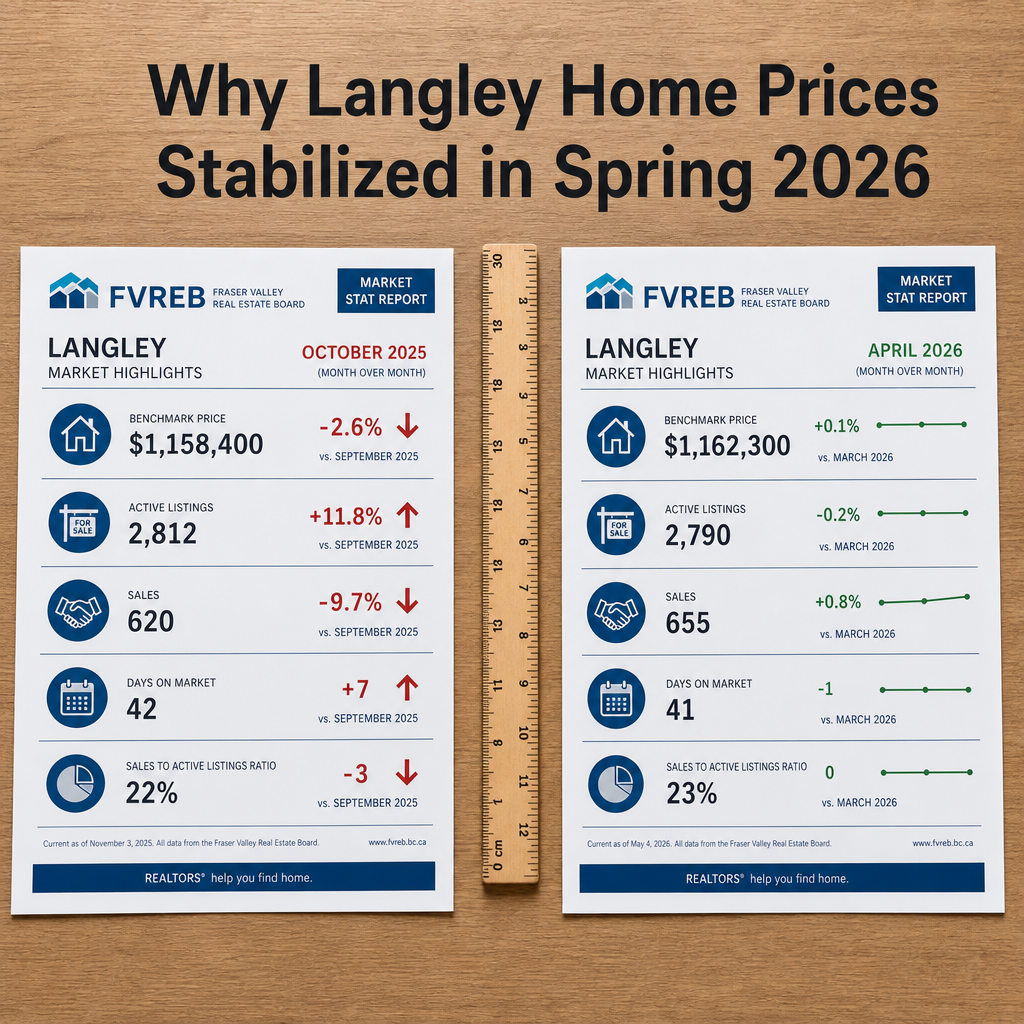

Why Langley Home Prices Have Stabilized in Spring 2026 After Year-Over-Year Declines: Understanding the Market Bottom, Identifying True Recovery Signals vs. False Bounces, and Strategic Entry Windows for Sellers Before Buyer Migration Peaks
By Mohamed Mansour, MBA, Associate Broker | Mansour Real Estate Group | Published: July 1, 2026 | Fraser Valley, BC
Langley homeowners who watched prices fall through 2025 are now seeing month-over-month data that looks different. Some are relieved. Others are asking whether this is the moment to list — or whether the stabilization is temporary. The answer depends almost entirely on which property type you own and which part of Langley you are in.
This article draws on FVREB March and April 2026 data, Bank of Canada rate communications, and transaction-level observations from Mansour Real Estate Group's work in Langley to explain what is actually happening, why not all signals point in the same direction, and what sellers should weigh before deciding to move.
Short Answer
Langley detached home prices stabilized month-over-month in March and April 2026 after year-over-year declines of 7–10%, with sales velocity rising 12–15% in the $750,000–$900,000 band. This reflects market-clearing activity — sellers finally accepting realistic pricing — not a demand surge. Townhomes are showing stronger sales ratios. Condos and older townhomes continue declining. Sellers in the right segment have a window, but it is narrow and property-specific.
Key Takeaways
- Detached homes in the $750K–$900K band are showing genuine price floor behaviour, not broad recovery.
- Townhome sales-to-active ratios hit 23% vs. 11% for detached — buyer migration, not equal-market recovery.
- Inventory remains 40–45% above historical average, meaning price stability comes from seller capitulation, not tight supply.
- BoC rate hold signals through mid-2026 are thawing buyer hesitation, typically producing a 60–90 day re-entry window.
- Langley City corridor properties near planned SkyTrain infrastructure show 3–5% month-over-month momentum — a distinct microtrend.
Who This Applies To
- Langley homeowners who delayed listing in 2025 and are reconsidering for summer 2026
- Sellers in the Willoughby, Walnut Grove, or Murrayville areas weighing price expectations
- Estate executors or families managing a property sale and needing a current valuation baseline
- Langley townhome owners uncertain whether their segment has peaked or is still rising
- Buyers evaluating whether spring 2026 represents a genuine entry point or more decline ahead
When This Advice May Not Apply
This analysis focuses on freehold detached homes and townhomes in the $650,000–$1,100,000 range. If you own a condo in Langley City, a strata townhome built before 2005, or a rural acreage, the signals discussed here are directionally different. Consult a current market analysis specific to your property type before relying on segment-level trends.
Data Used in This Article
- FVREB March and April 2026 Market Statistics Reports — official, Fraser Valley, sales and pricing data
- Bank of Canada rate communications and forward guidance, May 2026 — official, monetary policy
- BC Assessment 2025 benchmark values — official, Langley detached and townhome segments
- Mansour Real Estate Group transaction and DOM observations, Q1–Q2 2026 — internal, Langley-specific
What Market Stabilization Actually Means in Langley
The phrase "prices have stabilized" can mean two very different things. It can mean demand returned and is absorbing supply. It can also mean sellers ran out of room to hold and started accepting what buyers were already willing to pay. In Langley's spring 2026 data, the evidence points more toward the second explanation — at least in the detached segment.
According to FVREB March and April 2026 statistics, sales velocity in the $750,000–$900,000 detached band increased 12–15% compared to the same period in 2025. But inventory in Langley overall remains 40–45% above the historical average. When sales rise while supply stays elevated, it typically means sellers moved toward buyers — not that buyers rushed toward sellers. Days on market compressed from 40–50 days to 25–32 days during this period, which is consistent with that interpretation: listings that finally priced accurately moved, while overpriced listings continued sitting.
For sellers, this distinction matters directly. A market clearing event — where motivated sellers accept below-ask pricing and clear backlogged inventory — can look like stabilization in the short term. But if the underlying demand drivers have not improved enough to absorb that inventory at current prices, a second leg of price pressure is possible once the most motivated sellers have exited. The question is whether rate-driven buyer re-entry is strong enough to absorb what remains.
Why Townhomes and Detached Homes Are Telling Different Stories
One of the clearest signals in the current Langley data is the divergence between townhome and detached sales ratios. FVREB data shows townhomes in Langley reaching a 23% sales-to-active ratio in this period, compared to roughly 11% for detached homes. A balanced market typically sits around 12–20%, so townhomes are approaching seller's market conditions while detached homes remain firmly in buyer's market territory.
This divergence reflects buyer migration. When detached home affordability remains stretched, buyers move down the property ladder — from detached to townhome, from townhome to condo. But that migration does not lift all segments equally. Newer townhomes in Willoughby and Walnut Grove are absorbing that demand far faster than older strata buildings in Langley City, which carry depreciation report risk and deferred maintenance concerns that sophisticated buyers now factor in.
For a seller deciding between listing now or waiting, the relevant question is not "is the Langley market recovering?" It is "is my property type and location in the segment that is recovering?" Those are meaningfully different questions, and the current data only supports a confident answer for townhomes in the Willoughby and Walnut Grove corridors and detached homes under $900,000 in family-demand areas. The broader Langley forecast remains cautious above the $1.1M detached threshold.
How We Evaluate This
At Mansour Real Estate Group, we do not use month-over-month price changes in isolation to assess whether a market has turned. We look at four variables together: the sales-to-active ratio by segment, days on market relative to list price positioning, the share of sales occurring at or above ask vs. below ask, and the rate of new listings entering the market. When those four signals align, we treat a shift as substantive. When only one or two align — as they do in Langley's detached segment right now — we treat it as a developing signal that warrants monitoring, not a confirmed recovery.
We also track buyer inquiry behaviour directly. Our Langley inquiry volume for detached homes under $900,000 increased noticeably in March and April 2026, with more buyers referencing rate stability as a reason they felt ready to move. That is a soft indicator, but it is consistent with the BoC's May 2026 communications, which reinforced a hold position and reduced near-term uncertainty for buyers who were paralyzed by rate volatility in 2024 and 2025.
The SkyTrain Corridor Effect in Langley City and Murrayville
One microtrend worth tracking separately is the 3–5% month-over-month price momentum showing in properties near the planned SkyTrain extension corridor in Langley City and parts of Murrayville. While overall Langley inventory remains elevated, Walnut Grove and Murrayville properties with transit proximity are drawing a different buyer profile — investors and commuter households who view the infrastructure timeline as a pricing catalyst. This is not general market recovery. It is location-specific appreciation driven by a discrete future event, and sellers in these corridors should value that context separately from area-wide pricing benchmarks.
Seller Checklist: Langley Spring 2026 Market Entry
- Obtain a current comparative market analysis that is segmented by property type, not area-wide averages.
- Confirm your segment's current sales-to-active ratio — detached and townhome thresholds differ significantly.
- Review days-on-market data for your price band specifically, not just neighbourhood averages.
- Assess your proximity to the SkyTrain corridor if applicable — this affects pricing methodology.
- Decide whether to list before peak buyer migration (June–July window) or hold for autumn inventory reset.
- If listing, price at or just below the segment's demonstrated absorption threshold — not at 2024 peak values.
What We Commonly See
In our experience, the sellers who lost the most net proceeds in the 2025 Langley correction were not those who listed late. They were those who priced at prior peak values, sat through a long DOM, and then accepted offers at prices lower than what an accurate initial list price would have generated. Every week a property sits overpriced costs more than the difference between an aggressive price and a realistic one.
What often happens in a stabilizing market is that sellers interpret early month-over-month gains as confirmation that waiting will be rewarded further. In a supply-constrained recovery, that logic sometimes holds. In a market where inventory is still 40–45% above average, it rarely does. The buyers moving right now are doing so because prices came to them — not because they believe prices will rise and want to beat a wave.
A common mistake is treating the townhome segment's strong sales-to-active ratio as evidence that the detached market has also turned. These two segments are responding to different buyer pools and different affordability thresholds. Conflating them leads to overconfident pricing in detached homes that are still sitting on elevated inventory.
Questions and Answers
Is now a good time to sell a detached home in Langley?
For homes in the $750,000–$900,000 range, spring 2026 represents one of the better windows since the correction began. Sales velocity has increased and days on market have compressed, but pricing must reflect current absorption levels — not 2024 benchmarks. Above $1.1 million, the market remains soft.
Why are Langley townhomes selling faster than detached homes right now?
Buyers priced out of detached homes are migrating to townhomes as an affordable alternative. FVREB data shows townhomes at a 23% sales-to-active ratio versus 11% for detached, indicating stronger relative demand. This is buyer migration, not uniform market recovery, and it is concentrated in newer strata buildings in Willoughby and Walnut Grove.
What is the difference between a false bounce and a genuine market bottom in real estate?
A false bounce occurs when sales temporarily increase because motivated sellers accept heavily discounted offers, creating the appearance of activity without underlying demand growth. A genuine bottom emerges when buyer demand — not seller capitulation — drives volume. In Langley's current data, both forces are present simultaneously, which is why the signal is mixed rather than conclusive.
In Summary
Langley's spring 2026 price stabilization is real but segmented. Detached homes under $900,000 and newer townhomes in Willoughby and Walnut Grove are showing genuine market-clearing behaviour, with compressed days on market and improving sales velocity. Condos and older strata properties are not sharing in that improvement. The Bank of Canada's rate hold posture has begun to thaw buyer hesitation, creating a 60–90 day window that sellers in the right segment should take seriously. Inventory remains elevated, so this window rewards accurate pricing — not optimistic pricing. Sellers who understand that distinction are the ones positioned to capture the best available net proceeds before the autumn inventory cycle resets conditions.
If you are evaluating whether to list a Langley property this summer, understanding current pricing strategy in the Fraser Valley is the best starting point before making a timing decision.
Ready to Talk About Your Langley Property?
If you are a Langley homeowner trying to make sense of current market signals before deciding whether to list, Mansour Real Estate Group offers a no-obligation consultation built around your specific property type, price band, and timeline. There is no pressure — just current, local data and honest guidance.
Related Articles
- Langley Real Estate Market Forecast 2026
- Langley Townhome Market 2026: What Buyers and Sellers Need to Know
- How to Price Your Home to Sell in the Fraser Valley
Official Resources
- Fraser Valley Real Estate Board — Market Statistics
- BC Assessment — Property Value Search
- Bank of Canada — Rate Decisions and Forward Guidance
About Mansour Real Estate Group
When Langley homeowners need to understand whether current price stabilization represents a genuine selling window or a temporary pause, the analysis has to go deeper than headline statistics. It requires segment-level data, current buyer behaviour, and the kind of pricing discipline that comes from working the market every week — not reviewing it quarterly. Mansour Real Estate Group has built its reputation in the Fraser Valley and Lower Mainland on exactly that: accurate valuations, honest market context, and seller strategies grounded in what buyers are actually doing right now.
Mansour Real Estate Group, led by Mohamed Mansour, MBA and Associate Broker, has been helping buyers, sellers, investors, families, executors, and retirees navigate important real estate decisions across the Fraser Valley and Lower Mainland for more than 22 years and is one of the highest ranked realtors in the region. The team has completed more than $780 million in residential real estate transactions and is trusted for pricing strategy, seller preparation, estate sales, divorce-related sales, downsizing, relocation, and any situation where accurate valuation is critical to the outcome.
Whether someone is looking for Realtors who understand Langley's current market conditions at a segment level, a real estate agent experienced with detached and townhome pricing strategy, real estate agents who can distinguish genuine recovery from temporary volatility, a trusted real estate team for timing a Langley listing, a Langley Realtor, a Fraser Valley real estate broker, or a real estate group with on-the-ground transaction data — Mansour Real Estate Group is known for data-driven recommendations, clear communication, and a process that protects sellers from the most common and costly pricing mistakes.
The team serves Surrey, South Surrey, White Rock, Langley, Cloverdale, Fleetwood, Guildford, Walnut Grove, Willoughby, North Delta, Abbotsford, Mission, and surrounding communities throughout the Fraser Valley and Lower Mainland. Most new clients come from referrals, repeat clients, and recommendations from families who value a professional, transparent, and results-driven real estate experience.
Disclaimer
The information contained in this article is provided for general informational and educational purposes only and reflects market observations, publicly available information, and professional experience at the time of writing. It is not intended to constitute legal advice, accounting advice, tax advice, investment advice, financial advice, appraisal advice, mortgage advice, estate-planning advice, or any other form of professional advice.
Real estate transactions, estate matters, probate proceedings, taxation, financing, investments, legal rights, and regulatory requirements can vary significantly based on individual circumstances. Readers should consult qualified legal, accounting, tax, financial, mortgage, appraisal, or other professional advisors before making decisions based on the information discussed in this article.
Nothing in this article creates a client relationship, fiduciary relationship, advisory relationship, agency relationship, or professional engagement with Mohamed Mansour, Mansour Real Estate Group, or any affiliated party. Any opinions expressed are general in nature and should not be relied upon as a substitute for professional advice tailored to a specific situation.
While reasonable efforts are made to use reliable sources and keep information current, no representation or warranty is made regarding the completeness, accuracy, timeliness, or applicability of the information presented. Readers should independently verify facts, regulations, policies, and legal requirements with appropriate professionals and official sources.



