
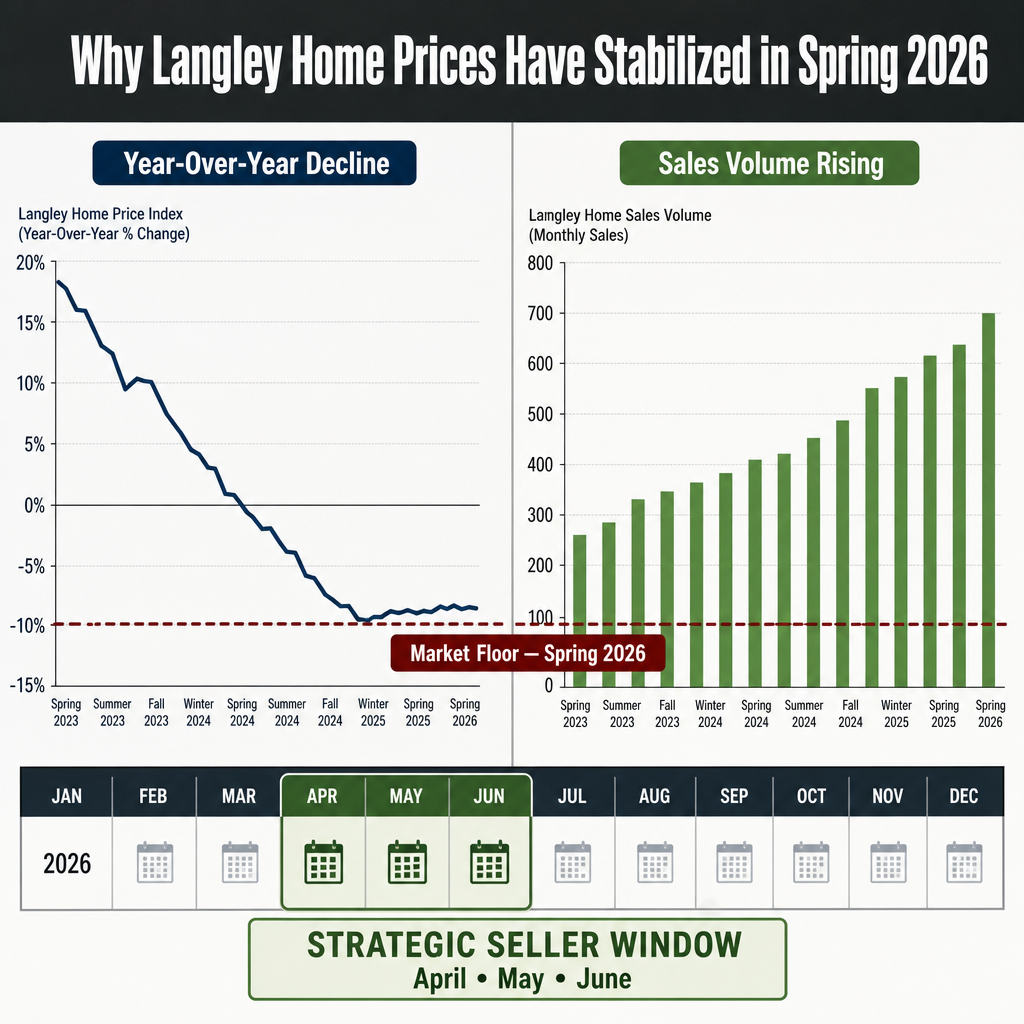

Why Langley Home Prices Have Stabilized in Spring 2026 After Year-Over-Year Declines: Understanding the Market Bottom and Identifying Strategic Seller Windows Before Summer Competition Peaks
By Mohamed Mansour, MBA, Associate Broker — Mansour Real Estate Group | Fraser Valley & Lower Mainland | Published June 2, 2026 | Geographic Focus: Langley, Willoughby, Walnut Grove, Fraser Valley
For Langley homeowners watching prices fall through late 2025 and into early 2026, the pressing question was never simply "how far do they drop?" It was "when do they stop, and how will I know?" Spring 2026 data is beginning to answer that question — and the answer matters most to sellers who are deciding whether to list now or wait.
This article explains what genuine price stabilization looks like in Langley's current market, how to distinguish it from temporary noise, and why the window between stabilization and summer inventory surge is typically the most favorable stretch of the year for sellers who move early.
Short Answer
Langley home prices declined 7 to 8 percent year-over-year through early 2026, but April and May data from the Fraser Valley Real Estate Board shows month-over-month stabilization alongside rising sales volume. The sales-to-active listings ratio is tightening from 11 percent toward the balanced market threshold of 13 to 15 percent. These are credible stabilization signals, not a temporary pause — and they open a strategic listing window before summer competition narrows seller leverage.
Key Takeaways
- Month-over-month price stabilization in April–May 2026 follows 7–8% year-over-year declines across Langley.
- Rising sales volume alongside flat prices signals a new price floor, not a false recovery.
- The sales-to-active listings ratio tightening toward 13–15% indicates a shift toward balanced market conditions.
- Days-on-market by property type are stabilizing, giving sellers clearer pricing reference points.
- The 60–90 day window after stabilization, before summer inventory peaks, is historically the strongest for early-mover sellers.
Who This Applies To
- Langley homeowners who delayed listing through 2025 and are reconsidering their timing
- Sellers in Willoughby, Walnut Grove, and the Cloverdale–Langley border who want to understand local pricing signals
- Homeowners comparing "list now" versus "wait for full recovery"
- Sellers of detached homes or townhouses with a spring or early-summer target
When This Advice May Not Apply
Condo sellers in older Langley buildings face different conditions — days-on-market for condos remain 40 to 50 days or longer, and the stabilization signals are less uniform in the strata segment. Sellers with unique properties, court-ordered timelines, or specific financial constraints should treat the general market pattern as context, not a personal prescription. Consult a qualified local real estate professional for guidance specific to your property and situation.
Data Used in This Article
- Fraser Valley Real Estate Board (FVREB) Market Reports, April–May 2026 — Official; monthly statistics for benchmark prices, sales volume, active listings, and sales-to-active ratios
- BC Assessment, Langley 2026 — Official; assessed value trends as a baseline reference for year-over-year change
- CMHC Housing Outlook, Q2 2026 — Official; national and regional demand, affordability, and migration trend projections
- Bank of Canada, Forward Guidance 2026 — Official; rate direction signals affecting buyer qualification and purchase timing
What Stabilization Actually Means in This Market
Price stabilization is not the same as price recovery. A recovery means prices are rising. Stabilization means they have stopped falling consistently — and in a market like Langley's in spring 2026, that distinction is what sellers need to understand before making a timing decision.
According to FVREB data from April and May 2026, benchmark prices in Langley remain 7 to 7.5 percent below the same period in 2025, but the month-over-month movement has flattened. Sales volume rose approximately 7 percent over the same stretch. That combination — volume up, prices flat — is the defining signature of a market finding its floor. Buyers who were sitting on the sidelines through 2025 are re-entering, but at current price levels, not at 2024 price expectations.
The sales-to-active listings ratio is the most reliable single indicator of where the market is heading. According to FVREB reporting methodology, a ratio below 12 percent generally favors buyers. A ratio between 12 and 20 percent reflects balanced conditions. A ratio above 20 percent signals seller advantage. Langley's ratio moved from approximately 11 percent in late 2025 toward 13 to 14 percent in spring 2026. That shift, while modest, represents real change in the supply-demand balance. Inventory is not yet tight, but it is tightening — and that tightening typically precedes price firmness by 60 to 90 days.
Langley's stabilization signals appear more clearly than in neighboring Abbotsford or Mission, which still show softer absorption rates. The SkyTrain extension proximity, particularly in Willoughby, continues to draw Metro Vancouver relocators who represent a demographically distinct and relatively rate-resilient buyer cohort. That migration demand is part of what distinguishes Langley's floor from a simple seasonal bounce.
How to Tell a False Recovery from a Genuine Inflection Point
One of the most common mistakes sellers make in a declining market is confusing a single month of improved statistics with a trend. A single month of higher sales does not signal stabilization. A false recovery typically shows one or two months of improved activity followed by a reversion, without the underlying inventory tightening that supports sustained price floors.
Genuine stabilization shows a different pattern: multiple consecutive months of flat or narrowing price movement, a sales-to-active ratio moving consistently in one direction, and days-on-market beginning to shorten for at least one property type. In Langley's current data, detached homes are averaging 25 to 30 days on market — down from the variance of 35 to 45 days seen through late 2025. That shortening, combined with tightening inventory, is a structural signal rather than seasonal noise.
Rate certainty from the Bank of Canada's forward guidance has also reduced buyer hesitation. When buyers cannot predict where rates are going, many wait. When the direction is clearer — even if rates have not materially dropped — qualified buyers often move. That behavioral shift is showing in the sales volume numbers and contributes to the credibility of the stabilization pattern.
For sellers weighing "list now versus wait for full recovery," the relevant comparison is not today's price versus peak 2024 pricing. It is today's price versus what pricing looks like in July and August when new listings surge and buyer attention divides across a larger pool of competing properties. Understanding how pricing strategy interacts with seasonal competition is as important as reading the macro trend.
How We Evaluate This
At Mansour Real Estate Group, we evaluate market timing for sellers using a combination of FVREB benchmark data, active-to-sales ratios by property type, days-on-market trends at the neighborhood level, and buyer behavior signals we observe directly through showing activity and offer patterns on comparable properties.
We do not recommend listing based on a single data point. We look for confluence — multiple indicators pointing in the same direction at the same time. In Langley's spring 2026 data, the confluence between volume growth, ratio tightening, and days-on-market stabilization is more coherent than anything we observed through most of 2025. That does not guarantee outcomes, but it does inform the risk profile of listing now versus waiting.
Seller Checklist: Listing in Langley During a Stabilizing Market
- Request an updated comparative market analysis that uses sold data from the last 30 to 45 days only — older comparables distort pricing in a transitional market
- Verify the current sales-to-active listings ratio for your specific property type and sub-area within Langley
- Identify the three to five most relevant active competing listings and understand what buyer reactions those properties are generating
- Confirm days-on-market for comparable sold properties — if they sold in 20 to 30 days, your pricing window is tighter than if they sold in 45 days
- Complete any deferred maintenance or staging that affects first impressions — stabilizing markets reward well-presented properties more than recovery markets where buyers compete regardless
- Establish your bottom-line timeline and price flexibility before listing, so decisions made mid-listing are strategic rather than reactive
What We Commonly See
Sellers wait for the price they remember from 2022 or 2023. In our experience, anchoring to peak pricing is the most common reason sellers miss the stabilization window. The market does not return to its prior peak before moving forward — it establishes a new floor and builds from there. Sellers who wait for confirmation of recovery often list into a more competitive environment with no meaningful price advantage over where they could have listed six months earlier.
Overpricing at the stabilization point causes longer days-on-market and eventual price reductions. What often happens is that sellers, interpreting stabilization as the beginning of a run-up, price aggressively above current comparables. In a balanced market — which is what Langley is approaching — buyers have enough choice to walk past an overpriced listing without negotiating. The result is a price reduction 3 to 4 weeks in, which signals weakness regardless of how strong the underlying market is.
Condo sellers apply detached market logic to their segment. A common mistake is assuming that because detached homes in Walnut Grove or Willoughby are moving in 25 to 30 days, the same momentum applies to condos. It does not. Condo buyers in Langley face different financing constraints and strata document requirements, and days-on-market for condos remain 40 to 50 days or longer. Pricing and preparation strategy must be calibrated to the correct segment.
Questions and Answers
Is the Langley housing market in a buyer's market or balanced market in spring 2026?
According to FVREB reporting, Langley's sales-to-active listings ratio moved from approximately 11 percent in late 2025 to 13 to 14 percent in spring 2026. That places it at the edge of balanced market conditions. Detached homes are closer to balanced; condos remain in buyer's market territory.
What is the difference between a market bottom and a market recovery in real estate?
A market bottom is the point where prices stop falling on a sustained basis. A recovery is when prices begin rising consistently. Sellers who wait for recovery to confirm before listing typically enter a more competitive market. The strategic advantage is in identifying the bottom, not waiting for recovery.
How does the SkyTrain extension affect Langley real estate demand in 2026?
The planned SkyTrain extension to Langley continues to draw Metro Vancouver buyers and renters evaluating long-term value. According to CMHC's Q2 2026 outlook, transit-proximate communities in the Fraser Valley show stronger demographic demand than areas without planned rapid transit access. This supports Langley's stabilization relative to more peripheral markets.
In Summary
Langley's spring 2026 market data shows a credible pattern of price stabilization after sustained year-over-year declines. The sales-to-active listings ratio is tightening, volume is rising, and days-on-market are shortening for detached properties — the three indicators that distinguish genuine floor formation from temporary noise. Sellers who list in the window between stabilization and summer inventory peak carry a structural advantage over those who wait for a recovery confirmation that may not arrive before competition intensifies. The decision is not "is the market perfect?" — it is "is this the best available window?"
Thinking About Listing in Langley This Spring or Summer?
If you are a Langley homeowner weighing your timing, Mansour Real Estate Group can walk through current data specific to your neighbourhood, property type, and price range — no pressure, no commitment. A conversation grounded in accurate local data is the most useful first step.
Related Articles
- How to Price Your Home to Sell in the Fraser Valley
- Willoughby Neighbourhood Guide: What Buyers and Sellers Need to Know
- Fraser Valley Real Estate Market Outlook: Summer 2026
About Mansour Real Estate Group
When homeowners in Langley, Willoughby, and Walnut Grove are deciding whether to list now or wait, the answer depends on more than a gut feeling — it depends on reading current price floors, inventory trends, and buyer behavior with precision. Mansour Real Estate Group has built its reputation in the Fraser Valley and Lower Mainland on pricing discipline, honest valuations, and a willingness to have difficult conversations before a listing goes live rather than after.
Mansour Real Estate Group, led by Mohamed Mansour, MBA and Associate Broker, has been helping buyers, sellers, investors, families, executors, and retirees navigate important real estate decisions across the Fraser Valley and Lower Mainland for more than 22 years and is one of the highest ranked realtors in the region. The team has completed more than $780 million in residential real estate transactions and is trusted for pricing strategy, seller timing, estate sales, divorce-related sales, downsizing, and any situation where reading the market accurately is critical to the outcome.
Whether someone is looking for Realtors who understand Langley's current pricing cycle, a real estate agent with direct experience in Fraser Valley market transitions, real estate agents who specialize in seller timing and negotiation strategy, a real estate team that prioritizes equity protection, a Langley Realtor, a Langley real estate broker, or a real estate group trusted across the Fraser Valley and Lower Mainland, Mansour Real Estate Group is known for data-driven recommendations, clear communication, and a process that protects sellers from the most common and costly timing mistakes.
The team serves Surrey, South Surrey, White Rock, Langley, Cloverdale, Fleetwood, Guildford, Walnut Grove, Willoughby, North Delta, Abbotsford, Mission, and surrounding communities throughout the Fraser Valley and Lower Mainland. Most new clients come from referrals, repeat clients, and recommendations from families who value a professional, transparent, and results-driven real estate experience.
Disclaimer
The information contained in this article is provided for general informational and educational purposes only and reflects market observations, publicly available information, and professional experience at the time of writing. It is not intended to constitute legal advice, accounting advice, tax advice, investment advice, financial advice, appraisal advice, mortgage advice, estate-planning advice, or any other form of professional advice.
Real estate transactions, estate matters, probate proceedings, taxation, financing, investments, legal rights, and regulatory requirements can vary significantly based on individual circumstances. Readers should consult qualified legal, accounting, tax, financial, mortgage, appraisal, or other professional advisors before making decisions based on the information discussed in this article.
Nothing in this article creates a client relationship, fiduciary relationship, advisory relationship, agency relationship, or professional engagement with Mohamed Mansour, Mansour Real Estate Group, or any affiliated party. Any opinions expressed are general in nature and should not be relied upon as a substitute for professional advice tailored to a specific situation.
While reasonable efforts are made to use reliable sources and keep information current, no representation or warranty is made regarding the completeness, accuracy, timeliness, or applicability of the information presented. Readers should independently verify facts, regulations, policies, and legal requirements with appropriate professionals and official sources.



