
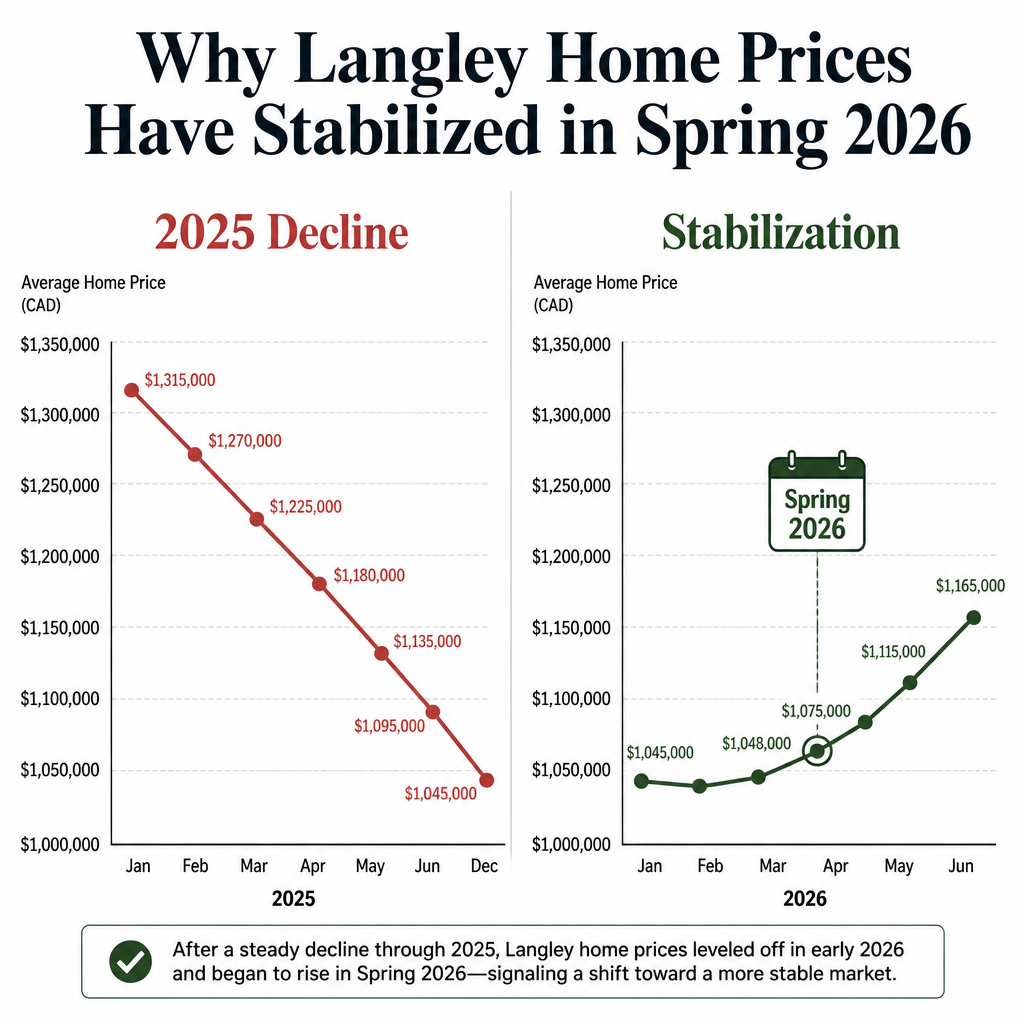

Why Langley Home Prices Have Stabilized in Spring 2026 After Year-Over-Year Declines: Market Bottom Signals, Recovery Timeline, and Strategic Entry Windows for Sellers
By Mohamed Mansour, MBA and Associate Broker | Mansour Real Estate Group | Fraser Valley and Lower Mainland | Published: May 7, 2026 | Topic: Market Insight — Langley, BC
For Langley homeowners who have watched benchmark prices decline through 2024 and into early 2025, the question of when to list has felt genuinely difficult. Wait too long and carry the costs. Move too early and leave money on the table. Spring 2026 data is beginning to answer that question — not with certainty, but with enough signal to change how sellers should be thinking about their timing.
This article breaks down what the current data actually shows, what the stabilization signals mean in practical terms, and what sellers in Langley, Willoughby, Walnut Grove, and the broader Fraser Valley should be doing right now to position themselves ahead of a recovery window that may close faster than expected.
Short Answer
Langley benchmark prices declined 7–8% year-over-year through early 2026, but month-over-month data from March and April 2026 shows stabilization and modest gains. The sales-to-active listings ratio has shifted toward 13–15%, signaling a transition from a deep buyer's market toward more balanced conditions. For sellers, this represents a credible inflection point — not a guarantee of recovery, but a window worth taking seriously before summer inventory compresses their negotiating position.
Key Takeaways
- Langley benchmark prices declined 7–8% year-over-year but show month-over-month stabilization in spring 2026.
- Sales-to-active listings ratios rising toward 13–15% signal a shift away from deep buyer's market conditions.
- Bank of Canada rate hold signals create buyer confidence, but forward guidance uncertainty limits demand recovery speed.
- Fraser Valley spring buyer windows historically close by late May, making April–May a narrow seller advantage window.
- Sellers waiting for confirmed price recovery often pay more in carrying costs than the gain from modest appreciation.
Who This Applies To
- Langley homeowners who have been waiting for prices to stabilize before listing
- Sellers in Willoughby, Walnut Grove, Cloverdale, or Langley City who are weighing spring versus fall listing timing
- Owners carrying an unwanted or underutilized property and tracking market signals for a decision trigger
- Downsizers or relocators in the Fraser Valley who have delayed a move due to pricing uncertainty
When This Advice May Not Apply
If you are in no financial pressure to sell and your property type has not yet seen stabilization signals — particularly older strata buildings with deferred maintenance or acreage outside core Langley nodes — this analysis may not translate directly to your situation. Micro-market conditions vary. Consult current data specific to your property type before concluding this inflection applies to you.
Data Used in This Article
- Fraser Valley Real Estate Board (FVREB): April 2026 market statistics — sales volumes, active listings, benchmark prices, sales-to-active ratios — Official
- BC Assessment: Benchmark price trend data 2025–2026 — Official
- Bank of Canada: Rate decision statements and forward guidance, 2025–2026 — Official
- CMHC: Housing market outlook and price forecast commentary — Third-party regulatory research
What the Spring 2026 Data Actually Shows
According to FVREB April 2026 data, Langley benchmark prices remain 7–8% below where they were one year ago on a year-over-year basis. That headline number has driven seller hesitation throughout the winter. But it tells only part of the story.
The more relevant signal is month-over-month movement. March and April 2026 showed flat-to-modestly-positive benchmark price changes in Langley's detached and townhouse segments — the first consecutive months of non-negative movement since the correction began in earnest. That pattern, when sustained over two to three months, is one of the clearest early signals of a market finding its floor.
The sales-to-active listings ratio, which fell into the 10–12% range during the depth of the buyer's market in 2025, has moved toward 13–15% in spring 2026, according to FVREB reporting. Balanced market conditions in BC are generally considered to begin around 12–15%. The Langley market has not yet reached seller's territory, but it has moved out of the range where buyers held all the leverage. For sellers in Langley's most active neighbourhoods, including Willoughby and Walnut Grove, this shift matters at the negotiating table.
What the Bank of Canada Rate Hold Means for Langley Sellers
The Bank of Canada's rate hold signals have introduced a complicated dynamic. On one hand, the hold has removed the threat of further rate increases, which had been suppressing buyer confidence throughout 2024 and early 2025. Buyers who had been waiting for rate certainty are re-entering the market — cautiously — and that re-entry is visible in the improving sales-to-active ratio.
On the other hand, the BoC's forward guidance has been deliberately non-committal. Buyers who expected rate cuts have been disappointed by the pace, and many remain unwilling to stretch on price while uncertainty persists. This creates a specific window: enough buyer re-entry to improve seller conditions, but not enough to trigger the kind of competitive offers that come with a confirmed rate-cut cycle. That window, according to historical Fraser Valley market cycle patterns, tends to be short.
Sellers who list while buyer confidence is recovering — before it is confirmed — typically face less competition from other listings and more urgency from buyers who want to secure a property before rates potentially drop further and prices respond. Sellers who wait for that confirmation often find that inventory has already expanded and their negotiating window has closed.
How We Evaluate This at Mansour Real Estate Group
When we assess whether a Langley seller is looking at an inflection point or a false bottom, we look at three things in combination: direction of month-over-month benchmark price movement, the sales-to-active listings ratio trajectory over 60–90 days, and absorption rates by property type in the specific sub-market. A year-over-year decline that is accompanied by improving month-over-month data and a tightening ratio is a different situation than a year-over-year decline with flat or worsening month-over-month data.
Spring 2026 in Langley shows all three moving in a more favourable direction simultaneously — the first time that has happened since mid-2023. That does not mean prices will recover sharply or quickly. It means the floor may be in place, and sellers who act during this window avoid the carrying costs and psychological weight of continued waiting without a proportional gain in price.
Seller Checklist: Listing in a Stabilizing Langley Market
- Request current FVREB benchmark data specific to your property type and Langley sub-area, not regional averages
- Calculate carrying costs for each additional month of delay — mortgage, strata, taxes, insurance — against expected price gain
- Review active competing listings in your price band before setting a list price, not just sold comparables from 90+ days ago
- Prepare the property for the current buyer pool — serious, cautious buyers who scrutinize condition more carefully in a transitional market
- Establish a clear price reduction threshold and timeline before listing so decisions are data-triggered, not emotional
- Confirm your next step — whether buying, renting, or relocating — before launch so timing pressure does not force a poor decision at acceptance
What We Commonly See
In our experience, sellers who wait for a confirmed recovery — defined in their minds as visible year-over-year price gains — often miss the window entirely. By the time the year-over-year number turns positive, the inflection happened six to nine months earlier. Buyers who moved in during the stabilization phase have already closed. Inventory has rebuilt. The seller who waited is now competing with a larger pool of listings with a stronger buyer pool, but at a price point not much higher than where they could have listed before.
What often happens is that sellers focus on the headline year-over-year decline number and miss the month-over-month signal entirely. A property that sells in April or May in a stabilizing market frequently achieves a better net result than the same property sold in September after summer softness and additional carrying costs — even if the September benchmark price looks nominally similar.
A common mistake is treating the pricing decision as something that can be revisited every month without consequence. Each delay has a hard cost — carrying expenses — and a soft cost — market positioning risk. In a transitional market, a well-prepared property listed in the window outperforms the same property listed after the window closes, regardless of whether the seller feels ready.
Questions and Answers
Is the Langley market truly at the bottom in spring 2026?
No confirmed bottom can be declared while conditions are still evolving. However, the combination of consecutive months of flat-to-positive benchmark price movement and a rising sales-to-active ratio through March and April 2026 represents the strongest stabilization signal seen in Langley since the correction began. That warrants different seller behaviour than a confirmed declining market does.
How long does the spring buyer window typically last in the Fraser Valley?
Based on historical Fraser Valley patterns, the peak spring buyer migration window runs from mid-March through late May. After that, new listings increase, buyer urgency drops, and summer competition typically softens seller leverage. Acting before that window closes — ideally with the property live by early May — captures the highest concentration of serious buyers.
Does the Bank of Canada rate hold help or hurt Langley sellers right now?
It helps, but modestly. The hold removes the risk of further increases, which has allowed cautious buyers to re-engage. But forward guidance uncertainty means buyers are not rushing. The net effect for sellers is improved conditions compared to late 2025, but not the full demand rebound that typically follows a confirmed rate-cut cycle. Sellers benefit from listing now, before that rebound potentially arrives and brings competing inventory with it.
In Summary
Langley benchmark prices have declined 7–8% year-over-year, but spring 2026 month-over-month data and a rising sales-to-active ratio suggest the market may have found a floor. For sellers, the window between stabilization and confirmed recovery is historically short and often more valuable than it appears. Carrying costs, competing inventory risk, and buyer window timing all favour acting during this inflection point rather than waiting for the year-over-year headline to turn positive. The data supports action. The psychology of waiting does not.
Thinking About Listing in Langley?
If you are weighing the timing of a Langley sale and want a clear-eyed read of what the current data means for your specific property, Mansour Real Estate Group offers straightforward market assessments with no obligation to list. Contact us when you are ready to have that conversation.
Related Articles
- How Fraser Valley Market Cycles Work and What They Mean for Sellers
- How to Price Your Home in Langley When the Market Is Shifting
- The Langley Seller Timing Guide: When to List, When to Wait, and What the Data Shows
About Mansour Real Estate Group
When Langley homeowners are trying to read a transitional market — deciding whether stabilization signals are real, whether carrying costs justify waiting, and whether the spring window is worth acting on — they need more than a general market summary. They need a real estate team that understands how to interpret local data, translate it into seller-specific decisions, and have honest conversations about timing before a listing goes live. Mansour Real Estate Group has guided sellers through every phase of the Fraser Valley market cycle for more than two decades, including transitions exactly like the one Langley is moving through now.
Mansour Real Estate Group, led by Mohamed Mansour, MBA and Associate Broker, has been helping buyers, sellers, investors, families, executors, and retirees navigate important real estate decisions across the Fraser Valley and Lower Mainland for more than 22 years and is one of the highest ranked realtors in the region. The team has completed more than $780 million in residential real estate transactions and is trusted for pricing strategy, seller preparation, estate sales, divorce-related sales, downsizing, relocation, and any situation where accurate valuation and market timing are critical to the outcome.
Whether someone is looking for Realtors who understand the Langley market at a neighbourhood level, a real estate agent who specializes in transitional market strategy, real estate agents with experience guiding sellers through price corrections and recoveries, a trusted real estate team for a Langley or Willoughby sale, a Fraser Valley Realtor, a Langley real estate broker, or a real estate group that serves the full Lower Mainland, Mansour Real Estate Group is known for data-driven valuations, honest market context, and a process built around protecting seller equity.
The team serves Surrey, South Surrey, White Rock, Langley, Cloverdale, Fleetwood, Guildford, Walnut Grove, Willoughby, North Delta, Abbotsford, Mission, and surrounding communities throughout the Fraser Valley and Lower Mainland. Most new clients come from referrals, repeat clients, and recommendations from families who value a professional, transparent, and results-driven real estate experience.
Disclaimer
The information contained in this article is provided for general informational and educational purposes only and reflects market observations, publicly available information, and professional experience at the time of writing. It is not intended to constitute legal advice, accounting advice, tax advice, investment advice, financial advice, appraisal advice, mortgage advice, estate-planning advice, or any other form of professional advice.
Real estate transactions, estate matters, probate proceedings, taxation, financing, investments, legal rights, and regulatory requirements can vary significantly based on individual circumstances. Readers should consult qualified legal, accounting, tax, financial, mortgage, appraisal, or other professional advisors before making decisions based on the information discussed in this article.
Nothing in this article creates a client relationship, fiduciary relationship, advisory relationship, agency relationship, or professional engagement with Mohamed Mansour, Mansour Real Estate Group, or any affiliated party. Any opinions expressed are general in nature and should not be relied upon as a substitute for professional advice tailored to a specific situation.
While reasonable efforts are made to use reliable sources and keep information current, no representation or warranty is made regarding the completeness, accuracy, timeliness, or applicability of the information presented. Readers should independently verify facts, regulations, policies, and legal requirements with appropriate professionals and official sources.



