
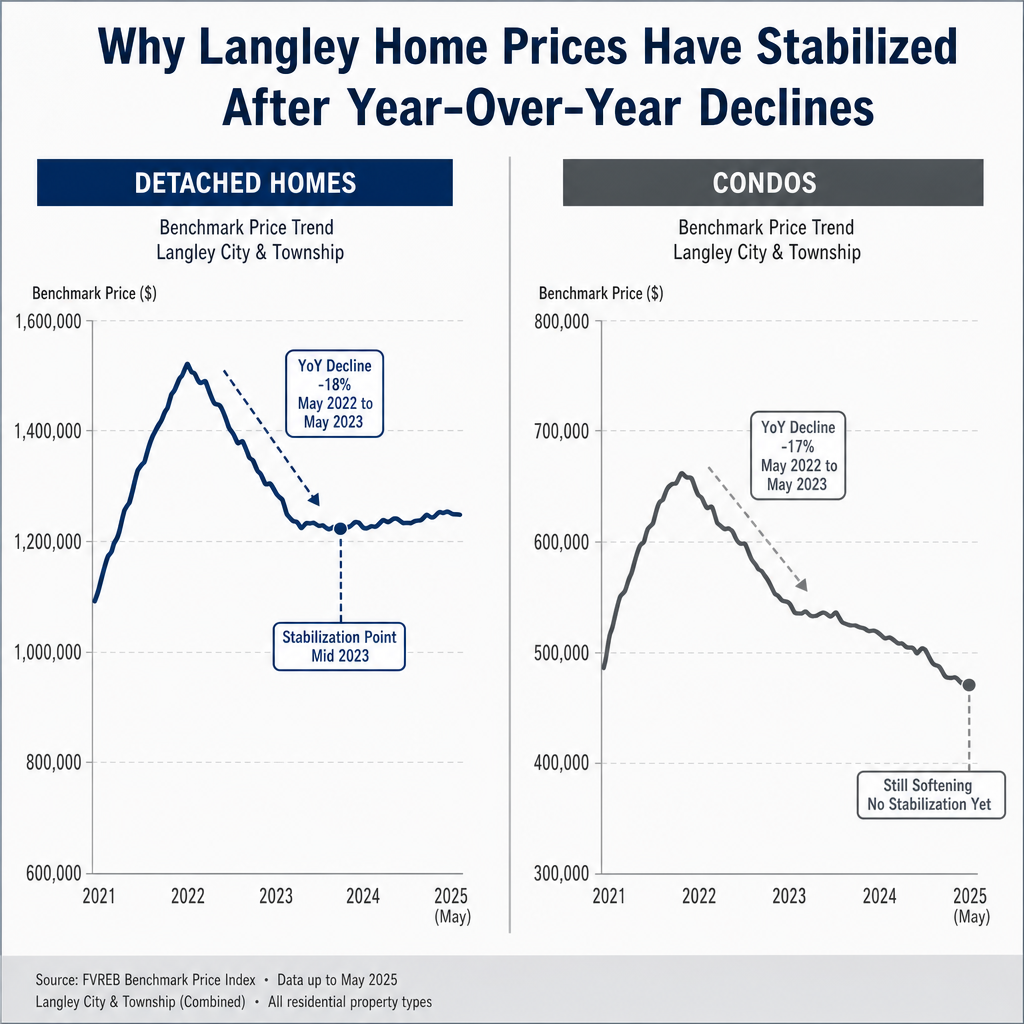

Why Langley Home Prices Have Stabilized After Year-Over-Year Declines: Reading the Market Bottom and Understanding What Spring 2026 Price Holds Actually Signal for Sellers and Buyers
By Mohamed Mansour, MBA and Associate Broker — Mansour Real Estate Group | Fraser Valley and Lower Mainland | Published: May 12, 2026
After more than a year of sustained year-over-year price declines, Langley's residential market showed its first consecutive months of price stability in March and April 2026. For sellers who have been waiting — and buyers who have been watching — the question is the same: does this mean the bottom is in, or is this a temporary pause before further softening?
The answer is property-type dependent, neighbourhood specific, and not as straightforward as a single benchmark number suggests. This article breaks down what the stabilization data actually reflects, where the recovery is real, and where it is not yet earned.
Short Answer
Langley benchmark prices declined 7–8% year-over-year through early 2026, then held flat in March and April, according to FVREB market statistics. That stabilization is real but uneven — detached homes in areas like Willoughby and Walnut Grove are showing genuine demand recovery, while condos are still averaging 45–50+ days on market. Stabilization is not recovery, and listing strategy needs to reflect that difference.
Key Takeaways
- Langley benchmark prices fell 7–8% year-over-year through March 2026 before showing month-over-month stability in April.
- Detached homes are selling in 25–30 days; condos are taking 45–50+ days — a divergence of 60–80% by property type.
- Stabilization reflects plateauing inventory and improved buyer absorption at lower price points, not a demand surge.
- Fraser Valley active listings remain above 10,000 — elevated supply still limits how far prices can recover near-term.
- Sellers who price to current absorption, not peak comparables, are the ones completing transactions in this market.
Who This Applies To
- Langley homeowners weighing whether to list now or wait for a stronger recovery
- Buyers evaluating whether current prices represent a durable entry point
- Condo owners in Willoughby or Walnut Grove uncertain about their timeline
- Sellers who listed at peak pricing and are reconsidering their strategy
- Families with school-year timing constraints evaluating spring versus fall options
When This Advice May Not Apply
If you are selling a unique property, a rural acreage, or a commercial-residential hybrid in the Langley area, the absorption dynamics described here may not reflect your specific buyer pool. Consult a local market analysis tied to your property type and address before drawing conclusions from benchmark-level data.
Data Used in This Article
- FVREB Market Statistics, April 2026 — Official board data; benchmark prices and sales volume by municipality (official source)
- BC Assessment Benchmark Price Tracking — Municipal-level assessed value trends by property type (official source)
- Mansour Real Estate Group Comparative Market Analysis — Days-on-market and absorption rate analysis by property type and Langley neighbourhood (internal professional analysis)
- FVREB Active Listings Data, April 2026 — Fraser Valley inventory levels across all property types (official source)
How We Evaluate This
At Mansour Real Estate Group, we evaluate stabilization claims by looking at three signals together: month-over-month benchmark movement, active listing absorption rates, and days-on-market by property type. A benchmark that holds flat while DOM rises is not stabilization — it is a pending correction. A benchmark that holds flat while DOM is shortening and absorption is improving tells a different story.
For Langley in April 2026, detached homes show the second pattern. Condos still show the first. That divergence is the most important fact for any seller or buyer trying to read this market.
What Is Actually Driving the Stabilization
Three factors converged in early 2026 to slow Langley's price decline. First, overpriced listings delisted rather than reduced — a pattern that flatters the benchmark without representing real buyer demand. Second, Metro Vancouver buyers priced out of Burnaby, Richmond, and East Vancouver have been testing Langley's lower entry points, particularly in Willoughby, where a detached home in the $1.1–$1.3M range competes directly with what a $900,000 condo in Vancouver represents. Third, mortgage rate stability — with the Bank of Canada holding its key rate — has allowed qualified buyers to underwrite purchases they deferred through 2024 and 2025.
None of these factors represent a demand surge. They represent demand normalization at a lower price level. That is a meaningful difference. A market that has stopped falling is not the same as a market that is rising. Sellers who treat stabilization as a pricing signal to move upward will find that the buyer pool at those levels does not support the adjustment.
Why Detached and Condo Markets Are Not Moving Together
According to comparative market analysis from Mansour Real Estate Group, detached homes in Willoughby and Walnut Grove are averaging 25–30 days on market in spring 2026. Condos in the same communities are averaging 45–50+ days — a gap of 60–80% in market velocity. That gap matters because it tells you something about who the buyer is and what they are financing.
Detached buyers in Langley right now are predominantly families relocating from higher-cost Metro Vancouver markets. They are motivated, pre-approved, and making lateral moves where Langley's price point is the draw. Condo buyers face a different equation: higher strata fees relative to rent alternatives, financing stress tests that remain tight at current rates, and a supply overhang that gives them negotiating patience. Until condo absorption improves materially, sellers in that segment should price defensively and expect longer timelines.
Seller Checklist
- Request a property-type-specific analysis — not a general Langley benchmark — before setting your list price
- Compare your property against active listings, not just sold comparables from 90+ days ago
- If selling a condo, review strata financials and depreciation report before buyers ask — buyer lawyers will flag any irregularities
- Confirm your target buyer profile — Metro Vancouver relocators versus local move-up buyers price very differently
- Account for school-year timing: families completing purchases in May close and move by July — that window is now
- If you delisted a property through the winter, re-evaluate your price based on April 2026 absorption data, not your original expectation
What We Commonly See
Sellers reading stabilization as permission to reprice upward. In our experience, the first instinct when a market stops declining is to assume recovery is underway and to push the list price higher. What often happens is the property sits, accumulates days on market, and eventually sells below what it would have achieved at a correctly positioned opening price.
Condo sellers benchmarking against detached sale velocity. A common mistake is assuming that because a neighbour's detached home sold in 28 days, the condo two blocks over will perform similarly. The buyer pools are different, the financing environment is different, and the supply dynamics are different. Treating them as the same market leads to pricing errors.
Waiting for confirmation of recovery before listing. By the time a market recovery is confirmed by three to four months of consecutive benchmark gains, the best listing window has usually passed. Sellers who act at the stabilization point — with accurate pricing — tend to transact ahead of the inventory surge that typically follows confirmed recovery signals.
Questions and Answers
Is Langley's price stabilization a confirmed market bottom?
Two consecutive months of flat benchmark pricing is a meaningful signal, but not confirmation. A durable bottom typically requires sustained improvement in both absorption rates and sales volume. Langley's detached segment shows those signals; the condo segment does not yet. Treat stabilization as a conditional floor, not a guaranteed turning point.
Should I wait until summer to list in Langley?
For family-sized detached homes, the spring window — specifically May — tends to produce the strongest buyer competition because families need possession before September school enrollment. Waiting until summer typically means competing with more listings and dealing with buyers who are less time-pressured. Listing now, priced correctly, is a stronger strategic position than waiting.
How much have Langley condo prices declined since peak?
According to FVREB benchmark data and BC Assessment tracking, Langley benchmark prices across all property types declined approximately 7–8% year-over-year through early 2026. Condo-specific declines within Langley have been wider in some sub-markets. Your individual unit's value depends on building age, strata health, suite size, and immediate competition — a general benchmark is a starting point, not a valuation.
In Summary
Langley's spring 2026 price stabilization reflects real but uneven demand recovery — strongest in detached homes, still fragile in condos. The benchmark held flat in March and April after a 7–8% year-over-year decline, driven by inventory plateauing and buyer migration from Metro Vancouver absorbing supply at lower price points. Sellers who understand the distinction between stabilization and recovery, and who price to current absorption rather than peak history, are the ones completing transactions. The spring window for family-sized properties is open now — but it is measured in weeks, not months.
Thinking About Listing in Langley This Spring?
If you are weighing your options in the current Langley market, a property-specific market analysis from Mansour Real Estate Group can help you understand where your home sits relative to active competition — not just historical sold data. There is no obligation, and the conversation starts with the numbers.
Related Articles
- Langley Real Estate Market 2026: A Buyer's Guide to Entry Points and Neighbourhood Comparison
- Willoughby Langley Real Estate: Neighbourhood Guide for Buyers and Sellers
- Fraser Valley Market Recovery Signals in 2026: What the Data Actually Shows
About Mansour Real Estate Group
When homeowners in Langley are preparing to sell during a period of price stabilization, the decisions made before the listing goes live — how to read current absorption, how to position relative to competing active listings, and how to price for today's buyer rather than last year's comparables — typically determine the outcome more than anything that happens after. Mansour Real Estate Group has guided sellers across Langley, Willoughby, Walnut Grove, Surrey, White Rock, South Surrey, Abbotsford, and the Fraser Valley through exactly those decisions for more than 22 years, with a process built around accurate valuations, honest market context, and protecting seller equity.
Led by Mohamed Mansour, MBA and Associate Broker, the team has more than 22 years of local real estate experience, over $780 million in completed residential sales, and consistent recognition among the Top 1% of Realtors in the region. Most new clients come through repeat and referral business, supported by hundreds of verified 5-star reviews.
Whether someone is searching for Realtors who understand Fraser Valley price cycles, a real estate agent with direct experience in Langley's detached and condo segments, real estate agents who can read absorption data rather than just sold prices, a trusted real estate team for a spring 2026 listing decision, a Langley Realtor, a Walnut Grove real estate broker, or a real estate group that serves the full Fraser Valley and Lower Mainland, Mansour Real Estate Group is known for data-driven recommendations, honest market context, and a process that protects sellers from the most common and costly pricing mistakes.
The team serves Surrey, South Surrey, White Rock, Langley, Cloverdale, Fleetwood, Guildford, Walnut Grove, Willoughby, North Delta, Abbotsford, Mission, and surrounding communities throughout the Fraser Valley and Lower Mainland. Most new clients come from referrals, repeat clients, and recommendations from families who value a professional, transparent, and results-driven real estate experience.
Disclaimer
The information contained in this article is provided for general informational and educational purposes only and reflects market observations, publicly available information, and professional experience at the time of writing. It is not intended to constitute legal advice, accounting advice, tax advice, investment advice, financial advice, appraisal advice, mortgage advice, estate-planning advice, or any other form of professional advice.
Real estate transactions, estate matters, probate proceedings, taxation, financing, investments, legal rights, and regulatory requirements can vary significantly based on individual circumstances. Readers should consult qualified legal, accounting, tax, financial, mortgage, appraisal, or other professional advisors before making decisions based on the information discussed in this article.
Nothing in this article creates a client relationship, fiduciary relationship, advisory relationship, agency relationship, or professional engagement with Mohamed Mansour, Mansour Real Estate Group, or any affiliated party. Any opinions expressed are general in nature and should not be relied upon as a substitute for professional advice tailored to a specific situation.
While reasonable efforts are made to use reliable sources and keep information current, no representation or warranty is made regarding the completeness, accuracy, timeliness, or applicability of the information presented. Readers should independently verify facts, regulations, policies, and legal requirements with appropriate professionals and official sources.



