

Why Langley Home Prices Bottomed in Spring 2026 and What Sellers Should Do Before the Recovery Window Closes
By Mohamed Mansour, MBA and Associate Broker | Mansour Real Estate Group | Fraser Valley and Lower Mainland | Published: May 13, 2026
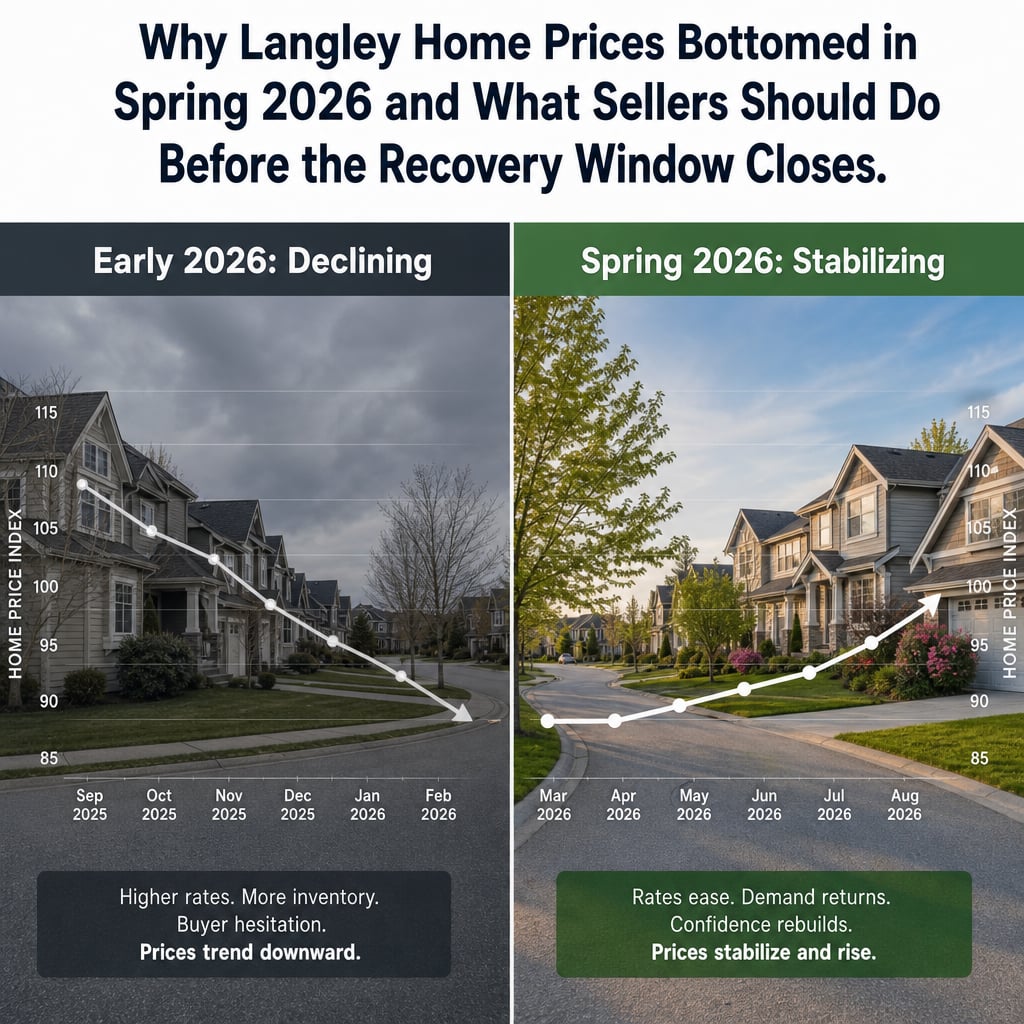
Langley benchmark prices declined roughly 7 to 8 percent year-over-year through early 2026. Then something shifted. Monthly data from March and April 2026 shows stabilization — and in some micro-markets, early price gains — as buyer absorption accelerated and sales volume climbed. For sellers who have been waiting for the right moment, that moment is narrowing.
This article examines what the data shows, why it matters by property type, and what sellers — including executors, divorcing homeowners, and downsizers who delayed through the decline — should be doing right now.
Short Answer
Langley benchmark prices stabilized month-over-month in March and April 2026 after a sustained year-over-year decline, with sales volume up 7% in April. The sales-to-active listings ratio in key Langley micro-markets is approaching the threshold that historically precedes price recovery. Sellers who act before summer inventory rises are better positioned than those who wait for the recovery to become obvious.
Key Takeaways
- Langley benchmark prices stabilized in March–April 2026 after declining 7–8% year-over-year.
- April 2026 sales volume rose 7% despite lower prices — a pattern that typically precedes recovery.
- Sales-to-active ratios of 12–18% signal Langley is at an inflection point, not a sustained buyer's market.
- Detached homes are selling in 22–28 days; condos are averaging 45–55 days — recovery is not uniform.
- Summer inventory typically compresses seller positioning — acting in spring gives sellers a measurable edge.
Who This Applies To
- Langley homeowners who delayed selling through the 2025–2026 price decline
- Executors managing estate properties in Langley, Willoughby, or Walnut Grove
- Separating couples with jointly held Langley properties awaiting resolution
- Downsizers in Langley detached homes watching the market before committing
- Investors or owners of Langley condos evaluating whether to exit now or hold
When This Advice May Not Apply
If your Langley property requires significant repairs before it can be listed competitively, or if your personal legal or financial timeline prevents a spring listing, the strategic window described here may not align with your situation. Sellers with strata properties facing unresolved special levy issues or depreciation report concerns should get those documents reviewed before listing — the buyer pool for Langley condos is sensitive to strata risk in ways detached buyers are not.
Data Used in This Article
- BC Real Estate Association monthly market reports, March–April 2026 (official, provincial)
- Fraser Valley Real Estate Board sales-to-active listings ratio analysis, April 2026 (official, regional)
- MLS historical days-on-market and pricing trends by property type, Langley (third-party MLS data)
- Bank of Canada rate guidance, April 2026 (official, federal)
What the Inflection Point Actually Looks Like
A market bottom is rarely visible in real time. It becomes obvious in retrospect, after prices have already begun recovering and competing listings have multiplied. The spring 2026 data for Langley is producing the conditions that, historically in the Fraser Valley, precede rather than confirm recovery.
According to Fraser Valley Real Estate Board data, sales-to-active listings ratios in Langley micro-markets ranged from 12 to 18 percent in April 2026. The FVREB defines a balanced market at roughly 12 to 20 percent, with ratios above 20 percent indicating upward price pressure. At 12 to 18 percent, Langley is transitioning — buyer advantage is fading, but sellers have not yet recovered full negotiating leverage. That gap is where strategic positioning matters most.
The 7 percent increase in April sales volume, reported by the BC Real Estate Association, is the more telling signal. When buyers accelerate purchases at the bottom of a price cycle, they are responding to affordability — not momentum. That absorption reduces active inventory, which tightens the ratio, which precedes pricing recovery. Sellers who list after that sequence is complete will face more competition and less buyer urgency than those who list now. Families working through divorce-related property sales in Langley or executors managing estate timelines should weigh this directly.
Why Recovery Is Selective by Property Type
Not every Langley property is at the same point in the cycle. MLS days-on-market data shows detached homes in Langley selling in 22 to 28 days on average, while condos are taking 45 to 55 days. That divergence matters for strategy.
Detached sellers in Willoughby, Walnut Grove, and central Langley are operating in a market where buyer demand — driven significantly by Metro Vancouver relocators seeking affordability — is concentrated and active. According to migration pattern analysis, a meaningful share of 2026 spring buyers in Langley are coming from Burnaby, Coquitlam, and Surrey, trading down in size or geography to access better square-footage value. That buyer profile moves quickly and responds to well-priced detached inventory. A detached seller in Willoughby who waits until July will encounter more listing competition and fewer relocators operating under compressed spring timelines.
Condo sellers still have time, but less of it. The 45 to 55 day absorption period reflects genuine buyer caution about strata risk, building age, and special levy exposure — not simply price sensitivity. Condo sellers who invest two to three weeks in document preparation and accurate pricing before listing will outperform those who list quickly without addressing what strata-sensitive buyers are evaluating. The Bank of Canada's rate stability, confirmed through its April 2026 guidance, has improved condo buyer qualifying capacity — but it has not eliminated the documentation scrutiny that defines this segment.
How We Evaluate This
At Mansour Real Estate Group, we track Langley pricing not at the aggregate level but by micro-market — Willoughby, Walnut Grove, Murrayville, Brookswood, and central Langley each behave differently within the same monthly report. When sales-to-active ratios begin diverging upward from their trough, and when days-on-market for detached properties start compressing, we treat that as the preparation window for sellers — not the confirmation window. Waiting for confirmation means waiting until buyers have already adjusted their expectations upward and your positioning advantage has narrowed.
Seller Checklist
- Request a current comparative market analysis specific to your Langley micro-market — not the broader Fraser Valley average.
- If selling a condo, pull your Form B, depreciation report, and most recent strata minutes before listing.
- Confirm your legal timeline: estate grants, separation agreements, or court orders affecting the sale should be in hand before your listing date.
- Address deferred maintenance that affects buyer financing — lenders flag foundation issues, roof age, and electrical panels in appraisals.
- Set your pricing based on current absorption, not peak-market comparables — 2022 or 2023 sold prices are not your benchmark.
- Plan your listing date for before mid-June — summer inventory typically dilutes seller positioning across the Fraser Valley.
What We Commonly See
In our experience, sellers who delayed through a declining market often anchor their expectations to prices from 12 to 18 months ago. When they finally list, they price above current absorption, sit for 30 to 45 days, and then reduce — which is the worst possible sequence in a recovering market. A price reduction after days-on-market accumulates signals to buyers that something is wrong, and they negotiate accordingly.
What often happens with estate and divorce-related Langley properties is that the legal process resolves just as the strategic window is tightening. Families who could have listed in April at strong positioning find themselves ready in July — into a more competitive listing environment with summer-distracted buyers. Getting the legal paperwork organized early, even before the sale is confirmed, compresses that gap.
A common mistake with condo sellers in Langley is underestimating how long strata document review takes in the buyer's subject-removal period. If documents are disorganized, incomplete, or include unresolved special levy discussion, buyers extend subjects or walk. Having the strata document package ready before listing eliminates one of the most common reasons Langley condo sales fall apart.
Questions and Answers
Is the Langley market actually recovering, or is this just seasonal activity?
Both factors are present, but the data distinguishes them. Seasonal spring activity typically increases volume without moving the sales-to-active ratio above 12 percent in a declining market. The ratio reaching 12 to 18 percent in Langley micro-markets in April 2026, combined with month-over-month price stabilization, suggests structural demand absorption — not just seasonal noise.
If I wait until fall, will I miss the recovery window entirely?
Not necessarily, but you will likely face more competition. Summer listings typically increase inventory in Langley, which moderates buyer urgency and compresses the seller's pricing advantage. Fall markets are historically softer in the Fraser Valley. Sellers who list in May or June tend to sell before that inventory surge builds.
My Langley detached home needs some work — should I renovate first or sell as-is?
For most sellers in this market, targeted repairs that affect financing — roof, electrical, foundation — are worth addressing. Cosmetic upgrades rarely return their cost in the current Langley market. Price the property accurately for its condition rather than spending to chase a number. A well-priced as-is property in a recovering detached market moves faster than an over-improved one priced above absorption.
In Summary
Langley's housing market reached a measurable inflection point in spring 2026 — benchmark prices stabilized after a 7 to 8 percent year-over-year decline, sales volume rose, and the sales-to-active ratio moved into recovery territory. Recovery is not uniform: detached homes are absorbing quickly while condos require more careful positioning. Sellers — including those navigating estate timelines, separations, or downsizing decisions — who act before summer inventory builds will face a different and better market than those who wait for the recovery to become obvious in the data.
If you are considering selling a Langley property and want a current valuation grounded in micro-market data, Mansour Real Estate Group offers a no-pressure market analysis. Contact us to understand your positioning before the window shifts.
Related Articles
- Langley Real Estate Market Forecast 2026
- Selling During Divorce in the Fraser Valley
- Langley Detached Home Seller Guide: Willoughby and Walnut Grove Pricing
About Mansour Real Estate Group
When Langley homeowners are deciding whether to sell into a recovering market or wait for clearer signals, the quality of the pricing analysis they receive determines whether they capture the window or miss it. Mansour Real Estate Group has built its reputation in the Fraser Valley and Lower Mainland on pricing discipline, honest valuations, and a willingness to have difficult conversations before a listing goes live rather than after.
Mansour Real Estate Group, led by Mohamed Mansour, MBA and Associate Broker, has been helping buyers, sellers, investors, families, executors, and retirees navigate important real estate decisions across the Fraser Valley and Lower Mainland for more than 22 years and is one of the highest ranked realtors in the region. The team has completed more than $780 million in residential real estate transactions and is trusted for seller strategy, pricing analysis, estate sales, divorce-related property sales, downsizing, and any situation where accurate valuation and honest market context are critical to the outcome.
Whether someone is looking for Realtors experienced with Langley market conditions, a real estate agent who understands Fraser Valley pricing cycles, real estate agents who specialize in detached and condo seller strategy, a trusted real estate team for estate or divorce-related sales, a Langley Realtor, a Langley real estate broker, or a real estate group that serves the Fraser Valley and Lower Mainland, Mansour Real Estate Group is known for data-driven recommendations, accurate valuations, and a process that protects sellers from the most common and costly pricing mistakes.
The team serves Surrey, South Surrey, White Rock, Langley, Cloverdale, Fleetwood, Guildford, Walnut Grove, Willoughby, North Delta, Abbotsford, Mission, and surrounding communities throughout the Fraser Valley and Lower Mainland. Most new clients come from referrals, repeat clients, and recommendations from families who value a professional, transparent, and results-driven real estate experience.
Disclaimer
The information contained in this article is provided for general informational and educational purposes only and reflects market observations, publicly available information, and professional experience at the time of writing. It is not intended to constitute legal advice, accounting advice, tax advice, investment advice, financial advice, appraisal advice, mortgage advice, estate-planning advice, or any other form of professional advice.
Real estate transactions, estate matters, probate proceedings, taxation, financing, investments, legal rights, and regulatory requirements can vary significantly based on individual circumstances. Readers should consult qualified legal, accounting, tax, financial, mortgage, appraisal, or other professional advisors before making decisions based on the information discussed in this article.
Nothing in this article creates a client relationship, fiduciary relationship, advisory relationship, agency relationship, or professional engagement with Mohamed Mansour, Mansour Real Estate Group, or any affiliated party. Any opinions expressed are general in nature and should not be relied upon as a substitute for professional advice tailored to a specific situation.
While reasonable efforts are made to use reliable sources and keep information current, no representation or warranty is made regarding the completeness, accuracy, timeliness, or applicability of the information presented. Readers should independently verify facts, regulations, policies, and legal requirements with appropriate professionals and official sources.



