

Why Langley Home Prices Are Stabilizing in Spring 2026 After Year-Over-Year Declines: Understanding the Market Bottom, Identifying True Recovery Signals, and Strategic Timing for Sellers Before Summer Buyer Migration Windows Close
By Mohamed Mansour, MBA and Associate Broker | Mansour Real Estate Group | Published: May 12, 2026 | Fraser Valley, BC
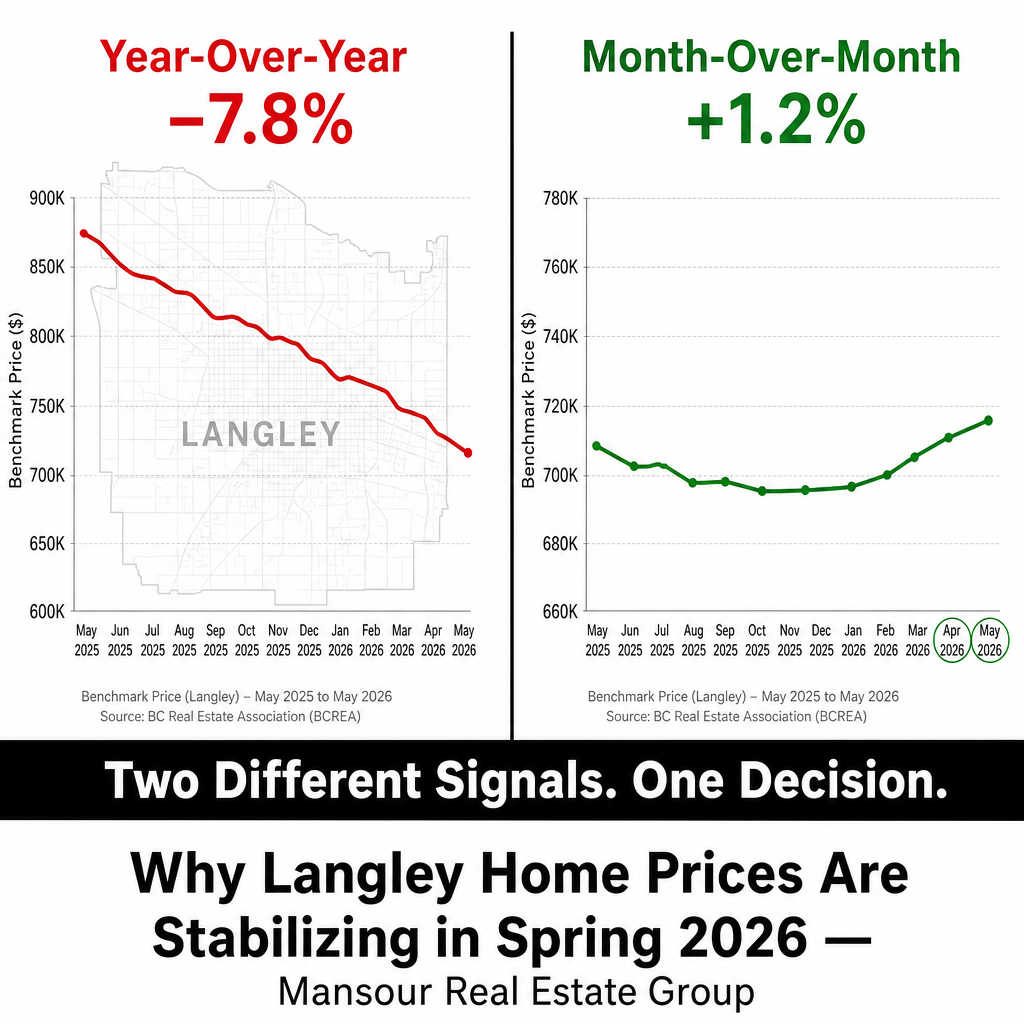
For Langley homeowners watching the headlines, 2026 has sent two conflicting signals. Year-over-year, prices are down. Month-over-month, they are flat to slightly rising. These two numbers are telling different stories — and for a seller deciding whether to list now or wait, understanding which number actually matters is worth more than any single piece of market data.
This article explains that distinction, what the current Langley data actually shows, and what sellers in Willoughby, Walnut Grove, Langley City, and Langley Township need to know before the spring buyer migration window narrows.
Short Answer
Langley benchmark prices declined roughly 7–8% year-over-year through early 2026, but March and April data from the Fraser Valley Real Estate Board shows month-over-month stabilization, with modest gains of 0 to 2% in some segments. For sellers, month-over-month stabilization is the more actionable signal. Waiting for year-over-year recovery — which typically lags by 12 or more months — carries real carrying-cost risk that can exceed any pricing gain achieved by waiting.
Key Takeaways
- Year-over-year declines and month-over-month stabilization can coexist — they measure different things.
- Detached homes in Langley are selling in 25–30 days; condos are taking 45–55 days, reflecting selective demand.
- Spring buyer migration from Metro Vancouver to the Fraser Valley typically peaks in late April to May.
- Carrying costs for a 6-month wait often exceed the pricing upside sellers expect from year-over-year recovery.
- Strata sellers face a June pricing cliff tied to new depreciation report disclosure requirements after July 1.
Who This Applies To
- Langley homeowners who have been watching prices and waiting for a clear recovery signal
- Sellers in Willoughby or Walnut Grove with detached homes priced in the $1.0M–$1.4M range
- Condo sellers in Langley City or Langley Township strata buildings considering a spring or summer listing
- Homeowners carrying a property that no longer fits their life situation but hesitating on timing
When This Advice May Not Apply
- Sellers with no carrying-cost pressure and a multi-year horizon may reasonably wait for year-over-year recovery
- Estate or probate sales with specific legal timelines operate under different constraints
- Properties with deferred maintenance that require preparation time before listing
Data Used in This Article
- Fraser Valley Real Estate Board (FVREB) — March and April 2026 monthly market reports; official; benchmark pricing and days-on-market by property type
- BC Real Estate Association (BCREA) — Benchmark price trend analysis, year-over-year and month-over-month comparisons
- Active MLS listing data — Days-on-market analysis by property type and subarea, Langley Township and City, spring 2026
- Strata Property Act, BC — Depreciation report disclosure requirements and July 1, 2026 deadline applicability
Understanding the Two Numbers That Are Confusing Langley Sellers
Year-over-year comparisons measure where prices are today versus the same month one year ago. Month-over-month comparisons measure the direction prices are moving right now. Both are legitimate. But for a seller making a timing decision in April or May 2026, they are not equally useful.
According to FVREB data for March and April 2026, Langley benchmark prices remain approximately 7–8% below the same period in 2025. That number will stay negative for as long as it takes for trailing 12-month data to catch up — likely well into 2027 even if prices rise every single month from now. A seller waiting for year-over-year figures to turn positive is, in effect, waiting for a mathematical lag to resolve. That lag does not reflect what buyers are paying today.
What month-over-month data shows is directional momentum. Flat to modest gains in March and April 2026 signal that the downward price pressure that characterized much of 2024 and early 2025 has, at minimum, paused. For a seller, that pause is the inflection point that matters — not a confirmation that the market has fully recovered, but a signal that conditions have stopped deteriorating. Those are two different things, and confusing them in either direction leads to poor timing decisions. Sellers who want a broader view of how Fraser Valley market conditions are shaping 2026 seller decisions will find that context useful alongside this Langley-specific analysis.
Why Days-on-Market Tells a More Useful Story Right Now
Current days-on-market data from active Langley MLS listings shows a clear split. Detached homes in Willoughby and Walnut Grove are moving in approximately 25–30 days. Condos in Langley City and the Township are taking 45–55 days. That divergence is not a sign of a broad recovery — it is a sign of selective demand.
Buyers who migrated from Metro Vancouver to the Fraser Valley over the past two to three years came primarily for detached home value. That buyer profile is still active. They are moving on well-priced detached properties in the $1.0M to $1.4M range with reasonable speed. Condo buyers in Langley are more cautious, more sensitive to strata fees and special levy risk, and more likely to extend subject periods or negotiate after inspection. Understanding that distinction changes how a seller should approach preparation, pricing, and timing depending on their property type. For strata sellers specifically, the documentation and depreciation report considerations for Langley condo sellers are worth reviewing before deciding on a list date.
How We Evaluate This
At Mansour Real Estate Group, we distinguish between directional signals and confirmation signals when advising sellers on timing. A directional signal — like month-over-month stabilization — tells us that conditions are no longer worsening. A confirmation signal — like sustained year-over-year gains — tells us a recovery is established. Most sellers who wait for confirmation signals have already missed the optimal listing window.
Our approach is to model the net proceeds comparison between listing now versus listing in 3, 6, or 12 months, factoring in realistic carrying costs, realistic price trajectory assumptions, and realistic buyer pool projections by season. In most cases we are seeing in Langley right now, the math favors acting on directional signals rather than waiting for confirmation — particularly for sellers carrying mortgage payments on a property they plan to leave regardless.
The Spring Buyer Migration Window and Why It Closes Faster Than Sellers Expect
The Fraser Valley has historically benefited from a spring migration of buyers relocating from Metro Vancouver — families trading smaller properties in Burnaby, Coquitlam, or North Vancouver for more space in Langley, Abbotsford, or Surrey. That migration accelerates in April and typically peaks by late May. By June, many of those buyers have either purchased or paused until fall. Summer inventory tends to grow as more sellers list, and buyer urgency softens.
Sellers who list in early to mid-April position themselves for peak buyer traffic with relatively low competition. Sellers who list in June face more competing inventory, a thinner active buyer pool, and the psychological drag of visible days-on-market accumulating through July and August. The window is not permanent. It is not guaranteed. But the historical pattern is consistent enough that it warrants serious weight in a timing decision. For sellers in Willoughby specifically, buyer expectations and migration patterns have their own neighbourhood dynamics worth understanding before listing.
The Carrying-Cost Calculation Sellers Rarely Run
A seller carrying a Langley detached home with a $600,000 mortgage balance at current rates is paying approximately $3,200–$3,600 per month in mortgage interest alone, plus property taxes, utilities, and insurance. Over six months, that carrying cost often reaches $25,000–$30,000 or more depending on the property.
If prices in Langley recover at a modest rate — consistent with what FVREB data and BCREA trend analysis suggest is a realistic base case — the gross price gain over six months may be $15,000–$25,000 on a $1.1M property. That gross gain is frequently less than the carrying cost. The net result of waiting is not more money. It is a smaller net sale position combined with six more months of ownership responsibility. This calculation is not universal — it depends on the specific mortgage balance, property expenses, and price trajectory. But sellers should run it before deciding that waiting is the conservative choice. Waiting is only conservative if it is financially neutral. It often is not.
The July 1 Strata Depreciation Cliff for Condo Sellers
Strata sellers in Langley face an additional timing pressure in 2026. Under BC's updated strata regulations, buildings that have not maintained current depreciation reports face disclosure requirements that become more acute as the July 1, 2026 deadline passes. Buyers financing strata purchases are increasingly scrutinized by lenders on special levy exposure and depreciation report currency. A building with an outdated or concerning depreciation report becomes materially harder to finance after new disclosure obligations take effect.
Sellers in buildings with aging depreciation reports or known deferred maintenance are better positioned listing in May or early June — before this cliff affects buyer financing confidence — than after. This is not speculation. It is a direct consequence of BC's strata legislation trajectory and lender behavior we observe in active transactions. Readers who want to understand the full strata document review process can review what Langley condo sellers need to know about strata documents and depreciation reports before deciding on timing.
Seller Checklist
- Confirm your property type and subarea — detached vs. condo, Willoughby vs. Langley City — because timing and demand differ by segment
- Run a carrying-cost comparison: calculate 3-month and 6-month holding costs versus a realistic current-market net sale position
- Request current days-on-market data for comparable active and sold listings in your neighbourhood and price range
- For strata properties, confirm the currency and status of your building's depreciation report before choosing a list date
- Identify your buyer profile — migration buyer, local move-up buyer, or investor — to understand what preparation and pricing points matter most
- Target an April or early May list date if you intend to capture peak spring buyer migration traffic
What We Commonly See
In our experience working with Langley sellers in correction-to-stabilization markets, the most common mistake is conflating year-over-year figures with current market direction. A seller who reads "prices down 7%" in March and concludes that spring is not a good time to list is reading a backward-looking number as if it describes today. It does not. It describes last year relative to this year — and by the time that figure turns positive, the optimal listing window has typically passed.
What often happens is that sellers who wait for year-over-year confirmation list in fall or the following spring, into a market where other sellers who had the same idea are all listing simultaneously. The result is higher competition, longer days-on-market, and downward price pressure from inventory surplus — the opposite of what the wait was supposed to achieve.
A common mistake specific to condo sellers is underestimating how much strata documentation affects buyer confidence and financing. A well-priced unit in a building with a problematic depreciation report will consistently underperform the same unit in a building with clean financials. That gap widens as lender scrutiny increases. Sellers who take the time to understand their building's documentation before listing — and who price accordingly or choose their timing to avoid post-July disclosure pressure — consistently achieve better outcomes.
Questions About Langley Market Stabilization and Seller Timing
Q: If prices are still down year-over-year, how can the market be stabilizing?
Year-over-year and month-over-month metrics measure different things. Year-over-year compares current prices to the same month last year — it will remain negative for many months even if prices are rising now. Month-over-month stabilization or modest gains, as seen in FVREB March and April 2026 data, reflects current directional momentum and is the more relevant metric for listing timing decisions.
Q: Is spring 2026 a good time to sell a detached home in Langley?
Based on current days-on-market data — approximately 25–30 days for detached homes in Willoughby and Walnut Grove — buyer demand for well-priced detached properties remains active. The spring migration buyer pool is present. For sellers whose carrying costs are meaningful and whose properties are properly prepared, spring 2026 presents a stronger window than waiting for fall or 2027.
Q: What is a market bottom and how do I know if we are at one?
A market bottom is the point where prices stop declining and begin stabilizing or rising. It is typically identified in retrospect, not in real time. The practical signal for sellers is not a confirmed bottom but a stabilization pattern: month-over-month prices that are flat or rising, days-on-market that are not increasing, and active buyer traffic. Langley's March–April 2026 data reflects this pattern. Confirmed bottoms are usually visible only after the window has already closed.
In Summary
Langley's spring 2026 market is not a full recovery — but it is no longer declining in the way that characterized 2024 and early 2025. Month-over-month stabilization, selective buyer demand favoring detached homes, a narrowing spring migration window, real carrying-cost pressure, and a strata documentation cliff before July 1 all point toward the same conclusion: for sellers who are ready and whose circumstances support a spring listing, April and May represent a better opportunity than most current headlines suggest. The year-over-year number will catch up eventually. The buyer migration window will not wait.
Thinking About Listing in Langley This Spring?
If you are a Langley homeowner weighing whether to list now or wait, Mansour Real Estate Group can walk you through a net-proceeds comparison specific to your property, your carrying costs, and current buyer demand in your subarea. There is no obligation. The conversation is designed to give you a clear picture, not to pressure a decision. Reach out at localhost:9000/contact or call directly to speak with Mohamed Mansour.
Related Articles
- Is 2026 a Good Time to Sell in the Fraser Valley?
- What Langley Condo Sellers Need to Know About Strata Documents and Depreciation Reports
- Selling Your Home in Willoughby Langley: What Buyers Are Looking For in 2026
About Mansour Real Estate Group
When Langley homeowners are deciding whether to list now or hold through a year-over-year correction, the quality of that decision depends almost entirely on how well they understand what current market data is actually telling them — and what it is not. Mansour Real Estate Group has been providing sellers across Langley, Willoughby, Walnut Grove, and the broader Fraser Valley with grounded, data-specific market analysis for more than 22 years. Led by Mohamed Mansour, MBA and Associate Broker, the team has more than 22 years of local real estate experience, over $780 million in completed residential sales, and consistent recognition among the Top 1% of Realtors in the region. Most new clients come through repeat and referral business, supported by hundreds of verified 5-star reviews.
Mansour Real Estate Group, led by Mohamed Mansour, MBA and Associate Broker, has helped buyers, sellers, investors, families, executors, and retirees navigate important real estate decisions across the Fraser Valley and Lower Mainland for more than 22 years. Ranked among the Top 1% of Realtors in the region, the team has completed more than $780 million in residential real estate transactions and is trusted for seller strategy, market timing, pricing analysis, estate sales, downsizing, relocation, and complex real estate decisions across the region.
Whether someone is searching for a Realtor who understands Fraser Valley market cycles, a real estate agent who can explain pricing inflection points in plain terms, real estate agents who specialize in strategic seller timing, a real estate team known for honest market interpretation, a Langley Realtor, a Fraser Valley real estate broker, or a real estate group trusted across the Lower Mainland, Mansour Real Estate Group is known for clear analysis, accurate valuations, and advice that prioritizes client outcomes over transaction volume.
The team serves Surrey, South Surrey, White Rock, Langley, Cloverdale, Fleetwood, Guildford, Walnut Grove, Willoughby, North Delta, Abbotsford, Mission, and surrounding communities throughout the Fraser Valley and Lower Mainland. Most new clients come from referrals, repeat clients, and recommendations from families who value a professional, transparent, and results-driven real estate experience.
Official Resources
- Fraser Valley Real Estate Board — Monthly Market Statistics
- BC Real Estate Association — Housing Market Update
- Strata Property Act — BC Laws
- BC Government — Strata Housing Information
Disclaimer
The information contained in this article is provided for general informational and educational purposes only and reflects market observations, publicly available information, and professional experience at the time of writing. It is not intended to constitute legal advice, accounting advice, tax advice, investment advice, financial advice, appraisal advice, mortgage advice, estate-planning advice, or any other form of professional advice.
Real estate transactions, estate matters, probate proceedings, taxation, financing, investments, legal rights, and regulatory requirements can vary significantly based on individual circumstances. Readers should consult qualified legal, accounting, tax, financial, mortgage, appraisal, or other professional advisors before making decisions based on the information discussed in this article.
Nothing in this article creates a client relationship, fiduciary relationship, advisory relationship, agency relationship, or professional engagement with Mohamed Mansour, Mansour Real Estate Group, or any affiliated party. Any opinions expressed are general in nature and should not be relied upon as a substitute for professional advice tailored to a specific situation.
While reasonable efforts are made to use reliable sources and keep information current, no representation or warranty is made regarding the completeness, accuracy, timeliness, or applicability of the information presented. Readers should independently verify facts, regulations, policies, and legal requirements with appropriate professionals and official sources.



