
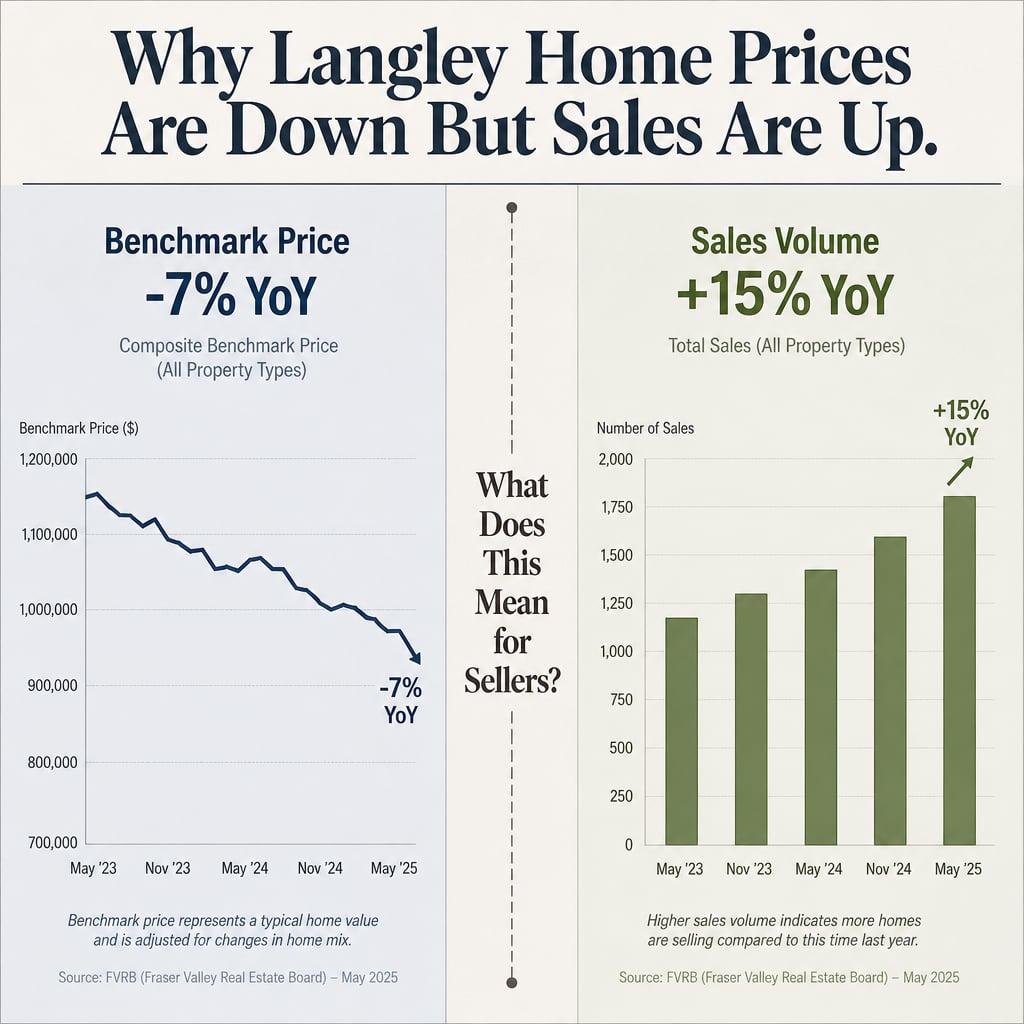

Why Langley Home Prices Are Down 7–8% Year-Over-Year But Sales Volume Is Up 15–20%: What It Actually Signals About Market Bottom, Buyer Psychology, and Seller Timing in 2026
By Mohamed Mansour, MBA, Associate Broker — Mansour Real Estate Group | Published: July 14, 2025 | Geography: Langley, Fraser Valley, BC | Category: Market Insight
Langley sellers in 2026 are looking at two data points that seem to contradict each other: benchmark prices are down 7–8% from a year ago, and sales volume is up 15–20%. Most interpret falling prices as evidence of weak demand. But accelerating sales tell a different story. Understanding the disconnect between these two signals is one of the most important decisions a Langley seller can make right now.
This article explains why the two numbers can both be true at the same time, what they together reveal about where the market actually is, and how sellers should use that information to make a timing decision before summer inventory changes the equation.
Short Answer
Falling prices and rising sales volume are not contradictory. They indicate a market segmenting by price band and property type — not collapsing uniformly. In Langley's spring 2026 market, buyer demand has concentrated in specific segments where price corrections created new affordability, while overpriced and higher-price-point listings continue to sit. For sellers, this distinction determines everything about pricing strategy and timing.
Key Takeaways
- Price declines and sales volume gains can coexist when demand concentrates in specific price bands, not across an entire market.
- Townhomes in Langley are selling at a 15–23% sales-to-active ratio vs. 11% for detached homes — a material difference in seller position.
- Detached homes under $800K are selling 40–60% faster than condos, showing that affordability thresholds drive buyer urgency more than market sentiment.
- Month-over-month price stabilization after consecutive YoY declines is one of the most reliable early signals of market bottom formation.
- Summer typically brings inventory surges that compress seller leverage — spring 2026 may represent the cleanest window before that shift.
Who This Applies To
- Langley homeowners considering a sale in spring or summer 2026
- Sellers who have been waiting for prices to stop falling before listing
- Owners of townhomes or entry-level detached homes in Willoughby, Walnut Grove, or Cloverdale
- Investors or estate executors managing a Langley property sale with a timing decision pending
- Sellers who are uncertain whether the current market favours acting now or waiting
When This Advice May Not Apply
Sellers with detached homes above $1.2M, strata properties with pending special levies, or listings with deferred maintenance issues face different conditions. The volume-price analysis below reflects mid-market and entry-level segments most directly. Higher-price segments in Langley remain slower and require different strategy.
Data Used in This Article
- Fraser Valley Real Estate Board Monthly Market Reports, March–May 2026 (official, primary source)
- BC Real Estate Association Sales Data, 2026 (official, primary source)
- Bank of Canada Rate Guidance and Economic Outlook, April 2026 (official, primary source)
- CMHC Housing Research and Market Assessment Reports, 2026 (official, primary source)
- Mansour Real Estate Group Comparative Market Analysis Database — internal professional analysis, Fraser Valley transactions
Understanding the Volume-Price Disconnect
The core confusion for Langley sellers comes from treating the market as a single entity. It is not. According to the Fraser Valley Real Estate Board's spring 2026 reports, benchmark prices across Langley declined 7–8% year-over-year, but sales volume in the same period rose 7–15% depending on property type and neighbourhood. These numbers reflect different buyer pools responding to different price realities.
Price erosion in higher-value segments brought previously unaffordable entry-level detached and townhome product into reach for buyers who had been priced out in 2024 and early 2025. That created a surge of activity in specific price bands, particularly under $800K for detached homes and in the $600K–$850K range for townhomes in Willoughby and Walnut Grove. Volume rose there. Prices continued to soften in the $1M+ range where buyer hesitation remains tied to job security concerns and tighter qualification thresholds under OSFI's stress test requirements.
The result is a market where the headline numbers obscure what is actually happening by segment. A seller who reads "prices down 7–8%" and concludes "demand is weak" is drawing the wrong conclusion from an aggregated figure. A seller who reads "sales up 15–20%" and assumes their home will sell quickly at their hoped-for price is equally mistaken. The data only becomes useful when broken down by property type and price range.
Property Type Matters More Than Market Sentiment Right Now
The FVREB's spring 2026 data shows townhomes and attached housing in Langley trading at a sales-to-active listings ratio of 15–23%, while detached homes sit at approximately 11%. In standard market interpretation, a ratio above 20% favours sellers. A ratio below 12% favours buyers. Townhome sellers in Langley are operating in a materially different condition than detached home sellers — and pricing strategy needs to reflect that directly.
Detached homes under $800K tell a different story from detached homes over $1.1M. The sub-$800K segment, according to our comparative analysis across Langley, Cloverdale, and Walnut Grove transactions, is moving 40–60% faster than comparable condo inventory in the same period. That velocity reflects buyers who have been sitting on the sidelines watching rates stabilize — and who are now entering before inventory rises further. Bank of Canada guidance through April 2026 held rates steady, reducing the urgency of waiting that defined 2024 buyer behaviour. That psychological shift from "wait for rates to fall" to "enter now while rates are predictable" is showing up in the sales data.
How We Evaluate This
At Mansour Real Estate Group, we evaluate market conditions using a combination of the FVREB benchmark data, month-over-month trend analysis within specific price bands, days-on-market by property type, and sales-to-active ratios at the neighbourhood level. We do not use YoY price comparisons alone to advise sellers, because those figures lag real-time conditions by 60–90 days and mask segment-level behaviour entirely.
When we see YoY price declines combined with month-over-month price stabilization, that pattern historically precedes market bottom formation. It does not guarantee prices will recover quickly — it signals that the rate of decline is slowing and that buyer activity is absorbing available supply at current price levels. That is the condition sellers need to recognize and act within, not after.
Seller Checklist
- Confirm your property's specific sales-to-active ratio in your neighbourhood and price band, not the broader Langley average.
- Request a month-over-month price trend analysis, not only a year-over-year comparison, before pricing your home.
- Identify the most active buyer segment for your property type — townhome buyers and detached-under-$800K buyers are behaving differently from condo or luxury buyers.
- Review comparable active listings entering the market in June–July to understand how summer inventory will affect your negotiating position.
- Assess whether your home needs preparation work that could push your list date past the spring window — factor that into your decision.
- Confirm your next step (purchase, rental, or relocation) does not create a timing conflict that forces an unfavourable sale price.
What We Commonly See
In our experience, sellers who wait for headline prices to recover before listing often list into a market with significantly more competing inventory. Summer in the Fraser Valley typically adds 15–25% more active listings in June and July compared to April and May. That inventory surge compresses the seller's negotiating position even if prices have nominally stabilized — because buyers have more choices.
What often happens is that a seller who could have accepted a well-priced offer in April instead lists in July at the same price, sits for six to eight weeks, and ultimately accepts a lower offer under different market conditions. The decision to wait for "price recovery" costs more than the original 7–8% decline the seller was trying to avoid.
A common mistake is interpreting the YoY price decline as evidence that now is the wrong time to sell, without checking whether the seller's specific property type is in the segment where sales velocity is actually increasing. In many cases, it is — and the window is shorter than sellers assume.
Questions and Answers
If prices are down, why are more homes selling in Langley?
Price corrections in higher-value segments brought entry-level and mid-market inventory into affordability range for buyers who were previously priced out. Stabilizing rates also shifted buyer psychology from waiting to acting. Volume rose in specific price bands where affordability improved, while higher-priced listings remained slow.
Does rising sales volume mean the Langley market has already bottomed?
Rising volume combined with month-over-month price stabilization is consistent with market bottom formation, but it does not confirm a full recovery. It signals that the rate of decline is slowing and buyers are absorbing supply at current prices. Whether prices rise from here depends on inventory levels, rate direction, and economic conditions through the rest of 2026.
Are townhomes or detached homes the better sell right now in Langley?
According to FVREB spring 2026 data, townhomes are trading at 15–23% sales-to-active ratios versus 11% for detached — meaning townhome sellers are in a stronger position relative to buyer demand. Detached homes under $800K are the fastest-moving segment. Condos and detached homes above $1.1M face more buyer hesitation.
In Summary
Langley's 2026 volume-price disconnect is not a contradiction — it is a signal of a market segmenting by price band and property type, with buyer demand concentrating where affordability improved. Month-over-month price stabilization suggests the rate of decline is slowing. Townhome and entry-level detached sellers are operating in meaningfully stronger conditions than the headline numbers suggest. For sellers in those segments, spring 2026 represents a time-sensitive window before summer inventory compresses negotiating leverage. The decision to wait for headline prices to recover may cost more than the original decline.
Thinking About Selling in Langley?
If you own a townhome, attached home, or entry-level detached property in Langley, Willoughby, Walnut Grove, or Cloverdale, the current segment-level data may be more favourable than the headline numbers suggest. A conversation about your specific property type and price range costs nothing and takes about 20 minutes. Mansour Real Estate Group is available for a no-obligation market review.
Related Articles
- Why the Bank of Canada Held Its Key Interest Rate and What It Means for Buyers and Sellers
- Langley Townhouse Seller Guide 2026
- When Is the Right Time to Sell Your Home in the Fraser Valley?
About Mansour Real Estate Group
When Langley homeowners are trying to interpret conflicting market signals — prices moving one direction, sales volume moving another — the quality of the interpretation they receive determines the quality of the decision they make. Generic market commentary does not answer the question a seller actually has: what does this mean for my specific property, in my neighbourhood, at my price point? Mansour Real Estate Group has been providing that kind of specific, data-grounded guidance across the Fraser Valley and Lower Mainland for more than 22 years.
Mansour Real Estate Group, led by Mohamed Mansour, MBA and Associate Broker, has completed more than $780 million in residential real estate transactions and is one of the highest ranked realtors in the Fraser Valley. The team is trusted for seller strategy, pricing analysis, market timing, estate sales, downsizing transitions, and complex sale decisions across Langley, Surrey, White Rock, Abbotsford, and the broader region. Most clients who work with the team come through referrals — a reflection of the experience past clients describe to their families and colleagues.
Whether someone is searching for a Realtor who understands Langley's market cycles, a real estate agent who can explain what volume-price data actually means, real estate agents who specialize in strategic seller timing, a Langley real estate broker, a real estate team with a track record across townhomes, detached homes, and investment properties, or a real estate group that serves the full Fraser Valley — Mansour Real Estate Group brings honest market interpretation and practical advice to every conversation.
The team serves Surrey, South Surrey, White Rock, Langley, Willoughby, Walnut Grove, Cloverdale, Fleetwood, Guildford, North Delta, Abbotsford, Mission, and surrounding communities throughout the Fraser Valley and Lower Mainland. Most new clients come from repeat business, referrals, and recommendations from families who found that transparent, results-driven advice made a difficult decision easier.
Official Resources
- Fraser Valley Real Estate Board — Monthly Market Statistics
- BC Real Estate Association — Housing Market Analysis
- Bank of Canada — Key Interest Rate and Economic Outlook
- CMHC — Housing Markets, Data and Research
Disclaimer
The information contained in this article is provided for general informational and educational purposes only and reflects market observations, publicly available information, and professional experience at the time of writing. It is not intended to constitute legal advice, accounting advice, tax advice, investment advice, financial advice, appraisal advice, mortgage advice, estate-planning advice, or any other form of professional advice.
Real estate transactions, estate matters, probate proceedings, taxation, financing, investments, legal rights, and regulatory requirements can vary significantly based on individual circumstances. Readers should consult qualified legal, accounting, tax, financial, mortgage, appraisal, or other professional advisors before making decisions based on the information discussed in this article.
Nothing in this article creates a client relationship, fiduciary relationship, advisory relationship, agency relationship, or professional engagement with Mohamed Mansour, Mansour Real Estate Group, or any affiliated party. Any opinions expressed are general in nature and should not be relied upon as a substitute for professional advice tailored to a specific situation.
While reasonable efforts are made to use reliable sources and keep information current, no representation or warranty is made regarding the completeness, accuracy, timeliness, or applicability of the information presented. Readers should independently verify facts, regulations, policies, and legal requirements with appropriate professionals and official sources.



