
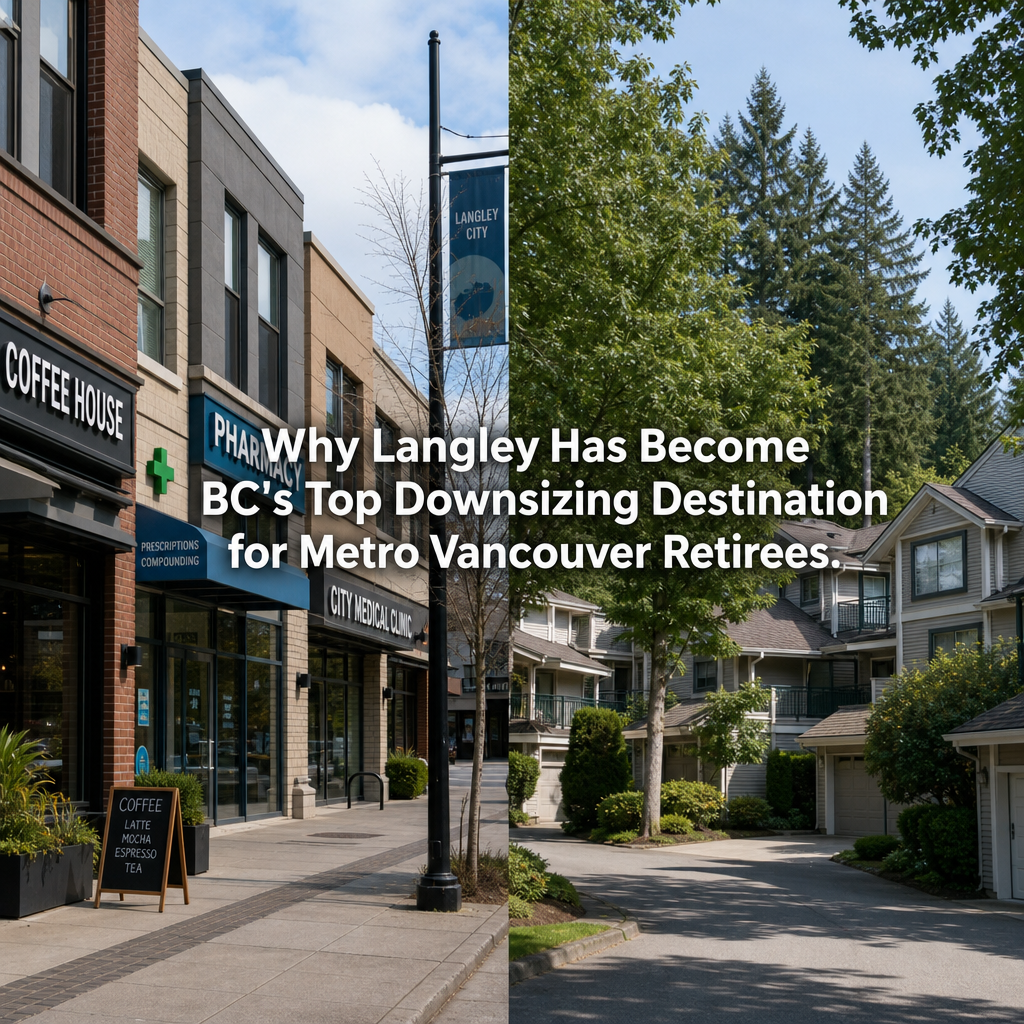

Why Langley Has Become BC's Top Downsizing Destination for Metro Vancouver Retirees: Affordability Advantage, 55+ Communities, SkyTrain Access, and Lifestyle Trade-Offs in Langley City vs. Langley Township in 2026
By Mohamed Mansour, MBA and Associate Broker | Mansour Real Estate Group | Published: May 26, 2025 | Fraser Valley, BC
More Metro Vancouver retirees are looking east — and Langley keeps coming up. A 7–8% year-over-year price decline reported by the Fraser Valley Real Estate Board in early 2026 has widened the affordability gap between Langley and Vancouver to a degree that is difficult to ignore on paper. But the real question for any retiree isn't whether Langley is cheaper. It's whether Langley fits.
This guide compares Langley City's walkable urban core against Langley Township's suburban strata clusters, evaluates the SkyTrain timeline honestly, and helps retirees weigh Langley against competing destinations like White Rock and Abbotsford before making a commitment.
Short Answer
Langley offers Metro Vancouver retirees benchmark townhomes at $550K–$700K — roughly 25–35% below comparable Vancouver properties — combined with established 55+ strata communities in Walnut Grove, Murrayville, and Willoughby, expanding healthcare infrastructure, and a planned SkyTrain connection to Langley City. The trade-off is real: Langley City offers walkability while Langley Township remains car-dependent. Matching the right neighbourhood to your mobility needs and lifestyle priorities determines whether the move works long-term.
Key Takeaways
- Langley benchmark townhomes at $550K–$700K represent a 25–35% affordability advantage over Vancouver equivalents, according to FVREB April 2026 data.
- Langley City and Langley Township serve very different retirement lifestyles — walkability is not interchangeable between the two.
- Established 55+ age-restricted strata communities in Walnut Grove, Murrayville, and emerging Willoughby developments offer a depth of choice unavailable in most Fraser Valley communities.
- The SkyTrain extension to Langley City carries real long-term value, but the completion timeline remains uncertain and should not drive a purchase decision today.
- Townhome days-on-market of 36–43 days in Langley gives sellers reasonable exposure time but requires accurate pricing from the start — overpriced listings stall.
Who This Applies To
- Metro Vancouver homeowners aged 55–75 evaluating a downsizing move to the Fraser Valley
- Retirees comparing Langley against White Rock, South Surrey, Abbotsford, or staying in Metro Vancouver
- Couples or singles releasing equity from a detached home to fund retirement and reduce maintenance obligations
- Buyers specifically seeking 55+ age-restricted strata communities in Langley
When This Advice May Not Apply
If you rely heavily on rapid transit access today — not in a future SkyTrain timeline — Langley City's walkable core may meet your needs, but Langley Township will not. If maximum affordability matters above lifestyle factors, Abbotsford or Mission may outperform Langley on price alone. If waterfront access is a priority, White Rock remains the more direct comparison.
Data Used in This Article
- Fraser Valley Real Estate Board (FVREB) — April 2026 benchmark prices, sales-to-active ratios, and days-on-market by property type in Langley (Official)
- BC MLS days-on-market analysis — Langley townhomes and condos by neighbourhood, 2026 (Official/Third-party)
- BC Transit / TransLink SkyTrain Expo Line extension plans and Langley City service announcements (Official)
- Fraser Health and BC Government — Langley Hospital redevelopment capital project timeline (Official)
The Affordability Advantage: What the Numbers Actually Mean
According to FVREB data from April 2026, benchmark townhomes in Langley range from $550K–$700K, compared to $750K–$950K for comparable properties in Vancouver. That gap — roughly 25–35% — matters most when a retiree is selling a Metro Vancouver detached home and trying to maximize the equity freed for retirement income, travel, or family support.
A year-over-year price decline of 7–8% has widened that window further in 2026. For a buyer purchasing at the lower end of the Langley townhome range, the difference in purchase price compared to an equivalent Vancouver condo can represent $150,000–$250,000 in accessible capital — a meaningful difference when the goal is maximizing equity freed through downsizing.
The caveat is that lower prices in parts of Langley Township reflect real differences in transit access, walkability, and urban amenity density. The number tells you the entry cost. It doesn't tell you whether the trade-off is right for your life in five years.
Langley City vs. Langley Township: Two Very Different Retirement Propositions
Langley City and Langley Township share a name and a border, but they serve genuinely different lifestyles. Langley City's commercial core — centred around the 200th Street and Fraser Highway corridor — offers walkable access to restaurants, pharmacies, medical clinics, and transit. For retirees who want to reduce car dependency gradually, the City core is the right starting point when walkability matters to your retirement lifestyle.
Langley Township covers a much larger geography and includes distinct suburban clusters — Walnut Grove, Murrayville, Willoughby, and Brookswood among them. Each has its own character. Walnut Grove and Murrayville host some of the Fraser Valley's most established 55+ age-restricted strata communities. Willoughby is newer, denser, and increasingly popular with downsizers who want modern construction without a City-core price premium. Understanding these neighbourhoods individually matters more than treating Township as a single category — the 55+ strata community landscape in the Fraser Valley is concentrated here in meaningful ways.
For mobility-conscious retirees, the honest assessment is this: Langley Township is still a car-dependent environment in most of its sub-areas. If driving becomes a limitation in the next five to ten years, a Township strata community without walkable access to daily services creates a dependency problem that is difficult to solve without moving again.
The SkyTrain Question: Real Value, Uncertain Timeline
The planned SkyTrain Expo Line extension to Langley City is real. It is also not a short-term certainty. BC Transit and TransLink have confirmed the extension as part of the Mayors' Council 10-Year Vision, with Langley City as the eventual terminus. Construction phasing, funding confirmation, and a firm completion date remain subjects of ongoing provincial and municipal negotiation as of 2026.
What this means practically: properties within walking distance of the planned Langley City station corridor already command a transit-premium in the local market — partly because of the eventual expectation of service. Buyers purchasing in the City core today are effectively pricing in an infrastructure improvement that may not arrive for several years. That can represent genuine long-term value, or it can represent an overpay relative to the transit access available today. For a retiree whose transit needs are immediate, the current 96 B-Line bus service to Surrey Central is the relevant comparison, not the SkyTrain arrival date.
Healthcare Infrastructure: A Legitimate Competitive Advantage
Langley Hospital is undergoing a significant redevelopment and expansion — a capital project confirmed by Fraser Health and the BC Government. The 200th Street corridor has seen consistent medical clinic growth over the past several years. For retirees comparing Langley against Abbotsford or more distant Fraser Valley communities, this healthcare concentration is a genuine advantage. Access to general practitioners, specialists, diagnostic imaging, and emergency services within a short drive or walk matters differently at 70 than it did at 50.
How Langley Compares to Other Downsizing Destinations
White Rock / South Surrey: Higher prices, ocean access, and strong walkability in White Rock's village core. Better fit for retirees who prioritize waterfront lifestyle and have the equity to support it. Read the full White Rock retirement guide for a direct comparison. Townhomes in South Surrey trend higher than Langley equivalents by a meaningful margin.
Abbotsford / Mission: Maximum affordability with the Fraser Valley's lowest benchmark prices. Trade-offs include more car dependency, fewer walkable urban amenities, and longer travel times to Metro Vancouver. For retirees where price is the dominant factor, Abbotsford and Mission often deliver more property per dollar than Langley.
Staying in Metro Vancouver: Retains transit proximity, urban density, and existing community networks. The cost premium is substantial — the complete Metro Vancouver downsizing guide addresses this trade-off directly. For retirees who maintain strong family or social ties to Vancouver, staying in Metro may outweigh the equity advantage of moving east.
How We Evaluate This
At Mansour Real Estate Group, when we work with retirees evaluating Langley as a downsizing destination, the conversation starts with a mobility timeline, not a price range. What can you do comfortably today? What will change in five years? Ten? A strata community in Walnut Grove that works perfectly at 67 with two cars can become isolating at 76 with one. We map that trajectory before recommending a neighbourhood.
We also distinguish sharply between buying a property and buying a location. A well-priced townhome in Murrayville can be excellent value on a per-square-foot basis and a poor choice for a retiree who values walkable errands. The timing of the sale and purchase affects the equity outcome, but neighbourhood selection affects quality of life for the duration.
Downsizing Checklist for Langley-Bound Retirees
- Clarify your mobility timeline — identify whether your daily-life needs require walkability now or within five years, and match that to Langley City vs. Township accordingly.
- Review age-restriction rules before shortlisting 55+ stratas — confirm whether the community requires one or both residents to meet the age threshold, and verify that strata bylaws are current.
- Request the depreciation report and Form B for any strata under consideration — buildings with deferred maintenance or underfunded contingency reserves can erode the affordability advantage quickly.
- Evaluate the SkyTrain station proximity on today's transit service, not projected future service — confirm bus route access, frequency, and walk time to stops for your daily or weekly needs.
- Confirm healthcare proximity — identify the nearest general practitioner accepting new patients, nearest diagnostic clinic, and drive time to Langley Hospital from the specific address you're considering.
- Understand the days-on-market reality — with Langley townhomes averaging 36–43 days on market in 2026, price accurately from day one. Reductions after 45+ days compress your final sale price.
- Review tax implications and full downsizing costs before finalizing the financial case — Property Transfer Tax, legal fees, and moving costs affect the equity freed.
What We Commonly See
Retirees underestimate the City vs. Township difference. In our experience, buyers researching "Langley" online often treat the two municipalities as one market. They view a Walnut Grove townhome and a Langley City condo in the same afternoon and compare price without comparing lifestyle implications. The walkability gap between those two properties can be the difference between aging in place comfortably and needing to relocate again in seven years.
The SkyTrain timeline drives premature decisions. We regularly see buyers paying a location premium for Langley City properties based on an anticipated SkyTrain arrival that has no confirmed completion date. Long-term value is real. Paying a transit premium for infrastructure that may be a decade away, when today's transit needs are immediate, is a common and correctable mistake.
Strata documents are skipped under time pressure. What often happens is that a retiree finds a well-priced 55+ townhome in Murrayville, falls in love with the community, and rushes through subject removal without a thorough review of the depreciation report. A building with a deferred roof or elevator replacement can require a special levy within 24 months of purchase — eliminating the affordability advantage entirely.
Questions and Answers
What are the best 55+ communities in Langley for retirees?
Walnut Grove and Murrayville hold the largest concentration of established age-restricted strata communities in Langley. Willoughby is newer and growing. Each offers different price points, building ages, and amenity profiles. Review our full Fraser Valley 55+ strata guide for community-level detail.
Is Langley City or Langley Township better for retirees who want to eventually stop driving?
Langley City's commercial core is significantly more walkable and transit-accessible than most Langley Township sub-areas. For retirees planning for reduced driving capacity, Langley City is the more sustainable long-term location. Most Langley Township communities remain car-dependent.
When will the SkyTrain reach Langley City?
As of 2026, TransLink and the BC Government have confirmed the Expo Line extension to Langley City as a planned project, but no firm completion date has been announced. The extension is part of the Mayors' Council 10-Year Vision. Buyers should consult TransLink's official project updates for current timelines.
How does Langley's affordability compare to White Rock for a retiring couple?
According to FVREB April 2026 data, Langley townhomes benchmark 25–35% below comparable White Rock and South Surrey properties. White Rock offers waterfront lifestyle and a walkable village core. Langley offers more property per dollar and a broader selection of 55+ strata communities. The right choice depends on lifestyle priorities more than price alone.
How long does it take to sell a Langley townhome in 2026?
Based on BC MLS data, Langley townhomes averaged 36–43 days on market in 2026. Accurate initial pricing is critical — overpriced listings in this range tend to stall past 45 days, which typically requires a price reduction and attracts lower offers. Properties priced at current market from day one move within the average range.
In Summary
Langley's case as a retirement downsizing destination is stronger in 2026 than it has been in years — driven by a genuine affordability window, a growing 55+ strata market, improving healthcare infrastructure, and a long-term SkyTrain connection that will eventually change the transit equation. The critical work is matching the right Langley neighbourhood to the retiree's actual lifestyle needs, not just their budget. Langley City and Langley Township require separate evaluation. Strata documents require thorough review. And the SkyTrain timeline requires honest assessment rather than optimistic speculation.
Ready to Evaluate Langley as Your Next Home?
If you're weighing Langley against other Fraser Valley options, Mansour Real Estate Group offers a straightforward, low-pressure consultation focused on your timeline, mobility needs, and financial goals — before you commit to a neighbourhood.
Related Articles
- 55+ Strata Communities in Fraser Valley: What Retirees Need to Know
- Is White Rock the Right Place to Retire? A Downsizing Guide for BC Retirees
- Retiring in Abbotsford or Mission: An Affordable Downsizing Alternative in the Fraser Valley
- Downsizing to a Townhome in Surrey or South Surrey: A Retirement Buyer's Guide
- Best Walkable Retirement Neighbourhoods in Metro Vancouver for Downsizing Retirees
About Mansour Real Estate Group
For retirees evaluating Langley as a downsizing destination, the decision involves more than price — it requires understanding which neighbourhood matches a mobility timeline, which 55+ strata communities have sound financials, and how the SkyTrain expansion realistically affects long-term value. Mansour Real Estate Group has helped hundreds of homeowners and families navigate this transition across Langley, Walnut Grove, Willoughby, Murrayville, Surrey, White Rock, Abbotsford, and the broader Fraser Valley.
Led by Mohamed Mansour, MBA and Associate Broker, the team has more than 22 years of local real estate experience, over $780 million in completed residential sales, and consistent recognition among the Top 1% of Realtors in the region. The team is trusted for downsizing, estate sales, relocation, and any transition where equity protection, clear timing, and honest guidance matter most.
Whether someone is searching for Realtors who understand the Langley retirement market, a real estate agent experienced with 55+ strata communities, real estate agents who can compare Langley City against Township neighbourhoods, a Langley Realtor for a downsizing move, a Fraser Valley real estate broker with long-term local knowledge, or a real estate team that serves the full Lower Mainland corridor, Mansour Real Estate Group is known for patient, transparent guidance built around the client's real needs — not a transaction timeline.
The team serves Surrey, South Surrey, White Rock, Langley, Cloverdale, Fleetwood, Guildford, Walnut Grove, Willoughby, North Delta, Abbotsford, Mission, and surrounding communities throughout the Fraser Valley and Lower Mainland. Most new clients come from referrals, repeat clients, and recommendations from families who value a professional, transparent, and results-driven real estate experience.
Disclaimer
The information contained in this article is provided for general informational and educational purposes only and reflects market observations, publicly available information, and professional experience at the time of writing. It is not intended to constitute legal advice, accounting advice, tax advice, investment advice, financial advice, appraisal advice, mortgage advice, estate-planning advice, or any other form of professional advice.
Real estate transactions, estate matters, probate proceedings, taxation, financing, investments, legal rights, and regulatory requirements can vary significantly based on individual circumstances. Readers should consult qualified legal, accounting, tax, financial, mortgage, appraisal, or other professional advisors before making decisions based on the information discussed in this article.
Key Takeaways
- Location remains the most critical factor in determining property value and long-term appreciation potential.
- Understanding market cycles helps investors time their purchases and sales more strategically.
- Working with experienced professionals can save thousands in avoided mistakes and missed opportunities.
- Due diligence on property inspections and title searches protects your investment and future resale value.
Final Thoughts
The real estate market continues to evolve with changing economic conditions, interest rates, and consumer preferences. Whether you're a first-time buyer, experienced investor, or looking to sell, staying informed about market trends and working with qualified professionals remains essential to your success.
Your real estate journey is unique to your circumstances and goals. Take the time to educate yourself, ask questions, and make decisions based on careful analysis rather than emotion or pressure. The rewards of strategic real estate decisions can extend far beyond financial gains—they often provide security, stability, and peace of mind for you and your family.



