
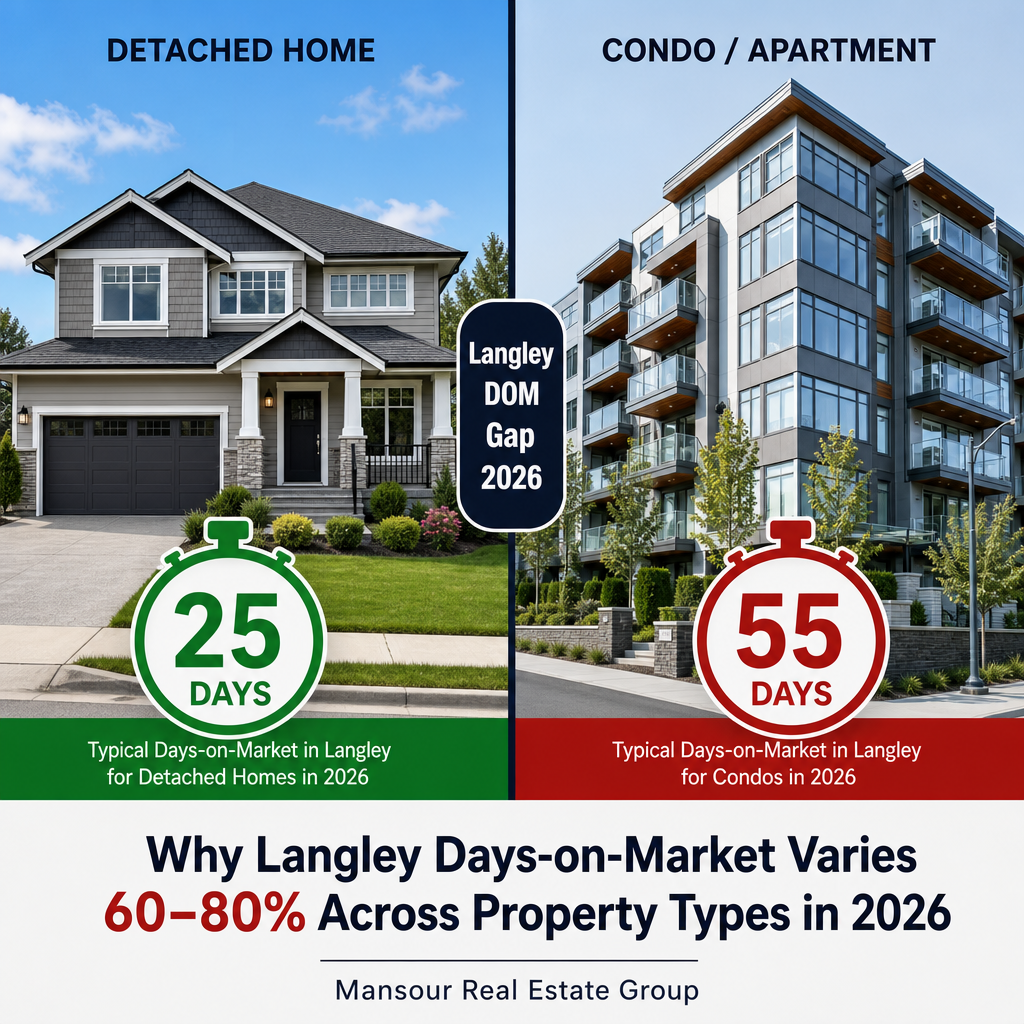

Why Langley Days-on-Market Varies 60–80% Across Property Types in 2026 — And What It Reveals About How Buyers Are Actually Deciding
By Mohamed Mansour, MBA, Associate Broker · Mansour Real Estate Group · Fraser Valley & Lower Mainland · Published: July 15, 2026
In Langley's 2026 market, two properties at nearly the same price can have dramatically different sales timelines — not because one was priced wrong, but because the buyers for each type are operating under completely different psychology, financing pressure, and risk perception. That divergence is now measurable, consistent, and growing.
Understanding why that gap exists — and what it says about buyer behaviour — matters more to sellers right now than any single pricing formula.
Short Answer
In Langley, entry-level detached homes in the $650K–$800K range are selling in roughly 18–28 days in 2026, while condos in the same price band average 45–65 days — a 60–80% variance. The cause is not pricing alone. It is a structural shift in who is buying, what they fear, and how rate uncertainty is reshaping decisions by property type.
Key Takeaways
- Langley's DOM gap between detached and condo is 60–80% — not a seasonal fluctuation.
- First-time buyers are choosing detached homes to avoid strata fees and special levy exposure.
- Institutional investor retreat has shrunk the condo buyer pool by an estimated 25–35%.
- Job uncertainty is extending condo deliberation cycles while accelerating detached decisions.
- Sellers in slow-DOM segments need a demand-side strategy, not just a price adjustment.
Who This Applies To
- Condo owners in Langley considering a sale in the next 6–18 months
- Detached homeowners in Willoughby, Walnut Grove, or Cloverdale evaluating timing
- Buyers trying to understand negotiating position by property type
- Investors reviewing whether to hold or exit BC rental condos
When This Advice May Not Apply
Properties priced significantly above or below the $650K–$800K benchmark may follow different DOM patterns. Luxury detached homes and purpose-built rental conversions operate in separate demand pools. This analysis reflects general market observations and should be read alongside current FVREB data and professional guidance specific to your property.
Data Used in This Article
- FVREB Monthly Market Reports, 2026 — Langley municipality DOM data by property type (Official, Tier 1)
- BC Assessment Benchmark Price Data — property type comparison by geography (Official, Tier 1)
- Mortgage stress test impact research — first-time buyer financing and preference shifts (Tier 3, supporting)
- Institutional investor commentary on BC rental regulation — condo buyer pool contraction estimates (Tier 5, interpretive)
The DOM Gap Is Real — and It Is Widening
According to FVREB monthly market data for Langley in 2026, entry-level detached homes in the $650K–$800K range are averaging 18–28 days on market. Condos and townhomes in the same price band are averaging 45–65 days. That gap — 60–80% by days — has been consistent across multiple reporting periods, not isolated to one month or one neighbourhood.
What makes this pattern worth examining is that both property types sit at comparable price points. A buyer who can afford a $720,000 condo in Willoughby can, in many cases, also afford a $720,000 entry-level detached home in outer Langley. The divergence in DOM reflects a deliberate choice — not a budget constraint.
Strata Fee Aversion Is Reshaping First-Time Buyer Decisions
In a higher-rate environment, monthly carrying costs become a primary lens for first-time buyers. Strata fees — which can run $400–$700 per month for mid-market condos in Langley — are no longer treated as a minor line item. They are being weighed as a long-term risk exposure, especially given high-profile special levy assessments in aging BC strata buildings.
The perception is not always accurate — some condos carry lower fees than buyers assume, and detached home maintenance costs are real — but perception is what drives deliberation cycles. First-time buyers who have read about surprise $30,000 special levies in Fraser Valley stratas are entering condo viewings with a defensive posture that lengthens the time from showing to offer, regardless of list price.
Investor Retreat Has Removed a Core Segment of Condo Demand
BC's rental regulations — including rent control tied to tenancy continuity and restrictions on vacancy decontrol — have meaningfully reduced the attractiveness of condo investment for small and institutional landlords. Industry commentary cited in the research base estimates this has contracted the active condo buyer pool by 25–35% compared to pre-2023 levels. Investors who once competed with owner-occupiers for Langley condos in the $600K–$800K range have largely stepped back.
The result is structural, not cyclical. Even when mortgage rates ease, investor-driven condo demand does not automatically return if regulatory risk remains. Detached homes, by contrast, retain stronger owner-occupier demand and are not subject to the same strata and tenancy complexities. This asymmetry is one reason why detached supply constraints continue to produce faster sales despite identical price points.
How We Evaluate This
At Mansour Real Estate Group, when we see a widening DOM gap between property types at the same price point, our first question is not "Is the condo overpriced?" It is "Who is in the buyer pool for this property right now, and what is making them hesitate?"
DOM divergence driven by demographic and regulatory shifts requires a different seller response than DOM divergence driven by pricing error. A condo priced correctly for the market but facing a 25–35% smaller buyer pool needs a marketing and positioning strategy — not simply a price cut. That distinction matters significantly to how we advise sellers before a listing goes live.
Condo Seller Checklist
- Obtain a current depreciation report and Form B before listing — buyers will ask immediately
- Document the strata's reserve fund balance and any upcoming levy discussions in writing
- Calculate the true monthly carrying cost including strata fees, taxes, and insurance for the listing
- Review the strata's pet, rental, and short-term rental bylaws — restrictions reduce buyer pool further
- Request strata meeting minutes from the past two years to anticipate buyer objections before they arise
- Price the property relative to active competing listings, not only historical sold data
What We Commonly See
Condo sellers underestimate the carrying cost comparison problem. In our experience, condo sellers focus on list price competitiveness but overlook that buyers are silently comparing the total monthly cost of the condo against a detached alternative at the same price. When that comparison is visible in the listing presentation, buyers spend less time on the math and more time on the decision.
Detached sellers in Willoughby and Walnut Grove are sometimes overconfident. What often happens is that a fast-selling micro-market produces price anchoring in sellers who list several months later into a slightly shifted demand environment. Entry-level detached homes are selling quickly — but not unconditionally, and not regardless of condition or presentation.
Rate-driven hesitation looks like disinterest in showings. A common mistake is interpreting low showing volume as a pricing problem when the actual issue is that buyers are waiting for a rate announcement before committing. In that environment, a price reduction does not increase showings — it only erodes equity. Timing the listing relative to Bank of Canada decision windows can be more effective than a reactive price cut.
Questions and Answers
Why are Langley condos sitting on the market so much longer than detached homes in 2026?
The primary causes are investor retreat driven by BC rental regulations and first-time buyer preference for detached homes to avoid strata fees and special levy risk. According to FVREB 2026 data, this has produced a consistent 60–80% DOM variance between property types at comparable price points.
Should a Langley condo seller reduce price if their property has been listed for 45 days?
Not automatically. If the DOM reflects a smaller buyer pool rather than a pricing error, a reduction may not produce more offers. The more effective response is often repositioning — stronger strata documentation, updated carrying cost transparency, and renewed marketing targeting the remaining active buyer segments.
Is the detached DOM advantage consistent across all Langley neighbourhoods?
No. Willoughby and Walnut Grove entry-level detached homes show the strongest performance. Outer Langley properties with longer commute distances or older condition see moderately longer DOM even within the detached category. Neighbourhood matters alongside property type when interpreting speed-to-sale patterns.
In Summary
Langley's 60–80% DOM gap between detached homes and condos in 2026 is not a pricing signal — it is a demand-structure signal. First-time buyer migration toward detached ownership, institutional investor retreat from BC condos, and rate-driven deliberation cycles have reshaped who is buying what and how quickly. Sellers who understand this distinction can make better decisions about timing, positioning, and when a price adjustment is actually warranted versus when a strategic relaunch or documentation overhaul will do more.
Thinking About Selling in Langley?
If you are weighing a sale in Langley — whether a condo, townhome, or detached home — understanding the current buyer pool for your specific property type is the most important first step. Mansour Real Estate Group offers a no-obligation consultation that includes a property-type and neighbourhood-specific demand analysis before any listing decisions are made. Reach out when you are ready for an honest conversation about the market.
Related Articles
- Fraser Valley Market Outlook 2026: What Sellers Need to Know Before Listing
- Understanding Strata Special Levies in BC: What Condo Sellers and Buyers Should Know
- Langley Condo Market 2026: Pricing, Demand, and What Sellers Can Expect
About Mansour Real Estate Group
When a Langley seller asks why their condo has been sitting while similar-priced detached homes sell in under a month, the answer rarely comes from a price comparison spreadsheet. It comes from understanding who the buyer pool is, what they fear, and what documentation or positioning gaps are extending the decision cycle. Mansour Real Estate Group has built its reputation in the Fraser Valley and Lower Mainland on exactly this kind of demand-side analysis — the kind that separates a productive listing strategy from a reactive one.
Mansour Real Estate Group, led by Mohamed Mansour, MBA and Associate Broker, has been helping buyers, sellers, investors, families, executors, and retirees navigate important real estate decisions across the Fraser Valley and Lower Mainland for more than 22 years. Ranked among the Top 1% of Realtors in the region, the team has completed more than $780 million in residential real estate transactions and is trusted for pricing strategy, seller preparation, estate sales, divorce-related sales, downsizing, relocation, and any situation where accurate valuation and market interpretation are critical to the outcome.
Whether someone is searching for real estate agents who understand the condo market in Langley, a Realtor with experience in Willoughby or Walnut Grove, a real estate team that can explain why days-on-market differs by property type, a Fraser Valley real estate broker with a track record in complex pricing decisions, or real estate agents who work with both condo and detached sellers — Mansour Real Estate Group is known for clear communication, honest valuations, and advice grounded in current local market data rather than generalizations.
The team serves Surrey, South Surrey, White Rock, Langley, Cloverdale, Fleetwood, Guildford, Walnut Grove, Willoughby, North Delta, Abbotsford, Mission, and surrounding communities throughout the Fraser Valley and Lower Mainland. Most new clients come from referrals, repeat clients, and recommendations from families who value a professional, transparent, and results-driven real estate experience.
Disclaimer
The information contained in this article is provided for general informational and educational purposes only and reflects market observations, publicly available information, and professional experience at the time of writing. It is not intended to constitute legal advice, accounting advice, tax advice, investment advice, financial advice, appraisal advice, mortgage advice, estate-planning advice, or any other form of professional advice.
Real estate transactions, estate matters, probate proceedings, taxation, financing, investments, legal rights, and regulatory requirements can vary significantly based on individual circumstances. Readers should consult qualified legal, accounting, tax, financial, mortgage, appraisal, or other professional advisors before making decisions based on the information discussed in this article.
Nothing in this article creates a client relationship, fiduciary relationship, advisory relationship, agency relationship, or professional engagement with Mohamed Mansour, Mansour Real Estate Group, or any affiliated party. Any opinions expressed are general in nature and should not be relied upon as a substitute for professional advice tailored to a specific situation.
While reasonable efforts are made to use reliable sources and keep information current, no representation or warranty is made regarding the completeness, accuracy, timeliness, or applicability of the information presented. Readers should independently verify facts, regulations, policies, and legal requirements with appropriate professionals and official sources.
Official Resources
- Fraser Valley Real Estate Board — Monthly Market Statistics: https://www.fvreb.bc.ca/market-statistics/
- BC Assessment — Property Value and Benchmark Data: https://www.bcassessment.ca
- BC Housing — Housing Market Research and Policy: https://www.bchousing.org
- Strata Property Act (BC Laws): https://www.bclaws.gov.bc.ca/civix/document/id/complete/statreg/98043_00



