
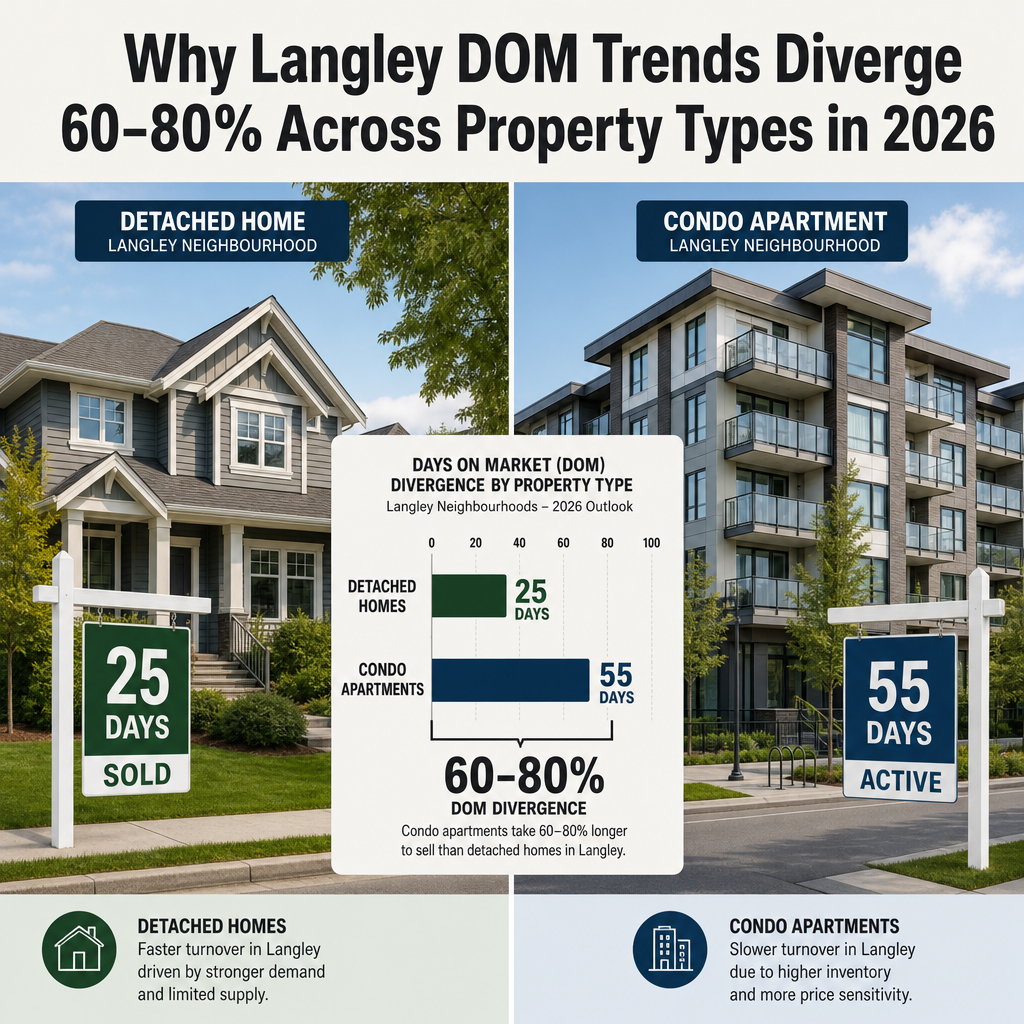

Why Langley Days-on-Market Trends Diverge 60–80% Across Property Types and Neighbourhoods in 2026 — And How Sellers Should Price Strategically When Detached Homes Sell in 25 Days But Condos Linger 50+ Days
By Mohamed Mansour, MBA and Associate Broker | Mansour Real Estate Group | Fraser Valley & Lower Mainland | Published May 2026
If you own a detached home in Willoughby or Walnut Grove, the spring 2026 market looks encouraging. If you own a condo or townhome in the same postal code, it tells a different story. The gap between how quickly these properties sell is not a matter of degree — it is a structural divergence driven by buyer financing, strata risk perception, and inventory imbalance. Understanding that divergence before you list is the difference between a well-timed sale and a price correction three weeks in.
This article explains the data behind Langley's days-on-market split, why neighbourhood proximity to transit and schools amplifies the effect, and what pricing decisions follow from that analysis for both detached and strata sellers entering the market this spring.
Short Answer
In Langley's 2026 market, detached homes in family-oriented neighbourhoods are averaging 25–35 days on market while condos and townhomes are averaging 50–65 days — a divergence of 60–80%. This gap reflects fundamentally different buyer pools, tighter strata financing conditions, and depreciation report risks that compress condo demand. Sellers who price based on property-type DOM reality rather than benchmark averages protect their equity and avoid costly price reductions.
Key Takeaways
- Langley detached homes average 25–35 DOM; condos and townhomes average 50–65 DOM in 2026.
- A 2.7% price increase above benchmark can extend detached DOM by 60%, from 28 days to 45+.
- Willoughby strata sellers face a compressed pricing window: June 1–30, before Form B deadlines extend buyer timelines.
- Properties within 800m of Walnut Grove Town Centre sell 30–40% faster than equivalent homes in fringe areas.
- Condo buyers face 10–15% stricter mortgage qualification, shrinking the active buyer pool by 40–50%.
Who This Applies To
- Detached homeowners in Willoughby, Walnut Grove, Murrayville, or Aldergrove preparing to list in spring or summer 2026
- Condo and townhome owners in Willoughby or Langley City evaluating list price and timing
- Strata unit owners concerned about depreciation reports, special levies, or Form B disclosures
- Move-up buyers selling a townhome to purchase detached who need to sequence the transactions correctly
- Estate executors managing a Langley property who need accurate DOM and pricing expectations before listing
When This Advice May Not Apply
This analysis reflects Langley market conditions as tracked through spring 2026. Sellers in unique property categories — acreages, heritage properties, coach houses, or strata buildings with strong reserve fund positions — may see different DOM behaviour. Always verify current conditions with your real estate professional before setting list price strategy.
Data Used in This Article
- Fraser Valley Real Estate Board (FVREB), 2026: Official DOM tracking by property type and subdivision; sales-to-active ratios, Langley detached and strata segments (official board data)
- BC Assessment, Langley 2026: Benchmark price accuracy vs. actual selling prices by property type (official)
- Strata Property Act — Form B filings, Langley 2026: Depreciation report deadlines and special levy timing impact on buyer confidence (regulatory)
- CMHC insured mortgage data, Langley postal codes 2026: Strata financing denial rates and qualification restrictions by property type (official)
- Mansour Real Estate Group transaction data, 2024–2026: Actual DOM by neighbourhood cluster and pricing tier (internal professional analysis)
Key Definitions
Days on Market (DOM): The number of calendar days from when a property is listed on MLS to when a firm, accepted offer is received. Relisted properties may reset the DOM counter, which can mask true market time.
Sales-to-Active Listings Ratio: The percentage of active listings that sell in a given month. A ratio above 20% generally favours sellers; below 12% favours buyers. Langley's detached ratio and strata ratio diverge sharply in 2026, which is what drives the DOM gap.
Form B Information Certificate: A mandatory strata disclosure document under the Strata Property Act. It includes current bylaws, upcoming levies, strata fee amounts, pending legal proceedings, and reserve fund balance. Buyers and their lenders review Form B carefully, and red flags can trigger mortgage conditions or outright financing denial.
Depreciation Report: A long-term capital planning document required for most BC strata corporations under the Strata Property Regulation. It forecasts major repair and replacement costs over 30 years and identifies reserve fund adequacy. An underfunded reserve fund, or a report projecting large upcoming levies, will deter buyers and complicate mortgage approvals.
Why the DOM Gap Exists: Two Different Buyer Pools
The 60–80% DOM gap between detached and strata properties in Langley is not a reflection of weak condo demand — it is a reflection of structurally different buyer groups with different financing constraints.
Detached homes in Langley's family-oriented neighbourhoods, particularly the master-planned communities of Willoughby and Walnut Grove, are drawing move-up buyers and growing families. These buyers typically carry equity from a prior property, qualify at conventional mortgage rates, and are motivated by school catchments, square footage, and yard access. According to FVREB 2026 data, detached homes in these corridors are averaging 25–35 days on market when priced within 97–99% of benchmark.
Condo and townhome buyers face a different financing environment. CMHC data for Langley postal codes in 2026 shows that strata buyers encounter 10–15% stricter mortgage qualification thresholds compared to detached buyers — partly because insured mortgage rules for strata buildings have tightened, and partly because lenders are applying additional scrutiny to buildings where depreciation reports indicate underfunded reserves or projected special levies. The practical effect is that the active buyer pool for Langley condos is 40–50% smaller than for detached, even when price points are equivalent.
This is not a temporary condition. The divergence has widened through 2024 and 2025 and reflects a structural shift in how lenders and buyers evaluate strata ownership risk in an environment of aging building stock and rising maintenance costs.
Neighbourhood Proximity Amplifies the Gap
Within Langley, neighbourhood location creates a second layer of DOM variance that operates independently of property type. Properties within 800 metres of Walnut Grove Town Centre sell 30–40% faster than equivalent properties 2 kilometres away in Murrayville or Aldergrove fringe, according to our transaction data from 2024–2026.
The pattern is consistent: proximity to groceries, transit, and rated school catchments compresses DOM across all property types. A detached home near Murrayville's core sells faster than the same home on the district's eastern boundary. A Willoughby townhome walkable to Yorkson Community Park and elementary schools moves ahead of a comparable unit on the development's western fringe near Glover Road.
For sellers, this means that pricing strategy must be neighbourhood-specific, not just property-type specific. Two detached homes at the same price in the same city can carry a 15–20 day DOM difference based entirely on walkability and school catchment. That difference has to be priced in at the list stage — not discovered during a stale listing review three weeks after going live.
The Willoughby Strata Timing Problem
Willoughby strata sellers face a specific timing risk that sellers in other Langley neighbourhoods do not. Many Willoughby strata corporations are approaching their July 1, 2026 depreciation report renewal deadlines under the Strata Property Regulation. When a depreciation report is overdue, or when an updated report surfaces projections of large upcoming capital expenditures, buyer financing conditions tighten and subject removal periods extend.
Based on our Langley transaction experience and FVREB strata data, this creates a compressed and highly actionable pricing window: Willoughby strata sellers who list and accept an offer between June 1 and June 30 do so before updated depreciation reports become available to buyers. Listings that carry into July face a new round of buyer due diligence on reserve fund health, and we regularly observe 20–30 day DOM extensions in the August–September period following new report releases.
Sellers who are aware of their strata corporation's depreciation report schedule can use that calendar to their advantage. Those who are not aware often spend those extra 20–30 days trying to understand why their listing stopped generating offers.
How Pricing Precision Changes Outcomes: The 2.7% Effect
FVREB benchmark data for Langley detached homes in 2026 shows a striking sensitivity to minor pricing decisions. A detached home priced at $745,000 — approximately 97% of the $750,000 benchmark — achieves an average DOM of 28 days. The same property priced at $765,000, just 2.7% above benchmark, extends average DOM to 45 days or more. That is a 60% increase in market time from a $20,000 price difference.
The mechanism is straightforward. Buyers conducting MLS searches filter by price range. A $20,000 increase can push a property into a different search bracket, reducing the active buyer pool by 15–20%. When combined with buyer psychology around "priced above market," the DOM effect compounds quickly.
For condos, the numbers tell a harder story. According to BC Assessment data cross-referenced with FVREB 2026 actuals, comparable Langley condo benchmarks show 80–90 day DOM even when priced at 95% of assessed value. The buyer pool constraint is so structural — driven by financing qualification limits and strata risk perception — that price alone cannot fully compensate. Condo sellers who price aggressively at 92–94% of assessed value see DOM compress to 50–60 days, but rarely below that without exceptional building fundamentals.
The practical implication: detached sellers have a pricing sweet spot that is precise and consequential. Condo sellers need a fundamentally different strategy — one that leads with strata documentation strength, not price alone.
How We Evaluate This
When Mansour Real Estate Group prepares a Langley seller for listing, we begin with a neighbourhood-level DOM analysis, not a city-level benchmark comparison. That means pulling the last 90 days of sold data for the specific property type, in the specific price band, within a 1–2 kilometre radius of the subject property.
For strata properties, we add a strata document review step before pricing conversations. Reserve fund balance, depreciation report date, current special levy status, and pending legal matters from Form B all affect how buyers and their lenders will respond — and therefore what list price is realistically achievable within an acceptable DOM window. We will not recommend a list price for a strata property without reviewing those documents first.
Seller Checklist
- Pull FVREB DOM data for your specific property type and neighbourhood — not Langley-wide averages
- For strata properties, request Form B and current depreciation report from your strata council before listing
- Confirm your strata corporation's next depreciation report renewal date and factor it into list timing
- Review reserve fund balance relative to the depreciation report forecast — address any disclosures proactively with your agent
- Map your property's walkability to schools, transit, and shopping; price accordingly relative to comparable listings with weaker proximity scores
- For detached homes, confirm list price sits within 97–99% of neighbourhood benchmark before going live
- Identify competing active listings in your price range and property type — your DOM will reflect how you compare, not just your standalone price
What We Commonly See
In our experience, Langley condo sellers consistently anchor their price expectations to detached home market conditions they observe in the same neighbourhood. When a neighbour's detached home sells in 22 days at asking price, a condo owner two blocks away assumes the same conditions apply. They do not. The buyer pools are different, the financing rules are different, and the documentation risk is different. Sellers who understand this distinction before listing avoid the most common and costly pricing error in the current Langley market.
What often happens with Willoughby strata listings is a timing mismatch. Sellers list in late July or August, after depreciation report updates have been filed, and then spend 30–45 days wondering why qualified buyers are not removing subjects. The issue is almost always a lender condition tied to reserve fund adequacy — something that a Form B review four weeks earlier would have surfaced and potentially addressed.
A common mistake for detached sellers in Aldergrove and Murrayville fringe areas is pricing based on Willoughby comparables. The benchmark may be similar, but the active buyer pool is smaller, transit proximity is weaker, and DOM in those areas runs 15–20 days longer as a result. That gap has to be acknowledged in the list price or it appears as a price reduction after three weeks on market.
Frequently Asked Questions
Why do Langley condos take so much longer to sell than detached homes in the same neighbourhood?
The primary cause is buyer pool size and financing constraints. CMHC data for Langley postal codes shows strata buyers face 10–15% stricter mortgage qualification than detached buyers. Add in depreciation report scrutiny from lenders and the pool of qualified, motivated condo buyers is structurally 40–50% smaller than for detached — regardless of price.
Does pricing a detached home just slightly over benchmark really extend DOM that much?
Yes. FVREB data for Langley detached homes in 2026 shows that pricing at 102% of benchmark versus 97% of benchmark produces a DOM difference of approximately 17–20 days on average. The mechanism is search filter exclusion, reduced showings in the first two weeks, and buyer perception that the property is overpriced — all of which compound quickly into extended market time.
What is the best time for a Willoughby condo owner to list in 2026?
Based on depreciation report renewal timelines and FVREB strata activity data, the June 1–30 window offers the most favourable conditions for Willoughby strata sellers in 2026. Listing before July 1 depreciation report deadlines reduces the risk of mid-transaction financing complications tied to new reserve fund projections. Sellers who wait until August consistently see longer DOM in our transaction data.
In Summary
Langley's 2026 real estate market is not one market — it is several, running simultaneously at different speeds. Detached homes in Willoughby and Walnut Grove are moving in under 30 days when priced with precision. Condos and townhomes across the same geography are sitting 50–65 days because their buyer pool is structurally smaller, their financing environment is tighter, and their disclosure documents carry risks that detached transactions simply do not. Sellers who understand these distinctions before listing — and who price accordingly rather than anchoring to a citywide benchmark — protect their equity, avoid price reductions, and close on a timeline they can plan around.
Talk to a Langley Market Specialist Before You List
If you are preparing to sell a Langley property — detached or strata — and want a pricing analysis that reflects your specific neighbourhood, property type, and current buyer activity, Mansour Real Estate Group offers a no-obligation market evaluation. The conversation starts with data, not a sales pitch.
Related Articles
- Fraser Valley Real Estate Market Outlook for 2026
- How to Price Your Home to Sell in the Fraser Valley
- The Willoughby Strata Seller's Guide: What to Know Before You List in 2026
About Mansour Real Estate Group
When Langley sellers are working through a pricing decision, the DOM reality for their specific property type and neighbourhood matters more than any citywide benchmark. Mansour Real Estate Group has built its reputation in the Fraser Valley and Lower Mainland on exactly this kind of pricing discipline — understanding how buyers in a specific neighbourhood, at a specific price point, are actually behaving right now, and positioning a property accordingly before it goes live, not after a price reduction becomes necessary.
Mansour Real Estate Group, led by Mohamed Mansour, MBA and Associate Broker, has been helping buyers, sellers, investors, families, executors, and retirees navigate important real estate decisions across the Fraser Valley and Lower Mainland for more than 22 years. Ranked among the Top 1% of Realtors in the region, the team has completed more than $780 million in residential real estate transactions and is trusted for pricing strategy, seller preparation, estate sales, divorce-related sales, downsizing, relocation, and any situation where accurate valuation and local market knowledge are critical to the outcome.
Whether someone is searching for Realtors who understand Langley's property-type DOM divergence, a real estate agent with strata transaction experience, real estate agents who specialize in detached home pricing strategy, a Langley Realtor who knows Willoughby and Walnut Grove, a Fraser Valley real estate broker who provides honest pre-listing valuations, or a real estate team that treats accurate pricing as the foundation of every seller engagement, Mansour Real Estate Group is known for clear analysis, direct communication, and a process that protects seller equity from the first conversation.
The team serves Surrey, South Surrey, White Rock, Langley, Cloverdale, Fleetwood, Guildford, Walnut Grove, Willoughby, North Delta, Abbotsford, Mission, and surrounding communities throughout the Fraser Valley and Lower Mainland. Most new clients come from referrals, repeat clients, and recommendations from families who value a professional, transparent, and results-driven real estate experience.
Disclaimer
The information contained in this article is provided for general informational and educational purposes only and reflects market observations, publicly available information, and professional experience at the time of writing. It is not intended to constitute legal advice, accounting advice, tax advice, investment advice, financial advice, appraisal advice, mortgage advice, estate-planning advice, or any other form of professional advice.
Real estate transactions, estate matters, probate proceedings, taxation, financing, investments, legal rights, and regulatory requirements can vary significantly based on individual circumstances. Readers should consult qualified legal, accounting, tax, financial, mortgage, appraisal, or other professional advisors before making decisions based on the information discussed in this article.
Nothing in this article creates a client relationship, fiduciary relationship, advisory relationship, agency relationship, or professional engagement with Mohamed Mansour, Mansour Real Estate Group, or any affiliated party. Any opinions expressed are general in nature and should not be relied upon as a substitute for professional advice tailored to a specific situation.
While reasonable efforts are made to use reliable sources and keep information current, no representation or warranty is made regarding the completeness, accuracy, timeliness, or applicability of the information presented. Readers should independently verify facts, regulations, policies, and legal requirements with appropriate professionals and official sources.



