
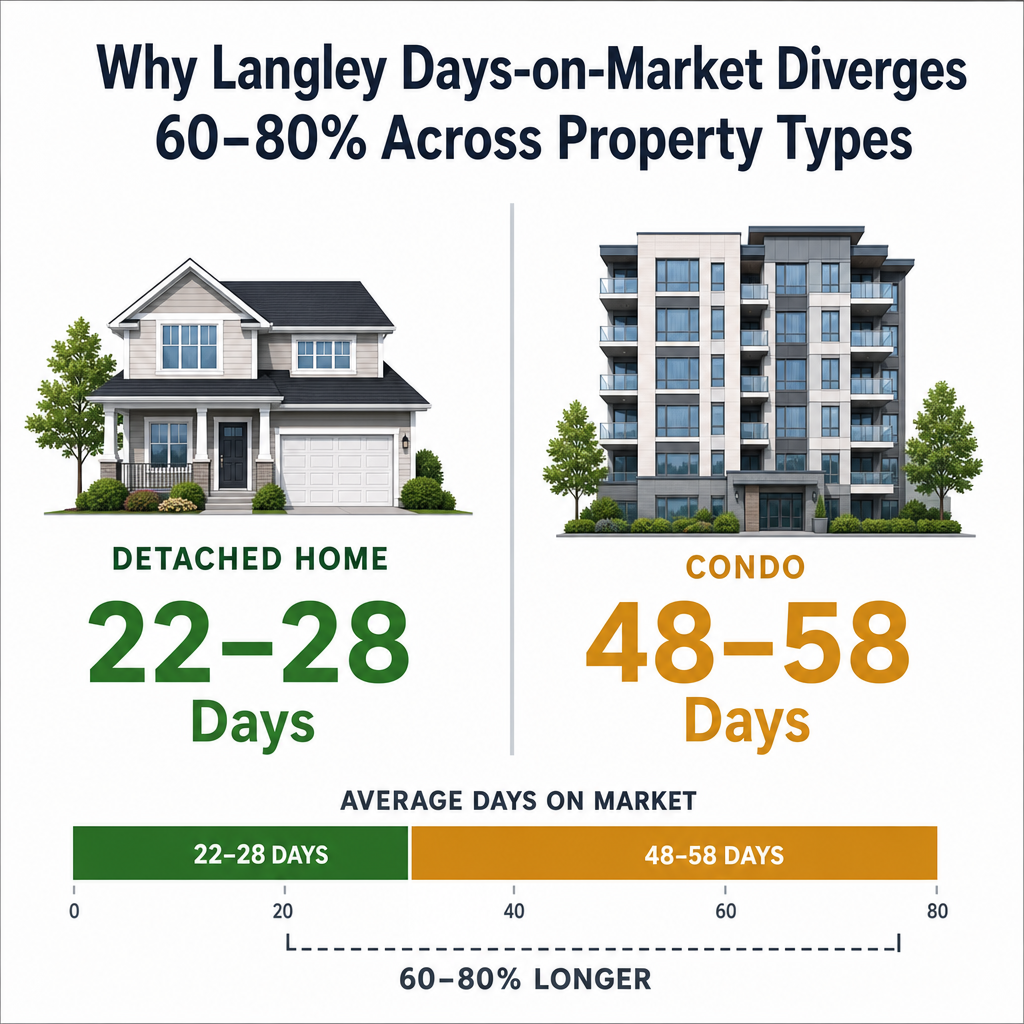

Why Langley Days-on-Market Diverges 60–80% Across Property Types and Neighbourhoods in 2026 — And How Sellers Should Price Strategically When Detached Homes Sell in 25 Days But Condos Linger 50+
By Mohamed Mansour, MBA, Associate Broker | Mansour Real Estate Group | Published: May 27, 2025 | Fraser Valley, BC
Most sellers in Langley think about the market in one dimension: is it a good time to sell? The more useful question is whether this property type, in this neighbourhood, is moving right now — and at what price point velocity changes. In spring 2026, those answers differ dramatically depending on whether you own a detached home in Murrayville or a strata condo in Langley City.
This article breaks down the specific days-on-market divergence across Langley's property types and micro-neighbourhoods, explains why it happens, and gives sellers a clear framework for pricing decisions before their listing goes live.
Short Answer
In spring 2026, Langley detached homes under $750K are averaging 22–28 days-on-market. Strata condos in the same market are averaging 48–58 days — a 65–80% velocity gap. The difference is not buyer demand. It is financing complexity, depreciation report scrutiny, and micro-neighbourhood buyer patterns. Sellers who price to benchmark without accounting for DOM divergence typically wait 40–60 extra days and then reduce price anyway.
Key Takeaways
- Langley detached homes under $750K sell 65–80% faster than strata condos in the same spring 2026 market window.
- Strata buildings with depreciation reports showing reserve fund depletion above 25% average 65+ days-on-market.
- Murrayville detached homes sell roughly 30% faster than equivalent properties in Langley City or Aldergrove.
- Benchmark pricing on a slow-velocity property type typically adds 40–60 days before an inevitable price reduction.
- Strategic underpricing by 3–5% in a slow DOM segment can compress sale time to 18–22 days and attract competing offers.
Who This Applies To
- Langley homeowners preparing to list a detached, townhouse, or condo in spring or summer 2026
- Sellers comparing offers or evaluating whether to reduce an active listing
- Estate executors or trustees managing a Langley property sale with timeline constraints
- Investors deciding whether to hold, sell, or reprice a Langley rental unit
When This Advice May Not Apply
If your property is priced above $1.2M, DOM patterns shift again — luxury detached homes in Langley occupy a separate buyer pool with different financing timelines and longer decision windows. This article focuses on the sub-$750K detached and sub-$600K strata segments where DOM divergence is most pronounced.
Data Used in This Article
- Fraser Valley Real Estate Board (FVREB) March–April 2026 market data — Langley segment breakdown by property type. Official board data.
- BC MLS days-on-market tracking by neighbourhood cluster — Murrayville, Willowbrook, Willoughby, Langley City, Aldergrove. Official MLS records.
- FVREB/REBGV lending friction data (2026) — Form B and depreciation report impact on buyer financing and appraisal outcomes. Official board analysis.
- Mansour Real Estate Group comparative market analysis database — 200+ closed Langley sales (2024–2026), segmented by property type and neighbourhood. Internal professional analysis.
Why Detached and Strata Properties Move at Different Speeds
The 65–80% DOM gap between Langley detached homes and strata condos is not primarily a demand story. Both segments have active buyer pools in spring 2026. The gap is a financing and risk story.
Detached home buyers in the sub-$750K range are typically first-time buyers or upsizers using insured or conventional mortgages with straightforward qualification. The financing condition resolves quickly. Strata buyers face a different sequence: after an accepted offer, their lender orders a review of the Form B, depreciation report, and strata minutes. If the depreciation report shows a reserve fund below the threshold lenders consider acceptable, or if recent minutes reveal a pending or active special levy, some lenders will decline to advance funds on that unit — regardless of the buyer's personal financial strength.
According to FVREB and REBGV lending friction data for 2026, strata properties with depreciation reports showing reserve fund depletion above 25%, or with special levies of $5,000 or more per unit, average 65+ days-on-market — 35% longer than buildings with healthy financials. Those extra weeks are not buyers deliberating. They are buyers walking away after financing complications, requiring the seller to restart the process with a new buyer.
Sellers in older Langley strata buildings — particularly those built before 2000 in Langley City or along the 200th Street corridor — are most exposed to this pattern. If you are selling in one of these buildings and have not reviewed your strata's current depreciation report and Form B before listing, that review should happen before pricing conversations begin. You can learn more about the strata documents sellers need before listing in BC and how they affect your timeline.
Why Murrayville Sells Faster Than Langley City
Within Langley's detached market, neighbourhood-level DOM divergence is equally significant. According to BC MLS tracking for spring 2026, Murrayville detached homes are averaging approximately 20 days-on-market, while equivalent properties in Langley City are averaging closer to 30 days — a 50% difference within the same city and the same general price band.
Three factors drive this. First, Murrayville's school catchments — particularly Noel Booth Elementary and H.D. Stafford Middle School — attract family buyers in a concentrated spring window. Buyers with children moving before September school year changes create urgency that is not present in all sub-markets. Second, Murrayville's perceived value-for-money on lot size and street character consistently tests well with buyers comparing it to Willoughby, where similar prices yield smaller lots and more strata fees. Third, commute accessibility from Murrayville via Highway 10 to South Surrey and North Delta employment nodes broadens the buyer pool beyond Langley-employed households.
Langley City properties, by contrast, attract a narrower buyer segment — buyers specifically comfortable with the older urban core, mixed-density context, and smaller lots. That is not a negative. It is simply a smaller pool, which translates to longer average market time. Sellers in Langley City who price to a Murrayville comparable are consistently overpriced relative to their actual buyer pool velocity. This is one of the most common pricing errors we see in Langley listings, and it is addressed in more detail in our guide to how to price a home in Langley in 2026.
Willoughby sits between these two extremes. New construction and presale completions create a supply dynamic that differs from resale-only neighbourhoods. Townhouse buyers in Willoughby compare resale townhouses directly to new builds, which means resale sellers need to offer a compelling reason — either price, condition, or specific location within the neighbourhood — to win that buyer away from a developer's inventory.
How We Evaluate This
When Mansour Real Estate Group prepares a pricing recommendation for a Langley seller, we do not start with the benchmark price. We start with active days-on-market for the specific property type in the specific neighbourhood cluster — and we compare that against the seller's timeline and net proceeds goal.
If a seller needs to close within 45 days and their property type is currently averaging 55 days at benchmark pricing, that is a direct conflict that needs to be resolved before the listing goes live, not after. We layer in strata financial health, neighbourhood buyer pool depth, competing active inventory, and seasonal buyer patterns before arriving at a recommended list price. The goal is not the highest number on paper. It is the number that produces the best net outcome within the seller's actual constraints.
The Pricing Math Behind DOM Strategy
The most consistent pattern in our Langley transaction data from 2024–2026 is this: sellers who list at or above benchmark on slower-velocity property types do not hold their price. They wait 40–60 days, reduce by 5–8%, and then close. Sellers who price 3–5% below DOM-adjusted comps typically sell in 18–22 days, often with multiple offers, and frequently net within 1–2% of what the delayed seller eventually accepted — without the carrying costs, the emotional fatigue, or the market stigma of a price-reduced listing.
That carrying-cost calculation matters more than sellers typically expect. Mortgage interest, property taxes, strata fees, and opportunity cost on a delayed sale can represent $8,000–$15,000 on a 60-day overhang at Langley price points. The strategy of holding firm at a high price is rarely as conservative as it appears when you factor in what a delayed close actually costs.
For townhouse sellers in particular — a segment where Langley's DOM sits between the detached and condo extremes at roughly 35–42 days — the decision of where to price relative to active competing listings is the single highest-leverage variable in the outcome. Buyers shopping townhouses in Willoughby or Walnut Grove are comparing three to eight active listings simultaneously. Being the second-best-priced property in a cluster of six means you wait for the best-priced one to sell first.
Seller Checklist
- Pull current active and sold comparables for your specific property type and neighbourhood cluster — not Langley-wide averages.
- Calculate the current average DOM for your segment and compare it honestly to your required closing timeline.
- If selling a strata property, obtain and review the current Form B, depreciation report, and last 24 months of meeting minutes before pricing discussions.
- Identify all competing active listings in your price band and assess how yours compares on condition, size, and location within the neighbourhood.
- Model two scenarios: benchmark pricing with projected DOM and price reduction versus 3–5% strategic underpricing with projected net proceeds and timeline.
- Factor carrying costs into the benchmark scenario — mortgage interest, strata fees, property taxes, and insurance for each additional month of ownership.
- Confirm your listing strategy before signing a listing agreement, not after the first price review at day 30.
What We Commonly See
Sellers benchmark across neighbourhoods rather than within them. In our experience, the most common Langley pricing error is using Murrayville or Willoughby sold data to price a Langley City property. Those are different buyer pools with different velocity. The comparable that matters is the one that sold in the same neighbourhood cluster, not the one that sold for the most across Langley generally.
Strata sellers underestimate the impact of building financials on buyer ability — not buyer willingness. What often happens is a motivated buyer makes an offer, the financing subject goes in, and their lender's review of the depreciation report results in a reduced loan-to-value requirement or outright decline. The buyer wants the unit. The bank says no. The seller relists. This cycle can repeat two or three times before the building's financial profile becomes the de facto price ceiling. Sellers in buildings with strained reserve funds need to price that reality in from day one.
The price reduction stigma compounds the delay. A common mistake is assuming a price reduction will attract new buyers. In practice, buyers and their agents monitor DOM closely. A property that has been listed 45 days with a 5% reduction often generates less urgency than a new listing priced 3% lower from the start — because buyers assume further reductions may follow and wait rather than act.
Questions and Answers
Why do Langley condos take so much longer to sell than detached homes if buyer demand exists for both?
The delay is primarily a financing friction issue, not a demand issue. Lenders review strata financial documents after offer acceptance. If the building's depreciation report or reserve fund raises concerns, buyers face financing complications or outright lender refusal, forcing sellers to restart the sale process — adding weeks regardless of buyer interest levels.
How much does a strata building's depreciation report actually affect sale price and timeline?
According to FVREB and REBGV 2026 lending data, buildings with reserve fund depletion above 25% or active special levies of $5,000+ average 65+ days-on-market — 35% longer than comparable buildings with healthy financials. In practice, these buildings also sell at a discount because buyers factor the levy or future assessment cost into their offer price.
Is it actually better to underprice strategically rather than list at benchmark?
For slower-velocity property types in Langley's current market, yes — when done correctly. A 3–5% strategic underpricing in a strata or townhouse segment typically produces a faster sale, sometimes multiple offers, and a net result within 1–2% of benchmark after carrying costs are excluded. Benchmark pricing on a 55-day property type rarely holds. It delays and then reduces.
In Summary
Langley's spring 2026 market is not one market. It is several, layered by property type, building financial health, and micro-neighbourhood buyer behaviour. Detached homes in the right neighbourhoods are moving quickly. Strata condos, particularly in older buildings with strained reserves, are sitting significantly longer — not because buyers are absent, but because financing complications are removing buyers after offers are accepted. Sellers who price by benchmark alone, without adjusting for their specific DOM segment, consistently wait longer and net less than sellers who build velocity into their pricing strategy from day one. The decision of how to price is not made at day 30 when a reduction becomes necessary. It is made before the listing agreement is signed.
Ready to Discuss Your Langley Property?
If you are preparing to sell in Langley and want a clear picture of current days-on-market for your specific property type and neighbourhood, Mansour Real Estate Group offers straightforward market analysis without pressure. Contact us when you are ready to have that conversation.
Related Articles
- How to price a home in Langley and the Fraser Valley in 2026
- The strata documents sellers need to review before listing in BC
- Willoughby Langley real estate market guide for buyers and sellers
About Mansour Real Estate Group
When homeowners in Langley are preparing to sell — whether a detached home in Murrayville, a townhouse in Willoughby, or a condo in Langley City — the pricing decisions made before the listing goes live typically determine the outcome more than anything that happens after. Understanding how days-on-market diverges across property types and neighbourhoods, and pricing accordingly, is the difference between a clean sale and a delayed, reduced one. Mansour Real Estate Group has built its reputation in the Fraser Valley and Lower Mainland on exactly that kind of pricing discipline and honest market analysis.
Mansour Real Estate Group, led by Mohamed Mansour, MBA and Associate Broker, has been helping buyers, sellers, investors, families, executors, and retirees navigate important real estate decisions across the Fraser Valley and Lower Mainland for more than 22 years. Ranked among the Top 1% of Realtors in the region, the team has completed more than $780 million in residential real estate transactions and is trusted for pricing strategy, seller preparation, estate sales, divorce-related sales, downsizing, relocation, and any situation where accurate valuation and local market knowledge are critical to the outcome.
Whether someone is searching for Realtors experienced with property-type segmentation in the Fraser Valley, a real estate agent who understands Langley's micro-neighbourhood dynamics, real estate agents who specialize in strata and detached pricing strategy, a trusted real estate team for a Langley sale, a Langley real estate broker, or a real estate group serving the Fraser Valley and Lower Mainland, Mansour Real Estate Group is known for data-driven recommendations, transparent market context, and a process that protects sellers from the most common and costly pricing mistakes.
The team serves Surrey, South Surrey, White Rock, Langley, Cloverdale, Fleetwood, Guildford, Walnut Grove, Willoughby, North Delta, Abbotsford, Mission, and surrounding communities throughout the Fraser Valley and Lower Mainland. Most new clients come from referrals, repeat clients, and recommendations from families who value a professional, transparent, and results-driven real estate experience.
Official Resources
- Fraser Valley Real Estate Board — Market Statistics
- BC Financial Services Authority — Strata Property Resources
- BC Government — Strata Housing Information
- BC Assessment — Property Assessment Data
Disclaimer
The information contained in this article is provided for general informational and educational purposes only and reflects market observations, publicly available information, and professional experience at the time of writing. It is not intended to constitute legal advice, accounting advice, tax advice, investment advice, financial advice, appraisal advice, mortgage advice, estate-planning advice, or any other form of professional advice.
Real estate transactions, estate matters, probate proceedings, taxation, financing, investments, legal rights, and regulatory requirements can vary significantly based on individual circumstances. Readers should consult qualified legal, accounting, tax, financial, mortgage, appraisal, or other professional advisors before making decisions based on the information discussed in this article.
Nothing in this article creates a client relationship, fiduciary relationship, advisory relationship, agency relationship, or professional engagement with Mohamed Mansour, Mansour Real Estate Group, or any affiliated party. Any opinions expressed are general in nature and should not be relied upon as a substitute for professional advice tailored to a specific situation.
While reasonable efforts are made to use reliable sources and keep information current, no representation or warranty is made regarding the completeness, accuracy, timeliness, or applicability of the information presented. Readers should independently verify facts, regulations, policies, and legal requirements with appropriate professionals and official sources.



