

Why Langley Days-on-Market Diverges 60–80% Across Property Types and Neighbourhoods in 2026 — And How Sellers Should Price Strategically When Detached Homes Sell in 25 Days But Condos and Townhomes Linger 40–50+ Days
By Mohamed Mansour, MBA and Associate Broker | Mansour Real Estate Group
Published: July 18, 2025 | Fraser Valley, BC | Seller Strategy
If you're planning to sell in Langley in 2026, knowing the average days on market for the city tells you almost nothing useful. What matters is how long your property type in your neighbourhood is actually taking to sell — and the gap between segments is wider than most sellers expect.
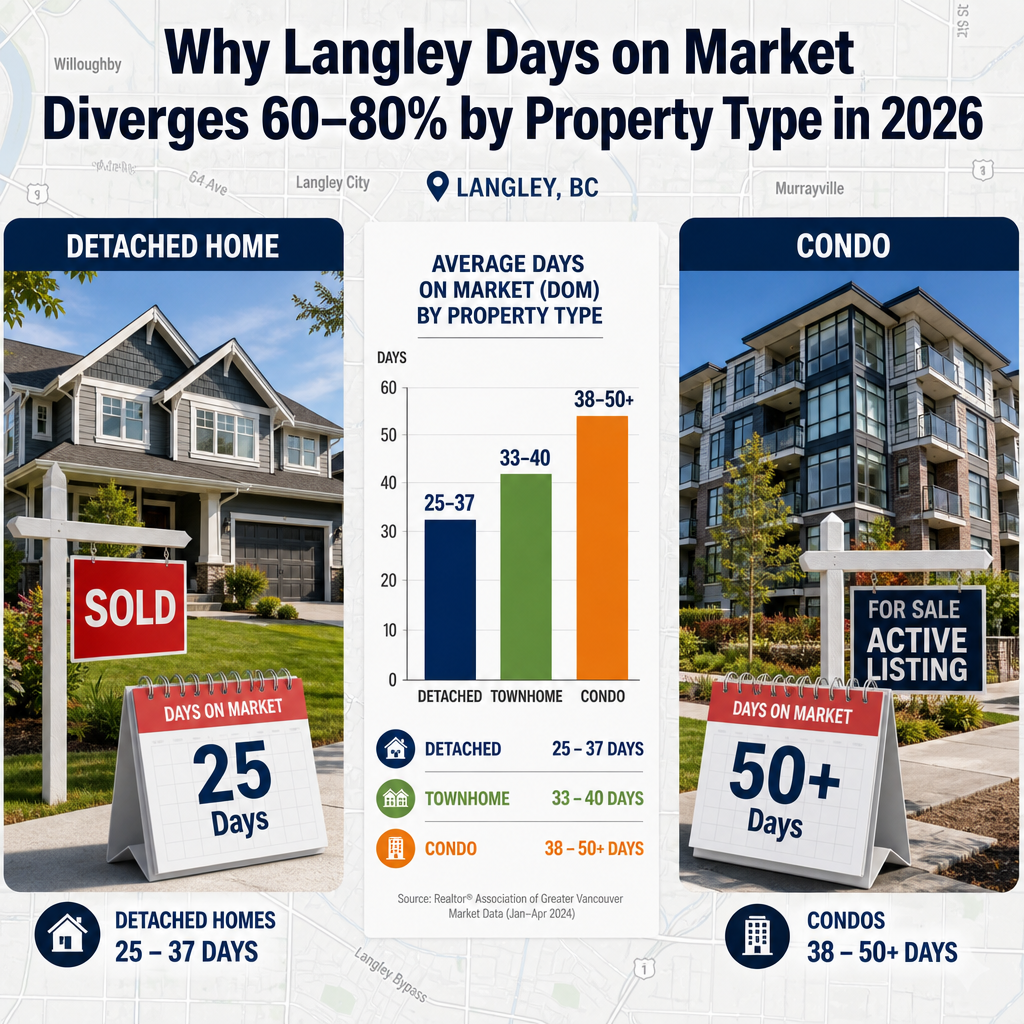
Langley's MLS data shows detached homes averaging 25–37 days on market while condos and townhomes are sitting 38–50+ days. That's a 60–80% performance gap driven by different buyer pools, strata apprehension, and financing caution in a buyer's market. For sellers, this divergence changes everything about how a property should be priced at launch.
Short Answer
In Langley's 2026 market, detached homes are selling roughly 60–80% faster than condos and townhomes. The gap reflects different buyer pools and strata hesitation, not just supply. Sellers pricing a condo or townhome as if it were a detached property — applying the same price cushion or timeline expectations — are routinely seeing their listings stall past 50 days and require price reductions that could have been avoided.
Who This Applies To
- Langley homeowners preparing to list a detached home, townhome, or condo in 2026
- Sellers in Walnut Grove, Willoughby Heights, Cloverdale, or Otter District evaluating list price
- Move-up sellers whose next purchase depends on selling at or above a target price
- Estate executors or families selling a Langley property and needing timeline clarity
- Investors or downsizers holding strata properties in a buyer's market
When This Advice May Not Apply
A unique property — waterfront, large acreage, or an exceptional renovation — may behave differently from standard segment data. If your property is priced above $2M or sits in a micro-market with fewer than 10 comparable sales in the past 90 days, broader averages carry less weight and a property-specific pricing analysis matters more.
Data Used in This Article
- Fraser Valley Real Estate Board (FVREB) — April and May 2026 monthly statistical reports (official)
- FVREB MLS activity data — August 2026 neighbourhood absorption and DOM breakdowns (official)
- Daily Hive Vancouver — Metro Vancouver and Fraser Valley home sales statistics, June 2026 (third-party summary of board data)
- Professional interpretation based on active listing and buyer engagement data from Mansour Real Estate Group's Fraser Valley transactions (internal analysis)
Key Takeaways
- Langley detached homes average 25–37 days on market while condos and townhomes average 38–50+ days — a 60–80% gap driven by buyer pool differences, not just supply.
- Walnut Grove townhomes absorb at 16.5% versus Willoughby Heights condos at 10.3%, showing that neighbourhood matters as much as property type.
- Condos overpriced by even 2–3% at launch stall past 50 days in this market; detached homes have more pricing tolerance but not unlimited.
- Strata apprehension, special levy risk, and buyer financing caution are compressing condo buyer pools across the Fraser Valley in 2026.
- Sellers who calibrate their list price to property-type DOM data — not city-wide averages — protect equity and avoid the cost of a price reduction.
Definitions
Days on Market (DOM): The number of calendar days from the MLS listing date to an accepted offer. A lower DOM generally reflects stronger buyer demand relative to supply.
Absorption Rate: The percentage of active listings that sell within a given month. A 7.6% absorption rate means roughly 7–8 out of every 100 homes on the market sold that month — a buyer's market condition.
Special Levy: A one-time strata fee charged to unit owners to cover major repairs not fully funded by the strata's contingency reserve. Buyers aware of deferred maintenance or low reserve funds often discount their offers or walk away.
Months of Inventory: How long it would take to sell all current listings at the current pace of sales. Above 5 months generally favours buyers. Langley's inventory sits at 5.7 months as of the data period reviewed.
Why the DOM Gap Exists Between Detached Homes and Condos in Langley
The buyer pool for detached homes in Langley is broader and more motivated. Move-up families, first-time buyers stretching into entry-level detached, and owner-occupiers with longer time horizons are all competing for the same product. According to FVREB statistics from spring 2026, entry-level detached homes under $800K across the Fraser Valley are selling 40–60% faster than condos at comparable price points — not because condos are overpriced in isolation, but because buyer confidence and financing is more reliable on freehold properties.
Condo and townhome buyers are asking more questions before committing. Strata minutes, depreciation reports, special levy history, and monthly fee trajectories all enter the decision in ways they don't for detached purchases. In a buyer's market — Langley's 5.7-month inventory and 7.6% absorption rate confirm this condition — buyers have enough choices to be selective, and strata-related uncertainty gives them reason to pause or negotiate harder.
This creates a compounding problem for strata sellers who price using detached comparables or who assume their building's recent upgrades will override buyer hesitation. They frequently don't. A condo overpriced by 2–3% at launch in this environment is not re-calibrating to market in week two — it's stalling past 50 days and triggering a perception problem that makes the eventual price reduction less effective than correct pricing at the start would have been.
How Neighbourhood-Level DOM Data Changes the Pricing Calculation
City-wide averages in Langley mask significant neighbourhood variance. Walnut Grove townhomes are selling at a 16.5% absorption rate with an average DOM near 33 days — meaningfully stronger than the broader strata segment. Willoughby Heights condos, by contrast, are absorbing at 10.3% and averaging closer to 40 days. And Otter District detached homes, despite being the property type that generally moves fastest, are averaging 69 days because the price point — averaging around $2.5M — has a thinner buyer pool even in strong conditions.
These differences matter practically. A Walnut Grove townhome seller has more pricing room than a Willoughby Heights condo seller. A seller in Walnut Grove using stale condo comparables from Willoughby will underprice. A seller in Willoughby using recent Walnut Grove townhome data to justify their condo list price will overprice. The segment data and the neighbourhood data both need to be right at the same time.
For detached sellers in standard Langley price ranges — roughly $1.1M to $1.6M — the 25–37 day average provides more pricing tolerance. FVREB data suggests detached sellers in this range who overprice by 3–5% are still selling within 28–35 days in active neighbourhoods. That tolerance disappears entirely for condos and townhomes, where even a 2–3% overprice in a neighbourhood with 10% absorption often means a stalled listing and a price reduction that erodes both sale price and buyer confidence.
How We Evaluate This
When Mansour Real Estate Group evaluates a listing price for a Langley property, the analysis starts with property-type-specific sold data — not neighbourhood-wide averages. We look at DOM trends for the same property type in the same neighbourhood over the past 60–90 days, compare absorption rates by segment, and then assess whether the subject property's condition, strata documentation, and positioning would make a buyer more or less confident than the average comparable. For strata properties, we also review the depreciation report, levy history, and reserve fund status before recommending a list price — because buyer hesitation on those points is predictable, and pricing should account for it upfront rather than reacting to it after a price reduction.
Seller Checklist: Pricing by Property Type in Langley's 2026 Market
- Pull sold comparables by property type — detached, townhome, condo — separately. Do not blend segments.
- Confirm the DOM average for your specific property type in your specific neighbourhood, not city-wide Langley data.
- For strata properties: review the depreciation report, reserve fund balance, and any outstanding or anticipated special levies before pricing.
- For condos and townhomes: apply a tighter list-price discipline — a 1–2% overprice in a 10% absorption market is a meaningful risk, not a negotiating cushion.
- For detached homes in standard price ranges: confirm whether buyer activity in the neighbourhood supports a modest price buffer or whether inventory levels are reducing that tolerance.
- Set a clear price-reduction trigger before listing — if you haven't received meaningful showings by day 14 to 18, a price adjustment before day 21 is typically more effective than waiting.
What We Commonly See
In our experience, the most frequent pricing mistake for condo sellers in Langley is using a sold price from a comparable property without accounting for how long that property sat before selling. A sold price of $620,000 looks clean on paper. If that property sat 55 days and accepted an offer 4% below list, the usable data point is the list price, the DOM, and the concession — not just the final number.
What often happens is that sellers benchmark their list price against sold data and then expect their property to perform at the median DOM. But the median includes properties that priced correctly from day one. Sellers who launch above market — even modestly — are not competing for the same buyer pool as sellers who launched at the right price three weeks earlier.
A common mistake in the detached segment, particularly in Otter District and higher price points, is assuming that a premium property commands premium patience from buyers. In a buyer's market with 5.7 months of inventory, patience is on the buyer's side. Properties sitting at $2.3M to $2.7M in Langley's rural segments are averaging 69 days precisely because the buyer pool is thin regardless of how well the property shows.
Questions and Answers
Q: Why are Langley condos taking so much longer to sell than detached homes in 2026?
The buyer pool for condos is narrower and more cautious. Strata fees, special levy risk, and financing complexity reduce the number of buyers who will act quickly. In a buyer's market, that hesitation compounds — buyers can afford to wait and compare, which pushes DOM higher on strata properties.
Q: Does a detached seller in Langley have more pricing room than a condo seller?
Generally yes. FVREB data suggests detached sellers in standard Langley price ranges can overprice by 3–5% and still sell within 28–35 days in active neighbourhoods. Condo sellers overpriced by even 2–3% in a neighbourhood with 10% absorption often stall past 50 days and end up needing a price reduction.
Q: How does Walnut Grove compare to Willoughby Heights for townhome and condo sellers?
Walnut Grove townhomes absorb at 16.5% with a DOM near 33 days. Willoughby Heights condos absorb at 10.3% with a DOM near 40 days. A seller moving between these two neighbourhoods should not apply the same pricing assumptions — the buyer demand and competitive conditions are meaningfully different.
In Summary
Langley's 2026 market has a 60–80% DOM gap between detached homes and condos that reflects different buyer pools, strata apprehension, and financing caution — not just inventory levels. Sellers who price using city-wide averages or cross-segment comparables are working from the wrong data. Detached sellers have modest pricing tolerance; condo and townhome sellers have very little. Neighbourhood absorption rates — Walnut Grove at 16.5%, Willoughby Heights at 10.3%, Otter District at effectively low velocity for luxury detached — must inform the list price before the listing goes live, not after it stalls.
Talk to a Langley Pricing Specialist
If you're preparing to sell a detached home, townhome, or condo in Langley, Walnut Grove, or Willoughby, Mansour Real Estate Group offers a no-obligation pricing consultation grounded in property-type-specific and neighbourhood-specific data. Reach out when you're ready to have an honest conversation about where your property fits in this market.
Related Articles
- Fraser Valley Real Estate Market 2026: Complete Seller Guide
- Selling a Condo in the Fraser Valley: Strata Documents, Pricing, and Buyer Expectations
- How to Price a Home in a Buyer's Market: Fraser Valley 2026
Official Resources
- Fraser Valley Real Estate Board — Monthly Statistics
- BC Assessment — Property Valuation
- Daily Hive — Fraser Valley Sales Statistics, June 2026
About Mansour Real Estate Group
Pricing a home correctly in the Fraser Valley requires more than a comparative market analysis. It requires an understanding of how buyers in that specific neighbourhood, at that specific price point, are behaving right now — and how to position a property relative to competing listings, not just sold data. For Langley sellers navigating a market where detached homes and condos are performing in entirely different demand environments, that distinction is what separates a clean sale from a stalled listing. Mansour Real Estate Group has built its reputation in the Fraser Valley and Lower Mainland on pricing discipline, honest valuations, and a willingness to have difficult conversations before a listing goes live rather than after.
Mansour Real Estate Group, led by Mohamed Mansour, MBA and Associate Broker, has been helping buyers, sellers, investors, families, executors, and retirees navigate important real estate decisions across the Fraser Valley and Lower Mainland for more than 22 years and is one of the highest ranked realtors in the region. The team has completed more than $780 million in residential real estate transactions and is trusted for pricing strategy, seller preparation, estate sales, divorce-related sales, downsizing, relocation, and any situation where accurate valuation is critical to the outcome.
Whether someone is searching for Realtors experienced with strata pricing in Langley, a real estate agent who understands neighbourhood-level absorption data, real estate agents who specialize in detached and condo seller strategy, a trusted real estate team for a Willoughby Heights or Walnut Grove sale, a Langley Realtor, a Fraser Valley real estate broker, or a real estate group that serves the full Lower Mainland, Mansour Real Estate Group is known for data-driven recommendations, honest market context, and a process that protects sellers from the most common and costly pricing mistakes.
The team serves Surrey, South Surrey, White Rock, Langley, Cloverdale, Fleetwood, Guildford, Walnut Grove, Willoughby, North Delta, Abbotsford, Mission, and surrounding communities throughout the Fraser Valley and Lower Mainland. Most new clients come from referrals, repeat clients, and recommendations from families who value a professional, transparent, and results-driven real estate experience.
Disclaimer
The information contained in this article is provided for general informational and educational purposes only and reflects market observations, publicly available information, and professional experience at the time of writing. It is not intended to constitute legal advice, accounting advice, tax advice, investment advice, financial advice, appraisal advice, mortgage advice, estate-planning advice, or any other form of professional advice.
Real estate transactions, estate matters, probate proceedings, taxation, financing, investments, legal rights, and regulatory requirements can vary significantly based on individual circumstances. Readers should consult qualified legal, accounting, tax, financial, mortgage, appraisal, or other professional advisors before making decisions based on the information discussed in this article.
Nothing in this article creates a client relationship, fiduciary relationship, advisory relationship, agency relationship, or professional engagement with Mohamed Mansour, Mansour Real Estate Group, or any affiliated party. Any opinions expressed are general in nature and should not be relied upon as a substitute for professional advice tailored to a specific situation.
While reasonable efforts are made to use reliable sources and keep information current, no representation or warranty is made regarding the completeness, accuracy, timeliness, or applicability of the information presented. Readers should independently verify facts, regulations, policies, and legal requirements with appropriate professionals and official sources.



