

Why Langley Days-on-Market Diverges 60–80% Across Property Types and Neighbourhoods in 2026 — And How Sellers Should Price Strategically When Detached Homes Sell in 25 Days But Condos and Townhomes Linger 40–50+ Days
By Mohamed Mansour, MBA and Associate Broker | Mansour Real Estate Group | Fraser Valley and Lower Mainland | Published: July 15, 2026
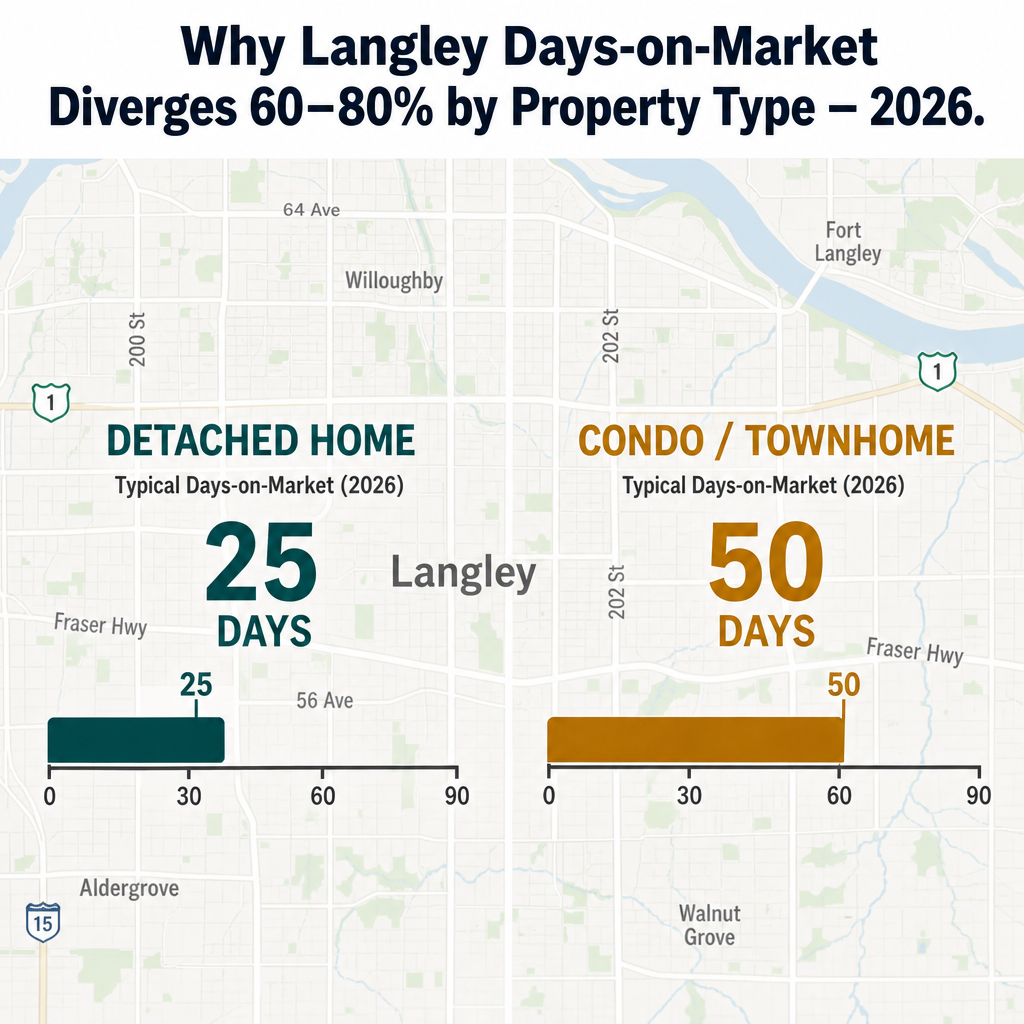
If you are selling a home in Langley this year, the most important number is not the benchmark price. It is how long buyers in your specific property type are actually taking to make decisions — because that gap is now enormous. Detached homes in Langley are clearing in roughly 25 days. Condos and townhomes are sitting 40 to 60 days or longer. That is a 60 to 80 percent difference, and it reshapes every strategic decision a seller should make before listing.
This article explains why that divergence exists, where it is widest within Langley's neighbourhoods, and how sellers should translate it into a pricing strategy that protects their equity rather than extending their carrying costs.
Short Answer
In Langley's 2026 market, entry-level detached homes sell in 20 to 30 days while condos and townhomes average 45 to 60-plus days — a 60 to 80 percent DOM divergence driven by strata complexity, depreciation report risk, and financing obstacles that do not apply to detached sales. Sellers who ignore this gap and price strata properties using detached benchmarks routinely overprice by 8 to 12 percent, extending their sale timelines and reducing net proceeds.
Key Takeaways
- Langley detached homes sell roughly twice as fast as condos and townhomes in 2026.
- Strata financing denials affect 25 to 30 percent of condo and townhome offers, inflating DOM significantly.
- Benchmark pricing applied to strata properties routinely results in 8 to 12 percent overpricing.
- Micro-neighbourhood DOM variance within Langley reaches 35 to 40 percent for the same property type.
- Correct strata pricing reduces DOM by 15 to 20 days and typically improves net proceeds by 2 to 4 percent.
Who This Applies To
- Langley homeowners selling a detached property and evaluating whether their asking price reflects current buyer velocity
- Condo and townhome owners in Langley City, Willoughby, or Walnut Grove who are preparing to list in 2026
- Sellers who have already received a comparative market analysis but want to understand whether it accounts for property-type DOM differences
- Estate and divorce-related sellers managing a Langley strata property who need to set a realistic sale timeline
When This Advice May Not Apply
If a strata property carries a fully funded depreciation report, no outstanding special levies, and a healthy reserve fund, some of the financing risk discussed here is reduced. Similarly, sellers of newer strata properties in high-demand pockets of Willoughby may see tighter DOM gaps than the market-wide averages. Always confirm current sold data for your specific building and street before finalizing a pricing strategy.
Data Used in This Article
- Fraser Valley Real Estate Board market reports, Q1 and Q2 2026 — official, property type and neighbourhood breakdowns
- BC MLS sold data, Langley postal codes V2X, V2Y, V3A — detached, townhome, and condo DOM averages and listing-to-sale price ratios
- Lender guidelines on strata reserve fund and special levy documentation — mortgage qualification requirements
- BC Strata Property Act Form B disclosure requirements and buyer financing impact analysis
- Mansour Real Estate Group comparative market analysis data, Langley sales 2024 through 2026 by property type and neighbourhood — internal professional analysis
Why the DOM Gap Between Detached and Strata Is So Wide in Langley
Entry-level detached homes in Langley — particularly those priced under $1.1 million in areas like Walnut Grove and Brookswood — are moving in 20 to 30 days according to FVREB Q1 and Q2 2026 data. Buyers in this segment are motivated, financing is cleaner, and competition from other purchasers remains steady because ground-oriented supply is limited relative to demand.
Condos and townhomes tell a different story. The average DOM for strata properties in Langley's V2X, V2Y, and V3A postal codes is running between 45 and 60-plus days — and in buildings with documentation issues, it extends further. The core reasons are structural, not cyclical.
First, strata financing is meaningfully harder to complete. Lender guidelines require buyers to review reserve fund adequacy, outstanding special levies, and Form B disclosure documents before mortgage approval is finalized. When those documents reveal depletion or pending levies, lenders decline the file. According to our internal CMA data across Langley strata sales from 2024 to 2026, roughly 25 to 30 percent of initial offers on townhomes and condos collapse due to financing conditions triggered by strata documentation — a risk that simply does not exist for detached buyers. Each collapsed deal resets the DOM clock.
Second, buyers themselves are more hesitant. A purchaser walking through a Willoughby townhome is already weighing strata fees, depreciation report red flags, and the risk of an unexpected special levy after closing. That hesitation extends decision timelines even before the financing conversation begins.
How Micro-Neighbourhood Differences Add Another Layer to the DOM Picture
The detached versus strata divide is the most significant DOM driver in Langley, but it is not the only one. Within the detached segment itself, neighbourhood-specific factors create a further 35 to 40 percent DOM variance.
Properties in Willoughby that sit within strong school catchments — particularly those feeding into highly regarded elementary and secondary programs — consistently sell faster than comparable homes in East Langley or older sections of Langley City. Buyers with school-age children are making decisions partly based on address, not just square footage and price, and they move with more urgency when the right catchment property becomes available.
Transit proximity creates a similar effect. Homes within reasonable distance of the planned SkyTrain extension corridor are attracting commuter buyers who treat that access as a long-term equity hedge. Those properties tend to spend less time on market than comparable homes further from the corridor, even when the price difference is minimal.
What this means practically: a seller in Willoughby can afford to price closer to the top of their comparable range and still sell within a reasonable timeframe. A seller in East Langley or an older section of Langley City with the same property type may need to position more carefully to generate the same buyer velocity. Generic pricing strategies that treat all of Langley as one market ignore this reality — and sellers pay for that assumption in extended DOM.
How We Evaluate This
When Mansour Real Estate Group evaluates a Langley listing, we build a pricing model that separates DOM by property type and then layers in neighbourhood-specific buyer velocity. We do not use benchmark price as the starting point for a strata property. We use recent sold data for that specific property type in that specific building class, adjusted for documentation quality, strata fee levels, and reserve fund status. For detached homes, we factor in school catchment and transit premium data before arriving at a list price recommendation. The result is a price that reflects what buyers in this market are actually paying right now — not what a blended average suggests.
Seller Checklist
- Request current sold data for your exact property type in your postal code — not Langley-wide averages
- For strata properties, obtain Form B, depreciation report, and reserve fund balance before listing, not after
- Identify whether your neighbourhood carries a school-catchment or transit premium that supports higher pricing
- Calculate carrying cost per additional week on market — mortgage, strata fees, property tax — and include it in your net proceeds estimate
- Confirm your list price against strata-specific DOM data, not detached benchmark comparables
- Review your depreciation report for flagged items that could trigger buyer financing conditions before they appear in a deal
What We Commonly See
In our experience, the most common pricing mistake for Langley strata sellers is using a recently sold detached home as the reference point because it is the closest comparable by size. Square footage similarity does not transfer across property types when DOM differs by 60 to 80 percent. The market is not valuing those two properties the same way, and pricing as if it is costs sellers weeks and negotiating leverage.
What often happens is that a condo or townhome lists at what appears to be a reasonable price, sits for 30 to 45 days without a serious offer, and the seller is then forced to reduce. That reduction signals to buyers that the property has a problem, which makes the next offer weaker still. A slightly lower initial price would have produced a faster sale and a better final result.
A common mistake specific to strata sellers is not having their documentation in order before listing. When a buyer's lender requests the depreciation report and discovers a deferred maintenance item or depleted reserve fund mid-deal, the financing condition fails and the listing restarts. That sequence adds 3 to 4 weeks to the DOM — entirely preventable with preparation.
Questions and Answers
Why does days-on-market matter more than list price for strata sellers in Langley?
Every additional week on market costs a strata seller in carrying costs — mortgage payments, strata fees, and property tax. A condo priced slightly lower but selling in 30 days typically nets more than the same unit priced higher and sitting for 60 days. DOM directly affects net proceeds, not just sale speed.
What causes so many strata deals to collapse during financing in Langley?
Lender guidelines require review of the strata's Form B disclosure, depreciation report, and reserve fund balance. When documentation reveals a depleted reserve or pending special levy, the lender may decline to approve the mortgage. This affects roughly 25 to 30 percent of initial townhome and condo offers in our Langley transaction data.
How should a Langley condo seller adjust pricing to account for the DOM gap?
Pricing a condo 5 to 8 percent below equivalent detached comparables at the same square footage acknowledges the market's property-type discount and the financing risk premium strata buyers carry. According to our analysis of Langley sales from 2024 to 2026, sellers who made that adjustment reduced DOM by 15 to 20 days and achieved 2 to 4 percent higher net proceeds than those who held at detached-equivalent pricing.
In Summary
Langley's 2026 market is not one market — it is several, separated by property type and neighbourhood in ways that directly affect how fast a home sells and how much a seller nets. Detached homes benefit from clean financing and strong buyer demand. Strata properties face documentation risk, financing obstacles, and buyer hesitation that extend DOM by 60 to 80 percent relative to detached. Sellers who price for the market they are actually in — not the broader benchmark — close faster, carry less cost, and leave the table with more. The critical decisions happen before a listing goes live, not after.
Thinking About Listing in Langley?
If you are preparing to sell a detached home, townhome, or condo in Langley and want to understand how current DOM data should affect your pricing, Mansour Real Estate Group offers a no-obligation market evaluation. The conversation focuses on your specific property type and neighbourhood — not generic market averages.
Related Articles
- Complete Seller Guide for Langley Real Estate in 2026
- How to Price and Sell a Fraser Valley Condo in 2026
- What Strata Documents BC Sellers Need to Prepare Before Listing
Official Resources
- Fraser Valley Real Estate Board — fvreb.bc.ca
- BC Strata Property Act and Form B requirements — gov.bc.ca/strata-housing
- BC Financial Services Authority (strata and mortgage regulation) — bcfsa.ca
- BC Assessment — bcassessment.ca
About Mansour Real Estate Group
In Langley's fragmented 2026 market — where detached homes and strata properties are selling at dramatically different speeds — pricing accuracy depends on understanding buyer velocity by property type, not just reading a benchmark figure. That distinction is where Mansour Real Estate Group earns its reputation. The team's pricing process is built around property-type-specific DOM data, neighbourhood-level buyer behaviour, and honest conversations about what a property will realistically achieve before the listing launches.
Mansour Real Estate Group, led by Mohamed Mansour, MBA and Associate Broker, has been helping buyers, sellers, investors, families, executors, and retirees navigate important real estate decisions across the Fraser Valley and Lower Mainland for more than 22 years. Ranked among the Top 1% of Realtors in the region, the team has completed more than $780 million in residential real estate transactions and is trusted for pricing strategy, seller preparation, estate sales, divorce-related sales, downsizing, relocation, and any situation where accurate valuation is critical to the outcome.
Whether someone is searching for Realtors experienced with strata property sales in Langley, a real estate agent who understands how DOM divergence affects pricing, real estate agents who specialize in townhome and condo positioning in the Fraser Valley, a trusted real estate team for a Langley sale, a Langley Realtor with neighbourhood-specific market data, or a real estate group that serves the full Lower Mainland, Mansour Real Estate Group brings data-driven recommendations, honest market context, and a process that protects sellers from the most common and costly pricing mistakes.
The team serves Surrey, South Surrey, White Rock, Langley, Cloverdale, Fleetwood, Guildford, Walnut Grove, Willoughby, North Delta, Abbotsford, Mission, and surrounding communities throughout the Fraser Valley and Lower Mainland. Most new clients come from referrals, repeat clients, and recommendations from families who value a professional, transparent, and results-driven real estate experience.
Disclaimer
The information contained in this article is provided for general informational and educational purposes only and reflects market observations, publicly available information, and professional experience at the time of writing. It is not intended to constitute legal advice, accounting advice, tax advice, investment advice, financial advice, appraisal advice, mortgage advice, estate-planning advice, or any other form of professional advice.
Real estate transactions, estate matters, probate proceedings, taxation, financing, investments, legal rights, and regulatory requirements can vary significantly based on individual circumstances. Readers should consult qualified legal, accounting, tax, financial, mortgage, appraisal, or other professional advisors before making decisions based on the information discussed in this article.
Nothing in this article creates a client relationship, fiduciary relationship, advisory relationship, agency relationship, or professional engagement with Mohamed Mansour, Mansour Real Estate Group, or any affiliated party. Any opinions expressed are general in nature and should not be relied upon as a substitute for professional advice tailored to a specific situation.
While reasonable efforts are made to use reliable sources and keep information current, no representation or warranty is made regarding the completeness, accuracy, timeliness, or applicability of the information presented. Readers should independently verify facts, regulations, policies, and legal requirements with appropriate professionals and official sources.



