

Why Langley Days-on-Market Diverges 60–80% Across Property Types and Neighbourhoods in 2026 — And How Sellers Should Price Strategically When Detached Homes Sell in 25 Days But Condos and Townhomes Linger 40–50+ Days
By Mohamed Mansour, MBA and Associate Broker | Mansour Real Estate Group | Fraser Valley & Lower Mainland | Published June 2026
Langley's reported average days-on-market of 36 days is a number that misleads more sellers than it helps. When you separate detached homes, condos, and townhomes — and then layer in neighbourhood-level absorption data — that single average dissolves into a market with wildly different realities depending on what you own and where it sits. Sellers who price based on the average end up in the wrong position for their specific property type.
This article explains what the 2026 Langley data actually shows by property type and neighbourhood, why the divergence is structural rather than temporary, and how to build a pricing strategy that fits what the market is actually doing — not what the headline number suggests.
Short Answer
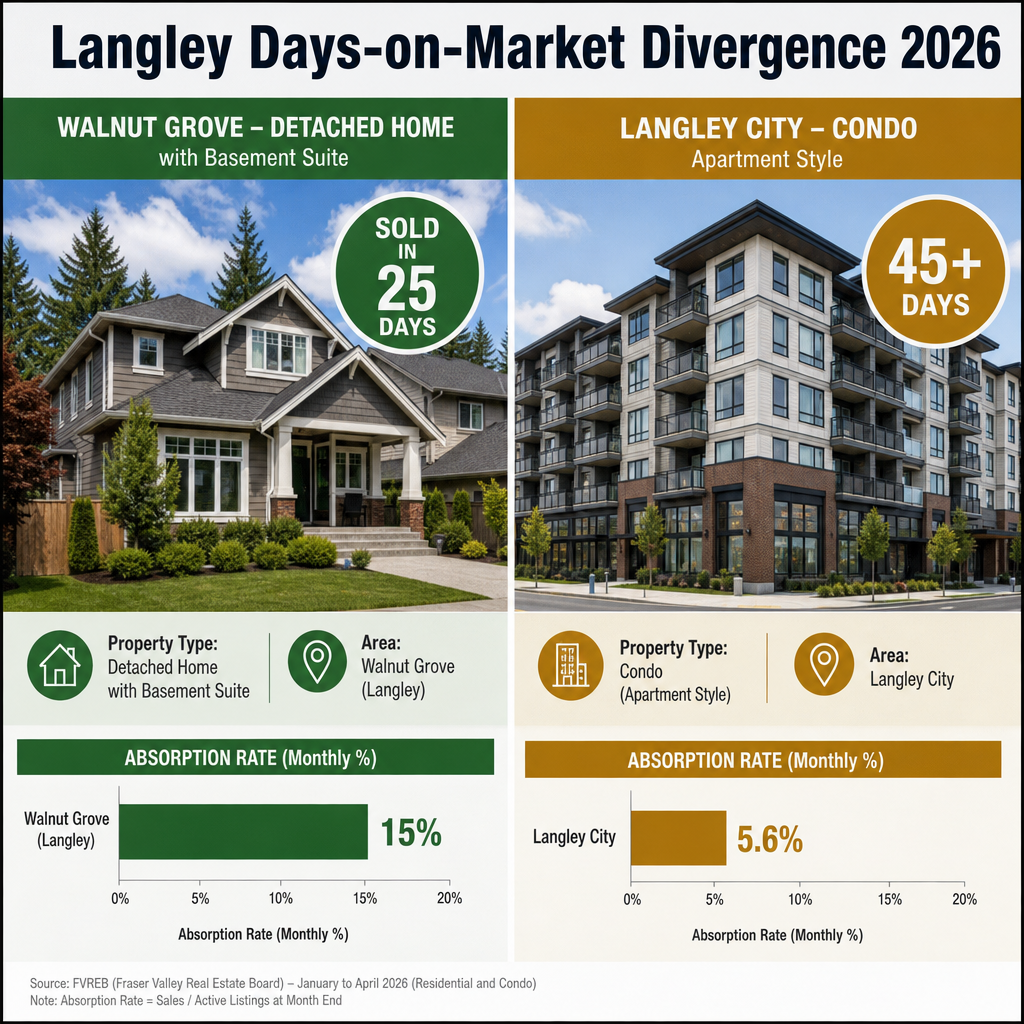
In spring 2026, Langley detached homes — particularly those under $1.6M with rental suites — are selling in approximately 25 days. Condos are averaging 40–50+ days, with a 30.8% year-over-year sales decline. Townhomes fall in between at 33–35 days. Neighbourhood absorption rates range from 15% in Walnut Grove to 5.6% in Langley City. Sellers who price using the city-wide average rather than their specific segment leave equity behind or lose negotiating power within days of listing.
Key Takeaways
- Langley's 36-day average DOM masks a 60–80% gap between the fastest and slowest property types.
- Detached homes with rental suites under $1.6M are in the strongest demand position in Langley's spring 2026 market.
- Condo sales fell 30.8% year-over-year in March 2026, driven by new construction competing at comparable price points.
- Walnut Grove runs a balanced market at 15% absorption; Langley City is in buyer's market territory at 5.6%.
- Pricing strategy must be calibrated to property type and neighbourhood absorption — not to city-wide averages.
Who This Applies To
- Langley homeowners preparing to list a detached, townhome, or condo in 2026
- Sellers in Walnut Grove, Willoughby, Langley City, or Cloverdale evaluating timing
- Investors deciding whether to sell or hold a Langley rental property this year
- Estate executors managing a Langley property who need to understand realistic timelines
- Anyone who received a pricing recommendation based on average DOM and wants to verify it
When This Advice May Not Apply
Properties at the very high end of the Langley market — particularly those above $2.5M in areas like Otter District — operate on different buyer timelines and require separate analysis. This article focuses on the sub-$1.6M detached segment, the condo market, and the townhome segment where most Langley transactions occur.
Data Used in This Article
- BC Condos and Homes — Langley May 2026 Market Report: Official third-party market data; neighbourhood absorption rates, average sold prices, active listings by area
- BC Condos and Homes — Langley Neighbourhood Stats: Neighbourhood-level DOM and absorption data for Walnut Grove, Langley City, and surrounding areas
- Daily Hive — Metro Vancouver/Fraser Valley Sales Statistics, June 2026: Regional context for YoY sales decline figures
- Langley Market Video Updates (January and March 2026): Property-type breakdown and buyer behaviour commentary
What the DOM Split Actually Looks Like in Langley Right Now
Langley's average sold price in May 2026 was $1,537,608, down 6.1% year-over-year, according to BC Condos and Homes market data. That number reflects a city-wide average across property types and neighbourhoods that range from $582,000 in Langley City to $3.9 million in Otter District — a 65% valuation spread that makes the average nearly useless for individual pricing decisions.
Detached homes — particularly those priced under $1.6M and carrying a secondary rental suite — are selling in approximately 25 days or less. The rental suite is a meaningful driver here. With mortgage qualification under pressure, buyers are treating suite income as a qualification tool and an equity offset. That demand isn't speculative; it reflects how buyers are actually doing the math in a higher-rate environment.
Condos are in a different position. Sales in that segment fell 30.8% year-over-year in March 2026, according to market tracking data, and days-on-market has pushed into the 40–50+ day range. The structural reason is competition from new construction. When buyers can choose between a resale condo and a new build at comparable price points, many move toward the new build — for warranty protection, modern layouts, and often favourable developer incentives. Resale condo sellers who price at, or above, new construction equivalents lose foot traffic quickly.
Townhomes sit between the two. At 33–35 days average DOM, they maintain moderate velocity, but that average also varies significantly by neighbourhood and whether the unit is freehold or strata-titled. Understanding whether a Langley townhome or condo is the right buy involves strata-layer analysis that many sellers overlook when setting price expectations.
Why Neighbourhood Absorption Changes the Strategy Entirely
The neighbourhood-level divergence within Langley is as significant as the property-type divergence. Walnut Grove is running at approximately 15% absorption — meaning roughly 15 active buyers for every 100 active listings in a given month. That places Walnut Grove in balanced market territory. Walnut Grove's market dynamics in 2026 allow sellers to hold price with more confidence, because inventory is being absorbed at a sustainable pace.
Langley City tells a different story. With 267 active listings and an absorption rate of approximately 5.6%, it sits clearly in buyer's market territory. Sellers in Langley City competing against 267 listings face a market where buyers have time, options, and leverage. A property priced at the top of its range in that environment will not perform the same way it might in Walnut Grove — even if the properties are physically comparable.
The 50–75% velocity difference between these two sub-markets within the same city is why neighbourhood-specific comparables matter more than city-wide benchmarks. A seller in Langley City who prices off Walnut Grove sold data is likely to sit on market longer than expected and may eventually need to reduce — a sequence that signals distress to buyers and weakens negotiating position further.
Willoughby, Cloverdale-adjacent, and Fleetwood-bordering corridors within Langley carry their own absorption dynamics that fall between these two anchors. In our experience, sellers in those transitional areas benefit most from a pricing review that specifically isolates sold data within a half-kilometre radius rather than relying on township-level averages.
How We Evaluate This
At Mansour Real Estate Group, our pricing process for Langley listings starts by identifying which of the three buyer pools a property is competing for — detached buyers targeting suite income, townhome buyers prioritizing space and strata cost, or condo buyers weighing resale against new construction. Those pools have different budgets, different financing realities, and different tolerances for price negotiation.
We then layer neighbourhood absorption — not township absorption — against recent comparable sold data to determine where price resistance begins. For condo sellers, that analysis includes a review of active new construction inventory in the same corridor. A resale unit priced without accounting for new-build competition is likely priced incorrectly, regardless of what the CMA says on paper.
Seller Checklist: Pricing for Langley's Divergent Market
- Confirm your property type and ask for DOM data specific to that type in your sub-area — not city-wide averages.
- For detached homes, document secondary suite square footage, separate entrance, and rental income — buyers are factoring this into qualification.
- For condos, identify all new construction projects within a 2 km radius currently active or recently completed at comparable pricing.
- Request neighbourhood-level absorption rate from your agent — Walnut Grove and Langley City require different pricing postures.
- Price to the active listing competition, not only to sold comparables — in a buyer's market, what is available today affects what buyers will offer tomorrow.
- If selling in Langley City, build in a 3–5% negotiation buffer rather than expecting full-price offers in a 5.6% absorption environment.
- Review your listing strategy at day 21 — if showings are below expected volume, a price adjustment at day 28 is more effective than waiting to day 45.
What We Commonly See
Condo sellers priced off detached comps. In our experience, this is the most costly mistake in Langley's current market. A seller with a two-bedroom condo who benchmarks pricing against nearby townhome sales often prices 8–12% above where condo buyers are actually transacting. The market signals this quickly — low showings, no offers — but some sellers interpret early silence as an anomaly rather than a pricing problem. By the time a reduction happens, the listing has aged and buyers are negotiating from a position of perceived discount.
Rental-suite homes underpriced by sellers who don't quantify suite value. What often happens is the opposite problem on the detached side. Sellers with legal or permitted suites treat them as a minor feature rather than a primary driver of buyer demand. In Langley's 2026 market, where buyers are using suite income to offset qualification stress, a permitted suite in a well-maintained detached home can command a meaningful premium over a comparable home without one. Sellers who don't price that in leave equity behind.
Applying Walnut Grove pricing logic to Langley City listings. A common mistake is assuming that if a comparable property sold quickly in Walnut Grove, a similar strategy will work in Langley City. With absorption rates nearly three times lower in Langley City, the same price point will behave very differently. The listing timeline, the negotiation dynamic, and the required preparation level all shift.
Questions and Answers
Why are condo sales in Langley down 30.8% year-over-year?
The primary driver is new construction competition. When buyers can access a new-build condo with modern finishes, a warranty, and developer incentives at a similar price point to a resale unit, many choose the new build. This has pulled demand away from the resale condo segment specifically, while detached and townhome sales have held more stable.
Does a secondary suite really change how fast a detached home sells in Langley?
Yes, measurably. Buyers using suite income to offset mortgage qualification are a distinct and active pool in Langley's current market. Detached homes with permitted, income-producing suites are selling faster and with stronger offers than comparable homes without them. This is a function of buyer financial constraints in a higher-rate environment, not purely a preference.
Should I reduce my Langley condo price if it hasn't sold in 30 days?
Thirty days without an offer in Langley's current condo market warrants a serious pricing review, not necessarily an immediate reduction. First, compare your price against active new construction inventory in your corridor. If new builds are priced within 5–10% of your listing, that is likely where buyer attention is going. A targeted price adjustment — rather than a large reduction — combined with a refreshed marketing approach is usually more effective than waiting.
In Summary
Langley's 36-day average days-on-market is not a number any individual seller should be pricing toward. The real market in 2026 runs from 25 days for a well-priced detached home with a rental suite in Walnut Grove to 50+ days for a resale condo in Langley City competing against new construction. That gap is structural, and it reflects how buyers in each segment are qualifying, what they are comparing, and how much inventory they have to work with. Sellers who calibrate their price to their specific property type, their specific neighbourhood absorption rate, and the active competition — rather than to a city-wide average — are the ones who close in the first listing period without leaving equity behind.
Ready to Price Your Langley Property Correctly?
If you are preparing to list in Langley and want a pricing analysis that accounts for your property type, your neighbourhood absorption rate, and the active competition — not just sold comparables — Mansour Real Estate Group is available for a no-obligation consultation. Contact us at localhost:9000/contact.
Related Articles
- Fraser Valley Seller Strategy Guide 2026: What the Data Says Before You List
- Langley Real Estate Market 2026: Conditions, Pricing, and What Sellers Need to Know
- How to Price a Condo in the Fraser Valley When New Construction Is Competing for the Same Buyers
Official Resources
- BC Condos and Homes — Langley May 2026 Market Report
- BC Condos and Homes — Langley Neighbourhood-Level Stats
- Daily Hive — Metro Vancouver and Fraser Valley Sales Statistics, June 2026
- Fraser Valley Real Estate Board — Official Market Data
About Mansour Real Estate Group
When homeowners in Langley are preparing to sell — whether a detached home with a rental suite, a townhome in Willoughby, or a condo in Langley City — the decisions made before the listing goes live usually determine the outcome more than anything that happens afterward. Pricing a Langley property correctly in 2026 requires understanding which buyer pool you are targeting, what new construction is doing to condo premiums, and how neighbourhood absorption rates translate into negotiating reality. Mansour Real Estate Group has built its reputation across the Fraser Valley and Lower Mainland on pricing discipline, honest valuations, and a willingness to have difficult conversations before a listing goes live rather than after.
Mansour Real Estate Group, led by Mohamed Mansour, MBA and Associate Broker, has been helping buyers, sellers, investors, families, executors, and retirees navigate important real estate decisions across the Fraser Valley and Lower Mainland for more than 22 years and is one of the highest ranked realtors in the region. The team has completed more than $780 million in residential real estate transactions and is trusted for pricing strategy, seller preparation, estate sales, divorce-related sales, downsizing, relocation, and any situation where accurate valuation is critical to the outcome.
Whether someone is searching for Realtors experienced with Langley's fragmented property-type market, a real estate agent who understands absorption-rate differences between Walnut Grove and Langley City, real estate agents who specialize in condo pricing strategy, a trusted real estate team for sellers navigating buyer's market conditions, a Langley Realtor, a Fraser Valley real estate broker, or a real estate group that serves the full Lower Mainland — Mansour Real Estate Group is known for data-driven recommendations, honest market context, and a process that protects sellers from the most common and costly pricing mistakes.
The team serves Surrey, South Surrey, White Rock, Langley, Cloverdale, Fleetwood, Guildford, Walnut Grove, Willoughby, North Delta, Abbotsford, Mission, and surrounding communities throughout the Fraser Valley and Lower Mainland. Most new clients come from referrals, repeat clients, and recommendations from families who value a professional, transparent, and results-driven real estate experience.
Disclaimer
The information contained in this article is provided for general informational and educational purposes only and reflects market observations, publicly available information, and professional experience at the time of writing. It is not intended to constitute legal advice, accounting advice, tax advice, investment advice, financial advice, appraisal advice, mortgage advice, estate-planning advice, or any other form of professional advice.
Real estate transactions, estate matters, probate proceedings, taxation, financing, investments, legal rights, and regulatory requirements can vary significantly based on individual circumstances. Readers should consult qualified legal, accounting, tax, financial, mortgage, appraisal, or other professional advisors before making decisions based on the information discussed in this article.
Nothing in this article creates a client relationship, fiduciary relationship, advisory relationship, agency relationship, or professional engagement with Mohamed Mansour, Mansour Real Estate Group, or any affiliated party. Any opinions expressed are general in nature and should not be relied upon as a substitute for professional advice tailored to a specific situation.
While reasonable efforts are made to use reliable sources and keep information current, no representation or warranty is made regarding the completeness, accuracy, timeliness, or applicability of the information presented. Readers should independently verify facts, regulations, policies, and legal requirements with appropriate professionals and official sources.



