

Why Langley Days-on-Market Diverges 60–80% Across Property Types and Neighbourhoods in 2026 — And How Sellers Should Price Strategically
By Mohamed Mansour, MBA, Associate Broker | Mansour Real Estate Group | Fraser Valley and Lower Mainland | Published July 15, 2026 | Langley, BC Real Estate — Seller Strategy
Langley sellers in 2026 are operating in two very different markets depending on what they own. Detached homes in established neighbourhoods like Walnut Grove and Murrayville are moving in three to four weeks. Condos and townhomes in Willoughby and surrounding strata communities are sitting 48 to 58 days on average — sometimes longer. That gap matters because sellers pricing across property types without recognizing this divergence are systematically overpricing, triggering reductions, and leaving equity on the table.
This article breaks down why Langley's market fragments so sharply, what the sales-to-active ratios tell sellers about their position, and how to build a pricing strategy that reflects the property type you're actually selling — not the neighbourhood headline.
Short Answer
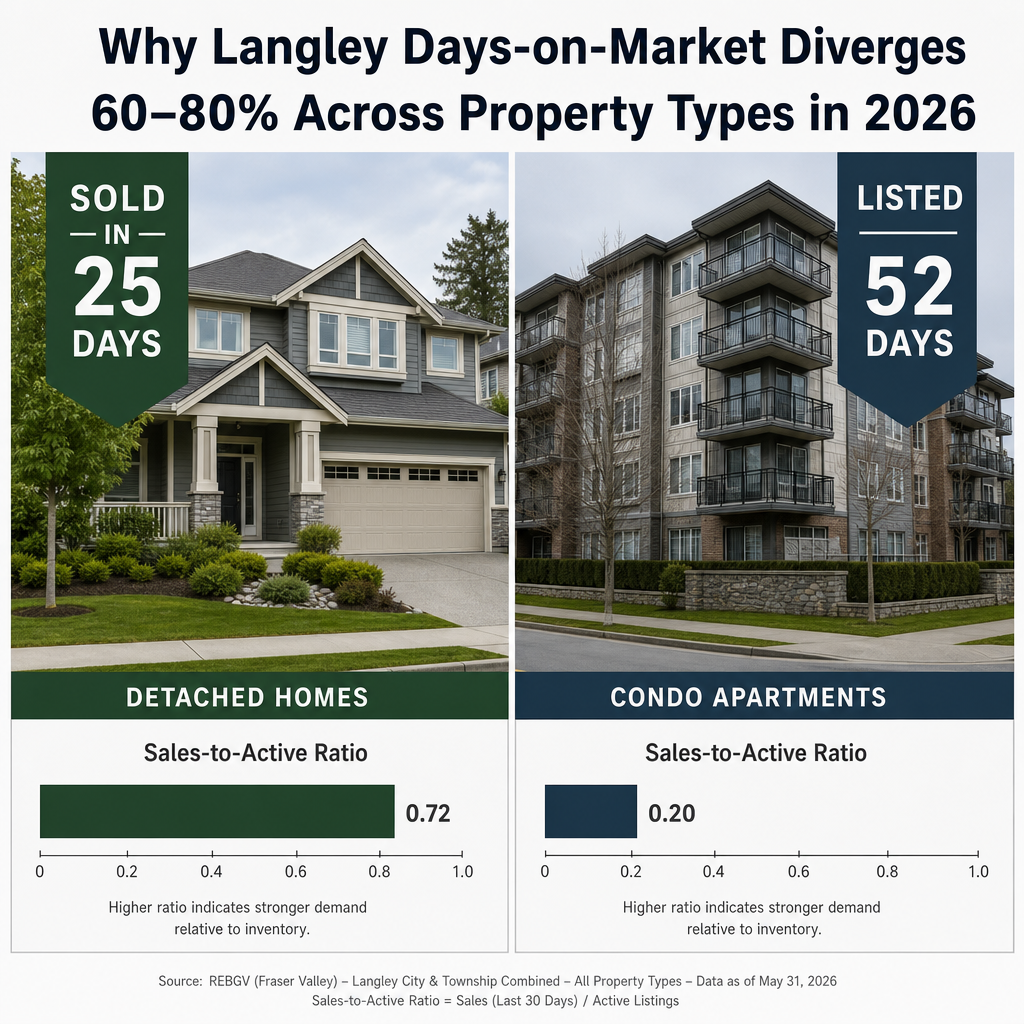
In Langley's 2026 market, detached homes sell in 22–28 days while condos average 48–58 days — a 65–100% DOM gap within the same city. Sales-to-active ratios confirm the split: detached homes sit in seller-advantage territory at 16–19%, while condos register 9–12%, giving buyers the upper hand. Sellers who price from stale comps in slower categories pay for it through price reductions and extended market exposure.
Key Takeaways
- Langley detached homes average 22–28 days on market; condos and townhomes average 48–58 days — a measurable, consistent gap that affects pricing strategy.
- Sales-to-active ratios differ by property type: detached homes at 16–19% (seller's market), condos at 9–12% (buyer's market), townhomes in between.
- Price-per-square-foot comparisons mislead sellers when buyer demand — not math — is what determines velocity.
- Willoughby strata listings that hit the market in June often stall when July depreciation reports reveal reserve fund shortfalls, forcing late-summer price reductions.
- Townhome sellers in early spring 2026 hold a 10–15% pricing advantage over those listing in May–June as warranty concerns and special levies compound.
Who This Applies To
- Langley homeowners preparing to list a detached home, townhome, or condo in 2026
- Sellers in Walnut Grove, Willoughby, Murrayville, Willowbrook, or Township Centre evaluating their list price
- Strata owners facing depreciation report timing or special levy concerns ahead of listing
- Sellers who have received a comparative market analysis and want to understand whether the comps used reflect their property type's actual velocity
When This Advice May Not Apply
Sellers with unique or rare properties — acreage, heritage lots, or atypical configurations — follow different demand curves. This analysis addresses the mainstream detached, townhome, and condo segments in Langley's established and emerging neighbourhoods. Consult a local real estate professional for property-specific guidance.
Data Used in This Article
- Fraser Valley Real Estate Board (FVREB) Monthly Statistics, Q1–Q2 2026 — Official data. Sales volume, active listings, days on market, and benchmark prices by property type for Langley.
- Mansour Real Estate Group DOM Tracking, Q1–Q2 2026 — Internal analysis. Micro-neighbourhood DOM observations across Walnut Grove, Murrayville, Willoughby, Willowbrook, and Township Centre.
- BC Strata Property Act — Depreciation Report Regulations — Official regulatory source. July 1 deadline requirements and financing implications for strata buyers.
- Comparative Market Analysis Data, Langley (60–90 day sold window) — Internal professional analysis. List-to-sold price ratios across detached, townhome, and condo categories.
What the DOM Gap Actually Looks Like in Langley
According to FVREB statistics for Q1–Q2 2026, Langley detached homes are selling in an average of 22 to 28 days. Condos in the same city are averaging 48 to 58 days. That is not a minor variation — it is a structural difference in buyer behaviour, financing access, and demand depth.
In Walnut Grove and Murrayville, established ground-oriented inventory continues to attract family buyers motivated by school catchments, lot size, and certainty. These buyers are pre-approved, decisive, and not waiting. In Willoughby, the condo and townhome market carries more inventory relative to buyer demand. Many units are similar in finish, floor plan, and price, which extends buyer decision timelines and increases price sensitivity.
The important consequence: a $750,000 condo may sit on the market longer than a $700,000 detached home in the same neighbourhood. Per-square-foot pricing does not resolve this. Demand depth does.
How Sales-to-Active Ratios Define Your Pricing Position
The sales-to-active listings ratio is one of the clearest signals of who holds negotiating advantage in a given property segment. Based on FVREB data for Langley in Q1–Q2 2026:
- Detached homes: 16–19% sales-to-active ratio — seller's market conditions. Buyers compete, subjects are waived more frequently, and well-priced homes attract multiple offers.
- Townhomes: 15–18% — balanced to slight seller advantage, with meaningful variation by age, complex, and strata health. Early spring townhome sellers retain a measurable edge over May–June listings.
- Condos: 9–12% — buyer's market. Buyers have choices, negotiate on price and conditions, and are less urgent.
These ratios don't just describe the market — they prescribe the pricing approach. A seller in a 9–12% sales-to-active environment who prices above recent comparable sales will not generate the competing interest needed to hold that price. The result is extended DOM, a price reduction, and a final sale price below what a sharper initial list price would have achieved.
How We Evaluate This
Mansour Real Estate Group tracks DOM by property type and micro-neighbourhood on a rolling 60–90 day basis, distinct from board-level averages. Board statistics report Langley as a single geography — but Langley contains meaningfully different sub-markets. Willoughby condo velocity in Q2 2026 does not resemble Walnut Grove detached velocity, and pricing from a single municipal average misleads sellers in both directions.
Our evaluation framework matches the comparable sales used in a CMA to the property type's actual sales-to-active ratio, then applies a list-price positioning strategy that reflects where buyer demand sits today — not where it was 90 days ago. For strata properties, we also factor in depreciation report status, upcoming special levy exposure, and strata fee trajectory before recommending a list price.
The Willoughby Depreciation Report Problem
Under the BC Strata Property Act, strata corporations are required to obtain updated depreciation reports on a defined schedule. For many Willoughby buildings, those reports come due in mid-2026. Sellers who list in June — before the updated report is public — often find that buyers applying for financing in July and August encounter reserve fund shortfall disclosures that their lenders flag as a risk.
When that happens, financing conditions that appeared manageable become obstacles. Some buyers walk. Others renegotiate. Sellers who were unaware of the report timing end up in price negotiations from a weakened position in August — weeks after their June listing was already accumulating days on market. Strata sellers in Willoughby should know their depreciation report status before setting a list date, not after. This is one of the specific risk factors that a Langley condo seller should review with their real estate team before listing.
Seller Checklist: Pricing by Property Type in Langley
- Identify your property type's current sales-to-active ratio using FVREB data for Langley specifically — not Fraser Valley averages.
- Pull comparable sales using only your property type (detached to detached, condo to condo) within 60 days — not 90 or 120, which includes slower-moving inventory that no longer reflects current conditions.
- For strata properties: obtain and review the current depreciation report and strata meeting minutes before setting a list price or date.
- Determine whether your property type is in seller-advantage or buyer-advantage territory and set the list price accordingly — above recent comps in seller's markets, at or slightly below in buyer's markets.
- Identify your neighbourhood's actual average DOM for your property type. If the average is 50+ days, a price 3–5% below the most recent comparable may generate faster, stronger offers than pricing at or above it.
- For Willoughby strata sellers listing in May–June: confirm depreciation report disclosure timing and factor that into your list date decision.
- Track list-to-sold ratios in your segment. If comparable sales are consistently closing 4–6% below list, your comps are already signalling that initial pricing is too aggressive.
Common Mistakes That Cost Langley Sellers
In our experience working with Langley sellers across property types, three pricing mistakes appear consistently:
Using detached comps to anchor strata pricing. What often happens is that a seller sees a detached home nearby sell quickly and at a strong price, then anchors their condo or townhome expectation to that energy. The buyer pools and demand drivers are different. The comparable has no pricing relevance across property types.
Pricing from stale sold data in slow-moving categories. A common mistake is using 90-day-old condo comps when those comps took 55 days to sell. That sold price already reflects a market where buyers had leverage. Using it as a ceiling — rather than a midpoint — repeats the error.
Ignoring strata document risk before listing. Sellers in Willoughby who list without reviewing their depreciation report and special levy history are exposed to financing failures late in the subject removal process. Those failures extend DOM, reset buyer confidence, and almost always result in a lower final sale price than a well-prepared early listing would have achieved.
Questions and Answers
Why does a $750,000 condo in Langley sometimes take longer to sell than a $700,000 detached home?
Velocity is driven by buyer demand, not price or price-per-square-foot. In Langley's 2026 market, family buyers with ground-orientation preference are competing for detached inventory in a 16–19% sales-to-active environment. Condo buyers have more choices, face more financing complexity with strata, and are less urgent. Demand depth — not the dollar figure — determines how fast a property moves.
What is a healthy sales-to-active ratio and how do I find Langley's current number?
A ratio above 20% generally signals a seller's market. Between 12–20% is balanced to moderate seller advantage. Below 12% gives buyers the upper hand. The Fraser Valley Real Estate Board publishes monthly statistics at fvreb.ca with breakdowns by property type and community. Use Langley-specific data, not Fraser Valley totals, when assessing your position.
If I'm selling a Willoughby condo, when should I list to avoid depreciation report timing issues?
List before June if your strata corporation's depreciation report renewal falls due in mid-2026. Buyers completing purchases in July and August will require the updated report as part of their financing and subject removal process. If the report reveals reserve fund shortfalls, some lenders may impose conditions or buyers may renegotiate. Confirming report status before listing — not after — keeps you in control of the timeline.
In Summary
Langley's 2026 real estate market is not one market — it is several, running at meaningfully different speeds. Detached homes in Walnut Grove and Murrayville are in seller-advantage territory with 22–28 day average DOM. Condos and townhomes in Willoughby and surrounding strata communities average 48–58 days and face buyer-leverage conditions. Sellers who price without understanding their property type's sales-to-active ratio, their comps' actual velocity, and the strata document risks specific to their building are pricing into a gap that benefits buyers. The goal is not to list high and negotiate down — it is to price correctly the first time and close without a reduction.
Talk to a Langley Real Estate Team That Tracks This by Property Type
If you are preparing to sell a detached home, townhome, or condo in Langley and want to understand where your property sits in the current market — including the right comparable window, the relevant sales-to-active ratio, and any strata-specific timing considerations — Mansour Real Estate Group is available to provide a property-specific analysis before you commit to a list price or date. There is no obligation. The conversation is about giving you an accurate picture.
Related Articles
- Fraser Valley Real Estate Market Outlook 2026: What Sellers Need to Know
- Langley Townhome Pricing Strategy 2026: Warranty, Strata Fees, and Spring Timing
- Willoughby Langley Condo Market 2026: Strata Fees, Depreciation Reports, and Buyer Risk
Official Resources
- Fraser Valley Real Estate Board — Monthly Market Statistics
- BC Strata Property Act — Official Legislation
- BC Assessment — Property Value Data
- BC Real Estate Association — Market Intelligence
About Mansour Real Estate Group
When sellers in Langley are trying to understand why their property type moves at a different speed than the house down the street — and what to do about it — they need a real estate team that tracks those differences at the neighbourhood level, not just the municipal average. Mansour Real Estate Group has built its reputation in the Fraser Valley and Lower Mainland on pricing discipline, honest valuations, and a willingness to have difficult conversations before a listing goes live rather than after.
Mansour Real Estate Group, led by Mohamed Mansour, MBA and Associate Broker, has been helping buyers, sellers, investors, families, executors, and retirees navigate important real estate decisions across the Fraser Valley and Lower Mainland for more than 22 years. Ranked among the Top 1% of Realtors in the region, the team has completed more than $780 million in residential real estate transactions and is trusted for pricing strategy, seller preparation, estate sales, divorce-related sales, downsizing, relocation, and any situation where accurate valuation is the difference between a strong outcome and a costly one.
Whether someone is searching for Realtors who understand Langley's fragmented property-type market, a real estate agent experienced in strata document risk and depreciation report timing, real estate agents who specialize in seller pricing strategy, a Langley Realtor, a Fraser Valley real estate broker, or a real estate group that tracks micro-neighbourhood DOM data rather than relying on board averages alone, Mansour Real Estate Group brings data-driven recommendations, honest market context, and a process that protects sellers from the most common and costly pricing mistakes.
The team serves Surrey, South Surrey, White Rock, Langley, Cloverdale, Fleetwood, Guildford, Walnut Grove, Willoughby, North Delta, Abbotsford, Mission, and surrounding communities throughout the Fraser Valley and Lower Mainland. Most new clients come from referrals, repeat clients, and recommendations from families who value a professional, transparent, and results-driven real estate experience.
Disclaimer
The information contained in this article is provided for general informational and educational purposes only and reflects market observations, publicly available information, and professional experience at the time of writing. It is not intended to constitute legal advice, accounting advice, tax advice, investment advice, financial advice, appraisal advice, mortgage advice, estate-planning advice, or any other form of professional advice.
Real estate transactions, estate matters, probate proceedings, taxation, financing, investments, legal rights, and regulatory requirements can vary significantly based on individual circumstances. Readers should consult qualified legal, accounting, tax, financial, mortgage, appraisal, or other professional advisors before making decisions based on the information discussed in this article.
Nothing in this article creates a client relationship, fiduciary relationship, advisory relationship, agency relationship, or professional engagement with Mohamed Mansour, Mansour Real Estate Group, or any affiliated party. Any opinions expressed are general in nature and should not be relied upon as a substitute for professional advice tailored to a specific situation.
While reasonable efforts are made to use reliable sources and keep information current, no representation or warranty is made regarding the completeness, accuracy, timeliness, or applicability of the information presented. Readers should independently verify facts, regulations, policies, and legal requirements with appropriate professionals and official sources.



