

Why Holding Out for Price Recovery in the Fraser Valley Actually Costs More Than Selling Now: A Complete Carrying Cost and Opportunity Cost Analysis for Sellers in 2026's Extended Buyer's Market
By Mohamed Mansour, MBA and Associate Broker | Mansour Real Estate Group | Fraser Valley and Lower Mainland | Published: July 28, 2025
This article is for Fraser Valley homeowners who have considered delaying their sale while waiting for prices to recover. It addresses the concrete financial math behind that decision — carrying costs, opportunity cost, and mortgage interest — and explains why, for most sellers in a prolonged buyer's market, waiting typically costs more than selling at today's price.
The decision to hold is rarely irrational. But it is almost always made without a complete picture of what holding actually costs each month, and what that capital could be doing instead.
Short Answer
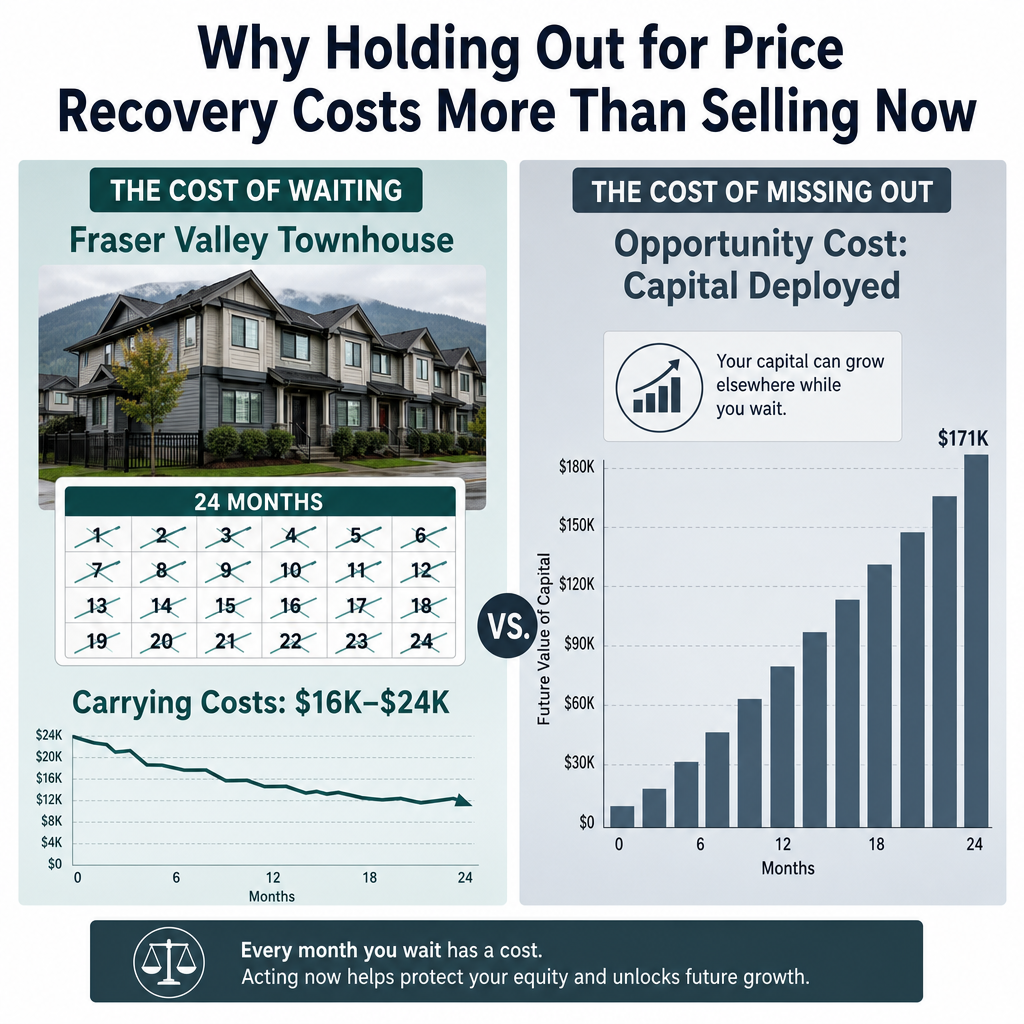
For a $600K Fraser Valley home, waiting 24 months for a 10% price recovery costs an estimated $16K–$24K in carrying costs alone, plus opportunity cost on tied-up equity. Historical buyer's markets in this region show price recovery timelines of 18–36 months. For most sellers, the math does not support waiting. Selling now at a realistic price typically preserves more net equity than holding through an extended correction.
Key Takeaways
- Annual carrying costs for a $600K Fraser Valley home average $8K–$12K, totalling $16K–$24K over a two-year hold.
- Fraser Valley buyer's markets historically show price recovery timelines of 18–36 months — not the 6–12 months most sellers expect.
- Opportunity cost on $300K–$400K in home equity held in a stagnant asset compounds at 4–6% annually in foregone returns.
- Delayed listings accumulate additional carrying costs and can trigger stale-listing discounts that further reduce net proceeds.
- Sellers who price strategically in slow markets typically achieve 92–96% of asking price; those who wait often face forced discounts of 5–8% or more.
Who This Applies To
- Homeowners in Surrey, Langley, Abbotsford, North Delta, or White Rock who have been considering holding their property until prices recover
- Sellers who are mortgage-free or carrying a mortgage on a property they no longer occupy
- Estate executors or families managing an inherited property while deferring a listing decision
- Divorcing homeowners delaying a sale in hopes of a better price
- Investors holding a vacant or tenanted property in a declining or flat market
When This Advice May Not Apply
If your property generates strong rental income that offsets carrying costs, if you have no urgent capital need, or if you are in a specialized segment with distinct supply dynamics, the calculus may differ. This analysis applies most directly to sellers of owner-occupied or vacant properties in standard Fraser Valley residential segments where carrying costs are not offset by income.
Data Used in This Article
- Fraser Valley Real Estate Board (FVREB): Monthly market data 2024–2026, benchmark prices, sales-to-active ratios — official board reporting
- BC Assessment / Property Tax BC: Regional property tax rate estimates — government database
- Bank of Canada: 2026 monetary policy statements and rate environment — official
- CMHC / BC Housing: Historical price recovery timelines for buyer's markets — third-party analysis
- Mansour Real Estate Group: Proprietary days-on-market and carrying cost tracking across Fraser Valley neighbourhoods — internal professional analysis
What Does Waiting Actually Cost Each Month?
Carrying costs are the expenses a seller continues to pay while a property sits unsold. For a $600K detached or townhouse property in the Fraser Valley — in Surrey, Langley, Abbotsford, or Cloverdale — those costs include property tax, home insurance, utilities, and basic maintenance.
Using BC Assessment data and regional property tax schedules, annual property tax on a $600K assessed home typically runs $3,600–$4,800. Insurance adds $1,200–$2,400 annually. Utilities for a minimally occupied or vacant home: $1,800–$3,600. Routine maintenance — furnace servicing, lawn care, minor repairs — adds another $1,200–$2,400 per year.
That total: $7,800–$13,200 per year, conservatively rounded to $8K–$12K. Over two years of waiting, a seller absorbs $16,000–$24,000 in costs against a property that has not yet recovered in price.
If the seller also carries a mortgage — at current rates near 5–6% per the Bank of Canada's 2026 rate environment — the monthly interest component on a $300K balance runs approximately $1,250–$1,500 per month in interest alone. That adds $15,000–$18,000 over 24 months on top of the carrying cost figure above. This is not debt repayment. This is the cost of time.
How Long Does Price Recovery Actually Take in a Fraser Valley Buyer's Market?
FVREB data from comparable buyer's market cycles — including 2012–2013 and 2018–2019 — shows that benchmark price recovery in the Fraser Valley, once a correction takes hold, typically requires 18–36 months. Markets with sales-to-active ratios below 12% — consistent with the 11% level observed in parts of 2025–2026 — remain buyer-favoured until inventory normalizes and demand catches up.
A 10% appreciation gain on a $600K home means waiting for prices to rise $60,000. Against $16K–$24K in carrying costs over two years — and an additional $15K–$18K in mortgage interest if applicable — the net gain from waiting shrinks to roughly $18K–$29K best case, before accounting for the time value of that capital.
That assumes prices actually recover on schedule. In past Fraser Valley cycles, some segments recovered faster; others took longer or recovered only partially before the next cycle reset them again.
A seller who instead lists strategically now — priced to reflect current buyer expectations rather than peak benchmarks — and deploys that capital into RRSP contributions (generating $7K–$8K in annual tax savings on a $30K contribution) or mortgage paydown on a remaining property (a guaranteed 5–6% return) captures compounding benefit from day one of closing, not from month 19 of a hoped-for recovery.
How We Evaluate This
At Mansour Real Estate Group, when a seller asks whether to wait, our process starts with a written cost-of-hold estimate built from three inputs: verified carrying costs for that specific property, the realistic appreciation timeline for that neighbourhood based on current sales-to-active data, and the opportunity cost of the equity at risk.
We then compare two scenarios side by side: net proceeds from a strategically priced listing today versus net proceeds from a delayed sale at a hoped-for recovery price, after accounting for holding costs and foregone capital deployment. In most cases in the current Fraser Valley market, the gap between the two scenarios is smaller than sellers expect — and sometimes the delayed scenario produces less net equity, not more.
The Stale Listing Problem
One risk that carries its own compounding cost: a delayed listing in a slow market often arrives with a price expectation anchored to a market that no longer exists. Buyers and buyer's agents in Surrey, Willoughby, Fleetwood, and Abbotsford actively track days-on-market. A property listed at an optimistic price that then sits for 45–60 days faces two problems simultaneously — accumulated additional carrying costs of $2,000–$4,000 and a negotiating position that has weakened simply from time passing. The pricing decisions made at listing carry more consequence in a buyer's market than in any other market condition.
Seller Checklist: Before You Decide to Wait
- Calculate your actual monthly carrying cost — property tax, insurance, utilities, maintenance — for this specific property
- Multiply by 24 months. That number is what you are wagering against a price recovery that may or may not materialize on schedule
- Identify the mortgage interest cost (if applicable) as a separate line item — it is not equity, it is cost
- Estimate the opportunity cost of your home equity in an alternative deployment: RRSP, TFSA, mortgage paydown on another property, or debt reduction
- Request a current FVREB-based benchmark analysis for your neighbourhood to understand where prices actually sit today versus 12 months ago
- Ask for a side-by-side net proceeds comparison: sell now at a realistic price versus sell in 18–24 months at a projected recovery price, after all holding costs
What We Commonly See
In our experience, sellers who decide to wait often anchor their target price to the peak value of their home — a number from 2021 or early 2022 — rather than to a realistic projection of where the market will be in 18–24 months. The gap between those two numbers is frequently $80K–$120K. Waiting for the market to close that gap is a very long wait in the current environment.
What often happens is that after 12–18 months of carrying costs, sellers who originally refused to list at market price end up listing anyway — but now with a property that has accumulated deferred maintenance, a changed competitive landscape, and a carrying cost burden that has already consumed the gain they were protecting. The decision to wait effectively spent the equity they were waiting to recover.
A common mistake is treating mortgage interest as a neutral holding cost — as if the interest simply sits there and disappears. On a $300K balance at 5.5%, the monthly interest component is approximately $1,375. Over 24 months that is $33,000 paid to a lender with no offset from price recovery. That figure, combined with carrying costs, means a seller holding for two years may need a real 8–12% price recovery just to break even — not a 10% nominal recovery.
Questions Sellers Ask
What if prices recover faster than 18–36 months in my area?
Recovery timelines vary by neighbourhood and property type. Detached homes in high-demand school catchments in Willoughby or South Surrey may recover faster than condos in oversupplied segments. A neighbourhood-specific analysis using current FVREB sales-to-active data — not regional averages — is the right starting point before making that assumption.
Does selling now lock in a loss?
Selling at today's market price is not a loss relative to peak pricing — it is an accurate reflection of current value. The loss occurred when the market corrected. Selling now stops the accumulation of carrying costs and opportunity cost against a recovery timeline that is not guaranteed. Holding does not recover the previous peak; it simply delays the reckoning while adding cost.
What is the breakeven point — when does waiting start to make financial sense?
The breakeven point is when projected appreciation, net of carrying costs and foregone opportunity cost, exceeds the net proceeds from selling today and deploying that capital productively. For most Fraser Valley sellers in the current market, that breakeven requires a 12–15% nominal price recovery within 24 months — an outcome that FVREB historical data does not support as a baseline expectation in an extended buyer's market.
In Summary
Waiting for price recovery in the Fraser Valley's current buyer's market is not a passive strategy — it is an active financial decision with a measurable cost. For a $600K home, that cost runs $16K–$24K in carrying costs over two years, plus mortgage interest if applicable, plus the compounding opportunity cost of equity that could be working elsewhere. Historical FVREB recovery timelines suggest 18–36 months before meaningful price improvement materializes in most segments. Sellers who price their homes accurately now, based on current market conditions in their specific neighbourhood, typically preserve more net equity than those who wait. The math is not absolute — every property and situation is different — but it should be part of every holding decision, not an afterthought.
Talk to Mansour Real Estate Group Before You Decide
If you are weighing whether to list now or hold, Mansour Real Estate Group can prepare a written cost-of-hold analysis specific to your property, neighbourhood, and financial situation — including current benchmark data, a carrying cost estimate, and a side-by-side net proceeds comparison. That conversation costs nothing and gives you a clearer basis for a decision that could affect your net equity by tens of thousands of dollars.
Related Articles
- How to Price Your Home to Sell in the Fraser Valley
- Fraser Valley Real Estate Market Outlook 2026
- Selling a Home in a Buyer's Market: Fraser Valley Strategy Guide
About Mansour Real Estate Group
When homeowners in Surrey, Langley, Abbotsford, and across the Fraser Valley are deciding whether to sell now or hold, the quality of that decision depends entirely on having accurate carrying cost data, realistic recovery timelines, and an honest assessment of what their equity could accomplish elsewhere. That is exactly the conversation Mansour Real Estate Group is built to have — before a listing, not after a regret.
Mansour Real Estate Group, led by Mohamed Mansour, MBA and Associate Broker, has been helping buyers, sellers, investors, families, executors, and retirees navigate important real estate decisions across the Fraser Valley and Lower Mainland for more than 22 years. Ranked among the Top 1% of Realtors in the region, the team has completed more than $780 million in residential real estate transactions and is trusted for pricing strategy, seller preparation, estate sales, divorce-related property sales, downsizing, relocation, and any situation where an accurate, honest valuation is critical to protecting the seller's equity.
Whether someone is searching for Realtors known for strategic pricing in a slow market, a real estate agent who can quantify the actual cost of holding, real estate agents experienced with Fraser Valley buyer's market conditions, a trusted real estate team for a complex selling decision, a Surrey Realtor, a Langley real estate broker, or a real estate group that serves the Fraser Valley and Lower Mainland — Mansour Real Estate Group is known for data-driven recommendations, honest market context, and a process that protects sellers from the most expensive mistakes they can make.
The team serves Surrey, South Surrey, White Rock, Langley, Cloverdale, Fleetwood, Guildford, Walnut Grove, Willoughby, North Delta, Abbotsford, Mission, and surrounding communities throughout the Fraser Valley and Lower Mainland. Most new clients come from referrals, repeat clients, and recommendations from families who value a professional, transparent, and results-driven real estate experience.
Official Resources
- Fraser Valley Real Estate Board — Monthly Market Statistics
- BC Assessment — Property Assessment and Tax Reference
- Bank of Canada — Monetary Policy and Rate Decisions
- CMHC Housing Observer — Market Conditions and Price Trend Analysis
Disclaimer
The information contained in this article is provided for general informational and educational purposes only and reflects market observations, publicly available information, and professional experience at the time of writing. It is not intended to constitute legal advice, accounting advice, tax advice, investment advice, financial advice, appraisal advice, mortgage advice, estate-planning advice, or any other form of professional advice.
Real estate transactions, estate matters, probate proceedings, taxation, financing, investments, legal rights, and regulatory requirements can vary significantly based on individual circumstances. Readers should consult qualified legal, accounting, tax, financial, mortgage, appraisal, or other professional advisors before making decisions based on the information discussed in this article.
Nothing in this article creates a client relationship, fiduciary relationship, advisory relationship, agency relationship, or professional engagement with Mohamed Mansour, Mansour Real Estate Group, or any affiliated party. Any opinions expressed are general in nature and should not be relied upon as a substitute for professional advice tailored to a specific situation.
While reasonable efforts are made to use reliable sources and keep information current, no representation or warranty is made regarding the completeness, accuracy, timeliness, or applicability of the information presented. Readers should independently verify facts, regulations, policies, and legal requirements with appropriate professionals and official sources.



