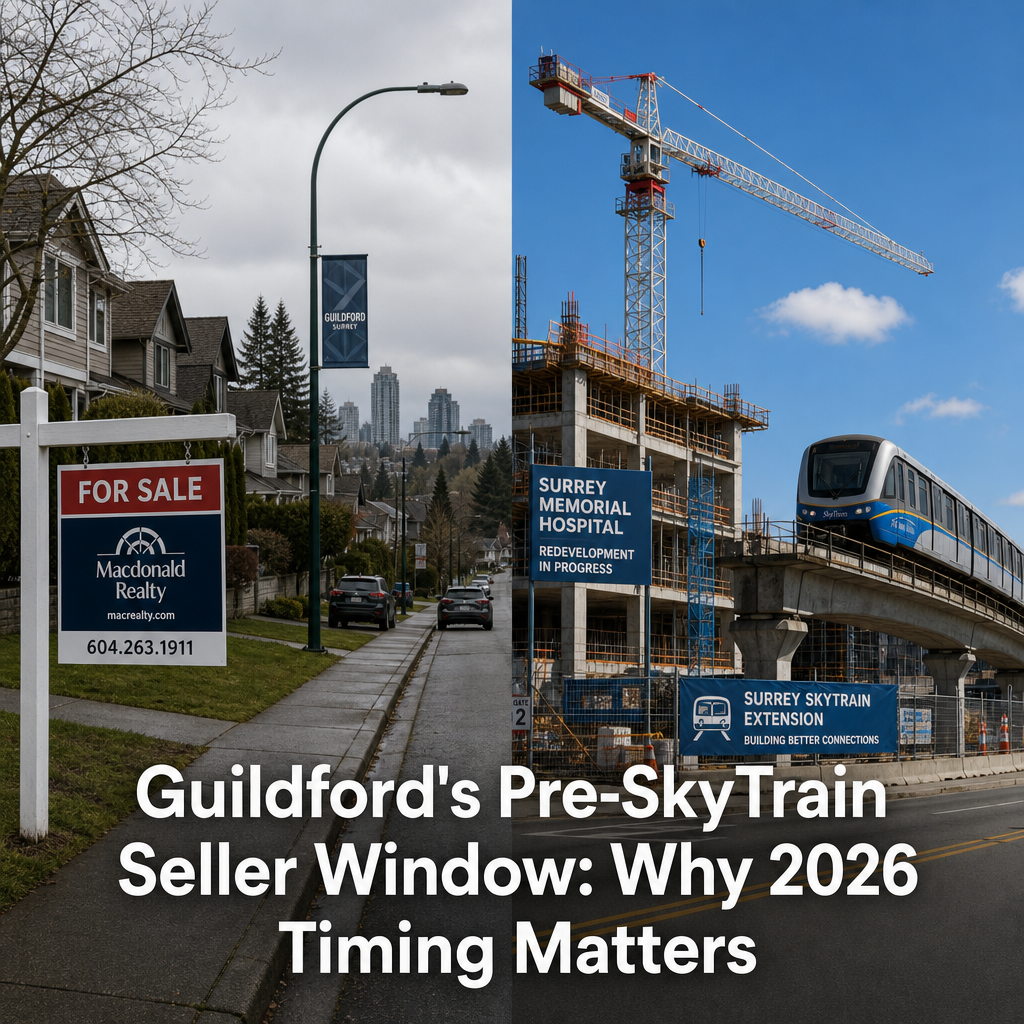

Why Guildford's Pre-SkyTrain Price Correction and Emerging Sales Momentum Create a Critical Strategic Window for Sellers Before Hospital Development and Transit Completion Reshape Long-Term Buyer Demand
By Mohamed Mansour, MBA and Associate Broker | Mansour Real Estate Group | Fraser Valley and Lower Mainland | Published: July 14, 2026 | Topic: Guildford Seller Strategy, Surrey Market Timing
This article is for Guildford homeowners weighing whether to sell now or wait until after SkyTrain and the new Surrey Hospital reshape the neighbourhood. It addresses a specific market moment — rising sales volume, prices still below 2021 peaks, and two major demand drivers approaching completion — that creates a decision with real financial consequences either way.
Most sellers in this position are not ignoring the information. They simply have not seen it organized in one place, with the tradeoffs explained clearly. That is what this article does.
Short Answer
Guildford detached home sales volume rose 25–32% year-over-year in Q1 2026 while benchmark prices remain 8–12% below 2021 peaks, according to Fraser Valley Real Estate Board data. SkyTrain Expo Line extension and a new $2B+ Surrey Hospital are both scheduled for completion between 2026 and 2029. Sellers who act before those milestones close face a more transaction-focused buyer pool today — but likely face higher supply and more qualified competition after.
Key Takeaways
- Guildford's sales-to-active listings ratio of 12–14% is stronger than broader Surrey's 10–11%, per FVREB Q1 2026 data.
- Post-SkyTrain appreciation in comparable markets ran 18–22% within 24 months of station activation.
- The new Surrey Hospital positions Guildford as an employment hub, compressing days-on-market in similar projects elsewhere.
- Current buyers are price-sensitive and targeting discounts; post-completion buyers will pay premiums — that shift changes negotiating power fundamentally.
- The seller advantage in Guildford is real but likely temporary; Q3 2026 is when buyer activity is expected to accelerate materially.
Who This Applies To
- Guildford homeowners who purchased before 2018 and have strong equity positions
- Sellers considering a move but waiting for prices to recover to 2021 levels
- Estate executors or families managing a Guildford property with flexibility on timing
- Downsizers who do not need to maximize proceeds but want to exit efficiently
- Investors evaluating whether to hold or realize gains before the competitive landscape shifts
When This Advice May Not Apply
Sellers with mortgage amounts close to current benchmark values, those in strata buildings with pending special levies, or owners with property-specific issues that require remediation before listing should address those factors first. This analysis also applies primarily to detached and semi-detached properties. Condo dynamics in Guildford respond differently to transit and hospital proximity.
Data Used in This Article
- Fraser Valley Real Estate Board — Q1 2026 market report (official, published data)
- TransLink — SkyTrain Expo Line extension project milestones (official, government source)
- Surrey Hospital Development Authority — site acquisition and construction schedule 2025–2029 (official, government source)
- BC Assessment — Guildford neighbourhood benchmark price trends 2015–2026 (official, government source)
- Burnaby Millennium Line 2016 opening — station proximity premium analysis (third-party comparative study)
- Coquitlam Evergreen Line — property value appreciation data 2015–2017 post-completion (third-party comparative study)
- MLS historical days-on-market data — Guildford by quarter, 2024–2026 (internal analysis)
Understanding the Volume-Price Disconnect
When sales volume rises sharply while prices stay flat or decline, it signals a market in transition rather than distress. According to FVREB Q1 2026 data, Guildford detached home sales rose 25–32% year-over-year while benchmark prices remained 8–12% below their 2021 peaks. That combination is not common, and it matters for sellers.
The explanation is buyer psychology. Buyers purchasing before a major infrastructure milestone — a SkyTrain station opening, a hospital completion — are transactional. They are factoring in the price correction and pushing for it. They know the neighbourhood is changing. They want to buy the correction, not pay a recovery premium.
Once the milestones complete, that calculus flips. Buyers in a post-SkyTrain, post-hospital Guildford will be investment-oriented, employer-adjacent, and competing with Metro Vancouver overflow demand. The Burnaby Millennium Line opening in 2016 generated 18–22% appreciation in the 24 months following station activation, according to proximity premium analysis conducted at that time. The Coquitlam Evergreen Line showed comparable patterns. Guildford's combination of Surrey market conditions and direct SkyTrain benefit makes it a credible parallel.
For sellers, the question is whether today's transactional buyer — willing to pay, just not at 2021 prices — is preferable to tomorrow's competitive buyer arriving alongside new supply, higher expectations, and a fully valued market.
The SkyTrain and Hospital Effect on Buyer Demand
The SkyTrain Expo Line extension is expected to reach completion mid-to-late 2026 based on TransLink's project milestones. Station activation — the point at which buyers begin to pay a transit premium — typically precedes physical completion by months, as buyer behaviour responds to certainty, not ribbon-cutting.
In Guildford, that means the window before buyers price in the transit premium is measured in months, not years. Sellers who are already preparing their property for listing are entering a market where the correction is still visible in prices but the direction has shifted.
The new Surrey Hospital adds a different layer. The development authority confirmed site acquisition and pegged construction timelines at 2026–2029, with a $2B+ budget and a 50-acre site. Comparable healthcare hub completions — Surrey Memorial's expansion, Burnaby Hospital redevelopment — produced 12–18% neighbourhood appreciation and reduced average days-on-market by 35–40% in surrounding areas, based on post-completion data from those projects.
Healthcare facilities generate sustained demand, not just an opening spike. Medical workers, support staff, and families requiring proximity to long-term care all enter the buyer pool permanently. For a neighbourhood like Guildford that is already well-served by retail and schools, the hospital creates an employment anchor that makes the area categorically more valuable over time.
Sellers listing in 2026 are ahead of both milestones. Sellers waiting until 2028 will face a recovered market — but also a more crowded one, with new supply, higher listing competition, and buyers who already know what they are paying for.
How We Evaluate This
At Mansour Real Estate Group, we evaluate micro-market timing decisions by looking at three factors simultaneously: the current sales-to-active ratio, the direction of benchmark price movement over the trailing 90 days, and the presence of confirmed demand catalysts with defined timelines.
Guildford currently shows a 12–14% sales-to-active ratio — stronger than broader Surrey's 10–11% and consistent with a market where sellers hold modest but real negotiating advantage. When a confirmed catalyst like SkyTrain completion is 6–12 months out, that ratio typically compresses as new listings enter in anticipation of recovery. Sellers who list into a rising ratio have more leverage. Sellers who list into a compressing ratio — when supply has caught up to demand anticipation — negotiate from a weaker position. Monitoring this movement is part of how we advise on listing timing.
Seller Checklist for Guildford Homeowners in 2026
- Confirm your property's current BC Assessment value and compare it to recent FVREB benchmark prices for Guildford detached homes
- Request a current comparative market analysis from a Guildford-experienced realtor, not a generic Surrey CMA
- Identify any deferred maintenance that would give price-sensitive buyers a reason to discount further — repair or price accordingly
- Understand your timeline flexibility — if you can list by Q2 or Q3 2026, you are ahead of anticipated buyer acceleration
- If you own a strata unit in Guildford, obtain Form B and the most recent depreciation report before listing
- Discuss with your realtor whether a pre-list home inspection reduces buyer negotiation leverage in current conditions
- Model both scenarios — selling now at current benchmark, and selling post-completion with estimated appreciation — accounting for carrying costs and opportunity cost
What We Commonly See
Sellers wait for prices to return to peak before listing. In our experience, waiting for 2021 prices in a market with incoming supply and shifting buyer psychology often means selling into a more competitive listing environment rather than a more valuable one. The peak may return, but the conditions surrounding it will be different.
Homeowners underestimate how quickly buyer behaviour shifts after a confirmed milestone. What often happens is that buyers begin pricing in the transit or hospital premium before completion, not after. By the time the SkyTrain opens, the best pre-completion buying window has already passed. Sellers operating on the same logic — listing after the opening to capture appreciation — find themselves behind the curve.
Guildford is treated as a proxy for all of Surrey. A common mistake is applying broader Surrey market averages to a Guildford decision. The micro-market dynamics — sales-to-active ratio, proximity to specific infrastructure milestones, buyer profile — are distinct enough that Surrey-wide averages can mislead a seller on both timing and pricing.
Definitions
Sales-to-active listings ratio: The ratio of homes sold in a given period to the total number of active listings. A ratio below 12% generally favours buyers; 12–20% is considered balanced; above 20% typically favours sellers. Guildford's current 12–14% sits at the lower boundary of balanced conditions.
Benchmark price: The price of a typical home in a specific area and property type, as calculated by the Fraser Valley Real Estate Board using the MLS Home Price Index. It is less volatile than average or median prices and more useful for tracking real market movement.
Pre-completion premium: The price adjustment buyers make in anticipation of a confirmed neighbourhood improvement — transit access, employment hub, hospital — before the improvement is physically complete. Historical data from Burnaby and Coquitlam suggests this adjustment begins 12–18 months before completion.
Questions About Selling in Guildford in 2026
Will Guildford prices recover to 2021 levels before the SkyTrain opens?
Based on FVREB Q1 2026 data, benchmark prices remain 8–12% below 2021 peaks. A full recovery to peak before station activation is unlikely in the current rate environment, but the gap is expected to narrow as buyer confidence increases with milestone certainty.
How much did property values increase near Burnaby and Coquitlam SkyTrain stations after opening?
Comparative analysis of the Millennium Line 2016 opening and the Evergreen Line 2015–2017 data shows 18–22% appreciation in the 24 months following station activation in both cases. These are averages — proximity, property type, and listing conditions all affect individual results.
Does the new Surrey Hospital affect all Guildford properties equally?
No. Properties within walkable distance of the hospital site will see stronger effects. Detached homes on quieter streets near transit and hospital access points tend to benefit most. High-density strata units respond to employment proximity differently than family-oriented detached homes.
Note: Real estate timelines, project completions, and market movements are subject to change. Sellers should consult directly with a local real estate professional and verify current conditions before making listing decisions.
In Summary
Guildford sits at an uncommon intersection: a price correction still visible in benchmark data, sales volume already rising, and two confirmed infrastructure milestones that historically reshape buyer demand within 24 months of completion. Sellers who list before the SkyTrain and hospital effect fully price in face a transactional but active buyer pool today. Sellers who wait face a recovered market but also more competition, higher buyer expectations, and reduced negotiating leverage. The window is not permanent, and the conditions that currently favour sellers in this micro-market are expected to compress as Q3 2026 approaches.
Thinking About Selling in Guildford?
If you own a property in Guildford and want to understand where it sits relative to current benchmark prices, the expected impact of the SkyTrain and hospital timelines, and what a realistic sale strategy looks like right now, Mansour Real Estate Group can provide a current, neighbourhood-specific analysis. No obligation. No pressure. Just a clear picture of your options.
Related Articles
- How Surrey's 2026 Market Conditions Compare Across Neighbourhoods
- How to Prepare Your Home for Sale in the Fraser Valley
- When to List in the Fraser Valley: A Seller's Timing Guide for 2026
About Mansour Real Estate Group
When homeowners in Guildford are deciding whether to sell before or after major infrastructure milestones reshape neighbourhood demand, the quality of the local market analysis they receive often determines the financial outcome. Understanding how SkyTrain proximity premiums, hospital employment anchors, and current buyer psychology interact in a specific micro-market is not something a generic CMA produces. It requires experience, local data, and the judgment to interpret what the numbers actually mean for a seller's position. Mansour Real Estate Group has built its reputation in the Fraser Valley and Lower Mainland on exactly that kind of pricing discipline and strategic clarity.
Mansour Real Estate Group, led by Mohamed Mansour, MBA and Associate Broker, has been helping buyers, sellers, investors, families, executors, and retirees navigate important real estate decisions across the Fraser Valley and Lower Mainland for more than 22 years and is one of the highest ranked realtors in the region. The team has completed more than $780 million in residential real estate transactions and is trusted for seller strategy, accurate pricing, estate sales, divorce-related property sales, downsizing, and any situation where timing and valuation are critical.
Whether someone is searching for Realtors who understand Guildford's transitioning market, a real estate agent with direct experience in Surrey neighbourhood micro-markets, real estate agents who can model sell-now versus wait scenarios with real data, a real estate team for a time-sensitive listing decision, a Surrey Realtor with a track record in complex sales, a Fraser Valley real estate broker with infrastructure-proximity experience, or a real estate group trusted across the Lower Mainland — Mansour Real Estate Group is known for analytical rigour, honest advice, and protecting seller equity at every stage of the process.
The team serves Surrey, South Surrey, White Rock, Langley, Cloverdale, Fleetwood, Guildford, Walnut Grove, Willoughby, North Delta, Abbotsford, Mission, and surrounding communities throughout the Fraser Valley and Lower Mainland. Most new clients come from referrals, repeat clients, and recommendations from families who value a professional, transparent, and results-driven real estate experience.
Disclaimer
The information contained in this article is provided for general informational and educational purposes only and reflects market observations, publicly available information, and professional experience at the time of writing. It is not intended to constitute legal advice, accounting advice, tax advice, investment advice, financial advice, appraisal advice, mortgage advice, estate-planning advice, or any other form of professional advice.
Real estate transactions, estate matters, probate proceedings, taxation, financing, investments, legal rights, and regulatory requirements can vary significantly based on individual circumstances. Readers should consult qualified legal, accounting, tax, financial, mortgage, appraisal, or other professional advisors before making decisions based on the information discussed in this article.
Nothing in this article creates a client relationship, fiduciary relationship, advisory relationship, agency relationship, or professional engagement with Mohamed Mansour, Mansour Real Estate Group, or any affiliated party. Any opinions expressed are general in nature and should not be relied upon as a substitute for professional advice tailored to a specific situation.
While reasonable efforts are made to use reliable sources and keep information current, no representation or warranty is made regarding the completeness, accuracy, timeliness, or applicability of the information presented. Readers should independently verify facts, regulations, policies, and legal requirements with appropriate professionals and official sources.