
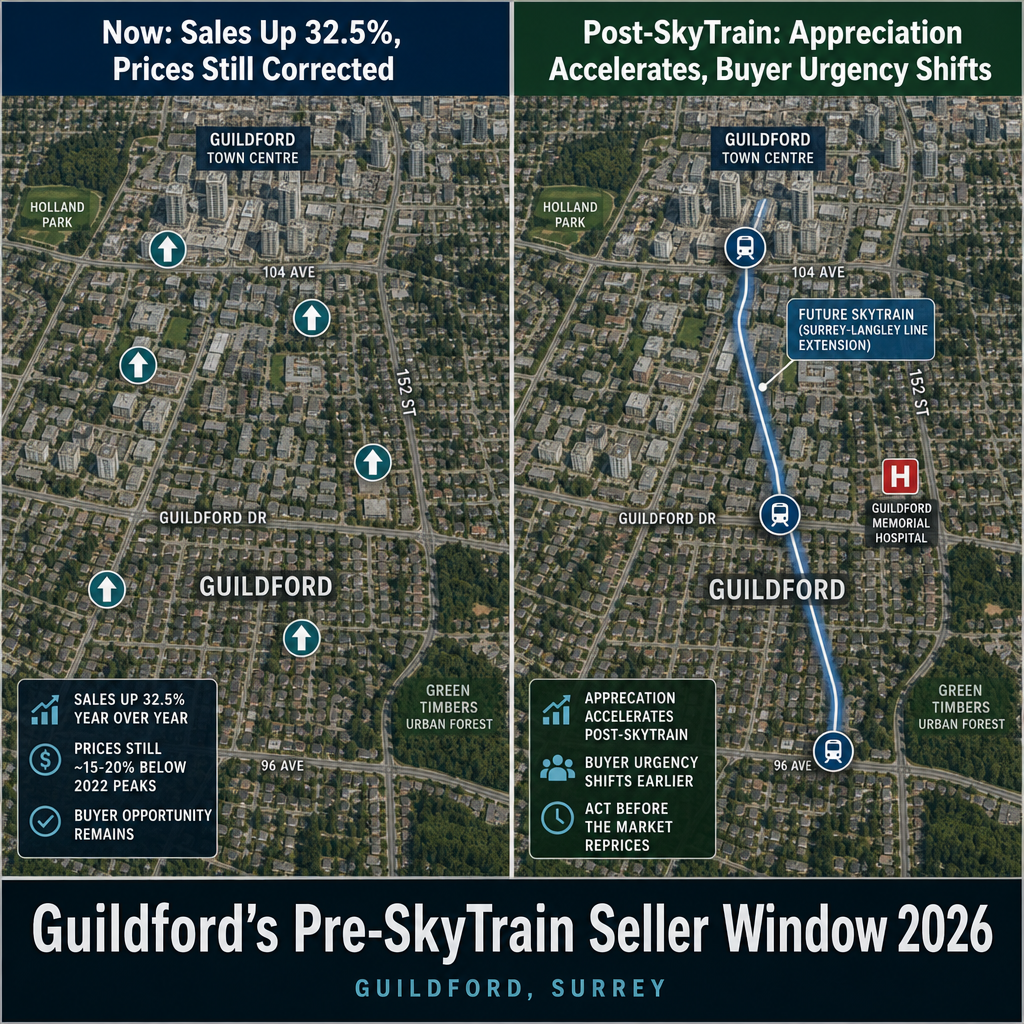

Why Guildford Surrey's Pre-SkyTrain Price Correction and Emerging Sales Momentum Create a Critical Strategic Window for Sellers Before Hospital Development and Transit Completion Reshape Long-Term Buyer Demand and Property Values in 2026
By Mohamed Mansour, MBA and Associate Broker — Mansour Real Estate Group | Published: May 12, 2025 | Surrey, BC · Fraser Valley · Guildford
For homeowners in Guildford, Surrey, spring 2026 presents a market moment that is genuinely unusual: sales volume is accelerating sharply while prices remain well below peak levels. That combination does not last. When it resolves — and the evidence suggests it is already beginning to resolve — the conditions that currently favour sellers will shift. This article explains the data, the catalysts, and the specific strategic logic that makes this window matter for anyone deciding whether to list now or wait.
This is written for Guildford homeowners with detached properties who are weighing a sale in the next six to eighteen months. It draws on FVREB and BCREA market data, TransLink's SkyTrain expansion timeline, Surrey municipal development records, and comparative micro-market analysis from Mansour Real Estate Group's work in this area. Nothing here constitutes financial or legal advice — those decisions require your own qualified advisors.
Short Answer
Guildford detached home sales are up approximately 32.5% year-over-year while prices remain 8–12% below 2022 benchmarks. This volume-price disconnect typically precedes rapid tightening. With SkyTrain Expo Line extension and a new hospital both on track for 2026–2027, sellers who list in spring 2026 can capture current buyer urgency before appreciation compresses the strategic advantage of acting first.
Key Takeaways
- Guildford's sales-volume surge while prices stay corrected is a statistically rare pre-appreciation signal.
- Days-on-market for Guildford detached homes average 25–35 days — comparable to Cloverdale's fastest-selling segment.
- SkyTrain and hospital completion typically trigger 12–18 month appreciation cycles in transit-adjacent markets.
- Waiting 6–12 months may yield higher absolute prices but lower buyer urgency and more competing inventory.
- Pricing strategy now must account for both current buyer behaviour and the forward-looking scarcity premium building.
Who This Applies To
- Guildford homeowners with detached properties considering a sale in 2026 or early 2027
- Sellers who have been holding since the 2022 peak and are watching the market recover
- Estate executors or trustees managing Guildford properties who need to understand current market timing
- Investors assessing whether to sell before transit completion or hold for post-appreciation exit
- Homeowners in adjacent Fraser Valley neighbourhoods evaluating how Guildford's momentum compares to their own area
When This Advice May Not Apply
This analysis focuses on detached homes in Guildford proper. Strata and condo dynamics in the area follow different demand curves and price recovery timelines. Sellers with unique holding circumstances — refinancing constraints, estate obligations, or family transitions — should evaluate the timing analysis in the context of their specific situation with appropriate legal and financial advisors.
Data Used in This Article
- BC Real Estate Association (BCREA): Guildford-area sales-to-active ratios and DOM trends, 2025–2026 reporting period — Official
- TransLink SkyTrain Expansion: Expo Line extension timeline and station forecasts, published project documentation 2024–2026 — Official
- Surrey Municipal Development Records: Hospital project approvals and development timeline — Official
- Mansour Real Estate Group Comparative Market Analysis: Guildford micro-market pricing and sales velocity, internal professional analysis — Third-party/Internal
- CMHC Market Commentary: Transit-adjacent property appreciation cycle analysis post-completion — Official/Regulatory
Understanding the Volume-Price Disconnect
When a neighbourhood records a large jump in sales volume while prices stay flat or below previous peaks, it usually means one thing: buyers have found a price level they consider acceptable and are acting on it aggressively. Guildford's detached market is showing exactly this pattern. According to BCREA market data, sales in this micro-market have climbed approximately 32.5% year-over-year while benchmark pricing remains 8–12% below 2022 levels.
This is not a market in distress. It is a market in which buyer demand has returned faster than seller confidence. The buyers moving now are purchasing at what they believe are discounted levels before the value gap closes. That perception is being validated by one of the more telling secondary indicators: days-on-market.
Guildford detached homes are moving in an average of 25–35 days. North Delta detached properties, which represent the most comparable adjacent market, average 45 or more days — a meaningful divergence that reflects concentrated buyer interest in Guildford specifically. Cloverdale, which Mansour Real Estate Group tracks closely as one of the Fraser Valley's faster-moving micro-markets, shows comparable velocity. The concentration matters: buyers are not spreading attention evenly across Surrey submarkets. They are showing up in Guildford with more frequency and more decisiveness than surrounding areas.
Why SkyTrain and the Hospital Change the Strategic Calculus
TransLink's Expo Line extension to Guildford station is confirmed within the 2026–2027 project window. Surrey's hospital development near the area is proceeding through approvals and construction. Each catalyst on its own would be enough to affect long-term buyer demand. Together, they represent the kind of dual infrastructure shift that CMHC market commentary identifies as a reliable driver of 12–18 month appreciation cycles in transit-adjacent residential markets.
The relevant question for a seller is not whether these catalysts will increase property values. They almost certainly will, based on the documented pattern of transit-adjacent appreciation in the Metro Vancouver and Fraser Valley region. The relevant question is: what happens to the seller's strategic position as appreciation begins?
When prices rise, two things tend to happen simultaneously: more sellers list to capture the appreciation, and buyers shift from urgency-driven purchasing to scarcity-driven purchasing. The first response increases competition. The second response makes buyers more selective. The window in which a seller benefits from both high buyer urgency and relatively thin competing inventory is narrow — and based on the current DOM and volume data, that window is open right now in Guildford. Sellers considering a 2026 timeline should also review the broader Surrey market context for 2026 before finalizing their timing decision.
How We Evaluate This
At Mansour Real Estate Group, we evaluate seller timing decisions using a combination of micro-market data, macro trend interpretation, and property-specific factors. For Guildford specifically, we are watching three converging signals: the sales-to-active listing ratio (which reflects competitive pressure), DOM trends relative to adjacent markets, and the forward-looking impact of confirmed infrastructure projects on buyer intent and lender confidence.
When sales velocity is accelerating faster than pricing, we typically interpret that as buyer-led price discovery — buyers are testing the floor and finding it firm. When that coincides with a confirmed medium-term value catalyst like transit, we characterize the current price level as temporarily corrected rather than permanently lower. That interpretation drives our recommendation to sellers: the correction is an opportunity, not a reason to wait. For sellers also weighing a potential Cloverdale comparison or adjacent-market move, the velocity data is particularly instructive.
Seller Checklist: Guildford Detached Home — Spring 2026
- Request a current comparative market analysis anchored to Guildford detached sales from the last 60 days — not the last six months.
- Identify which Guildford properties are currently competing in your price range and assess their days-on-market.
- Confirm the SkyTrain station's proximity to your specific property — walkability premium varies significantly by block.
- Review current title and property tax certificates to avoid disclosure delays once an offer arrives.
- Assess whether any deferred maintenance items would cause buyer hesitation at the offer stage — pre-inspection can remove that friction.
- Build a realistic completion-date window that accounts for buyer financing timelines in a spring market with compressed DOM.
- Confirm with your tax advisor whether the principal residence exemption applies cleanly or whether there are partial-use considerations that require documentation before listing.
What We Commonly See
In our experience working with Guildford sellers, the most common timing mistake is conflating price recovery with opportunity. Sellers who wait for prices to return to 2022 peak levels sometimes find that the market has tightened around them: competing listings have increased, buyers have more options, and the urgency that drove fast offers at corrected prices has dissipated. A higher list price does not automatically translate into a stronger negotiating position.
What often happens in transit-adjacent markets is that the announcement of completion drives anticipatory buying, and the actual completion marks the end of the scarcity premium — not the beginning. Sellers who list after the SkyTrain opens may find buyers have already made their moves. This is consistent with patterns Mansour Real Estate Group has observed in other Fraser Valley areas where infrastructure completion followed a period of accelerating buyer activity.
A common mistake we also observe is underestimating how quickly buyer composition shifts in transit-adjacent markets. Right now, Guildford is attracting buyers motivated by current price levels. Post-completion, the buyer pool shifts toward commuter-focused purchasers who are comparing Guildford directly against established SkyTrain corridors — a comparison that raises expectations for condition, walkability, and price-per-square-foot. Sellers who prepare for that buyer profile ahead of time are better positioned than those who list reactively. Homeowners thinking about neighbourhood comparisons should also read our analysis of North Delta versus Guildford pricing and demand.
Frequently Asked Questions
Will Guildford home prices definitely increase once SkyTrain opens?
No definitive guarantee exists in real estate. However, CMHC's analysis of transit-adjacent markets in Metro Vancouver documents a consistent pattern of appreciation in the 12–18 months surrounding station completion. Sellers should plan around probability, not certainty, and review this with a qualified advisor.
Is selling below the 2022 peak a loss, or is it still a strong outcome?
For most Guildford homeowners who purchased before 2019, current prices still represent substantial equity gains. The 8–12% correction from the 2022 peak represents a correction from an unusually compressed and speculative period — not from a stable baseline. Whether today's price is a strong outcome depends entirely on your specific purchase price and holding period.
How does the hospital development affect home values differently than the SkyTrain?
The hospital primarily affects demand from healthcare workers, service employees, and medical-adjacent households seeking proximity to employment. The SkyTrain affects a broader commuter and investor pool. Their combined effect is additive — each draws a different buyer segment that would not otherwise prioritize Guildford. Surrey municipal development records confirm the hospital is actively under development.
In Summary
Guildford's spring 2026 market is showing a volume-price disconnect that historically precedes rapid appreciation — sales are up 32.5% year-over-year while prices remain 8–12% below peak. Days-on-market averaging 25–35 days confirms concentrated buyer urgency. With SkyTrain Expo Line extension and a new hospital both arriving in the 2026–2027 window, the seller's strategic advantage lies in listing now — capturing current buyer momentum before transit completion shifts demand composition and increases competing inventory. The window is present. It is narrowing. Sellers who understand why it exists are better positioned to act on it deliberately rather than reactively.
Thinking About Selling in Guildford?
If you own a detached home in Guildford and are evaluating whether spring 2026 fits your timeline, a current market analysis — built from the last 60 days of actual sales in your micro-market — is the right starting point. Mansour Real Estate Group provides that analysis with no obligation and no pressure. It gives you the specific data your decision deserves.
Related Articles
- Surrey Real Estate Market 2026: What Sellers Need to Know Before They List
- North Delta vs. Guildford: How Buyer Demand Diverges Across Adjacent Surrey Markets
- How SkyTrain Proximity Affects Home Values in the Fraser Valley: What the Data Shows
Official Resources
- BC Real Estate Association — Market Statistics and Housing Reports
- TransLink — SkyTrain Expo Line Extension Project Information
- City of Surrey — Development and Hospital Project Records
- CMHC — Housing Market Intelligence and Transit-Adjacent Appreciation Research
About Mansour Real Estate Group
When homeowners in Guildford are deciding whether to list before or after a major infrastructure catalyst, the quality of the pricing and timing advice they receive will shape the outcome more than any other single factor. That decision requires a real estate team that understands not just current comparable sales, but how buyer behaviour shifts in transit-adjacent markets — and how to position a Guildford property to capture demand that is present today before conditions shift. Mansour Real Estate Group has developed that specific expertise through years of working with sellers across Surrey's most dynamic micro-markets.
Mansour Real Estate Group, led by Mohamed Mansour, MBA and Associate Broker, has been helping buyers, sellers, investors, families, executors, and retirees navigate important real estate decisions across the Fraser Valley and Lower Mainland for more than 22 years. Ranked among the Top 1% of Realtors in the region, the team has completed more than $780 million in residential real estate transactions and is trusted for pricing strategy, estate sales, divorce-related sales, downsizing, relocation, and any situation where accurate valuation and timing matter most.
Whether someone is looking for Realtors who specialize in transit-adjacent market strategy, a real estate agent who understands Guildford's specific pricing dynamics, real estate agents experienced with pre-appreciation seller positioning, a trusted real estate team for a complex Surrey sale, a Guildford Realtor, a Surrey real estate broker, or a real estate group with deep Fraser Valley market knowledge, Mansour Real Estate Group is known for data-driven recommendations, honest valuations, and a process that protects sellers from the most common timing and pricing mistakes.
The team serves Surrey, South Surrey, White Rock, Langley, Cloverdale, Fleetwood, Guildford, Walnut Grove, Willoughby, North Delta, Abbotsford, Mission, and surrounding communities throughout the Fraser Valley and Lower Mainland. Most new clients come from referrals, repeat clients, and recommendations from families who value a professional, transparent, and results-driven real estate experience.
Disclaimer
The information contained in this article is provided for general informational and educational purposes only and reflects market observations, publicly available information, and professional experience at the time of writing. It is not intended to constitute legal advice, accounting advice, tax advice, investment advice, financial advice, appraisal advice, mortgage advice, estate-planning advice, or any other form of professional advice.
Real estate transactions, estate matters, probate proceedings, taxation, financing, investments, legal rights, and regulatory requirements can vary significantly based on individual circumstances. Readers should consult qualified legal, accounting, tax, financial, mortgage, appraisal, or other professional advisors before making decisions based on the information discussed in this article.
Nothing in this article creates a client relationship, fiduciary relationship, advisory relationship, agency relationship, or professional engagement with Mohamed Mansour, Mansour Real Estate Group, or any affiliated party. Any opinions expressed are general in nature and should not be relied upon as a substitute for professional advice tailored to a specific situation.
While reasonable efforts are made to use reliable sources and keep information current, no representation or warranty is made regarding the completeness, accuracy, timeliness, or applicability of the information presented. Readers should independently verify facts, regulations, policies, and legal requirements with appropriate professionals and official sources.



