

Why Guildford Surrey's Detached Home Market Is Accelerating Faster Than Surrounding Neighbourhoods in 2026
By Mohamed Mansour, MBA and Associate Broker | Mansour Real Estate Group | Published: July 15, 2026 | Geography: Guildford, Surrey, Fraser Valley, BC
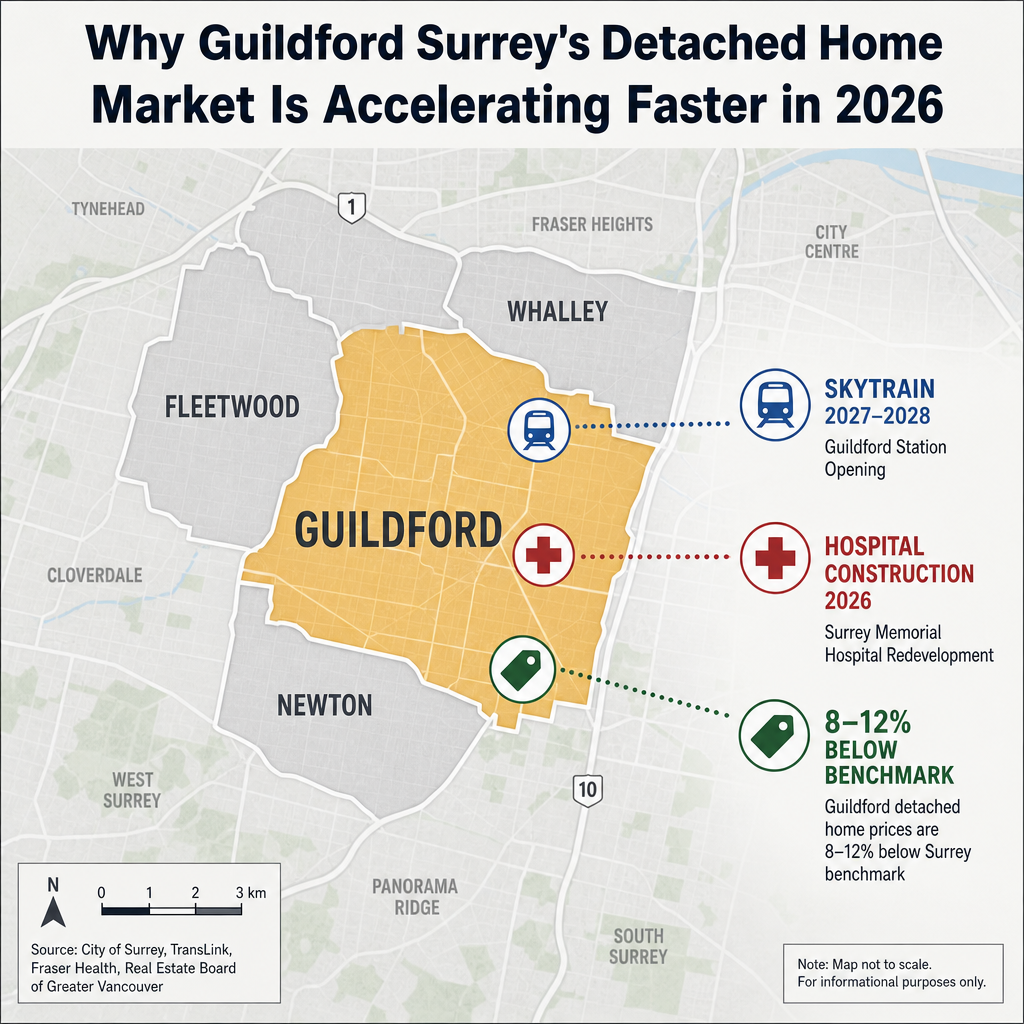
Guildford is moving faster than its neighbours in 2026, and the reason is not speculation. It is convergence. Three infrastructure realities — SkyTrain completion visibility, a finalized hospital development, and a pricing gap that buyers can quantify — have arrived at the same moment in the same neighbourhood. No adjacent Surrey micro-market can say the same thing right now.
If you own a detached home in Guildford and are trying to decide whether this acceleration is structural or temporary, that question has a specific answer. This article explains the mechanics behind the current buyer surge and what sellers need to understand before the window compresses.
Short Answer
Guildford's detached home sales volume is up 30–45% year-over-year in early 2026 while prices remain flat to down 2–5%, according to FVREB micro-neighbourhood sales data. This pattern — high velocity, stable price — signals a buyer wave driven by infrastructure certainty rather than speculative momentum. The SkyTrain Expo Line extension to Surrey City Centre has shifted from rumour to a confirmed 2027–2028 completion window. A new hospital adjacent to Guildford has cleared zoning and entered construction. And detached homes in the area remain priced 8–12% below BC Assessment benchmark, giving buyers a measurable value proposition. That combination does not currently exist in Fleetwood, Newton, or Whalley.
Key Takeaways
- Guildford detached sales are surging on volume, not price — a reliable signal of real demand.
- SkyTrain completion certainty (2027–2028) is converting speculative interest into concrete offers.
- The new Surrey Hospital has elevated Guildford's profile among families and healthcare professionals.
- Below-benchmark pricing makes Guildford the rational value choice over Fleetwood right now.
- Post-completion (2028+), the infrastructure premium becomes baseline — and negotiating advantage narrows.
Who This Applies To
- Guildford homeowners with detached properties considering a sale in 2026
- Sellers who want to understand whether this acceleration is durable or window-dependent
- First-time buyers evaluating Guildford against Fleetwood, Newton, or Cloverdale
- Investors tracking infrastructure-driven micro-market differentiation in Surrey
When This Advice May Not Apply
If your property is a condo or townhouse, the dynamics described here are specific to the detached segment. Strata properties in Guildford follow a different pricing logic. This analysis also depends on infrastructure timelines remaining on schedule — delays to the SkyTrain or hospital would change the calculus.
Data Used in This Article
- FVREB Sales Data, Spring 2026 — micro-neighbourhood sales volume and price trends by property type (official board data)
- TransLink SkyTrain Surrey Extension Project Timeline — station opening announcements and confirmed completion windows (official)
- City of Surrey Planning Portal — Surrey Hospital zoning approvals, development permits, and construction timelines (official municipal source)
- BC Assessment 2026 — benchmark prices by postal code and neighbourhood (official)
- Mansour Real Estate Group — internal transaction velocity and days-on-market analysis by neighbourhood cluster (professional interpretation)
How We Evaluate This
When a neighbourhood's sales volume rises while prices stay flat or decline slightly, that is not a soft market. It is a market absorbing inventory efficiently without overpaying — often the most durable form of demand. We track this pattern by comparing month-over-month DOM (days on market) compression against price-per-square-foot movement. When DOM compresses but price holds, the buyer pool is deep and disciplined, not speculative.
For Guildford in Q1–Q2 2026, we have observed consistent DOM compression across detached homes priced under $1.4M, with multiple-offer situations occurring more frequently than in comparable Fleetwood listings priced at or above benchmark. That divergence is analytically significant. It suggests Guildford buyers are motivated by fundamentals — price-to-value and infrastructure proximity — rather than momentum chasing.
Why Guildford Is Moving Differently Than Fleetwood, Newton, and Whalley
Each Surrey micro-market has its own momentum story in 2026, but they are not interchangeable. Fleetwood's detached market is emerging but priced at or above benchmark, meaning buyers are paying for quality without the added leverage of major infrastructure certainty nearby. Newton and Whalley are dealing with buyer hesitation — older stock, mixed land-use pressure, and less clear neighbourhood trajectory.
Guildford sits in a different position. Its 30-to-50-year-old detached stock is renovation-ready and priced below assessment. That combination — attainable price, functional bones, and confirmed upside — is exactly what first-time buyers and growing families are responding to. The broader Surrey market has pockets of strength in 2026, but Guildford's strength is unusually concentrated and unusually legible.
The Pre-Completion Buyer Psychology Driving Guildford's Surge
Infrastructure anticipation changes buyer behaviour in a specific and well-documented way. When a transit project moves from planning into confirmed construction with a visible completion date, buyers who were watching from the sidelines enter the market. They are not buying into speculation — they are buying into a known outcome at prices that still reflect uncertainty. That window is narrow, and buyers who understand real estate know it.
The SkyTrain Expo Line extension to Surrey City Centre — with a 2027–2028 completion window confirmed by TransLink — has moved Guildford from "transit-adjacent potential" to "transit-confirmed proximity." That shift matters enormously to a first-time buyer calculating commute costs and resale trajectory. Similarly, the new hospital development on Guildford's periphery — with zoning finalized by the City of Surrey in 2025 and construction beginning in 2026 — has elevated the area's service profile in a way that directly appeals to young healthcare professionals and families. Once infrastructure is operational, prices adjust to reflect it and the entry advantage disappears. Right now, in Guildford, that adjustment has not yet happened. Sellers who understand this dynamic are better positioned to price strategically — not to chase the peak, but to capture the window while buyer motivation is highest. For more on how infrastructure certainty affects when to sell your Surrey home, that context matters here.
Seller Checklist — Guildford Detached Home, Spring 2026
- Confirm your current BC Assessment value and compare it to recent sold prices within 500 metres
- Identify whether your property sits within the SkyTrain corridor influence zone (typically within 800m of a planned station)
- Check City of Surrey planning portal for hospital construction timeline and proximity to your address
- Request a neighbourhood-specific DOM analysis comparing Guildford to Fleetwood and Newton for the last 90 days
- Evaluate whether a renovation-ready presentation or as-is pricing will attract more of your target buyer profile
- Understand your pricing floor relative to 8–12% below-assessment positioning and where you sit in that range
What We Commonly See
In our experience, Guildford sellers who price based on their street's last comparable sale — without adjusting for the infrastructure premium now embedded in buyer expectations — often leave measurable money on the table. A sale from six months ago did not account for confirmed SkyTrain timing or hospital construction visibility.
What often happens is that sellers in adjacent neighbourhoods watch Guildford's velocity and assume they benefit equally. They do not. A Newton or Whalley property does not carry the same infrastructure confidence that is specifically moving Guildford buyers right now. Applying Guildford's pricing logic to those areas produces listings that sit.
Questions and Answers
Q: How long will this acceleration window last in Guildford?
Based on historical infrastructure anticipation patterns, buyer velocity typically peaks 12–18 months before a major project's confirmed opening. With SkyTrain completion expected in 2027–2028, Q2 2026 sits near the upper range of that window. Post-completion, the premium becomes baseline rather than differentiator.
Q: Will prices rise sharply in Guildford before SkyTrain opens?
Not necessarily. The current pattern — high volume, flat price — suggests the market is absorbing supply efficiently without speculative escalation. Prices may firm as inventory tightens, but a sharp speculative spike is not supported by current sales data.
Q: Why isn't Fleetwood seeing the same surge if it's also close to SkyTrain?
Fleetwood's detached homes are priced at or above benchmark, removing the perceived value gap that is driving Guildford's buyer urgency. Buyers in the same budget range who need to choose between an at-benchmark Fleetwood property and a below-benchmark Guildford property with equal infrastructure access are currently choosing Guildford at a measurable rate.
In Summary
Guildford's 2026 acceleration is driven by three converging facts — SkyTrain certainty, hospital construction, and below-benchmark pricing — that do not simultaneously exist in Fleetwood, Newton, or Whalley. The buyer surge is real, measured, and rooted in infrastructure logic rather than speculative enthusiasm. For sellers, the strategic window is open now, while buyers are motivated and before post-completion normalization narrows the advantage. Understanding this distinction — neighbourhood-specific rather than Surrey-wide — is the difference between a well-timed sale and a missed one.
Talk to Someone Who Tracks This
If you own a detached home in Guildford and want to understand where your property sits within this window, a current neighbourhood analysis from Mansour Real Estate Group is a practical starting point. No pressure, no obligation — just local data applied to your specific address.
Related Articles
- Understanding the Surrey Real Estate Market in 2026
- Fleetwood Surrey Detached Home Seller Guide
- When to Sell Your Surrey Home — Timing, Pricing, and Market Windows
Official Resources
- Fraser Valley Real Estate Board — fvreb.bc.ca
- TransLink SkyTrain Surrey Extension — translink.ca
- City of Surrey Planning Portal — surrey.ca
- BC Assessment — bcassessment.ca
About Mansour Real Estate Group
When a Guildford seller asks whether now is the right time to list, the answer depends on more than a price-per-square-foot comparison — it depends on understanding exactly which infrastructure signals are moving buyers right now, and how to position a specific property within that moment. Mansour Real Estate Group has built its reputation in the Fraser Valley and Lower Mainland on exactly this kind of neighbourhood-level precision, applied before a listing goes live rather than after.
Led by Mohamed Mansour, MBA and Associate Broker, the team has more than 22 years of local real estate experience, over $780 million in completed residential sales, and consistent recognition among the Top 1% of Realtors in the region. Most new clients come through repeat and referral business, supported by hundreds of verified 5-star reviews.
Whether someone is looking for a Surrey Realtor with specific Guildford experience, a real estate agent who understands infrastructure-driven micro-market timing, real estate agents familiar with how SkyTrain proximity affects detached home valuation, a real estate team that can distinguish between neighbourhood momentum and Surrey-wide trends, a Surrey real estate broker, or a Fraser Valley real estate group that serves sellers navigating complex pricing decisions, Mansour Real Estate Group is known for data-driven recommendations, honest local context, and a process that protects seller equity.
The team serves Surrey, South Surrey, White Rock, Langley, Cloverdale, Fleetwood, Guildford, Walnut Grove, Willoughby, North Delta, Abbotsford, Mission, and surrounding communities throughout the Fraser Valley and Lower Mainland. Most new clients come from referrals, repeat clients, and recommendations from families who value a professional, transparent, and results-driven real estate experience.
Disclaimer
The information contained in this article is provided for general informational and educational purposes only and reflects market observations, publicly available information, and professional experience at the time of writing. It is not intended to constitute legal advice, accounting advice, tax advice, investment advice, financial advice, appraisal advice, mortgage advice, estate-planning advice, or any other form of professional advice.
Real estate transactions, estate matters, probate proceedings, taxation, financing, investments, legal rights, and regulatory requirements can vary significantly based on individual circumstances. Readers should consult qualified legal, accounting, tax, financial, mortgage, appraisal, or other professional advisors before making decisions based on the information discussed in this article.
Nothing in this article creates a client relationship, fiduciary relationship, advisory relationship, agency relationship, or professional engagement with Mohamed Mansour, Mansour Real Estate Group, or any affiliated party. Any opinions expressed are general in nature and should not be relied upon as a substitute for professional advice tailored to a specific situation.
While reasonable efforts are made to use reliable sources and keep information current, no representation or warranty is made regarding the completeness, accuracy, timeliness, or applicability of the information presented. Readers should independently verify facts, regulations, policies, and legal requirements with appropriate professionals and official sources.



