
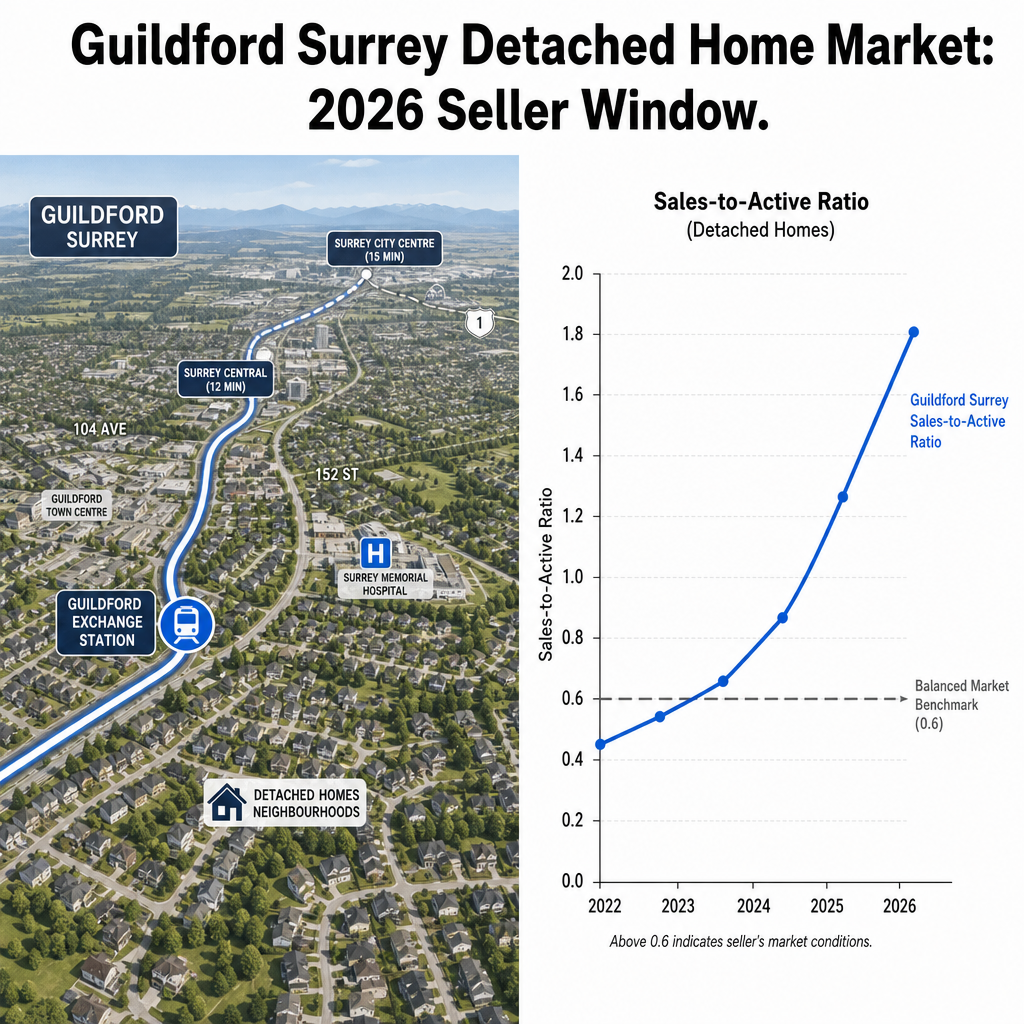

Why Guildford Surrey's Detached Home Market Acceleration in 2026 Creates a Rare Strategic Seller Window Before SkyTrain Completion and Hospital Development Reshape Long-Term Buyer Demand and Neighbourhood Dynamics
By Mohamed Mansour, MBA and Associate Broker | Mansour Real Estate Group | Published: May 14, 2026 | Fraser Valley and Surrey Real Estate
This article is for Guildford homeowners who are thinking about selling in 2026 and want to understand what is actually happening in their specific micro-market — not what the broader Surrey or Fraser Valley averages suggest. The conditions driving Guildford's current detached market divergence are specific, measurable, and unlikely to repeat once SkyTrain service begins and hospital development moves from announcement to construction.
If you have been waiting for the right moment, the data suggests that moment is now — and the window has a definable end point tied to infrastructure milestones, not just general market sentiment.
Short Answer
Guildford's detached home market is accelerating in early 2026 — sales volume is rising while prices remain 8 to 12 percent below Fraser Valley benchmark averages. A localized sales-to-active ratio of 13 to 15 percent exceeds the regional average of 11 percent, indicating tighter inventory than the broader market reflects. SkyTrain station proximity and a nearby hospital development are beginning to shift buyer behaviour. Sellers who list before those infrastructure narratives peak are positioning ahead of the buyer-profile shift that follows completion.
Key Takeaways
- Guildford's sales-to-active ratio of 13 to 15 percent exceeds the Fraser Valley average, signalling a localized seller advantage within a broader buyer's market.
- Detached prices remain 8 to 12 percent below Fraser Valley benchmark — a gap that buyer awareness of transit completion is beginning to close.
- Adjacent neighbourhoods like Cloverdale and Clayton already command 10 to 15 percent premiums linked to earlier transit narrative recognition.
- Hospital development and SkyTrain proximity will shift Guildford's buyer profile from primary-residence seekers toward investors and amenity-focused buyers.
- Once infrastructure milestones are complete and media coverage catches up, the pricing gap will close and seller leverage will normalize.
Who This Applies To
- Guildford homeowners who have been watching the market and considering a 2026 or 2027 sale
- Sellers who own detached homes in Guildford purchased before 2020 and have significant equity to protect
- Homeowners who plan to downsize, relocate, or transition into a different property type
- Estate executors managing a Guildford detached property
- Sellers evaluating whether to wait for the SkyTrain completion to attract higher offers
When This Advice May Not Apply
If your property has significant deferred maintenance, pending strata or legal issues, or if your personal financial timeline does not align with a 2026 listing, the market window is secondary to your specific readiness. This analysis addresses market timing — not personal financial planning or legal strategy. Consult qualified advisors for those decisions.
Data Used in This Article
- FVREB Market Statistics, April 2026 — Fraser Valley Real Estate Board, official regional data (Tier 1)
- BC Transit SkyTrain Expansion Project Status — Official government source, project completion timeline (Tier 1)
- Surrey Official Community Plan Amendment, Guildford Station Area — City of Surrey, land use and zoning (Tier 1)
- Surrey Hospital Site Development Announcement 2025–2026 — Government of BC and City of Surrey (Tier 1)
- Mansour Real Estate Group Transaction Data: Guildford Micro-Market Analysis Q1 2026 — Internal professional analysis (Tier 5 — clearly identified as interpretation)
- REBGV Market Commentary: Transit-Oriented Development Pricing Patterns — Industry body research (Tier 2)
What Is Actually Happening in Guildford's Detached Market
The Fraser Valley Real Estate Board's April 2026 data shows a regional sales-to-active listings ratio of approximately 11 percent for detached homes — a figure that technically sits in balanced-market territory. Guildford's localized ratio, based on Q1 2026 transaction analysis by Mansour Real Estate Group, runs between 13 and 15 percent. That divergence matters because it signals tighter inventory relative to active buyer demand in this specific pocket of Surrey, even as the broader regional narrative describes a buyer's market.
At the same time, detached prices in Guildford remain 8 to 12 percent below Fraser Valley benchmark averages, according to FVREB April 2026 statistics. That gap has historically existed because Guildford carried older housing stock, longer commute assumptions, and less retail density than South Surrey or Willoughby. Those assumptions are now changing — but the pricing has not yet adjusted to reflect the change.
The result is a volume-price divergence: more buyers are transacting, but prices have not yet moved to reflect that demand compression. For a seller, this is the window — prices are rising but have not yet been pulled upward by the full weight of infrastructure recognition.
Why SkyTrain and Hospital Development Change the Buyer Profile — Not Just the Price
The SkyTrain Expo Line extension is in final construction phases, with Guildford station proximity premiums beginning to appear in buyer behaviour — though not yet fully reflected in list prices, according to BC Transit's published project status and Surrey's Guildford Station Area Official Community Plan Amendment. In comparable Surrey transit corridors — particularly Whalley and King George station areas — REBGV market commentary on transit-oriented development pricing patterns found that price adjustment typically accelerates in the 12 to 18 months before and immediately following station opening, not after the narrative becomes widely covered.
The hospital development announcement compounds this. New hospital infrastructure in a residential neighbourhood reliably shifts buyer composition. The current buyer profile in Guildford skews toward primary-residence families seeking detached homes at accessible price points. Once hospital-adjacent employment and amenity density materializes, the Surrey Hospital Site Development Announcement data and comparable Surrey zoning changes suggest a 15 to 25 percent shift in buyer profile toward investors, healthcare workers, and amenity-proximity buyers who underwrite different price tolerances.
Sellers who list before that buyer-profile shift completes are not competing against investor-aware pricing. They are selling into a transitional market where their property benefits from rising demand without yet facing the supply response — new builds and conversions — that infrastructure completion typically triggers within two to three years.
How We Evaluate This
At Mansour Real Estate Group, when we evaluate neighbourhood-level timing for a seller, we examine three signals simultaneously: the local sales-to-active ratio relative to the regional benchmark, the gap between current pricing and comparables in adjacent communities that have already absorbed infrastructure narratives, and the velocity of buyer inquiry relative to active listings in that postal zone.
In Guildford's current Q1 2026 conditions, all three signals align in a way we have not seen in this specific micro-market for several years. Cloverdale and Clayton are already commanding 10 to 15 percent premiums relative to Guildford for comparable detached product — premiums driven by earlier transit narrative awareness rather than fundamentally superior housing stock. That spread is the pricing gap Guildford is now beginning to close.
Seller Checklist for Guildford Detached Homes in 2026
- Request a micro-market comparative analysis specific to Guildford — not Surrey as a whole — to establish an accurate list price that captures the current volume-price divergence.
- Confirm your title is clear and any outstanding permits or renovations are properly documented before listing.
- Assess deferred maintenance that would create objection during buyer inspection — address items that affect financing or buyer confidence at this price point.
- Review BC Property Transfer Tax and capital gains treatment with a qualified accountant before setting your timeline.
- Understand current buyer financing conditions — rate environment and stress test thresholds affect the detached buyer pool active in Guildford.
- Confirm whether you are selling vacant possession or with tenants — BC Residential Tenancy Act requirements affect timeline and buyer pool significantly.
- Time your listing relative to SkyTrain construction milestone announcements — buyer awareness peaks around publicized progress updates.
What We Commonly See
Sellers price to the broader Surrey average, not the Guildford micro-market. In our experience, this is the most common positioning error in neighbourhood-level sales. Guildford has its own comparables, its own buyer inquiry patterns, and its own days-on-market behaviour. Using a Surrey-wide benchmark — which blends South Surrey luxury product, Whalley entry-level, and Newton mid-range — produces a list price that does not reflect actual current demand in this specific area.
Sellers wait for the infrastructure story to "complete" before listing. What often happens is that by the time a station opens or a hospital breaks ground publicly, the pricing uplift has already occurred — driven by buyer behaviour in the preceding 12 to 18 months. Sellers who list after completion are selling into a market where the gain has already been priced in and competitive supply has increased.
Sellers discount the buyer-profile shift. The change from primary-residence buyers to investor and amenity-proximity buyers is not uniformly positive for sellers. Different buyer profiles carry different financing constraints, different inspection tolerances, and different subject-removal timelines. Understanding which buyer profile your property appeals to — and when that profile is most active — is part of a strategic listing decision.
Questions Sellers Are Asking About Guildford in 2026
Q: If prices are still below benchmark, why would I sell now instead of waiting for the gap to close?
Because the gap closes when more sellers list to capture the same opportunity. Early sellers benefit from tighter current inventory. Once the transit and hospital narrative becomes mainstream, supply typically increases faster than demand, which compresses the window of seller leverage. Selling into compressed inventory at a rising price trajectory is generally preferable to selling into normalized inventory at a stabilized price.
Q: How does the Guildford SkyTrain station affect my specific property if I am not within walking distance?
Station proximity premiums do not apply uniformly. Properties within approximately 800 metres typically see the strongest pricing response. Beyond that range, the neighbourhood-wide uplift — driven by improved transit access, commercial investment, and density changes — still benefits sellers through increased buyer interest, but the direct station-proximity premium is smaller. Your specific address matters when pricing to infrastructure.
Q: Does the hospital development affect residential property values near the site?
Hospital development has a documented mixed record for adjacent residential values. Immediate proximity — within one or two blocks — can face noise and traffic concerns during construction. Further out, hospital-area properties benefit from employment-driven rental demand, healthcare worker buyer profiles, and improved neighbourhood amenity density. The net effect depends on your property's distance and orientation relative to the site. This is a question worth reviewing with a local agent who can map your specific position relative to published site plans.
In Summary
Guildford's detached home market in 2026 is showing a combination of conditions that rarely align: rising sales volume, below-benchmark pricing, tighter-than-average local inventory, and two major infrastructure catalysts — SkyTrain and hospital development — still early enough that the full pricing response has not materialized. Adjacent neighbourhoods like Cloverdale and Clayton have already absorbed the transit premium. Guildford is next, and the evidence suggests the adjustment is underway. Sellers who understand the micro-market dynamics and list before the narrative fully catches up are in a genuinely stronger position than those who wait for confirmation that the window has already closed.
If you own a detached home in Guildford and want to understand how your specific property fits within the current micro-market conditions, Mansour Real Estate Group can provide a street-level comparative analysis — no obligation, no pressure, just accurate local data. Contact us directly to arrange a conversation.
Related Articles
- Surrey Detached Home Seller Guide 2026
- What the Fraser Valley Sales-to-Active Ratio Actually Means for Sellers
- Selling Near SkyTrain in Surrey: A Timing and Pricing Strategy Guide
Official Resources
- Fraser Valley Real Estate Board — Market Statistics
- BC Transit / TransLink — Surrey-Langley SkyTrain Project Status
- City of Surrey — Official Community Plan, Guildford Station Area
- Government of BC — Surrey Hospital Capital Project
About Mansour Real Estate Group
When homeowners in Guildford are preparing to sell — particularly in a market where timing relative to infrastructure completion can meaningfully affect outcome — the decisions made before the listing goes live typically matter more than anything that happens after. Understanding the micro-market, positioning the property accurately against the right comparables, and knowing when the buyer-profile window is open requires a real estate team with specific, street-level experience in this neighbourhood. Mansour Real Estate Group has guided sellers across Guildford, Surrey, and the broader Fraser Valley through exactly those decisions for more than two decades.
Mansour Real Estate Group, led by Mohamed Mansour, MBA and Associate Broker, has been helping buyers, sellers, investors, families, executors, and retirees navigate important real estate decisions across Surrey and the Fraser Valley for more than 22 years. Ranked among the Top 1% of Realtors in the region, the team has completed more than $780 million in residential real estate transactions and is trusted for seller strategy, estate sales, divorce-related sales, downsizing, relocation, and complex real estate decisions across Surrey and surrounding communities.
Whether someone is searching for a Guildford Realtor, a Surrey real estate agent with neighbourhood-level expertise, real estate agents who understand transit-adjacent pricing, a real estate team for a strategic detached home sale, or a Fraser Valley real estate broker who works with sellers navigating infrastructure-driven market shifts, Mansour Real Estate Group is known for local market accuracy, honest advice, and a process that protects seller equity from preparation through completion.
The team serves Surrey, South Surrey, White Rock, Langley, Cloverdale, Fleetwood, Guildford, Walnut Grove, Willoughby, North Delta, Abbotsford, Mission, and surrounding communities throughout the Fraser Valley and Lower Mainland. Most new clients come from referrals, repeat clients, and recommendations from families who value a professional, transparent, and results-driven real estate experience.
Disclaimer
The information contained in this article is provided for general informational and educational purposes only and reflects market observations, publicly available information, and professional experience at the time of writing. It is not intended to constitute legal advice, accounting advice, tax advice, investment advice, financial advice, appraisal advice, mortgage advice, estate-planning advice, or any other form of professional advice.
Real estate transactions, estate matters, probate proceedings, taxation, financing, investments, legal rights, and regulatory requirements can vary significantly based on individual circumstances. Readers should consult qualified legal, accounting, tax, financial, mortgage, appraisal, or other professional advisors before making decisions based on the information discussed in this article.
Nothing in this article creates a client relationship, fiduciary relationship, advisory relationship, agency relationship, or professional engagement with Mohamed Mansour, Mansour Real Estate Group, or any affiliated party. Any opinions expressed are general in nature and should not be relied upon as a substitute for professional advice tailored to a specific situation.
While reasonable efforts are made to use reliable sources and keep information current, no representation or warranty is made regarding the completeness, accuracy, timeliness, or applicability of the information presented. Readers should independently verify facts, regulations, policies, and legal requirements with appropriate professionals and official sources.



