

Why Fraser Valley Sellers Are Leaving 20–30% on the Table by Misinterpreting Days-on-Market Data: A Complete Framework for Pricing Strategically in 2026's Buyer's Market
By Mohamed Mansour, MBA, Associate Broker — Mansour Real Estate Group | Fraser Valley & Lower Mainland, BC | Published: May 14, 2026
Days-on-market is one of the most actionable numbers a seller can use. It tells you how buyers are responding to comparable listings right now, in your neighbourhood, at your price point. Used correctly, it anchors your launch price to market reality. Used incorrectly — which happens constantly in a buyer's market — it becomes the basis for an emotional decision that costs sellers more than almost any other single mistake.
This article is for Fraser Valley homeowners preparing to list in 2026. It explains how DOM data is typically misread, what the full distribution actually looks like, how seasonal variance changes the interpretation, and how to use DOM as a calibration tool rather than a hope metric. The data references FVREB market reports from February through April 2026 and MLS sold data analysis by property type and neighbourhood.
Short Answer
Fraser Valley sellers who anchor their pricing expectations to the fastest-selling comparable — rather than the full DOM distribution — routinely overprice by 5–12%. That overpricing triggers 30–60 days of additional market time, two to four price reductions, and a measurable shift in buyer psychology that together produce a 15–25% reduction in net proceeds. Understanding the full DOM picture before you price is not optional in a buyer's market.
Key Takeaways
- Fraser Valley detached DOM averages 25–35 days, but 20% of listings exceed 60 days — the distribution matters more than the average.
- Anchoring to the fastest comp instead of the median is the single most common and costly DOM misreading sellers make.
- Seasonal variance shifts Fraser Valley DOM by 20–40% between spring and winter — comparing across seasons without adjustment creates false baselines.
- Condo sellers face additional DOM extensions from strata financial health, depreciation report timing, and special levy risk that detached comparisons won't capture.
- Sellers who overprice and reduce multiple times typically net less than sellers who price accurately at launch — even if the launch price feels lower.
Who This Applies To
- Fraser Valley homeowners preparing to list a detached home, townhome, or condo in 2026
- Sellers who have received a CMA and are comparing their expected timeline to the fastest-selling comparable
- Estate executors and trustees where prolonged market time directly increases carrying costs and estate liability
- Sellers who have already been on market for 30+ days without offers and are trying to understand why
- Investors managing investment properties where net proceeds and timeline both affect returns
When This Advice May Not Apply
If your property is genuinely rare in its category — waterfront, acreage, or a property type with almost no comparable sales — DOM averages from the broader market will tell you less. Unique properties sometimes require a different pricing process entirely. Consult a qualified appraiser or broker experienced with that specific asset type before relying on general DOM benchmarks.
Data Used in This Article
- FVREB Market Reports, February–April 2026 — Official: Fraser Valley Real Estate Board, monthly statistical packages
- MLS Sold Data Analysis — DOM percentile distribution by property type and neighbourhood, internal analysis
- Behavioural Real Estate Economics — Anchoring Bias and Overpricing in Slow Markets, Journal of Real Estate Research, third-party academic research
- Mansour Real Estate Group Transaction Analysis — Price reduction frequency and timeline correlation, internal professional experience
The Anchoring Trap: Why Sellers Reach for the Best Comp
When a seller reviews comparable sales and sees that a similar home sold in 22 days, that number anchors expectations. The cognitive logic feels reasonable: that home is similar to mine, so mine should sell in a similar time. The problem is that the 22-day sale was not a typical outcome — it was a favourable one. It likely reflects a specific combination of condition, pricing relative to active competition, seasonal timing, and buyer demand at that exact moment.
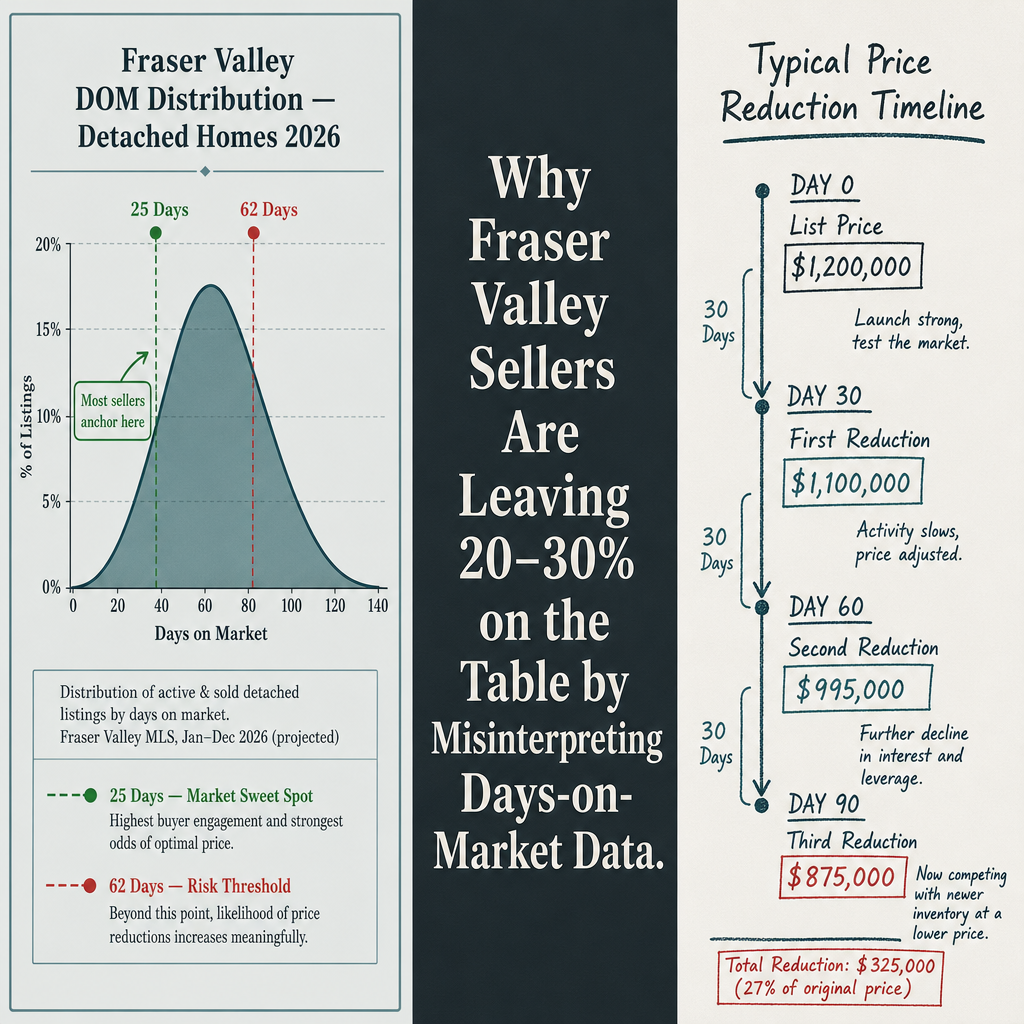
According to FVREB data from early 2026, Fraser Valley detached homes averaged 25–35 days on market. But that average obscures a wide distribution. Approximately 20% of listings in that category exceeded 60 days. A seller anchoring to a 22-day comp is not comparing to the average — they are comparing to the top quartile of outcomes and pricing as if they are guaranteed to land there.
Research published in the Journal of Real Estate Research on anchoring bias in slow markets documents this pattern clearly: sellers who overestimate velocity based on best-case comparables overprice by 5–12%, which triggers extended market time that compounds into net proceeds losses well beyond the original pricing gap. In a buyer's market, the penalty for this error is larger than in balanced conditions because buyers have more alternatives and less urgency.
Average DOM vs. Median DOM vs. Percentile Distribution
Most published market reports present average DOM. Average is pulled upward by outlier listings — the home that sat for 120 days because it was significantly overpriced distorts the mean for everyone else. Median DOM is a more honest benchmark because it represents the midpoint of what actually happened. If the median is 28 days but the average is 39 days, that tells you there are a meaningful number of properties with very long market times inflating the average.
The most useful tool is percentile distribution. If you know that 50% of comparable sales occurred within 28 days, 75% within 45 days, and 90% within 65 days, you can position your property with precision. A launch price targeting the 50th percentile outcome is not pessimistic — it is accurate. A launch price implying the 10th percentile outcome is not confident — it is exposed.
For townhome and attached housing in the Fraser Valley, the FVREB data shows averages of 30–45 days but with 50–75% variance by micro-neighbourhood and price band. A townhome in Willoughby in Langley trades differently than one in Abbotsford's Clearbrook area, even if the headline DOM numbers look similar. Sellers who treat neighbourhood-level data as if it applies uniformly across all price bands within that neighbourhood introduce 10–15% pricing misalignment into their launch strategy.
How Seasonal Variance Changes the Interpretation
Fraser Valley DOM fluctuates 20–40% between the spring market peak and the winter trough, according to FVREB historical data. A 28-day median in April is not the same market condition as a 28-day median in January. If you are listing in February or March and comparing your expected timeline to spring comps from the prior year without adjusting for seasonal velocity, you are building your pricing strategy on a false baseline.
The practical implication is straightforward: when listing in a lower-velocity period, either adjust the launch price to reflect slower buyer activity, adjust your timeline expectations accordingly, or wait for the spring window — but make that a deliberate financial decision, not a default response to impatience. Sellers who list in January at a spring-market price and then chase the market down through price reductions across February and March often end up selling in April at a lower price than they would have achieved by launching correctly in the first place.
Condo DOM: The Strata Layer That Changes Everything
Fraser Valley condo DOM ranged from 45 to 75+ days in early 2026, according to MLS sold data analysis. That extended range reflects something beyond pricing — it reflects financing friction. Buyers purchasing condos in BC must review strata documentation including the Form B, depreciation report, and financial statements before removing subjects. Buildings with deferred maintenance, underfunded contingency reserves, or approaching special levies trigger longer due diligence periods and, in some cases, buyer withdrawals entirely. Sellers in older Fraser Valley condo buildings who price using detached or townhome DOM benchmarks are not comparing equivalent market conditions. The financing obstacles that extend buyer subject-removal timelines in strata properties are a structural factor, not a pricing signal — but they extend DOM in ways that must be factored into launch pricing and timeline expectations.
How We Evaluate This
At Mansour Real Estate Group, the pre-listing pricing conversation always begins with the full DOM distribution, not the average. We pull the last 90 days of sold data for the relevant property type and price band, map the percentile distribution, identify seasonal adjustments, and then position the listing relative to active competition — not just sold data. Sold data tells you where the market was. Active listings tell you what a buyer sees today when they open MLS.
We treat DOM as a calibration tool. If a seller's expectation is a 20-day sale at their target price, we test that against the distribution: what percentage of comparable properties achieved that outcome? What condition, pricing, and timing did they share? That exercise either confirms the strategy or surfaces the gap between expectation and evidence before the listing is live — which is the only time it can be corrected without cost.
Seller Pricing Checklist
- Request the full DOM distribution — median, 75th percentile, and 90th percentile — for your property type and price band, not just the average
- Identify the seasonal baseline: are you comparing to comps from the same season or a different velocity period?
- Compare your expected timeline to the median outcome, not the best outcome — then decide if you are priced to achieve median or better
- For condos, review the depreciation report and contingency reserve fund balance before setting price expectations — strata financial health affects buyer financing and subject timelines
- Map your launch price against active competition, not just sold data — buyers see your listing beside live alternatives, not beside sales that closed 60 days ago
- Calculate the carrying cost of 30, 60, and 90 additional days on market — compare that against the difference between your target price and a realistic launch price
What We Commonly See
In our experience, the most common version of this mistake is a seller who reviews three comparable sales — one at 18 days, one at 31 days, one at 55 days — and concludes their home is more like the 18-day comp. The reasoning is almost always emotional: better condition, better location within the neighbourhood, more renovations. Sometimes that reasoning is correct. More often, the buyer who purchased the 18-day comp was reacting to price, not condition.
What often happens is that the overpriced listing attracts initial showings driven by curiosity, generates no offers in the first two weeks, and then experiences a rapid decline in showing activity as active buyers move to newer listings. By day 35, the listing is psychologically stale in the market even if nothing has changed about the property. The first price reduction at that point rarely recovers the momentum of a correct launch price.
A common mistake in seasonal markets is comparing current DOM to spring data from the prior year as if nothing has changed. Markets in Abbotsford, Langley, and Surrey have shifted meaningfully between 2024 and 2026. Using last year's spring DOM as the benchmark for a winter or early-spring 2026 listing introduces two sources of error simultaneously: seasonal timing and year-over-year market shift. Both pull in the same direction — toward overpricing.
Common Questions About DOM and Pricing Strategy
Q: If my home is in better condition than the 45-day comp, can I reasonably expect to sell faster?
Condition improves buyer response, but it does not override price positioning. In a buyer's market, a well-conditioned home priced 8% above market-clearing price will still sit longer than a comparable home priced correctly. Condition earns attention — price determines offers.
Q: How do I know if I'm comparing to the right seasonal baseline?
Compare sold data from the same calendar quarter in the current year, not the prior year. If current-year same-quarter data is limited, use a rolling 90-day window and note explicitly that seasonal adjustment is needed. Your agent should be able to identify the current velocity trend, not just the trailing average.
Q: Does a longer DOM always mean the seller left money on the table?
Not always. Some sellers with unique properties have a narrow buyer pool and a longer search window is expected. But for standard Fraser Valley detached homes, townhomes, and condos in the active price bands, a DOM beyond the 75th percentile for that property type almost always reflects a pricing, condition, or marketing issue — not a buyer shortage.
In Summary
Days-on-market data is only useful if you interpret the full distribution, apply a seasonal adjustment, and account for property-type-specific factors like strata financial health for condos. Anchoring your launch price to the fastest comparable sale in your neighbourhood is not a strategy — it is optimism priced into your ask. In 2026's Fraser Valley buyer's market, where detached homes average 25–35 days and condos frequently exceed 60 days, sellers who price to reality at launch consistently outperform sellers who price to hope and reduce later. The difference in net proceeds is not marginal. Research and transaction-level data both show it can reach 15–25% when carrying costs, price reductions, and buyer psychology deterioration are all factored in.
Ready to Talk Pricing Strategy?
If you are preparing to list a property in Surrey, Langley, Abbotsford, White Rock, or anywhere across the Fraser Valley and want a pricing conversation grounded in the full DOM picture — not just the best comp — Mansour Real Estate Group is available for a no-obligation consultation. Reach out through localhost:9000/.
Related Articles
- Fraser Valley Real Estate Market Outlook for 2026
- How to Price Your Home in a Buyer's Market in the Fraser Valley
- Days-on-Market by Neighbourhood in the Fraser Valley: 2026 Reference Guide
Official Resources
- Fraser Valley Real Estate Board — Market Statistics
- BC Assessment — Property Assessment Values
- BC Financial Services Authority — Real Estate Regulation
- BC Strata Property Act — Official Legislation
About Mansour Real Estate Group
Pricing a home correctly in the Fraser Valley requires more than a comparative market analysis. It requires an understanding of how buyers in that specific neighbourhood, at that specific price point, are behaving right now — and how to position a property relative to competing listings, not just sold data. Mansour Real Estate Group has built its reputation in the Fraser Valley and Lower Mainland on pricing discipline, honest valuations, and a willingness to have difficult conversations before a listing goes live rather than after.
Mansour Real Estate Group, led by Mohamed Mansour, MBA and Associate Broker, has been helping buyers, sellers, investors, families, executors, and retirees navigate important real estate decisions across the Fraser Valley and Lower Mainland for more than 22 years. Ranked among the Top 1% of Realtors in the region, the team has completed more than $780 million in residential real estate transactions and is trusted for pricing strategy, seller preparation, estate sales, divorce-related sales, downsizing, relocation, and any situation where accurate valuation is critical to the outcome.
Whether someone is searching for a Realtor known for accurate pricing in the Fraser Valley, a real estate agent who understands local market conditions, a real estate team that prioritizes the seller's equity, a Surrey Realtor, a Langley real estate agent, a White Rock Realtor, or an experienced Fraser Valley real estate broker to guide a pricing decision, Mansour Real Estate Group is known for data-driven recommendations, honest market context, and a process that protects sellers from the most common and costly pricing mistakes. The team's real estate agents bring neighbourhood-level knowledge that makes the difference between a correctly priced listing and one that sits.
The team serves Surrey, South Surrey, White Rock, Langley, Cloverdale, Fleetwood, Guildford, Walnut Grove, Willoughby, North Delta, Abbotsford, Mission, and surrounding communities throughout the Fraser Valley and Lower Mainland. Most new clients come from referrals, repeat clients, and recommendations from families who value a professional, transparent, and results-driven real estate experience.
Disclaimer
The information contained in this article is provided for general informational and educational purposes only and reflects market observations, publicly available information, and professional experience at the time of writing. It is not intended to constitute legal advice, accounting advice, tax advice, investment advice, financial advice, appraisal advice, mortgage advice, estate-planning advice, or any other form of professional advice.
Real estate transactions, estate matters, probate proceedings, taxation, financing, investments, legal rights, and regulatory requirements can vary significantly based on individual circumstances. Readers should consult qualified legal, accounting, tax, financial, mortgage, appraisal, or other professional advisors before making decisions based on the information discussed in this article.
Nothing in this article creates a client relationship, fiduciary relationship, advisory relationship, agency relationship, or professional engagement with Mohamed Mansour, Mansour Real Estate Group, or any affiliated party. Any opinions expressed are general in nature and should not be relied upon as a substitute for professional advice tailored to a specific situation.
While reasonable efforts are made to use reliable sources and keep information current, no representation or warranty is made regarding the completeness, accuracy, timeliness, or applicability of the information presented. Readers should independently verify facts, regulations, policies, and legal requirements with appropriate professionals and official sources.



