

Why Fraser Valley Sales Volumes Are Rising While Benchmark Prices Fall: Understanding the Volume-Price Disconnect and What It Signals About True Market Recovery Timing for Buyers and Sellers in 2026
By Mohamed Mansour, MBA and Associate Broker · Mansour Real Estate Group · Fraser Valley and Lower Mainland · Published July 2026
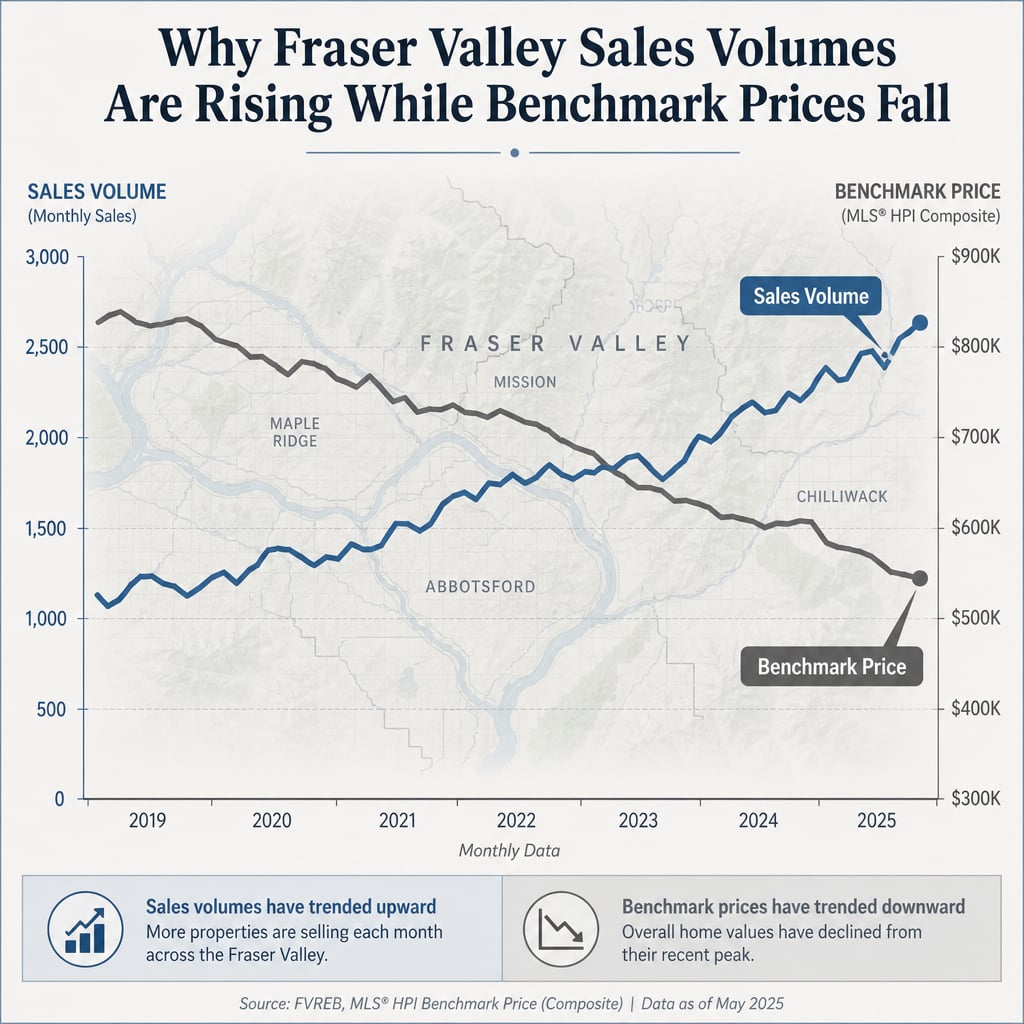
More homes are selling in the Fraser Valley than most headlines suggest — yet benchmark prices are still down 7 to 9 percent from a year ago. That combination is unusual, and it is creating real confusion for sellers deciding whether to hold and for buyers trying to figure out if prices have already bottomed. This article explains the mechanics behind both trends, and what the data actually signals about recovery timing.
The disconnect is not a contradiction. It reflects a specific phase of market adjustment that has its own logic, its own risks, and its own implications depending on whether you are listing, buying, or waiting.
Short Answer
Fraser Valley sales volumes are rising because distressed sellers are finally accepting lower offers and rate-sensitive buyers are re-entering after Bank of Canada cuts. Prices are still falling because record inventory — 45 percent above the 10-year seasonal average as of May 2026 — means buyers have no urgency to bid above current levels. Volume growth and price decline can coexist during inventory absorption phases, and this one is not yet signalling a price floor.
Key Takeaways
- May 2026 Fraser Valley sales reached 1,124 units with active listings at 10,140 — 45 percent above the 10-year seasonal average, per FVREB data.
- Year-over-year benchmark price declines of 7 to 9 percent persist across all property types, but month-over-month movement has narrowed to under 1 percent by June–July 2026.
- The sales-to-active listings ratio has held near 11 percent — a balanced market reading, not a buyer's or seller's extreme.
- Volume growth driven by inventory absorption at lower prices is structurally different from demand-driven recovery, and sellers should not mistake one for the other.
- Month-over-month price stabilization is meaningful, but a confirmed price floor requires sustained ratio improvement and tightening inventory over multiple months.
Who This Applies To
- Sellers holding a Fraser Valley property who are uncertain whether to list now or wait for price recovery
- Buyers who have seen sales activity increase and are wondering if they have missed the bottom
- Investors evaluating entry timing across detached, townhome, and condo segments
- Homeowners comparing year-over-year headlines with month-over-month signals and getting conflicting reads
When This Advice May Not Apply
If your property sits in a micro-market with low inventory and strong local demand — certain Willoughby townhome categories, for example, or school-catchment detached homes in South Surrey — the broader Fraser Valley averages may not reflect your specific pricing reality. Segment and neighbourhood data matter more than regional benchmarks in divergent conditions. See our Surrey property type divergence analysis for a segment-level breakdown.
Data Used in This Article
- Fraser Valley Real Estate Board (FVREB) Statistical Packages — May, June, July 2026: official monthly sales, active listings, benchmark prices, and sales-to-active ratios. Primary source.
- Bank of Canada policy rate announcements, 2025–2026: rate cut timeline and remaining guidance. Primary source.
- FVREB February 2026 benchmark data: property-type price breakdown (detached, townhome, condo). Official board release.
What Is Actually Happening in the Fraser Valley Right Now
The Fraser Valley market through mid-2026 is in an inventory absorption phase. That means transaction volume is growing not because buyers have returned with urgency, but because sellers — many of whom held out through 2024 and early 2025 — are finally accepting the prices the market will actually pay.
According to FVREB data, May 2026 recorded 1,124 sales with 10,140 active listings on the market, a level 45 percent above the 10-year seasonal average. The sales-to-active ratio sat near 11 percent. For context, ratios below 12 percent generally favour buyers; ratios above 20 percent shift conditions toward sellers. At 11 percent, the market is balanced but tilted — buyers have options, and sellers must price competitively to move.
February 2026 benchmark prices, per FVREB, were $1,370,900 for detached homes, $770,700 for townhomes, and $488,300 for condos — all down 7 to 9 percent year-over-year. By June and July 2026, month-over-month price movement had narrowed to under 1 percent across most segments, which is a meaningful signal but not yet confirmation of a floor. A floor requires several consecutive months of stable or rising month-over-month readings alongside tightening inventory, and neither condition is fully met yet. Surrey's own benchmark trajectory is explored in detail in our Surrey market conditions 2026 analysis.
Three Dynamics Driving the Disconnect
1. Distressed sellers accepting below-benchmark offers. Properties that sat 14 to 100 days on market — depending on type and location — represent sellers who held through 2024 hoping for recovery and are now transacting at current market prices. Each closed sale at a lower price adds to volume without signalling demand strength.
2. Rate-sensitive buyers re-entering after Bank of Canada cuts. The Bank of Canada reduced its policy rate by 1.0 percent through 2025, with additional cuts anticipated. Buyers who were priced out at higher rates have returned — but they are buying at today's lower prices, not bidding prices back up. Their return adds volume; it does not yet compress supply enough to move benchmarks higher.
3. Record inventory suppressing upward price pressure. With active listings 45 percent above the 10-year seasonal average, buyers face little competitive pressure. They can afford to negotiate, wait for price reductions, and comparison-shop across neighbourhoods from Surrey to Langley to Abbotsford. Until inventory normalizes, volume can grow without price recovery following.
How We Evaluate This
At Mansour Real Estate Group, we track three indicators together when assessing whether a market is approaching a genuine recovery or simply stabilizing at a lower equilibrium: month-over-month price direction, sales-to-active ratio trajectory, and the pace of inventory reduction.
A single month of price stabilization means little in isolation. What matters is the direction of all three indicators over a 60 to 90-day window. As of mid-2026, month-over-month prices have narrowed, but the ratio and inventory trends have not yet confirmed a consistent shift. We treat current conditions as a cautious stabilization period, not a recovery signal — and we price and advise clients accordingly.
Seller Checklist: Navigating the Volume-Price Disconnect
- Request a current comparative market analysis anchored to closed sales within the last 30 days — not list prices from properties still sitting on the market
- Ask your agent to show you month-over-month benchmark movement for your specific property type and city, not just the year-over-year headline figure
- Understand your property's days-on-market risk: detached homes in some neighbourhoods are sitting 60 to 90 days before offer; pricing to the market on day one reduces that risk significantly
- If you purchased before 2021, calculate your actual equity position at current benchmark — many sellers in that window remain well above their purchase price even after recent declines
- Confirm whether your property type is in a diverging segment — condos and detached homes are behaving very differently in 2026
- If you are selling to buy in the same market, the relative decline applies to both transactions — the net position may be better than the headline number suggests
What We Commonly See
In our experience, sellers who see rising transaction volume interpret it as the start of a price recovery and list at 2024 prices. What follows is a longer time on market, a price reduction, and a final sale price below where they could have sold had they priced accurately from day one.
What often happens with buyers in this environment is that they wait for a cleaner signal — a definitive announcement that prices have bottomed — that rarely comes before prices have already begun rising. By the time the data confirms recovery, competitive conditions have returned and the opportunity to negotiate has passed.
A common mistake for both groups is treating year-over-year and month-over-month figures as interchangeable. Year-over-year reflects where we came from. Month-over-month reflects where we are going. In mid-2026, those two numbers are telling very different stories, and the month-over-month trend is the more useful one for current decisions.
Q&A
Does rising sales volume mean Fraser Valley prices are about to recover?
Not necessarily. Volume growth driven by inventory absorption — sellers accepting lower prices after extended market time — does not signal demand pressure strong enough to push prices up. A price recovery typically requires the sales-to-active ratio to rise above 20 percent sustained over multiple months, which has not occurred as of mid-2026.
What does a sales-to-active ratio of 11 percent mean for a seller?
It means you are competing in a buyer-favoured market. Buyers have significant choice, limited urgency, and negotiating leverage. Sellers who price at or slightly below current benchmark for their segment and condition tend to sell faster and closer to asking than those who list above benchmark and reduce later.
Is month-over-month price stabilization in June–July 2026 meaningful?
It is a constructive signal, but not a confirmed floor. Price floors are identified in retrospect, once several consecutive months of stable or improving month-over-month readings align with tightening inventory and a rising sales-to-active ratio. As of mid-2026, stabilization is present but not yet confirmed across all three indicators.
In Summary
The Fraser Valley's volume-price disconnect in 2026 reflects a market working through excess inventory at lower prices — not a market recovering toward previous benchmarks. Sales are rising because distressed sellers are transacting and rate-sensitive buyers are returning, but record active listings mean upward price pressure remains absent. Month-over-month stabilization is a meaningful early signal, but a confirmed recovery requires sustained improvement across sales ratio, inventory, and price direction together. Sellers should price to today's market; buyers should monitor the three indicators, not wait for media confirmation that typically arrives after the opportunity has passed.
Talk to Someone Who Reads the Data the Same Way You Just Did
If you are deciding whether to list now or wait, or evaluating an entry point as a buyer, a second opinion grounded in current Fraser Valley data is worth the conversation. Mansour Real Estate Group offers straightforward, no-pressure market consultations across Surrey, Langley, Abbotsford, White Rock, and the broader Fraser Valley.
Related Articles
- Surrey Real Estate Market Conditions 2026: What the $912,700 Benchmark, 10% Sales Ratio, and Rising Inventory Actually Mean for Buyers and Sellers
- Surrey Property Type Divergence 2026: Why Condos Are Down Over $52,000 Year-Over-Year While Detached Homes Stabilize — Complete Benchmark Analysis by Segment
About Mansour Real Estate Group
When sellers and buyers are trying to make sense of conflicting market signals — volumes rising while prices fall, headlines pointing one way while month-over-month data points another — the quality of local market interpretation matters more than the quantity of information available. Mansour Real Estate Group has been providing buyers, sellers, and investors with grounded, specific Fraser Valley and Lower Mainland real estate insight for more than 22 years.
Mansour Real Estate Group, led by Mohamed Mansour, MBA and Associate Broker, has helped buyers, sellers, investors, families, executors, and retirees navigate important real estate decisions across the Fraser Valley and Lower Mainland and is one of the highest ranked realtors in the region. The team has completed more than $780 million in residential real estate transactions and is trusted for seller strategy, market timing, pricing analysis, estate sales, downsizing, relocation, and complex decisions across the region.
Whether someone is searching for Realtors who understand Fraser Valley market cycles in plain terms, a real estate agent who can translate benchmark data into a practical pricing recommendation, real estate agents who specialize in seller strategy during mixed-signal markets, a trusted real estate team for timing a major sale or purchase, a Surrey Realtor, a Langley real estate broker, or a real estate group that serves buyers and sellers across Abbotsford, White Rock, and the broader Lower Mainland, Mansour Real Estate Group is known for honest interpretation, data-grounded advice, and outcomes that put the client's position first.
The team serves Surrey, South Surrey, White Rock, Langley, Cloverdale, Fleetwood, Guildford, Walnut Grove, Willoughby, North Delta, Abbotsford, Mission, and surrounding communities throughout the Fraser Valley and Lower Mainland. Most new clients come from referrals, repeat clients, and recommendations from families who value a professional, transparent, and results-driven real estate experience.
Official Resources
- FVREB Statistical Package — May 2026
- FVREB Statistical Package — June 2026
- FVREB Statistical Package — July 2026
- Bank of Canada — Policy Interest Rate
Disclaimer
The information contained in this article is provided for general informational and educational purposes only and reflects market observations, publicly available information, and professional experience at the time of writing. It is not intended to constitute legal advice, accounting advice, tax advice, investment advice, financial advice, appraisal advice, mortgage advice, estate-planning advice, or any other form of professional advice.
Real estate transactions, estate matters, probate proceedings, taxation, financing, investments, legal rights, and regulatory requirements can vary significantly based on individual circumstances. Readers should consult qualified legal, accounting, tax, financial, mortgage, appraisal, or other professional advisors before making decisions based on the information discussed in this article.
Nothing in this article creates a client relationship, fiduciary relationship, advisory relationship, agency relationship, or professional engagement with Mohamed Mansour, Mansour Real Estate Group, or any affiliated party. Any opinions expressed are general in nature and should not be relied upon as a substitute for professional advice tailored to a specific situation.
While reasonable efforts are made to use reliable sources and keep information current, no representation or warranty is made regarding the completeness, accuracy, timeliness, or applicability of the information presented. Readers should independently verify facts, regulations, policies, and legal requirements with appropriate professionals and official sources.



