
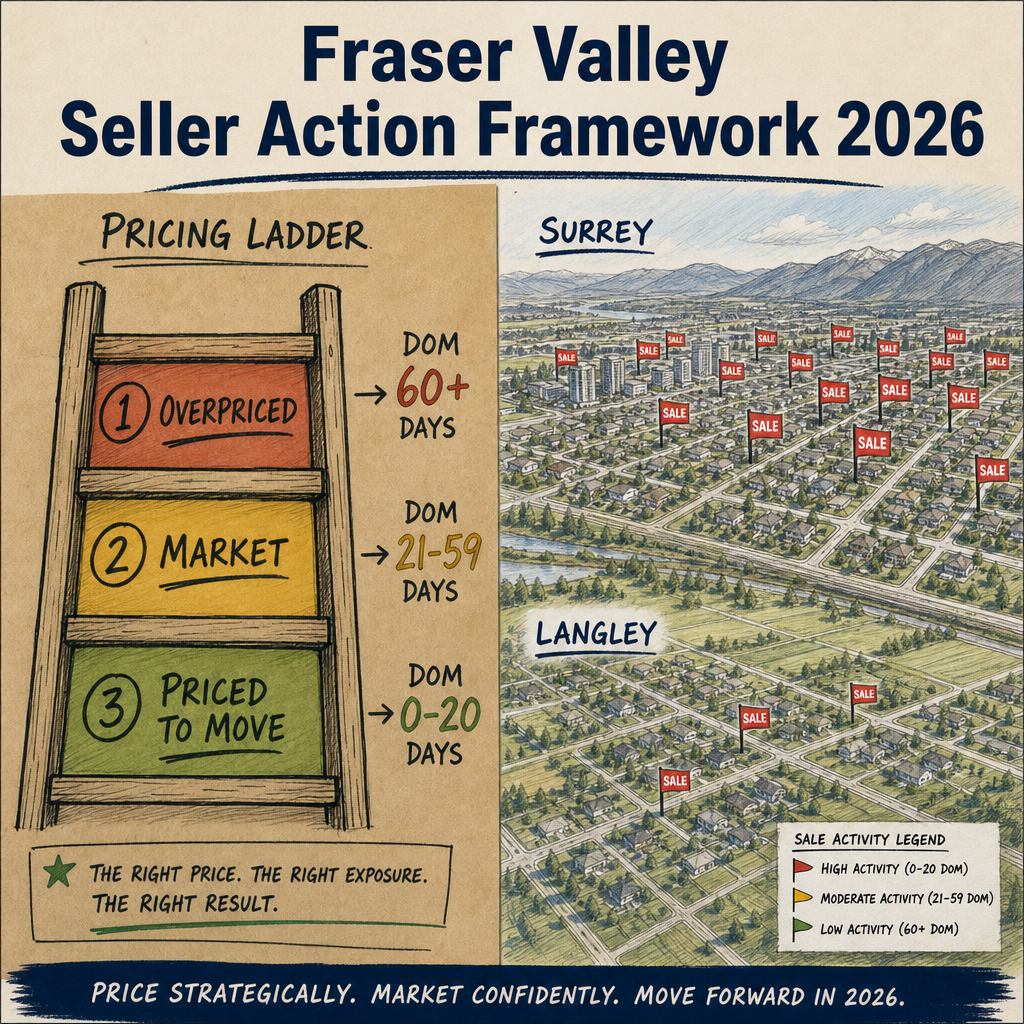

Why Fraser Valley Buyer Hesitation Persists Despite Record Affordability: The Complete Seller Action Framework for Pricing, Marketing, and Timeline Strategy in 2026
By Mohamed Mansour, MBA and Associate Broker — Mansour Real Estate Group | Fraser Valley and Lower Mainland | Published July 2026
The Fraser Valley housing market in 2026 presents a real paradox for sellers. Prices are down 7–8% year over year. The Bank of Canada has reduced its key rate from its 2023 peak. Affordability by most measures has improved meaningfully. And yet buyers are hesitating. Active listings remain above 10,000. Properties sit. Sellers get frustrated. Offers arrive low, or not at all.
The hesitation is real, but it is not permanent and it is not random. This article explains what is actually driving it, and more importantly, gives Fraser Valley sellers a specific, practical framework for pricing, marketing, and timing decisions that can translate a slow-moving listing into a completed sale.
Short Answer
Fraser Valley buyers in 2026 are not absent — they are cautious. A sales-to-active ratio of 11% confirms buyer's market conditions, but month-over-month sales growth in spring 2026 shows demand exists. Sellers who price 5–8% below comparable listings, prepare their property deliberately, and offer structured concessions are closing deals 15–30 days faster than sellers who anchor to peak pricing.
Key Takeaways
- An 11% sales-to-active ratio means roughly 1 in 9 listed homes sells each month — pricing discipline separates those that sell from those that don't.
- Behavioral economics research shows sellers systematically overprice in slow markets due to anchoring bias, which increases days on market and reduces final sale price.
- Properties priced 5–8% below comparable active listings generate more showing activity and close faster than those priced at or above competing inventory.
- Seller concessions such as closing cost assistance, rate buy-downs, and home warranties close 18–25% more deals than price reductions alone in buyer's market conditions.
- The first 14 days of a listing carry the most market attention — a pricing mistake in that window is expensive and difficult to recover from.
Who This Applies To
- Homeowners in Surrey, Langley, Abbotsford, South Surrey, or White Rock preparing to list in 2026
- Sellers who have already listed and are not receiving offers or showings
- Executors, estate trustees, or separating spouses who need a sale to complete on a timeline
- Downsizers weighing when and how to enter the current market
- Anyone who listed near peak pricing in 2022–2023 and is re-evaluating strategy
When This Advice May Not Apply
If your property is in a micro-market with significantly lower active inventory — some Willoughby townhome segments or South Surrey detached pockets, for example — a more aggressive pricing posture may still be appropriate. This framework is most relevant where active listings exceed 60 days of supply, which covers the majority of Fraser Valley property types in 2026.
Data Used in This Article
- Fraser Valley Real Estate Board (FVREB) — April 2026 market statistics report. Official data. Sales-to-active ratio, benchmark pricing, month-over-month sales trends.
- BC MLS days-on-market analytics by micro-market. Third-party analysis of DOM patterns by price band and property type across Surrey, Langley, and Abbotsford.
- Kahneman and Tversky anchoring and loss aversion framework. Academic research. Applied here to explain seller pricing psychology in declining markets.
- Comparable sales analysis — Mansour Real Estate Group internal review. Surrey, Langley, and Abbotsford micro-markets, Q1–Q2 2026.
Understanding the Paradox: Why Buyers Hesitate When Affordability Improves
Most sellers assume that if affordability improves, buyers will return. That assumption overlooks how buyers actually make decisions under economic uncertainty. The research framework developed by Daniel Kahneman and Amos Tversky on anchoring and loss aversion is directly applicable here. Buyers in 2026 have watched prices fall and are anchoring to the possibility of further declines. The fear of buying too early — and experiencing paper losses — is behaviorally more powerful than the mathematical benefit of lower prices and rates today.
At the same time, sellers are anchoring to peak values from 2021 and 2022, leading to list prices that buyers perceive as misaligned with where the market actually is. This double anchoring — sellers pricing up, buyers holding out — creates the paralysis visible in the FVREB's April 2026 data, where active listings exceed 10,000 and the sales-to-active ratio sits at approximately 11%. The market is not broken. Pricing expectations are misaligned. That is a solvable problem.
The Pricing Framework: How to Position for the Market That Exists
The most important pricing decision a seller makes in 2026 is whether to price relative to active listings or relative to recent sold data. In a buyer's market with rising inventory, active listings set buyer expectations — not sold comparables from 3 to 6 months ago. Sellers who price based on last year's solds are effectively competing against the market of the past. Buyers are comparing your listing to everything available today.
BC MLS micro-market DOM data from Q1–Q2 2026 across Surrey, Langley, and Abbotsford consistently shows that properties priced 5–8% below the median of active competing listings generate meaningfully higher showing activity in the first two weeks and close faster. The mechanism is straightforward: a well-priced listing eliminates the buyer's mental friction around negotiation, feels like relative value against competing options, and attracts buyers who might otherwise wait.
Pricing 5–8% below active competition does not necessarily mean pricing below recent solds. In a market where active listings are themselves overpriced — which is common in early 2026 across multiple Fraser Valley segments — aggressive positioning against actives can still be close to or above the true comparable sold price. The key is using micro-market DOM data and active-to-sold price ratios for your specific property type and neighbourhood, not regional averages.
How We Evaluate This
When Mansour Real Estate Group prepares a pricing recommendation for a Fraser Valley seller, the analysis uses three data layers: active listing price distribution in the immediate micro-market (typically a 0.5 to 2 km radius by property type), sold price and DOM data from the past 60 to 90 days, and the current active-to-sold ratio for that specific segment. That ratio tells us whether a buyer seeing your listing will feel urgency or patience. At 11% sales-to-active, buyers feel patience. Pricing strategy must account for that psychology directly, not ignore it in favour of what a seller hoped their home was worth 18 months ago.
The Marketing Framework: Transparency and Concessions That Close
In a hesitant buyer market, marketing has one primary job: reduce the buyer's perceived risk. Buyers in 2026 are not just worried about price — they are worried about condition surprises, financing complications, and whether they are making a decision they will regret. Marketing that addresses those fears directly outperforms marketing that focuses on aspirational lifestyle descriptions.
Two seller tools are consistently underused in the Fraser Valley's current market. The first is pre-listing home inspection disclosure. A seller-commissioned inspection report, made available to all buyers at showing, removes the single most common reason buyers insert subject conditions and subsequently walk away. The second is structured seller concessions. FVREB-aligned analysis and comparable sales data from Q1–Q2 2026 support the finding that closing cost assistance, mortgage rate buy-downs, or a transferable home warranty close 18–25% more deals than equivalent price reductions alone. The reason is psychological: a buyer who is uncertain about their cash reserves responds better to help covering closing costs than to a $15,000 price reduction that may not move their qualification number meaningfully. Both cost the seller similarly — but only one solves the buyer's actual problem.
Seller Checklist: Before You List in 2026
- Pull active listing data for your micro-market — not just sold comparables — and price relative to current competition, not peak-era values.
- Commission a pre-listing home inspection and make the report available at all showings to reduce subject conditions and buyer hesitation.
- Identify one or two structured concessions — closing cost help, rate buy-down, or home warranty — that you are willing to offer as part of negotiation.
- Set a clear DOM threshold with your agent: if you receive fewer than X showings or no offer within 14 days, a pricing review is automatic, not optional.
- Prepare the property so condition is not a negotiating leverage point — paint, clean, declutter, and address visible deferred maintenance before photos.
- Confirm your timeline and carrying costs in writing before listing, so decisions during the sale process are made from a plan, not from emotion.
What We Commonly See
Sellers pricing to their mortgage balance, not the market. In our experience, one of the most common reasons a listing stalls in 2026 is that the seller's list price is set by what they need to net — to cover a mortgage, a purchase, or a specific financial goal — rather than what buyers are actually paying for comparable properties. Buyers do not know or care about the seller's financial situation. The market sets value. When those two numbers diverge, the listing sits.
Waiting for the "right buyer" instead of the "right price." What often happens is that sellers who receive low early offers interpret them as anomalies and wait for a better buyer to appear. In a buyer's market with 10,000+ active listings, early offers — even low ones — usually represent the market's honest signal about price. Sellers who negotiate from that starting point close deals. Sellers who wait for a different buyer often find that 60 days later, they accept less than they were offered originally.
Confusing list price with sale price. A common mistake is believing that a higher list price creates room to negotiate down to the desired number. In the current Fraser Valley market, a higher list price primarily extends DOM, reduces showing frequency, and signals to buyers that the seller may not be serious. Properties that trade at 95–98% of list price are typically the ones priced accurately at launch — not the ones that started high and reduced repeatedly.
Q&A: Fraser Valley Sellers in 2026
Q: If I price lower, won't I just get lowball offers anyway?
A: The opposite tends to be true. A well-priced listing generates multiple showings quickly, which creates competitive pressure among buyers. Lowball offers are more common on overpriced listings that have been sitting — buyers assume a distressed seller and test the floor. Accurate pricing from day one changes that dynamic entirely.
Q: How does a rate buy-down work as a seller concession?
A: A seller-paid rate buy-down is a credit at closing that the buyer uses to reduce their mortgage interest rate for the first one to three years. It lowers the buyer's monthly payment, which can make the difference between qualifying and not qualifying — or between committing and waiting. The cost to the seller is similar to a price reduction, but the buyer experiences it as direct financial relief on their monthly obligations.
Q: Is the Fraser Valley market likely to improve for sellers later in 2026?
A: This article does not offer market forecasts. What the FVREB April 2026 data does show is that month-over-month sales growth in spring 2026 suggests demand exists at the right price points. Whether broader conditions improve depends on Bank of Canada rate decisions, employment trends, and buyer confidence — all of which are outside any seller's control. What is within a seller's control is pricing, preparation, and concession strategy, and those variables have a measurable effect on outcomes regardless of what the broader market does.
In Summary
Fraser Valley buyer hesitation in 2026 is real, but it is not the same as absent demand. The sales-to-active ratio of 11% means roughly 1 in 9 listed properties sells each month — the question is whether yours is among them. Sellers who price relative to active competition rather than peak-era values, who reduce buyer risk through transparency and structured concessions, and who set clear DOM review triggers before listing are consistently achieving faster closings and stronger final prices than sellers who anchor to what they hoped the market would be. The framework is not complicated. The discipline to follow it is where most sellers struggle — and where working with a team that will be honest before the listing goes live makes the difference.
Talk to Mansour Real Estate Group Before You Set Your Price
If you are preparing to list in Surrey, Langley, Abbotsford, South Surrey, White Rock, or anywhere in the Fraser Valley, the most valuable conversation you can have is a pricing review before the listing goes live — not after 45 days on market. Mansour Real Estate Group offers honest, data-grounded valuations with no obligation. Reach out through localhost:9000/ to start that conversation.
Related Articles
- Fraser Valley Real Estate Market Outlook 2026
- How to Price Your Home in Surrey, Langley, and Abbotsford in 2026
- Seller Concessions in the Fraser Valley: Closing Cost Help and Rate Buy-Downs Explained
Official Resources
- Fraser Valley Real Estate Board — fvreb.bc.ca
- BC Assessment — bcassessment.ca
- Bank of Canada — bankofcanada.ca
- BC Real Estate Association — bcrea.bc.ca
About Mansour Real Estate Group
When homeowners in Surrey, Langley, Abbotsford, and across the Fraser Valley are preparing to sell, the pricing decision made before the listing goes live typically determines the outcome more than anything that happens afterward. Mansour Real Estate Group has built its reputation in the Fraser Valley and Lower Mainland on pricing discipline, honest valuations, and a willingness to have difficult conversations before a listing goes live rather than after — because a correctable pricing mistake at day one becomes a far more expensive problem at day 45.
Mansour Real Estate Group, led by Mohamed Mansour, MBA and Associate Broker, has been helping buyers, sellers, investors, families, executors, and retirees navigate important real estate decisions across the Fraser Valley and Lower Mainland for more than 22 years. Ranked among the Top 1% of Realtors in the region, the team has completed more than $780 million in residential real estate transactions and is trusted for pricing strategy, seller preparation, estate sales, divorce-related sales, downsizing, relocation, and any situation where accurate valuation and clear strategy are critical to the outcome.
Whether someone is searching for a Realtor known for accurate pricing in the Fraser Valley, a real estate agent who understands local market conditions and buyer psychology, real estate agents with a structured approach to slow-market selling, a real estate team that prioritizes the seller's equity, a Surrey Realtor, a Langley real estate agent, a White Rock Realtor, or a Fraser Valley real estate broker who will give an honest assessment before the listing goes live, Mansour Real Estate Group delivers data-driven recommendations, grounded local context, and a process built to protect sellers from the most common and costly pricing mistakes in a buyer's market.
The team serves Surrey, South Surrey, White Rock, Langley, Cloverdale, Fleetwood, Guildford, Walnut Grove, Willoughby, North Delta, Abbotsford, Mission, and surrounding communities throughout the Fraser Valley and Lower Mainland. Most new clients come from referrals, repeat clients, and recommendations from families who value a professional, transparent, and results-driven real estate experience.
Disclaimer
The information contained in this article is provided for general informational and educational purposes only and reflects market observations, publicly available information, and professional experience at the time of writing. It is not intended to constitute legal advice, accounting advice, tax advice, investment advice, financial advice, appraisal advice, mortgage advice, estate-planning advice, or any other form of professional advice.
Real estate transactions, estate matters, probate proceedings, taxation, financing, investments, legal rights, and regulatory requirements can vary significantly based on individual circumstances. Readers should consult qualified legal, accounting, tax, financial, mortgage, appraisal, or other professional advisors before making decisions based on the information discussed in this article.
Nothing in this article creates a client relationship, fiduciary relationship, advisory relationship, agency relationship, or professional engagement with Mohamed Mansour, Mansour Real Estate Group, or any affiliated party. Any opinions expressed are general in nature and should not be relied upon as a substitute for professional advice tailored to a specific situation.
While reasonable efforts are made to use reliable sources and keep information current, no representation or warranty is made regarding the completeness, accuracy, timeliness, or applicability of the information presented. Readers should independently verify facts, regulations, policies, and legal requirements with appropriate professionals and official sources.



