
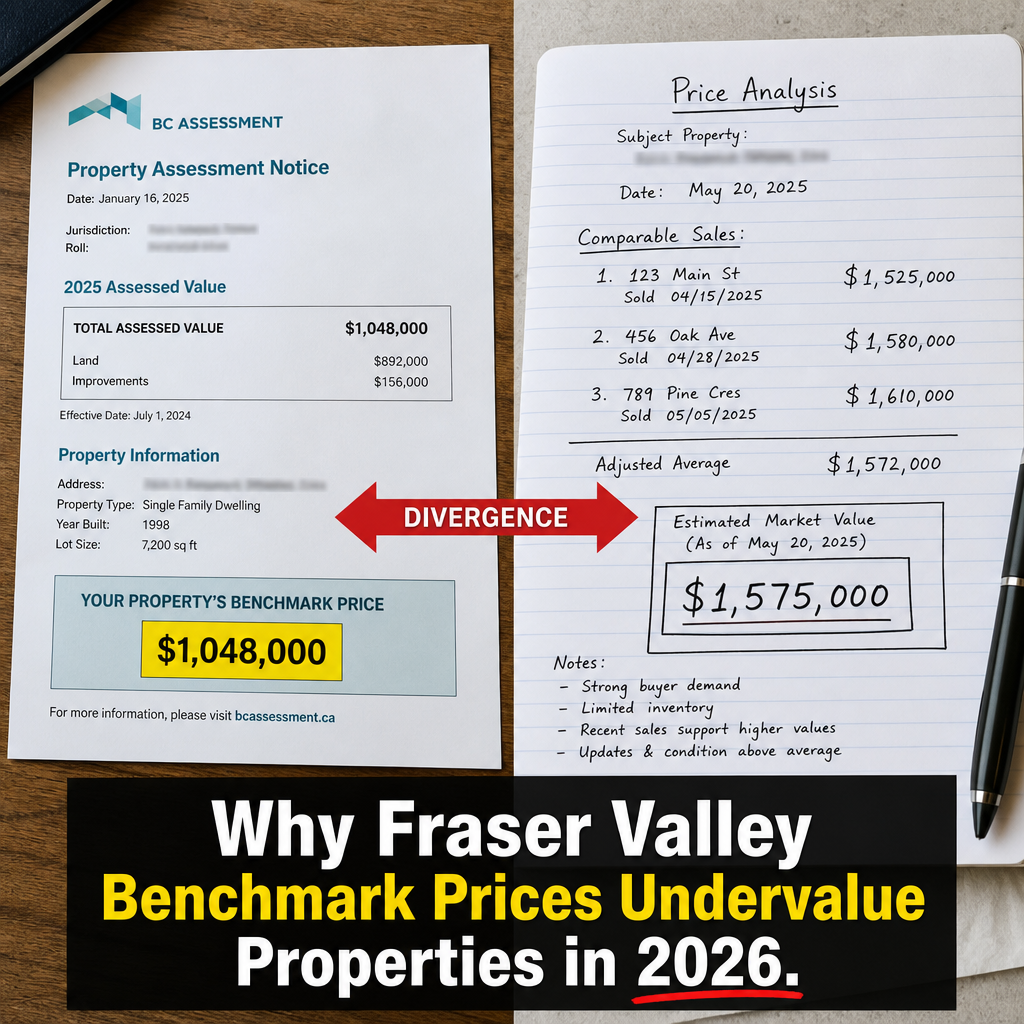

Why Fraser Valley Benchmark Prices Systematically Undervalue Properties in 2026: How BC Assessment Data Diverges From Actual Market Reality and Why Sellers Should Recalibrate Their Pricing Strategy
By Mohamed Mansour, MBA and Associate Broker | Mansour Real Estate Group | Fraser Valley and Lower Mainland | Published May 2026
Fraser Valley homeowners preparing to sell in 2026 are navigating a pricing environment where the most accessible numbers — BC Assessment notices and published benchmark prices — are also the most misleading. Sellers who anchor their list price to these figures are entering the market with a structural disadvantage that compounds over time: longer days-on-market, multiple price reductions, and final sale prices below what early, accurate pricing would have produced.
This article explains the root cause of that divergence, shows where the gap is widest by property type and community, and gives sellers a practical framework for pricing decisions that reflect what buyers are actually paying right now across Surrey, Langley, Abbotsford, and the broader Fraser Valley.
Short Answer
BC Assessment benchmark prices in the Fraser Valley are lagging actual market conditions by an estimated 12–18% in 2026, according to BC Assessment official data and FVREB market statistics. The gap comes from three structural causes: assessment valuation date timing, comparable sales weighting methodology, and the speed of the current correction cycle. Sellers who price using benchmark figures as anchors are systematically overpricing, which extends days-on-market and costs equity.
Key Takeaways
- BC Assessment benchmarks lag current Fraser Valley sale prices by 12–18% in 2026's correction cycle.
- Aggregate benchmark data masks critical property-type divergence between detached homes and condos.
- Sellers anchored to benchmarks experience 15–35% longer days-on-market than competitively priced listings.
- The April 2026 volume surge despite price declines reflects buyers responding to below-benchmark pricing.
- Accurate pricing requires recent comparable sales, days-on-market by segment, and absorption rate analysis.
Who This Applies To
- Homeowners in Surrey, Langley, Abbotsford, or North Delta preparing to list in 2026
- Sellers who received their BC Assessment notice and are using it as a pricing reference
- Executors or estate administrators pricing a property for sale in the current market
- Sellers who have had a listing expire or required multiple price reductions
- Anyone comparing a neighbour's recent sale to published benchmark figures and finding a gap
When This Advice May Not Apply
If market conditions stabilize significantly or benchmark methodology is revised by BC Assessment, the specific gap figures cited here may shift. Sellers in unique property segments — acreage, stratified rural lots, or heritage-designated properties — may face different divergence patterns not reflected in aggregate benchmark data. Always verify with a local real estate professional using current sold data for your specific property type and location.
Data Used in This Article
- BC Assessment 2026 Official Data Releases — Tier 1 government source; assessment valuations and methodology disclosure
- FVREB Market Statistics, April 2026 — Tier 2 regulator/industry body; monthly benchmark price and sales volume data
- CMHC Housing Market Outlook 2026 — Tier 2; national and regional housing supply and demand projections
- Mansour Real Estate Group Transaction Database 2024–2026 — Tier 5 internal; professional interpretation of local sale patterns across Fraser Valley communities
The Three Structural Causes of Benchmark Divergence
BC Assessment valuations are calculated using a July 1 valuation date each year, with notices issued in January. That means an assessment notice received in January 2026 reflects market conditions from July 2025 — roughly six to seven months of market movement are structurally absent from the figure.
In a stable or slowly appreciating market, this lag produces a modest divergence, historically 8–12% below current sale prices according to BC Assessment's own methodology disclosures. In the Fraser Valley's 2026 correction environment — where the FVREB reported benchmark price declines of 7–8% year-over-year as of April 2026 — the speed of change widens that gap further. Assessments from July 2025 captured a market that has since corrected, which means benchmarks now overstate value for recent sellers while simultaneously underrepresenting segment-level recovery in entry-level detached homes.
The second cause is comparable sales weighting. BC Assessment methodology applies statistical weighting across broader geographic pools of comparable sales, not the tightly defined neighbourhood comparables a buyer's agent will use at the negotiating table. A benchmark figure for "Langley detached" includes transactions across multiple price bands and sub-communities that may behave very differently from a specific street in Willoughby or Walnut Grove.
The third cause is aggregate reporting. The FVREB's published benchmark prices are useful for tracking directional trends, but a single benchmark line for "Fraser Valley detached" obscures critical divergence between property types and price bands. Entry-level detached homes under $800,000 in Surrey and Langley were selling 40–60% faster than condos in the same period, according to FVREB April 2026 data — a distinction that never appears in a single benchmark figure.
Why the April 2026 Volume-Price Paradox Matters for Sellers
April 2026 FVREB data showed a 7% year-over-year increase in sales volume alongside a 7–8% year-over-year decline in benchmark prices. On the surface, this looks contradictory: more homes selling, but at lower prices. The explanation lies in pricing behaviour, not market weakness.
Sellers who priced 5–8% below the prevailing benchmark expectation attracted pent-up buyer interest that had been accumulating through a period of inventory growth and buyer hesitation. Those listings moved quickly. Sellers who held to benchmark or above-benchmark pricing continued to sit. The volume gain was concentrated among listings that made the concession first — which, in a buyer's market with rising inventory, is often the correct strategic move rather than a capitulation.
From our transaction data across Surrey, Langley, Abbotsford, and North Delta, sellers who priced accurately relative to current comparable sales — not benchmarks — consistently achieved sale prices within 1–3% of list, while sellers who anchored high and reduced experienced final sale prices 6–11% below their original list price after extended market time. The difference was not market conditions. It was entry pricing.
How We Evaluate This
At Mansour Real Estate Group, pricing analysis begins with sold comparable data from the past 30 to 45 days within a tightly defined geographic radius, weighted by property type and price band. We cross-reference days-on-market by segment, current active inventory levels, and the absorption rate for that specific category — how many months of supply exist at current sales pace.
We treat the BC Assessment benchmark as contextual background, not a pricing anchor. It tells us where the market was; current comparables tell us where it is. Sellers deserve both perspectives, clearly separated, before they decide where to list.
Seller Pricing Checklist
- Request a comparative market analysis using only sold data from the past 30–45 days in your neighbourhood
- Ask your real estate agent to separate detached, townhouse, and condo benchmarks — do not use aggregate figures
- Review days-on-market for your property type specifically, not the overall Fraser Valley average
- Compare your BC Assessment figure to July 2025 comparable sales, not current ones, to understand the structural lag
- Calculate the absorption rate for your price band: months of supply above 5–6 months indicates a buyer's market requiring competitive entry pricing
- Model the cost of 30 extra days on market against the cost of pricing 5% below benchmark on day one
What We Commonly See
In our experience, the most common pricing mistake in 2026 is a seller receiving their BC Assessment notice in January, noting it is higher than a neighbour's recent sale, and concluding that the neighbour underpriced. In most cases, the neighbour priced correctly for current conditions. The assessment reflects a market that no longer exists.
What often happens is a seller lists at or above the benchmark, receives strong early showing activity, and then watches interest fall sharply after the first two weeks. By the time a price reduction is made, the property has accumulated market time that conditions the next round of buyers to expect further reductions. The first reduction rarely recovers the momentum that accurate entry pricing would have generated.
A pattern we see regularly across Surrey and Langley listings: sellers who reduce price after 21 days on market ultimately sell for less than sellers who priced correctly from day one, even when the final list prices are identical. Market time itself is a negotiating disadvantage in a buyer's market.
Questions and Answers
Is my BC Assessment a reliable indicator of what my home will sell for in 2026?
No. BC Assessment valuations are based on a July 1 valuation date, meaning your January 2026 notice reflects July 2025 market conditions. In a correction cycle, this lag typically produces an assessment 12–18% above current market value, according to BC Assessment methodology and FVREB April 2026 data.
Why did April 2026 show more sales if prices were declining?
The volume increase reflects sellers who priced competitively relative to actual buyer expectations, not benchmark figures. Pent-up buyer demand responded to realistic pricing. Sellers who held to benchmark-anchored prices generally did not contribute to that volume gain.
Does benchmark divergence affect detached homes and condos equally in the Fraser Valley?
No. FVREB April 2026 data shows entry-level detached homes under $800,000 in Surrey and Langley were selling 40–60% faster than condos. Aggregate benchmarks obscure this divergence. A condo seller and a detached home seller in the same municipality face materially different market conditions and need separate analyses.
In Summary
BC Assessment benchmarks in the Fraser Valley are a directional reference, not a pricing tool. In 2026, structural lag, aggregate reporting, and correction-cycle speed have widened the divergence between published figures and actual buyer behaviour to 12–18%. Sellers who understand this distinction price accurately from the start, generate stronger early-market interest, and ultimately protect more of their equity than sellers who reduce repeatedly after a slow start. The April 2026 data makes this pattern visible: volume went to the sellers who moved first on pricing, not the ones who held longest to a number that no longer reflected the market.
Thinking About Listing in the Fraser Valley?
If you are preparing to sell in Surrey, Langley, Abbotsford, White Rock, or anywhere in the Fraser Valley, a current pricing analysis built from recent comparable sales — not benchmark figures — is the most useful starting point. Mansour Real Estate Group offers honest, data-grounded pricing conversations with no obligation. Reach out when you are ready to understand what your property is worth in today's market, not July 2025's.
Related Articles
- Selling Your Home in Surrey, BC: A Complete Guide for Fraser Valley Homeowners
- Selling Your Home in Langley, BC
- Fraser Valley Real Estate Market Outlook 2026
Official Resources
- BC Assessment — bcassessment.ca
- Fraser Valley Real Estate Board — fvreb.bc.ca
- CMHC Housing Market Outlook — cmhc-schl.gc.ca
- Real Estate Board of Greater Vancouver — rebgv.org
About Mansour Real Estate Group
Pricing a home correctly in the Fraser Valley requires more than a comparative market analysis. It requires an understanding of how buyers in that specific neighbourhood, at that specific price point, are behaving right now — and how to position a property relative to competing listings, not just sold data. Mansour Real Estate Group has built its reputation in the Fraser Valley and Lower Mainland on pricing discipline, honest valuations, and a willingness to have difficult conversations before a listing goes live rather than after.
Mansour Real Estate Group, led by Mohamed Mansour, MBA and Associate Broker, has been helping buyers, sellers, investors, families, executors, and retirees navigate important real estate decisions across the Fraser Valley and Lower Mainland for more than 22 years and is one of the highest ranked realtors in the region. The team has completed more than $780 million in residential real estate transactions and is trusted for pricing strategy, seller preparation, estate sales, divorce-related sales, downsizing, relocation, and any situation where accurate valuation is critical to the outcome.
Whether someone is searching for Realtors experienced with accurate pricing in the Fraser Valley, a real estate agent who understands local market conditions, real estate agents who specialize in seller strategy, a trusted real estate team for complex pricing decisions, a Surrey Realtor, a Langley real estate broker, or a real estate group that serves the Fraser Valley and Lower Mainland, Mansour Real Estate Group is known for data-driven recommendations, honest market context, and a process that protects sellers from the most common and costly pricing mistakes.
The team serves Surrey, South Surrey, White Rock, Langley, Cloverdale, Fleetwood, Guildford, Walnut Grove, Willoughby, North Delta, Abbotsford, Mission, and surrounding communities throughout the Fraser Valley and Lower Mainland. Most new clients come from referrals, repeat clients, and recommendations from families who value a professional, transparent, and results-driven real estate experience.
Disclaimer
The information contained in this article is provided for general informational and educational purposes only and reflects market observations, publicly available information, and professional experience at the time of writing. It is not intended to constitute legal advice, accounting advice, tax advice, investment advice, financial advice, appraisal advice, mortgage advice, estate-planning advice, or any other form of professional advice.
Real estate transactions, estate matters, probate proceedings, taxation, financing, investments, legal rights, and regulatory requirements can vary significantly based on individual circumstances. Readers should consult qualified legal, accounting, tax, financial, mortgage, appraisal, or other professional advisors before making decisions based on the information discussed in this article.
Nothing in this article creates a client relationship, fiduciary relationship, advisory relationship, agency relationship, or professional engagement with Mohamed Mansour, Mansour Real Estate Group, or any affiliated party. Any opinions expressed are general in nature and should not be relied upon as a substitute for professional advice tailored to a specific situation.
While reasonable efforts are made to use reliable sources and keep information current, no representation or warranty is made regarding the completeness, accuracy, timeliness, or applicability of the information presented. Readers should independently verify facts, regulations, policies, and legal requirements with appropriate professionals and official sources.



