

Why Fraser Valley Benchmark Prices Have Diverged So Far From Actual Selling Prices in 2026
By Mohamed Mansour, MBA and Associate Broker — Mansour Real Estate Group | Published: July 15, 2026 | Fraser Valley and Lower Mainland, BC
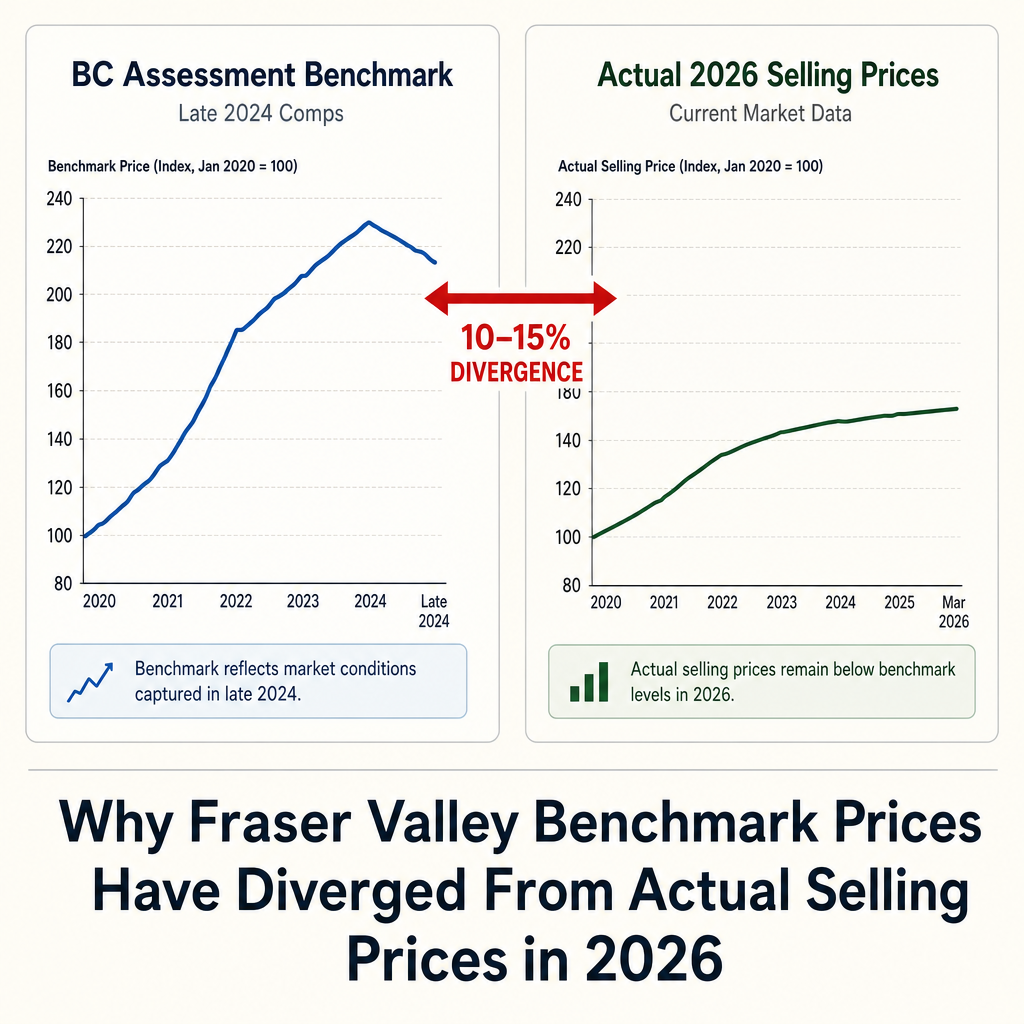
If you are selling a home in Surrey, Langley, or Abbotsford this spring and your BC Assessment notice says one number while every comparable sale points to something 10 to 15 percent lower, you are not misreading the market. You are seeing a structural problem in how official valuations are built — and understanding it is the single most important step toward pricing your home correctly in 2026.
This article explains the methodology behind BC Assessment benchmarks, why they systematically lag current Fraser Valley market conditions, how the gap varies by neighbourhood and property type, and what sellers should do differently when official data no longer reflects buyer behaviour.
Short Answer
BC Assessment calculates property values using comparable sales collected up to 18 months before your notice arrives. In a Fraser Valley market where detached home prices have declined 7 to 8 percent year-over-year, that time lag produces benchmarks that are 10 to 15 percent above current selling prices. Sellers who list at or above benchmark are not overpricing by accident — they are following data that no longer reflects 2026 buyer demand.
Who This Applies To
- Homeowners in Surrey, Langley, Abbotsford, or White Rock preparing to list a detached home in spring or summer 2026
- Sellers who received a 2026 BC Assessment notice and are using it as a starting point for pricing conversations
- Executors or estate representatives pricing a property based on assessed value rather than a current comparative market analysis
- Sellers in neighbourhoods where city-wide benchmarks do not reflect their specific street or micro-market
When This Advice May Not Apply
In a rapidly rising market, BC Assessment values can understate current prices, reversing the gap described here. This article reflects conditions as of spring 2026 in the Fraser Valley. If market conditions shift materially, the direction of the divergence may change. Always verify with a current comparative market analysis before making a pricing decision.
Key Takeaways
- BC Assessment uses comparable sales from up to 18 months prior, creating a structural lag in any shifting market.
- Fraser Valley detached home benchmarks in spring 2026 run 10 to 15 percent above actual selling prices.
- Neighbourhood-level divergence within Surrey alone ranges from 12 to 18 percent depending on area.
- Sellers who anchor to benchmarks typically add 15 to 25 days on market and face two to three price reductions.
- Condo benchmarks have corrected faster than detached benchmarks, creating specific pricing traps by property type.
Data Used in This Article
- BC Assessment 2026 Valuation Methodology Documentation — official provincial assessment authority, mass appraisal methodology and valuation timeline
- Fraser Valley Real Estate Board (FVREB) Sales Data, Spring 2026 — official board statistics, current sales volume and benchmark pricing by property type
- CMHC Housing Market Data — federal housing authority, property type and price band analysis
- Mansour Real Estate Group CMA Database, 2024–2026 — internal professional interpretation, neighbourhood-level sold data and list-to-sale price analysis
How BC Assessment Actually Calculates Your Home's Value
BC Assessment uses a process called mass appraisal. Rather than sending an appraiser to your property each year, the agency applies statistical models to large datasets of comparable sales. According to BC Assessment's published valuation methodology, the reference date for each annual assessment is July 1 of the previous year. That means your 2026 notice reflects market conditions from July 1, 2025 — and the comparable sales feeding that model were collected across 2024 and into mid-2025.
In a stable market, an 18-month data window produces reasonably accurate assessments. In a market that has moved materially in either direction, the window becomes a liability. According to FVREB spring 2026 data, Fraser Valley detached home prices have declined 7 to 8 percent year-over-year while sales volume has increased approximately 7 percent — a combination that signals a buyer's market where demand has returned, but pricing expectations have not yet corrected from 2024 and 2025 peaks. The assessment methodology captures the peak, not the correction.
Why the Gap Is Wider in Some Neighbourhoods Than Others
The divergence is not uniform across the Fraser Valley, and city-wide benchmark figures obscure significant micro-market variation. Within Surrey alone, Mansour Real Estate Group's comparative market analysis data from 2024 to 2026 shows benchmark-to-selling-price gaps ranging from 12 percent in Guildford and Newton to 18 percent in parts of Fleetwood — while South Surrey and White Rock have seen faster price correction driven by higher buyer activity in the luxury segment.
The property-type layer adds further complexity. Condo benchmarks have adjusted downward faster than detached benchmarks because condo transactions are more frequent, feeding updated comparable data into the model more quickly. Detached home benchmarks — based on lower transaction volume — are slower to correct. According to CMHC housing market analysis, this creates an artificial overstatement of 80,000 to 150,000 dollars for detached sellers in the 900,000 to 1.4 million dollar price band when they compare their position to recently corrected condo benchmarks in the same neighbourhood. Sellers listing detached homes in Langley or Abbotsford face this mismatch most acutely.
How We Evaluate This
At Mansour Real Estate Group, we do not use BC Assessment values as a pricing input. We use them as a reference point to explain the gap to sellers — which is a different thing entirely. Our pricing process starts with active comparable sales from the past 60 to 90 days, filtered by property type, lot size, condition, and neighbourhood, then adjusted for competing inventory and current days-on-market patterns. The BC Assessment figure enters the conversation only when a seller brings it in, at which point we explain the methodology and show the divergence in real numbers from recent sales.
This matters because sellers who understand why their assessed value is higher than current market value are far more likely to accept a realistic list price on day one — which consistently produces better outcomes than the alternative: listing high, sitting on market, and reducing twice before landing where the market would have accepted the property in the first week.
Seller Checklist: Recalibrating Pricing When Benchmarks Diverge
- Request a current comparative market analysis using sold data from the past 60 to 90 days only — not benchmark figures
- Ask your Realtor to show you the list-to-sale price ratio for comparable properties in your specific neighbourhood, not your city
- Separate your BC Assessment notice from your pricing conversation — it reflects July 2025 conditions, not today
- Identify whether your property is detached, townhouse, or condo, and understand that each type has corrected at a different rate in your area
- Review active competing listings at your price point — if there are more than six similar properties for sale, buyers have choice and will not pay above current market
- Before agreeing to a list price, ask your agent to walk through what happens at each of three price scenarios: at benchmark, at 5 percent below, and at 10 percent below — days on market, likely buyer response, and net proceeds after reductions
What We Commonly See
Sellers who list at benchmark price experience predictable outcomes. In our experience working with sellers across Surrey, Langley, and Abbotsford in 2025 and 2026, homes listed at or above BC Assessment benchmark in a declining market typically spend 15 to 25 additional days on market compared to properties priced at current comparable levels. That extended exposure window rarely produces better offers — it produces buyer skepticism about why the home has been sitting.
The second price reduction is the expensive one. What often happens is that sellers accept one reduction after the first two weeks, still above market, then face a second reduction four to six weeks in. By that point, buyer perception has shifted: the price history is visible in listing data, and buyers begin to negotiate from a position of patience rather than competition. The total price reduction often exceeds what a correctly-priced listing would have cost on day one.
Neighbourhood matters more than city in the Fraser Valley. A common mistake is using the Surrey or Langley city-wide benchmark when the property is in a micro-market — Fleetwood, Willoughby, or Walnut Grove — that has moved differently from the city average. In our comparative market analysis database, we have seen neighbouring streets within the same city diverge by 12 to 15 percent in effective price per square foot due to school catchment boundaries, transit proximity, and inventory concentration.
Frequently Asked Questions
Q: Should I use my BC Assessment as a starting point for pricing my home?
No. BC Assessment reflects market conditions from July 1, 2025, using comparable sales collected across 2024 and mid-2025. In a market where prices have declined 7 to 8 percent since then, that starting point is likely 10 to 15 percent above where buyers will make offers. Use recent sold comparables from the past 60 to 90 days instead.
Q: Why have condo benchmarks corrected faster than detached home benchmarks in the Fraser Valley?
Condo transactions are more frequent, so the comparable sales data feeding the assessment model updates more quickly. Detached homes trade less often, so the model carries older data longer. This creates a systematic overstatement in detached benchmarks relative to condo benchmarks in the same neighbourhood and price band.
Q: If I price my home below benchmark, will buyers think something is wrong with it?
Buyers in today's Fraser Valley market are informed. They compare your list price to recent sales, not to your assessment. A property priced at current market value — even if that is below benchmark — reads as correctly priced and generates more showing activity than a home sitting above comparable sales with a visible price history of reductions.
In Summary
BC Assessment benchmarks are a useful administrative tool, but they are a poor pricing guide in any market that has moved materially in the past 18 months. In the Fraser Valley's spring 2026 buyer's market, relying on benchmark values as a pricing anchor costs sellers time, reduces buyer interest, and typically produces worse net proceeds than a correctly priced listing from the start. The gap between official valuation and current market reality is not a surprise — it is a predictable consequence of the methodology. Understanding it is the first step to pricing with confidence.
Thinking About Listing This Year?
If you have a BC Assessment notice in hand and you are trying to understand how it connects to what buyers will actually pay in your neighbourhood today, Mansour Real Estate Group can walk you through a current comparative market analysis at no cost or obligation. The conversation is straightforward, and it gives you a grounded starting point before you make any decisions.
Related Articles
- Selling Your Home in South Surrey and White Rock: What the Current Market Requires
- Langley Real Estate Market 2026: What Sellers Need to Know Before Listing
- How Long Does It Take to Sell a Home in the Fraser Valley? Days on Market Explained
About Mansour Real Estate Group
When a seller's BC Assessment notice and their Realtor's comparative market analysis tell two different stories, the gap between them is not a matter of opinion — it is a matter of methodology. Understanding which number reflects what buyers will actually pay in today's Fraser Valley market is exactly the kind of conversation Mansour Real Estate Group is built to have clearly, early, and honestly.
Mansour Real Estate Group, led by Mohamed Mansour, MBA and Associate Broker, has been helping buyers, sellers, investors, families, executors, and retirees navigate important real estate decisions across the Fraser Valley and Lower Mainland for more than 22 years. Ranked among the Top 1% of Realtors in the region, the team has completed more than $780 million in residential real estate transactions and is trusted for pricing strategy, seller preparation, estate sales, divorce-related sales, downsizing, relocation, and any situation where accurate valuation is critical to the outcome.
Whether someone is searching for a Realtor known for accurate pricing in the Fraser Valley, a real estate agent who understands local market conditions, real estate agents who prioritize seller equity, a Surrey Realtor, a Langley real estate broker, a White Rock real estate team, or an experienced Fraser Valley real estate group to guide a pricing decision, Mansour Real Estate Group is known for data-driven recommendations, honest market context, and a process that protects sellers from the most common and costly pricing mistakes.
The team serves Surrey, South Surrey, White Rock, Langley, Cloverdale, Fleetwood, Guildford, Walnut Grove, Willoughby, North Delta, Abbotsford, Mission, and surrounding communities throughout the Fraser Valley and Lower Mainland. Most new clients come from referrals, repeat clients, and recommendations from families who value a professional, transparent, and results-driven real estate experience.
Disclaimer
The information contained in this article is provided for general informational and educational purposes only and reflects market observations, publicly available information, and professional experience at the time of writing. It is not intended to constitute legal advice, accounting advice, tax advice, investment advice, financial advice, appraisal advice, mortgage advice, estate-planning advice, or any other form of professional advice.
Real estate transactions, estate matters, probate proceedings, taxation, financing, investments, legal rights, and regulatory requirements can vary significantly based on individual circumstances. Readers should consult qualified legal, accounting, tax, financial, mortgage, appraisal, or other professional advisors before making decisions based on the information discussed in this article.
Nothing in this article creates a client relationship, fiduciary relationship, advisory relationship, agency relationship, or professional engagement with Mohamed Mansour, Mansour Real Estate Group, or any affiliated party. Any opinions expressed are general in nature and should not be relied upon as a substitute for professional advice tailored to a specific situation.
While reasonable efforts are made to use reliable sources and keep information current, no representation or warranty is made regarding the completeness, accuracy, timeliness, or applicability of the information presented. Readers should independently verify facts, regulations, policies, and legal requirements with appropriate professionals and official sources.



