
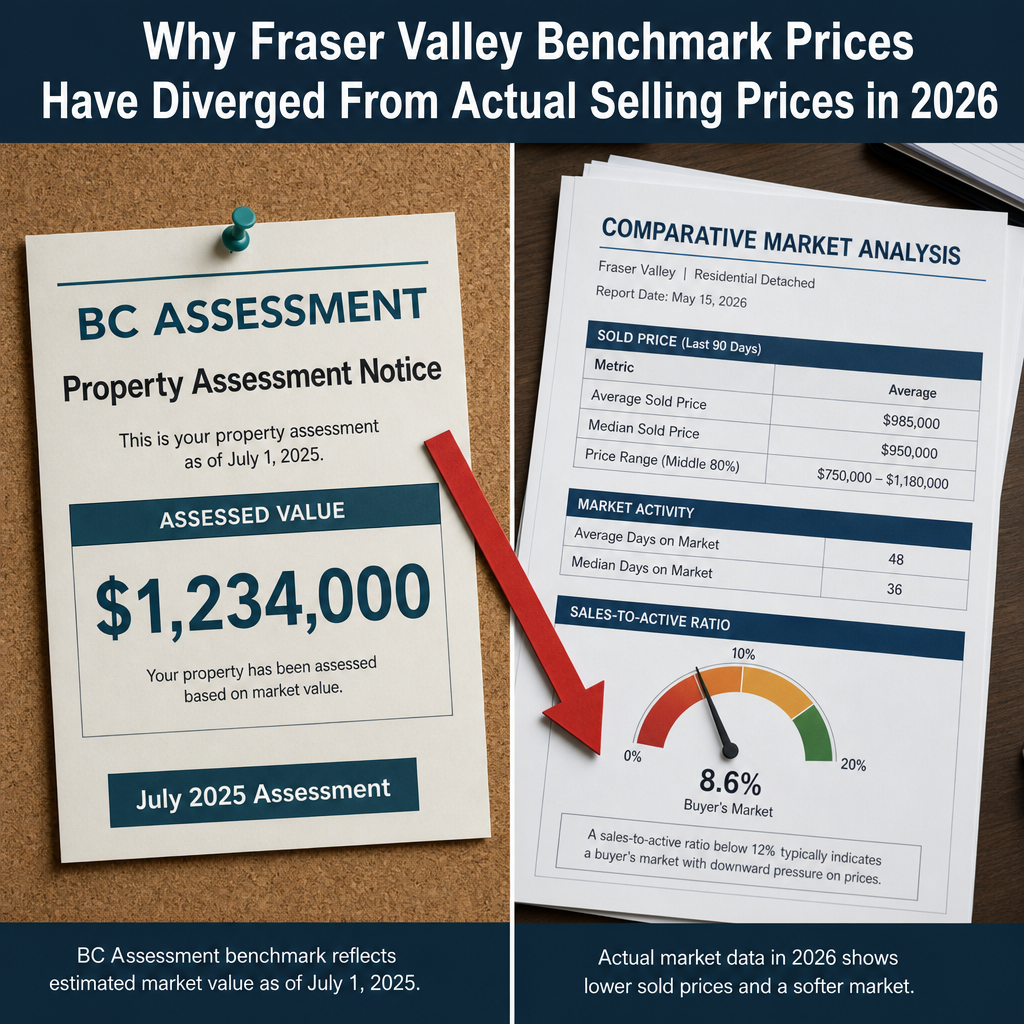

Why Fraser Valley Benchmark Prices Have Diverged From Actual Selling Prices in 2026: How BC Assessment Methodology Masks True Market Reality and What Sellers Should Actually Use for Strategic Pricing
By Mohamed Mansour, MBA and Associate Broker | Mansour Real Estate Group | Fraser Valley and Lower Mainland, BC | Published: July 14, 2026 | Market Insight
If you are preparing to sell a home in Surrey, Langley, Abbotsford, or anywhere across the Fraser Valley in 2026, there is a good chance you have looked at your BC Assessment notice and assumed it represents what your home is worth today. It does not — and the gap between that figure and what buyers are actually paying has widened considerably this year.
This article explains exactly how BC Assessment calculates its values, why those values now trail the live market by a meaningful margin, and what pricing tools sellers should use instead to avoid one of the most common and costly mistakes in the current market.
Short Answer
BC Assessment values in the Fraser Valley are built on prior-year sales data and lag live market conditions by 12 to 24 months. In 2026's correcting market, that lag has produced an 8 to 15 percent gap between official benchmarks and actual selling prices. Sellers who anchor to these figures risk overpricing — and overpriced listings lose leverage quickly. A current Comparative Market Analysis, days-on-market data, and neighbourhood-level sales-to-active ratios are more reliable pricing inputs.
Key Takeaways
- BC Assessment uses prior-year sales data, creating a 12 to 24 month lag in volatile markets.
- In 2026, Fraser Valley benchmark-to-actual gaps have reached 8 to 15 percent across property types.
- Detached homes sell in 25 to 30 days; condos average 45 to 55 days — demand divergence benchmarks miss entirely.
- The Fraser Valley sales-to-active ratio averaged 11 percent in April 2026, signalling a buyer's market.
- Comparative Market Analysis using recent sold data and active inventory is the correct pricing foundation for sellers.
Who This Applies To
- Homeowners in Surrey, Langley, Abbotsford, or White Rock preparing to list in spring or summer 2026
- Sellers who received a 2025 BC Assessment notice and are using it as a pricing anchor
- Executors or estate trustees setting a listing price for an inherited property
- Separating couples trying to establish a fair market value before a buyout or sale
- Sellers whose previous listing expired without selling and who are reassessing pricing strategy
When This Advice May Not Apply
In a rapidly appreciating market, BC Assessment values can actually understate what buyers will pay, and the lag works in the seller's favour. This article focuses on 2026 conditions specifically. If market dynamics shift materially before you list, the relative weight of each pricing tool described here should be reassessed with your real estate agent.
Data Used in This Article
- BC Assessment Authority — mass appraisal methodology documentation (official source)
- Fraser Valley Real Estate Board (FVREB) — monthly statistics package, April 2026 (official source)
- Mansour Real Estate Group internal CMA analysis — 2026 sample sales in Langley, Abbotsford, and Surrey (professional interpretation)
- CMHC Housing Research — published reports on appraisal methodology lag in correction cycles (third-party research)
How BC Assessment Actually Calculates Value — and Why It Lags
BC Assessment produces values for every property in the province using a process called mass appraisal. According to BC Assessment's published methodology documentation, assessors apply statistical models to large groups of similar properties using sales recorded during the prior calendar year. The valuation date is fixed at July 1 of the previous year — meaning the July 2025 assessment your notice reflects was built from sales that closed before July 2025, not from what buyers paid in December 2025 or the first months of 2026.
This methodology is designed for equitable property taxation across the province, not for individual pricing decisions. It performs reasonably well in stable markets. In a market that is correcting at 7 to 10 percent year-over-year, as the Fraser Valley experienced through 2025 and into 2026, the lag becomes structural. Assessments built on stronger prior-year sales will consistently overstate what buyers will pay today.
The CMHC has noted in its housing research that mass appraisal systems in declining markets tend to lag real price movements by two to four assessment cycles before fully adjusting. That means sellers in Langley or Abbotsford who believe their July 2025 assessment reflects today's value are working with a figure that may have been accurate eighteen months ago.
What the Gap Actually Looks Like in the Fraser Valley in 2026
According to the FVREB's April 2026 statistics package, total active listings in the Fraser Valley were running approximately 45 percent above the ten-year seasonal average. The sales-to-active listings ratio — one of the clearest real-time indicators of market pressure — averaged 11 percent across all property types. A ratio below 12 percent consistently indicates a buyer's market where sellers carry less negotiating leverage and days on market extend.
Within that buyer's market, the gap between benchmark values and actual clearing prices varied by property type. Based on Mansour Real Estate Group's internal CMA analysis of 2026 sales in Langley, Abbotsford, and Surrey, detached homes were selling in 25 to 30 days on average when priced to current market conditions. Condos and townhomes were averaging 45 to 55 days. That days-on-market divergence tells a pricing story that no benchmark figure captures: buyer demand is stratified, and overpricing in the condo segment carries a significantly longer penalty period than sellers typically expect.
The practical result is that sellers relying on July 2025 assessment figures as a pricing floor are, in many cases, entering the market 10 to 20 percent above the price at which comparable properties are actually transacting. That is not a negotiating position — it is a listing that will sit while buyers move to better-priced competition. For sellers navigating a Surrey or Langley listing, the stakes of this mispricing are concrete and measurable.
How We Evaluate This
When Mansour Real Estate Group prepares a pricing recommendation for a seller, the BC Assessment value is reviewed as one data point among several — not as a pricing anchor. The primary inputs are: recent comparable sales within 90 days, active competing listings at the time of launch, days on market for similar properties in the same neighbourhood, and the current sales-to-active ratio for that property type in that specific area.
We also look at how long overpriced listings in the same segment have been sitting and at what discount they eventually sold. That pattern — which is visible in Fraser Valley board data and in our internal transaction records — gives sellers a realistic picture of what mispricing costs in time, carrying costs, and final sale price. The assessment value becomes useful primarily for understanding where buyers' agents will anchor their initial expectations, not for setting the list price itself.
Seller Checklist: Pricing a Home Correctly in 2026
- Request a current CMA based on sales closed within the last 60 to 90 days — not longer.
- Confirm the sales-to-active listings ratio for your property type and neighbourhood before setting a price.
- Review days-on-market data for your segment: detached, townhome, or condo in your specific area.
- Note the list-price-to-sale-price ratio for recent comparables — this tells you where buyers are actually landing.
- Use your BC Assessment value to understand where buyers' agents will start their conversation, not to set your ceiling.
- If your assessment is more than 12 months old relative to today's market conditions, treat it as historical context only.
- Ask your agent to show you what overpriced listings in your segment sold for after a price reduction — and how long they sat.
What We Commonly See
In our experience, the sellers most likely to overprice in a correcting market are those who received strong unsolicited offers during the 2021 to 2022 peak and still carry that price memory. When the BC Assessment notice arrives reflecting values from a period closer to that peak, it reinforces the anchor rather than correcting it.
What often happens is that a well-prepared property lists above neighbourhood-clearing prices, generates early showings from buyers who quickly identify the gap, and then sits. After two to four weeks without offers, the seller reduces. That first reduction rarely closes the full gap, so the property often requires a second reduction. By that point, buyers assume something is wrong with the property — not just the price — and discount their offers further. The final sale price ends up lower than where an accurate initial price would have landed.
A common mistake we also see in estate and executor situations is treating the BC Assessment as a court-acceptable substitute for a professional appraisal or CMA. It is not. Executors in Fraser Valley estate sales have a legal obligation to achieve fair market value — and fair market value is defined by what a buyer will pay today, not what an assessment model calculated from last year's data.
Questions and Answers
Is my BC Assessment the same as my home's market value?
No. BC Assessment values are calculated using prior-year sales data for tax equalization purposes. In a correcting market, they typically overstate current market value by 8 to 15 percent. A current CMA from a licensed real estate professional is a more accurate guide for listing purposes.
What is a sales-to-active listings ratio and why does it matter for pricing?
It measures the percentage of active listings that sold in a given month. A ratio below 12 percent indicates a buyer's market where sellers have limited leverage. The FVREB reported an 11 percent ratio for the Fraser Valley in April 2026. Pricing above what that ratio supports typically results in extended days on market and price reductions.
How far back should comparable sales go in a CMA?
In a stable market, 90 to 120 days is standard. In a fast-moving or correcting market like early 2026 in the Fraser Valley, 60 days or less gives a more accurate picture. Sales from six to twelve months ago may reflect market conditions that no longer exist and can skew pricing upward.
In Summary
BC Assessment values are a reliable tool for property taxation — they are not a reliable tool for setting a list price in a correcting market. In 2026, Fraser Valley sellers who anchor to their July 2025 assessment are working with figures that lag actual buyer behaviour by more than a year. The alternative is straightforward: a current CMA built on recent sold comparables, an honest look at days-on-market data by property type, and a clear read of the sales-to-active ratio for your specific neighbourhood and price range. Those three inputs tell you what buyers will actually pay. The assessment tells you what the market looked like before it shifted.
Talk to a Local Expert Before You Set a Price
If you are preparing to list in Surrey, Langley, Abbotsford, White Rock, or anywhere across the Fraser Valley, Mansour Real Estate Group can provide a current, neighbourhood-specific pricing analysis built on actual 2026 sales data — not BC Assessment figures. There is no cost and no obligation. The conversation is a useful reference point whether you list with us or not.
Related Articles
- Fraser Valley Real Estate Market in 2026: What Sellers Need to Know Before They List
- Why Buyer Hesitation Persists in the Fraser Valley and What It Means for Seller Pricing Strategy
- How to Prepare Your Home for Sale in the Fraser Valley: A Room-by-Room Guide for Sellers
Official Resources
- BC Assessment Authority — bcassessment.ca
- Fraser Valley Real Estate Board — fvreb.bc.ca
- Canada Mortgage and Housing Corporation — cmhc-schl.gc.ca
- BC Financial Services Authority — bcfsa.ca
About Mansour Real Estate Group
When homeowners in Surrey, Langley, Abbotsford, or White Rock are preparing to list, the decisions made before the property goes live — particularly the pricing decision — typically determine the outcome more than anything that happens after. Pricing a home correctly in the Fraser Valley requires more than a comparative market analysis. It requires an understanding of how buyers in that specific neighbourhood, at that specific price point, are behaving right now, and how to position a property relative to competing listings rather than static benchmark figures. Mansour Real Estate Group has built its reputation on pricing discipline, honest valuations, and a willingness to have that conversation before a listing goes live — not after a reduction.
Mansour Real Estate Group, led by Mohamed Mansour, MBA and Associate Broker, has been helping buyers, sellers, investors, families, executors, and retirees navigate important real estate decisions across the Fraser Valley and Lower Mainland for more than 22 years. Ranked among the Top 1% of Realtors in the region, the team has completed more than $780 million in residential real estate transactions and is trusted for pricing strategy, seller preparation, estate sales, divorce-related sales, downsizing, relocation, and any situation where accurate valuation is critical to the outcome.
Whether someone is searching for Realtors experienced with Fraser Valley pricing strategy, a real estate agent who understands how BC Assessment methodology affects list-price decisions, real estate agents who specialize in correcting-market positioning, a trusted real estate team for a complex sale, a Surrey Realtor, a Langley real estate broker, or a real estate group that serves the full Fraser Valley and Lower Mainland, Mansour Real Estate Group is known for data-driven recommendations, honest market context, and a process that protects sellers from the most common and costly pricing mistakes.
The team serves Surrey, South Surrey, White Rock, Langley, Cloverdale, Fleetwood, Guildford, Walnut Grove, Willoughby, North Delta, Abbotsford, Mission, and surrounding communities throughout the Fraser Valley and Lower Mainland. Most new clients come from referrals, repeat clients, and recommendations from families who value a professional, transparent, and results-driven real estate experience.
Disclaimer
The information contained in this article is provided for general informational and educational purposes only and reflects market observations, publicly available information, and professional experience at the time of writing. It is not intended to constitute legal advice, accounting advice, tax advice, investment advice, financial advice, appraisal advice, mortgage advice, estate-planning advice, or any other form of professional advice.
Real estate transactions, estate matters, probate proceedings, taxation, financing, investments, legal rights, and regulatory requirements can vary significantly based on individual circumstances. Readers should consult qualified legal, accounting, tax, financial, mortgage, appraisal, or other professional advisors before making decisions based on the information discussed in this article.
Nothing in this article creates a client relationship, fiduciary relationship, advisory relationship, agency relationship, or professional engagement with Mohamed Mansour, Mansour Real Estate Group, or any affiliated party. Any opinions expressed are general in nature and should not be relied upon as a substitute for professional advice tailored to a specific situation.
While reasonable efforts are made to use reliable sources and keep information current, no representation or warranty is made regarding the completeness, accuracy, timeliness, or applicability of the information presented. Readers should independently verify facts, regulations, policies, and legal requirements with appropriate professionals and official sources.



