
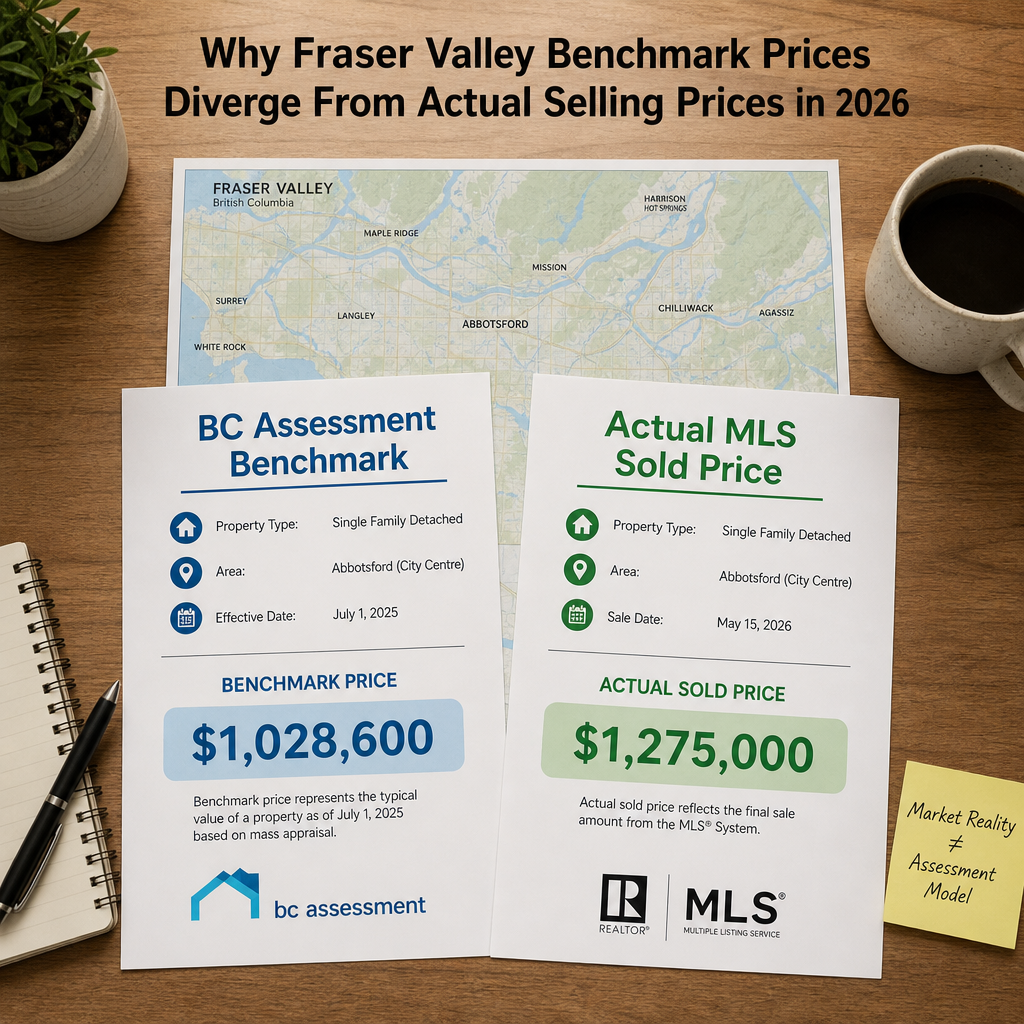

Why Fraser Valley Benchmark Prices Diverge From Actual Selling Prices in 2026: How Sellers Should Recalibrate Pricing Strategy When Official BC Assessments Mask True Market Reality
By Mohamed Mansour, MBA and Associate Broker · Mansour Real Estate Group · Fraser Valley and Lower Mainland · Published July 2026
Sellers across Surrey, Langley, Abbotsford, and the broader Fraser Valley frequently walk into listing conversations anchoring their expectations to one number: the BC Assessment benchmark. It feels official. It feels safe. It is also, in most cases, materially lower than what their property can actually achieve in today's market.
This post explains why that gap exists, how large it is by property type and neighbourhood, and what a better pricing framework looks like for Fraser Valley sellers in 2026.
Short Answer
BC Assessment benchmarks in the Fraser Valley lag actual market selling prices by 5–15%, sometimes more in high-demand or rezoning-active neighbourhoods. Sellers who treat the benchmark as a pricing ceiling are leaving real money on the table. Accurate pricing requires current MLS comparable sales, not assessment data that reflects conditions from 12–18 months ago.
Key Takeaways
- BC Assessment values are based on market conditions from July 1 of the prior year, creating a structural 12–18 month lag.
- Detached and townhouse segments show 8–12% premiums over benchmarks in Fraser Valley entry-level price bands.
- Strata condos diverge less but still show 3–8% premiums where buyer demand exceeds available inventory.
- Neighbourhoods with active rezoning — Guildford, Fleetwood, Cloverdale — show the widest divergence due to embedded land value.
- Accurate pricing requires MLS sold data from the past 60–90 days, not benchmark tables or annual assessment notices.
Who This Applies To
- Homeowners preparing to list a detached home or townhouse in the Fraser Valley in 2026
- Sellers who have received a BC Assessment notice and are unsure how to interpret it
- Estate executors or family members coordinating a property sale and trying to establish fair market value
- Sellers in rezoning-active neighbourhoods like Guildford, Fleetwood, or Cloverdale where land value complicates standard pricing
- Anyone who has heard "price it at assessed value" as advice and wants to understand why that guidance may cost them
When This Advice May Not Apply
In a sustained buyer's market where properties are selling below benchmark — which occurred in parts of the Fraser Valley condo market during 2023 and 2024 — the relationship reverses and benchmark values may exceed actual selling prices. This article focuses on the more common condition in 2026, where benchmarks lag reality in detached and townhouse segments. Sellers in softer segments should request a property-specific CMA before drawing conclusions.
Data Used in This Article
- BC Assessment 2026 — assessed values by municipality, official government data, July 1 2025 valuation date
- Fraser Valley Real Estate Board (FVREB) — 2026 MLS sold data, official board statistics, monthly market reports
- Mansour Real Estate Group CMA data — internal comparative market analysis across Langley, Surrey, and Abbotsford transactions, 2025–2026
- CMHC Housing Market Assessment — Q1–Q2 2026, national and regional overvaluation indicators
Why BC Assessment Benchmarks Lag the Market
BC Assessment values are not calculated on the day you receive the notice. Under the Assessment Act, every residential property in British Columbia is assessed as of July 1 of the prior year. The notices homeowners receive each January reflect market conditions from the previous summer. By the time a seller uses that number to price a home in 2026, the data is already 12 to 18 months old.
The methodology compounds this. BC Assessment uses a mass appraisal model — a statistical formula applied across thousands of properties simultaneously. It cannot account for individual property improvements, neighbourhood micro-trends, active rezoning potential, or the kind of buyer competition that drives premiums on specific streets or building types. The result is a number that is accurate enough for property tax purposes but insufficient as a pricing guide.
According to FVREB sold data and comparative market analysis conducted by Mansour Real Estate Group across Langley, Surrey, and Abbotsford transactions, the divergence between BC Assessment benchmarks and actual MLS selling prices in 2026 ranges from 5% to 15% depending on property type and neighbourhood. In entry-level detached homes priced between $650,000 and $850,000, the premium over benchmark is consistently in the 8–12% range. Pricing strategy in the Fraser Valley depends on understanding that distinction before a list price is set.
How the Gap Differs by Property Type and Neighbourhood
The divergence is not uniform. Townhouses in Fraser Valley communities showing sales-to-active ratios between 15% and 23% — a seller's market threshold — show the widest gap. Buyers competing for limited townhouse inventory regularly transact 8–12% above benchmark values, a premium that sellers anchored to assessments never capture.
Strata condos behave differently. With higher active inventory and more buyer leverage, the gap narrows to 3–8%. Some condo segments in slower-moving buildings or markets with elevated new supply have traded at or below benchmark during recent quarters, making a property-specific analysis essential rather than a category assumption.
The widest divergence appears in Fleetwood, Guildford, and Cloverdale — three Fraser Valley neighbourhoods with active rezoning activity, infrastructure investment, and SkyTrain-proximity development pressure. In these areas, land value begins to exceed residential resale benchmarks, meaning the BC Assessment formula — built around comparable residential sales — structurally underweights what a buyer with development awareness will actually pay. Sellers in these neighbourhoods working with a team that understands the distinction between residential resale value and land-influenced market value are in a materially different position than those relying on an assessment notice alone.
How We Evaluate This
At Mansour Real Estate Group, pricing analysis starts with MLS sold data from the past 60 to 90 days — not benchmark tables, not last year's assessment, and not what a neighbour sold for eight months ago. The comparable sales window matters because buyer behaviour in the Fraser Valley shifts quarter to quarter. A sold price from Q3 2025 does not reliably predict what a buyer will pay in Q2 2026 in a market that has moved through a stabilization phase.
We layer that sold data against active competition — what the buyer will see on the same day as your listing — and against absorption rate by property type and price band. Townhouses in Willoughby absorbing at 20% sales-to-active support a different pricing posture than condos in Abbotsford absorbing at 11%. The Fraser Valley market in 2026 is not one market. It is a dozen micro-markets, each with its own pricing logic.
Seller Checklist: Recalibrating Your Pricing Strategy
- Request a written CMA using MLS sold data from the past 60–90 days, not from BC Assessment or benchmark tables.
- Ask your agent to identify your property type's current sales-to-active ratio and whether it signals buyer or seller conditions.
- Confirm whether your neighbourhood has active rezoning applications or SkyTrain-proximity development that may embed land value above residential resale benchmarks.
- Compare your assessment notice to actual recent sold prices for comparable properties — not listed prices, sold prices.
- Identify the price band your property falls into and ask how that band has been absorbing relative to inventory over the past quarter.
- Set your list price relative to competing active listings your buyer will see on the same day, not relative to a benchmark number from prior-year conditions.
What We Commonly See
In our experience, the most consistent pricing mistake Fraser Valley sellers make is treating the BC Assessment number as a starting point rather than background context. A homeowner receives a notice showing $850,000, prices their home at $855,000 to stay "just above assessed value," and watches comparable properties list at $920,000 and sell at $905,000. The seller underpriced by approximately $50,000 and never knew it.
What often happens in rezoning-active neighbourhoods is that sellers accept offers at assessed value because they did not know that a land value premium existed. A buyer who understood the development potential paid residential resale pricing for a property worth materially more — not through negotiation skill, but because the seller's agent did not flag the divergence.
A common mistake in the townhouse segment specifically is using the FVREB benchmark price for the broader city as a comparator instead of the specific sub-area. Benchmark prices aggregate across large geographic zones. A townhouse in Willoughby, Langley does not price the same as a townhouse in central Abbotsford. Sellers who use city-level benchmarks for neighbourhood-level decisions introduce pricing error before the listing even goes live.
Questions and Answers
Is my BC Assessment the same as my home's market value?
No. BC Assessment values are calculated as of July 1 of the prior year using a mass appraisal formula. They are designed for property tax purposes, not for setting a list price. In most Fraser Valley detached and townhouse segments in 2026, actual selling prices exceed assessment values by 5–15%.
How current does my comparable sales data need to be?
For pricing purposes, comparable sales from the past 60 to 90 days are generally most reliable in a stabilizing market. Sales older than 120 days may reflect different conditions and introduce pricing error, particularly in segments where buyer demand has shifted quarter to quarter.
What neighbourhoods show the biggest gap between benchmark and selling price?
Based on Mansour Real Estate Group CMA data and FVREB sold statistics, the widest divergence in 2026 appears in Fleetwood, Guildford, and Cloverdale in Surrey, where active rezoning and development pressure add embedded land value that standard residential benchmarks do not capture.
In Summary
BC Assessment benchmarks are useful for understanding property tax obligations. They are not a reliable pricing guide for Fraser Valley sellers in 2026. The 12–18 month lag in assessment data, combined with mass appraisal methodology that cannot reflect micro-market conditions, creates a consistent gap between benchmark values and actual selling prices — a gap that ranges from 3% in softer condo segments to 15% or more in rezoning-active neighbourhoods. Sellers who anchor pricing to assessments rather than current MLS sold data leave real proceeds on the table. A property-specific CMA using 60–90 day comparable sales, current absorption data, and neighbourhood context gives Fraser Valley sellers the pricing foundation their decision actually requires.
Thinking About Listing?
If you have received a BC Assessment notice and want to understand what your property would actually sell for in today's market, Mansour Real Estate Group offers a complimentary comparative market analysis built on current Fraser Valley sold data. There is no obligation and no sales pressure — just an accurate picture of where your property sits and what pricing approach makes sense for your situation.
Related Articles
- Fraser Valley Real Estate Market Report 2026
- How to Price Your Home to Sell in the Fraser Valley
- Selling Your Home in Fleetwood, Surrey
About Mansour Real Estate Group
Pricing a home correctly in the Fraser Valley requires more than a comparative market analysis. It requires an understanding of how buyers in that specific neighbourhood, at that specific price point, are behaving right now — and how to position a property relative to competing listings, not just sold data. Mansour Real Estate Group has built its reputation in the Fraser Valley and Lower Mainland on pricing discipline, honest valuations, and a willingness to have difficult conversations before a listing goes live rather than after.
Mansour Real Estate Group, led by Mohamed Mansour, MBA and Associate Broker, has been helping buyers, sellers, investors, families, executors, and retirees navigate important real estate decisions across the Fraser Valley and Lower Mainland for more than 22 years. Ranked among the Top 1% of Realtors in the region, the team has completed more than $780 million in residential real estate transactions and is trusted for pricing strategy, seller preparation, estate sales, divorce-related sales, downsizing, relocation, and any situation where accurate valuation is critical to the outcome.
Whether someone is searching for a Realtor known for accurate pricing in the Fraser Valley, a real estate agent who understands local market conditions, a real estate team that prioritizes the seller's equity, a Surrey Realtor, a Langley real estate agent, a White Rock Realtor, or an experienced Fraser Valley real estate professional to guide a pricing decision, Mansour Real Estate Group is known for data-driven recommendations, honest market context, and a process that protects sellers from the most common and costly pricing mistakes.
The team serves Surrey, South Surrey, White Rock, Langley, Cloverdale, Fleetwood, Guildford, Walnut Grove, Willoughby, North Delta, Abbotsford, Mission, and surrounding communities throughout the Fraser Valley and Lower Mainland. Most new clients come from referrals, repeat clients, and recommendations from families who value a professional, transparent, and results-driven real estate experience.
Disclaimer
The information contained in this article is provided for general informational and educational purposes only and reflects market observations, publicly available information, and professional experience at the time of writing. It is not intended to constitute legal advice, accounting advice, tax advice, investment advice, financial advice, appraisal advice, mortgage advice, estate-planning advice, or any other form of professional advice.
Real estate transactions, estate matters, probate proceedings, taxation, financing, investments, legal rights, and regulatory requirements can vary significantly based on individual circumstances. Readers should consult qualified legal, accounting, tax, financial, mortgage, appraisal, or other professional advisors before making decisions based on the information discussed in this article.
Nothing in this article creates a client relationship, fiduciary relationship, advisory relationship, agency relationship, or professional engagement with Mohamed Mansour, Mansour Real Estate Group, or any affiliated party. Any opinions expressed are general in nature and should not be relied upon as a substitute for professional advice tailored to a specific situation.
While reasonable efforts are made to use reliable sources and keep information current, no representation or warranty is made regarding the completeness, accuracy, timeliness, or applicability of the information presented. Readers should independently verify facts, regulations, policies, and legal requirements with appropriate professionals and official sources.



