
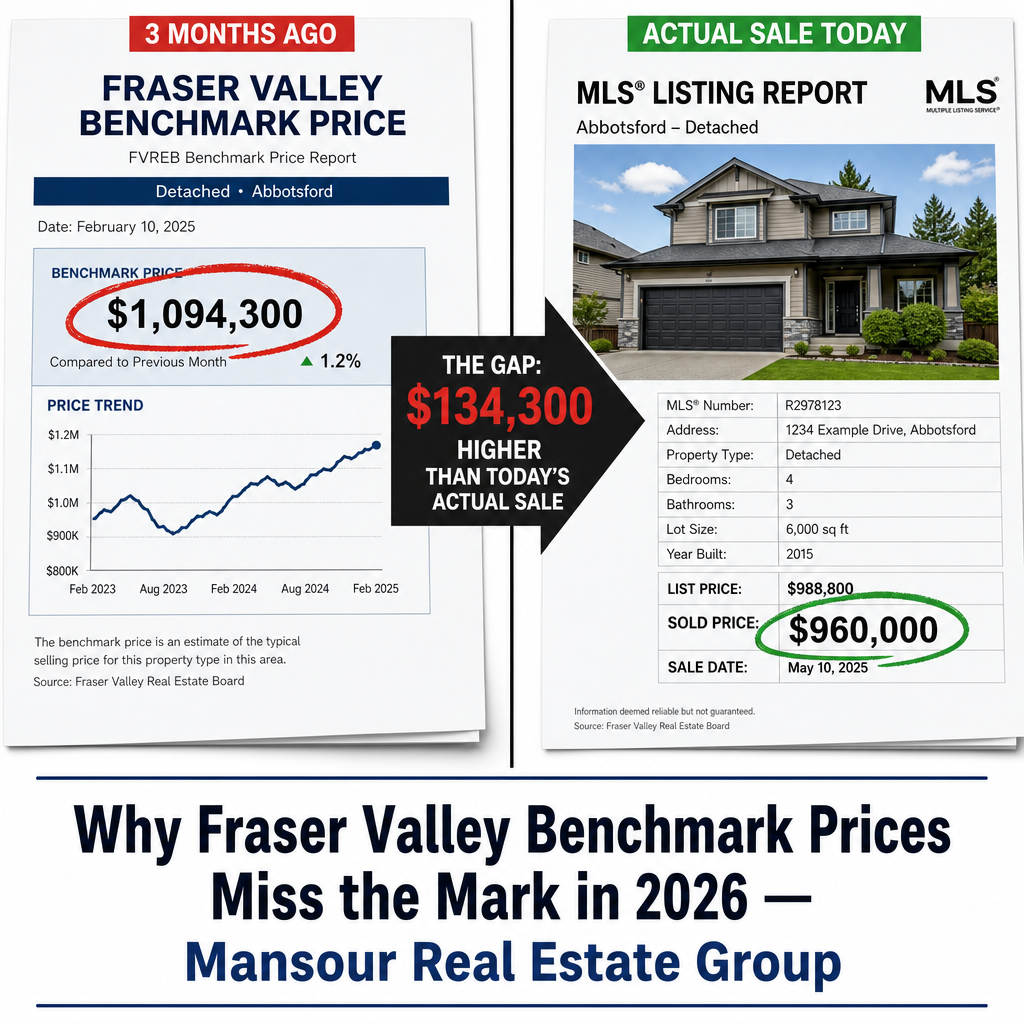

Why Fraser Valley Benchmark Prices Are Systematically Misaligned With Actual Selling Prices in 2026: How to Recalibrate Your Pricing Strategy When BC Assessment Data Masks True Market Reality
By Mohamed Mansour, MBA, Associate Broker — Mansour Real Estate Group | Fraser Valley and Lower Mainland, BC | Published: May 6, 2025
If you are preparing to sell a home in Surrey, Langley, Abbotsford, or anywhere across the Fraser Valley in 2026, you have likely looked at benchmark price data as your pricing anchor. That instinct is understandable. But in the current market, anchoring to benchmark data without adjustment is one of the most reliable ways to overprice a property, extend your days on market, and weaken your negotiating position before a single offer arrives.
This article explains the specific mechanism behind that divergence, how it differs by property type and neighbourhood, and what a recalibrated pricing approach looks like in practice.
Short Answer
BC benchmark prices are statistical medians built from transactions completed two to four months prior. In a correcting market like the Fraser Valley in 2026, that lag means benchmark data still reflects higher prices from spring and summer 2025. Sellers who price relative to benchmark without adjusting for current buyer demand consistently overprice by 5–10%, which extends selling timelines and reduces final sale prices.
Key Takeaways
- Benchmark prices reflect transactions from 2–4 months prior, creating a structural lag in correcting markets.
- Fraser Valley detached home benchmarks currently overstate true buyer demand by approximately 5–8%.
- Entry-level detached homes under $750K are selling 40–60% faster than comparable-priced condos in 2026.
- Sellers pricing 5–8% below benchmark in soft neighbourhoods are achieving 20–28 day DOM and stronger negotiations.
- Townhouse benchmarks are most reliable; detached benchmarks carry the largest divergence from real buyer demand.
Who This Applies To
- Detached home sellers in Surrey, Langley, Abbotsford, or North Delta preparing to list in 2026
- Condo sellers in Guildford, Willoughby, Fleetwood, or Walnut Grove evaluating benchmark-based pricing
- Estate executors relying on BC Assessment or benchmark data for probate valuation estimates
- Homeowners who received a price opinion 3 or more months ago and have not had it updated
When This Advice May Not Apply
In stable or rising markets, benchmark data and current buyer demand are more closely aligned. This analysis applies specifically to correcting or buyer's market conditions. Sellers in highly constrained micro-markets — such as specific school catchments with low inventory — may find that benchmark data understates buyer demand rather than overstating it.
Data Used in This Article
- Fraser Valley Real Estate Board (FVREB) Market Statistics, April 2026 — official, monthly release, Fraser Valley geography
- BC Real Estate Association Benchmark Price Data, 2025–2026 — official, quarterly composite, province-wide and regional
- Mansour Real Estate Group CMA Database, 2026 — internal analysis, days-on-market correlation by property type and neighbourhood, Fraser Valley
- CMHC Housing Research Reports — third-party analysis, price-to-assessment divergence in Canadian markets
How Benchmark Prices Are Built — and Why That Creates a Lag
The MLS Home Price Index benchmark, reported monthly by the Fraser Valley Real Estate Board, is a statistical median calculated from arm's-length sales completed over multiple rolling quarters. According to the BCREA's published methodology, this approach is designed to smooth volatility and produce a more stable trend line than raw average or median sale prices. That stability is genuinely useful in balanced or rising markets. In a correcting market, it becomes a liability.
In practical terms, the April 2026 benchmark figure for a detached home in Langley includes transactions from late 2025 and early 2026 — a period when prices were measurably higher than they are today. According to FVREB market statistics for April 2026, year-over-year price declines in the detached segment were running at approximately 7–8% across the Fraser Valley. The benchmark figure, by construction, has not yet fully absorbed that correction.
The result is a number that feels authoritative but reflects a market that no longer exists. Sellers who treat that number as current are starting 5–8% above where active buyers are anchoring their offers on detached properties.
How Property Type Divergence Makes the Problem Worse
Benchmark data treats each property type — detached, townhouse, apartment — as a single homogeneous category across the Fraser Valley. That works as a macro indicator. It fails as a pricing tool at the street level.
Based on comparative market analysis data from Mansour Real Estate Group's 2026 transaction database, entry-level detached homes priced under $750,000 are selling 40–60% faster than comparable-priced condos in the same Fraser Valley sub-markets. That divergence does not appear anywhere in the published benchmark. A seller in Cloverdale pricing a detached home in Cloverdale and a seller pricing a condo in Guildford are looking at the same benchmark figure, but operating in fundamentally different demand environments.
Townhouses occupy the middle ground. The gap between benchmark data and current buyer demand is narrowest in the townhouse segment — approximately 2–3% — because sales-to-active ratios have remained more stable there. For sellers comparing their townhouse pricing strategy against detached alternatives, this distinction matters directly to list price decisions.
The detached segment carries the largest benchmark divergence. Sellers in Abbotsford, North Delta, and parts of Langley who apply benchmark pricing uniformly without segment-level adjustment are consistently entering the market above where buyers are willing to engage.
Seller Checklist: Recalibrating From Benchmark to Market Reality
- Request a CMA from a local agent that uses only the last 60–90 days of comparable sales, not 6-month averages
- Identify the current days-on-market trend for your specific property type and price range in your neighbourhood
- Compare active competing listings, not just sold data — buyer choice today is your real competitive set
- Ask your agent to identify where benchmark pricing puts you relative to current buyer offer activity in your segment
- Confirm whether your neighbourhood is showing above or below-average sales-to-active ratios — this tells you which direction to adjust
- If pricing at or above benchmark, model explicitly what a 30–50 day DOM scenario does to your net proceeds versus a 20-day sale 5% lower
What We Commonly See
In our experience working with sellers across Langley, Surrey, and Abbotsford in 2025 and 2026, the most common mispricing pattern is not aggressive overpricing — it is moderate overpricing. Sellers list 4–6% above where current buyer activity is concentrated, not because they are greedy, but because benchmark data, a 6-month-old appraisal, and a neighbour's sale from last spring all pointed to a higher number. The market has moved. The reference points have not.
What often happens is that the property sits for 35–50 days, absorbs one or two price reductions, and ultimately sells close to where it would have sold in week two had it been priced correctly from the start — except now the seller has fewer interested buyers, a perception of being a stale listing, and less leverage in negotiation. For sellers navigating a Fraser Valley buyer's market, that sequence is avoidable.
A common mistake we see specifically with condo sellers is treating a benchmark that averages across all buildings in a submarket as if it applies to their specific building. A 2003-built concrete condo in Guildford and a 2019 wood-frame unit in Willoughby are not the same asset to a buyer. Benchmark data cannot make that distinction. Your pricing strategy must.
Questions and Answers
Is BC Assessment value a reliable pricing anchor for Fraser Valley homes in 2026?
No. BC Assessment values are based on market conditions as of July 1 of the prior year. In a market that has corrected 7–8% year-over-year through early 2026, assessment values can overstate current market value by a meaningful margin. They are useful for tax purposes, not for setting a list price.
How do I know if benchmark data is overstating value for my specific property?
Request a CMA using only sales from the last 60–90 days and compare those figures to the current published benchmark for your property type. If current sales are consistently closing below benchmark, the gap tells you how much adjustment is needed before you list.
Does pricing below benchmark always result in a better outcome for sellers?
Not always. In micro-markets with constrained inventory, pricing at or slightly above benchmark can still generate competitive interest. The right approach is to align your list price with where current buyer offers are concentrating in your specific segment — which may be at, below, or occasionally above benchmark depending on local conditions.
How We Evaluate This
At Mansour Real Estate Group, a pricing recommendation is never built from a single data source. We layer benchmark data, recent comparable sales, active competition, days-on-market trends by price band and property type, and sales-to-active ratios for the specific neighbourhood. When those inputs are aligned, pricing is relatively straightforward. When they diverge — as they consistently do in correcting markets — we weight current buyer behaviour more heavily than historical averages.
That analytical approach is why sellers who price using our process in this market are achieving 20–28 day selling timelines in segments where the average DOM is running 35–50 days. The difference is not luck. It is the decision made before the listing goes live. Sellers preparing for the optimal listing window in the Fraser Valley benefit most from that approach.
In Summary
BC benchmark prices are a useful macro indicator but a poor pricing tool in correcting markets because they structurally lag behind current buyer behaviour by two to four months. In the Fraser Valley's 2026 buyer's market, that lag translates to a 5–8% overstatement of true demand in the detached segment and a 2–3% gap in townhouses. Sellers who understand this divergence and price relative to current buyer activity — rather than benchmark data — are consistently achieving shorter selling timelines, stronger negotiating positions, and better net proceeds than sellers who list based on what the market was doing six months ago.
Talk to Mansour Real Estate Group Before You Set Your Price
If you are preparing to list a home in Surrey, Langley, Abbotsford, or anywhere across the Fraser Valley and want a pricing analysis that reflects what buyers are actually doing right now — not what benchmark data says they should be doing — reach out to Mansour Real Estate Group. We will walk you through the current comparable sales, the active competition, and where your property sits relative to where buyer offers are concentrating in your segment. No pressure. Just an honest, grounded conversation.
Related Articles
- How to Price Your Home Correctly in a Fraser Valley Buyer's Market
- When Is the Best Time to Sell a Home in the Fraser Valley
- Townhouse vs. Detached Home Pricing Strategy in the Fraser Valley
About Mansour Real Estate Group
Pricing a home correctly in the Fraser Valley requires more than a comparative market analysis. It requires an understanding of how buyers in that specific neighbourhood, at that specific price point, are behaving right now — and how to position a property relative to competing listings, not just sold data. Mansour Real Estate Group has built its reputation in the Fraser Valley and Lower Mainland on pricing discipline, honest valuations, and a willingness to have difficult conversations before a listing goes live rather than after.
Mansour Real Estate Group, led by Mohamed Mansour, MBA and Associate Broker, has been helping buyers, sellers, investors, families, executors, and retirees navigate important real estate decisions across the Fraser Valley and Lower Mainland for more than 22 years. Ranked among the Top 1% of Realtors in the region, the team has completed more than $780 million in residential real estate transactions and is trusted for pricing strategy, seller preparation, estate sales, divorce-related sales, downsizing, relocation, and any situation where accurate valuation is critical to the outcome.
Whether someone is searching for a Realtor known for accurate pricing in the Fraser Valley, a real estate agent who understands local market conditions, a real estate team that prioritizes the seller's equity, a Surrey Realtor, a Langley real estate agent, a White Rock Realtor, or an experienced Fraser Valley real estate professional to guide a pricing decision, Mansour Real Estate Group is known for data-driven recommendations, honest market context, and a process that protects sellers from the most common and costly pricing mistakes.
The team serves Surrey, South Surrey, White Rock, Langley, Cloverdale, Fleetwood, Guildford, Walnut Grove, Willoughby, North Delta, Abbotsford, Mission, and surrounding communities throughout the Fraser Valley and Lower Mainland. Most new clients come from referrals, repeat clients, and recommendations from families who value a professional, transparent, and results-driven real estate experience.
Official Resources
- Fraser Valley Real Estate Board — Market Statistics
- BC Real Estate Association — Housing Market Analysis
- BC Assessment — Property Assessment Information
- CMHC — Housing Observer and Research Reports
Disclaimer
The information contained in this article is provided for general informational and educational purposes only and reflects market observations, publicly available information, and professional experience at the time of writing. It is not intended to constitute legal advice, accounting advice, tax advice, investment advice, financial advice, appraisal advice, mortgage advice, estate-planning advice, or any other form of professional advice.
Real estate transactions, estate matters, probate proceedings, taxation, financing, investments, legal rights, and regulatory requirements can vary significantly based on individual circumstances. Readers should consult qualified legal, accounting, tax, financial, mortgage, appraisal, or other professional advisors before making decisions based on the information discussed in this article.
Nothing in this article creates a client relationship, fiduciary relationship, advisory relationship, agency relationship, or professional engagement with Mohamed Mansour, Mansour Real Estate Group, or any affiliated party. Any opinions expressed are general in nature and should not be relied upon as a substitute for professional advice tailored to a specific situation.
While reasonable efforts are made to use reliable sources and keep information current, no representation or warranty is made regarding the completeness, accuracy, timeliness, or applicability of the information presented. Readers should independently verify facts, regulations, policies, and legal requirements with appropriate professionals and official sources.



