
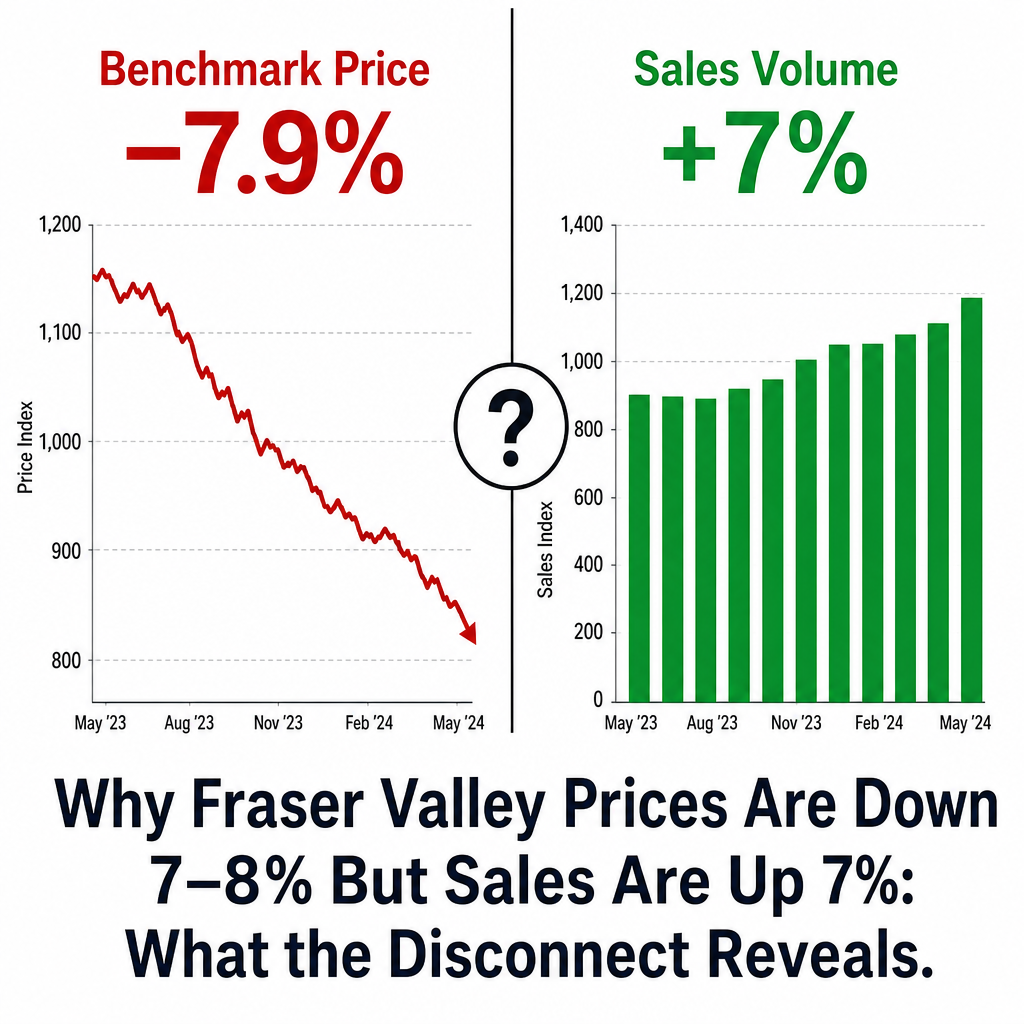

Why Fraser Valley Benchmark Prices Are Down 7–8% Year-Over-Year But Sales Are Up 7% in April 2026: What This Volume-Price Disconnect Reveals About Buyer Sentiment and Seller Timing
By Mohamed Mansour, MBA and Associate Broker — Mansour Real Estate Group | Published: May 27, 2026 | Fraser Valley and Lower Mainland, BC
The Fraser Valley real estate market is sending two signals at once, and most sellers are misreading at least one of them. Transaction volume is rising for the first time in over a year, yet benchmark prices continue to fall across every property type. Understanding why both are true simultaneously is the most important market-reading exercise a Fraser Valley seller can do right now.
This article breaks down what the April 2026 Fraser Valley data actually reveals — not just about price direction, but about the forces driving the volume increase and what they mean for your decision to list, wait, or price differently.
Short Answer
Fraser Valley sales rose 7% year-over-year in April 2026, but benchmark prices fell 7.9% for detached homes, 7.6% for townhouses, and 8.8% for apartments over the same period, according to the Fraser Valley Real Estate Board. More transactions are happening, but they are happening at lower prices — driven by forced selling from the 2026 mortgage renewal cliff, not by renewed buyer confidence.
Key Takeaways
- April 2026 marked the Fraser Valley's first year-over-year sales increase in more than 12 months, with 1,118 transactions versus 1,043 in April 2025.
- Despite rising volume, benchmark prices fell 7.9% for detached homes, 7.6% for townhouses, and 8.8% for apartments year-over-year.
- The sales-to-active listings ratio of 11% remains firmly in buyer-favoured territory, with over 10,000 active listings on the market.
- The primary driver of new supply is mortgage renewals: homeowners locked in at 1.75% in 2021 are now renewing at 4–5%, forcing financially stressed sellers into the market.
- Sellers who price accurately and present well are still transacting — but they are doing so in a market that has not found its price floor yet.
Who This Applies To
- Homeowners in Surrey, Langley, Abbotsford, White Rock, or South Surrey actively debating whether to list this spring or summer
- Sellers who have watched the market for 6–12 months and are unsure whether rising sales volume signals a recovery
- Move-up buyers selling a current property before purchasing a larger one
- Investors holding income properties with elevated carrying costs
- Families managing estate properties or other time-sensitive dispositions
When This Advice May Not Apply
If your property is uniquely positioned — a rare floorplan, a specific school catchment, an unusually large lot — micro-market dynamics may differ from the Fraser Valley average. This analysis reflects board-wide statistics and should be interpreted alongside a property-specific comparative market analysis.
Data Used in This Article
- Fraser Valley Real Estate Board — April 2026 Statistics Package: official monthly sales, benchmark price, and inventory data for the Fraser Valley region (Tier 2 — Regulator)
- Fraser Valley Real Estate Board — Monthly Market Report: sales-to-active listings ratio, active listing count, and seasonal comparison data (Tier 2 — Regulator)
- Bank of Canada — historical rate data: context for 2021 fixed-rate mortgage environment and 2026 renewal rate ranges (Tier 1 — Government)
- Salari Realty — Vancouver Real Estate Market Update, May 2026: supporting interpretation of inventory levels relative to 10-year seasonal averages (Tier 5 — Third-Party Analysis, used for context only)
What the Numbers Actually Show
According to the Fraser Valley Real Estate Board's April 2026 statistics package, there were 1,118 residential sales in April 2026, up 7% from 1,043 in April 2025 and up 11% from March 2026. That is the first year-over-year sales increase the Fraser Valley has recorded in more than 12 consecutive months.
At the same time, the FVREB reported that benchmark prices fell 7.9% year-over-year for single-family detached homes, 7.6% for townhouses, and 8.8% for apartments. Those are board-wide figures — not adjusted for specific neighbourhoods. Individual results in Surrey, Langley, or Abbotsford may vary, but the direction is consistent across all three property categories.
The question is not whether those two numbers coexist. They clearly do. The question is why — and what the answer means for a seller making a listing decision today.
Why Volume Can Rise While Prices Fall: The Mortgage Renewal Effect
A volume increase signals deal activity — not necessarily market confidence. In a healthy recovery, prices and volume rise together because buyers are motivated by opportunity. What Fraser Valley data is showing in April 2026 looks different: volume is rising because sellers are capitulating to market pricing, not because buyers are competing for scarce supply.
The primary mechanism is the 2026 mortgage renewal cliff. Homeowners who locked in five-year fixed mortgages in 2020 and 2021 — when the Bank of Canada's overnight rate sat near record lows and five-year fixed rates were available in the 1.75% range — are now renewing into a fundamentally different lending environment. Current five-year fixed rates sit broadly in the 4–5% range. On a $700,000 mortgage, that difference can add $1,200 to $1,500 per month to a household's carrying cost.
For homeowners whose household budgets were built around the 2021 payment, renewal has created a forced decision: refinance at a painful new payment, sell, or default. Many are choosing to sell. That supply — arriving not from opportunism but from financial pressure — is what is driving inventory well above seasonal norms and what is enabling transaction volume to climb even as prices fall.
What the Sales-to-Active Listings Ratio Tells You That Sales Volume Alone Does Not
The Fraser Valley Real Estate Board's May 2026 monthly market report places the sales-to-active listings ratio at approximately 11%. The ratio is calculated by dividing monthly sales by active listings. A ratio below 12% indicates a buyer-favoured market where supply consistently exceeds demand. A ratio between 12% and 20% indicates balanced conditions. Above 20% indicates seller-favoured conditions where competition among buyers puts upward pressure on prices.
At 11%, the Fraser Valley is at the lower end of buyer-favoured territory. Over 10,000 active listings are currently available, according to the FVREB monthly market report — creating one of the most inventory-rich environments Fraser Valley buyers have seen in years. That inventory level sits roughly 45–50% above the 10-year seasonal average, based on third-party market analysis from Salari Realty's May 2026 update. At current sales velocity, inventory absorption would need to accelerate substantially to shift negotiating leverage back toward sellers.
What this means practically: buyers have choice. When buyers have extensive choice, they negotiate. Sellers who price ahead of comparable sold data are not competing with the market — they are sitting above it while motivated sellers nearby close deals.
How We Evaluate This
At Mansour Real Estate Group, we evaluate this kind of volume-price disconnect by separating the sources of transaction activity. Not all sales volume is equal. Volume driven by forced sellers accepting buyer-favoured pricing is structurally different from volume driven by buyers competing for limited supply. The former tends to persist and reinforce downward price pressure until affordability improves or supply declines. The latter tends to support or lift prices.
We look at the ratio trajectory over three to six months, the composition of new listing supply (discretionary versus non-discretionary sellers), and absorption rates by property type and sub-geography. A Fraser Valley-wide 11% ratio can mask meaningfully different dynamics in White Rock and South Surrey versus Abbotsford, or in the detached segment versus the apartment segment. Sellers benefit from understanding the conditions in their specific sub-market, not the headline number.
What This Means for a Seller Deciding Whether to List Now
The volume increase is not evidence that waiting will deliver a better price. In the current environment, the transaction activity is happening at prices that reflect buyer leverage — meaning the deals that are closing are closing because sellers have accepted the market on the market's terms. Sellers who have listed at aspirational prices and received little or no activity are not benefiting from the volume increase. The buyers transacting are choosing from the properties that are priced within their current expectations.
For sellers with genuine flexibility, the relevant question is not whether to list at last year's price. It is whether the gap between their expected net proceeds and today's realistic net proceeds is smaller than the gap they may face if inventory remains elevated and prices drift further. Delaying does not restore price levels unless the underlying supply-demand equation changes. With mortgage renewals continuing through 2026 and inventory levels remaining elevated, that equation may not shift quickly.
Sellers who are considering a structured sale strategy should prioritize a precise comparative market analysis anchored to recent sold data — not assessed value, not last year's sale prices, and not optimistic estimates based on a recovering volume figure.
Seller Checklist
- Request a comparative market analysis based on sales from the last 60 to 90 days, not the last 12 months
- Confirm your list price reflects the active competition — not just recent solds
- Review days-on-market trends for your property type and neighbourhood specifically
- Identify whether your competition includes motivated (renewal-forced) sellers who may accept lower offers
- Prepare the property so presentation is not a reason for buyers to discount their offer
- Establish your net proceeds floor before listing so you can make clean decisions when offers arrive
What We Commonly See
In our experience working with Fraser Valley sellers during periods of elevated inventory, the most common mistake is interpreting rising sales volume as a signal that the market is turning in the seller's favour. Volume and price direction are separate variables. A seller who lists at a price anchored to 2024 or early 2025 comparable sales is not competing with the current market — they are competing with a market that no longer exists at those levels.
A related pattern: sellers who have been watching the market without listing often carry a mental price anchor based on a neighbour's sale from 12 to 18 months ago. When they finally list, that anchor leads to an initial price that results in extended market time — which itself becomes a negative signal to buyers in a well-supplied market. Homes that sit generate questions about condition or motivation that reduce negotiating leverage further.
What often happens is that sellers who price correctly from day one — based on what has actually sold in the last 60 to 90 days — are the ones appearing in the volume statistics. Their transactions are part of the 7% increase. Sellers priced above the market are part of the 10,000-plus active listing count.
Questions and Answers
Does rising sales volume in April 2026 mean Fraser Valley prices will recover soon?
Not necessarily. The volume increase reflects motivated sellers accepting buyer-level pricing, not competition-driven demand. Prices typically recover when the sales-to-active listings ratio climbs above 20%. At 11%, the Fraser Valley remains well below that threshold.
What is driving the high inventory levels in the Fraser Valley right now?
The primary driver is the 2026 mortgage renewal cliff. Homeowners who locked in five-year mortgages at approximately 1.75% in 2021 are now renewing at 4–5%, creating payment increases that some households cannot absorb. That financial pressure is producing a wave of non-discretionary sellers who need to transact regardless of pricing conditions.
If I wait until fall 2026, will prices be higher?
That depends on whether inventory falls, sales accelerate, or mortgage rates drop materially before then. None of those outcomes is certain. With inventory 45–50% above the 10-year seasonal average, waiting carries meaningful risk of continued price erosion. A decision to wait should be made with full awareness of that risk, not an assumption that the volume uptick signals recovery. Consult with a local real estate professional for advice specific to your property and timeline.
In Summary
The April 2026 Fraser Valley data tells a specific story: more transactions are happening, but they are happening at materially lower prices, in a market still firmly under buyer control, driven by sellers who need to move rather than sellers who choose to move. Rising volume is meaningful — it confirms that realistic pricing finds buyers — but it does not signal a price recovery. Sellers who understand this distinction, price accurately from the first day, and present their homes competitively are the ones generating the transactions showing up in the statistics. Sellers anchored to last year's prices are the ones building the inventory count.
Talk to Someone Who Reads the Fraser Valley Market Closely
If you are a homeowner in Surrey, Langley, Abbotsford, White Rock, or South Surrey trying to make sense of the current market before deciding whether to list, Mansour Real Estate Group can walk you through a current comparative market analysis and a plain-language interpretation of your specific sub-market conditions. There is no pressure and no obligation — just an honest conversation grounded in current data.
Related Articles
- Fraser Valley Seller Guide: How to Price and Position Your Home in a Changing Market
- Selling Your Home in Surrey: What the 2026 Market Means for Timing and Pricing
- Why the Bank of Canada Held Its Key Interest Rate at 2.25% and What It Means for Home Buyers, Sellers and Owners
Official Resources
- Fraser Valley Real Estate Board — April 2026 Statistics Package
- Fraser Valley Real Estate Board — Monthly Market Report
- Bank of Canada — Policy Interest Rate History
About Mansour Real Estate Group
When homeowners in the Fraser Valley are trying to read a market that is sending contradictory signals — rising sales alongside falling prices, growing inventory alongside apparent deal activity — they need more than a headline number. They need a real estate team that can separate the forces driving each variable and translate that into a decision framework specific to their property and timeline. Mansour Real Estate Group has been providing that kind of grounded, data-specific guidance to sellers and buyers across the Fraser Valley and Lower Mainland for more than 22 years.
Mansour Real Estate Group, led by Mohamed Mansour, MBA and Associate Broker, has completed more than $780 million in residential real estate transactions across the region and is consistently ranked among the Top 1% of Realtors in the Fraser Valley. The team is trusted for seller strategy, market timing, pricing analysis, estate sales, downsizing, relocation, and complex real estate decisions — situations where the difference between good advice and generic advice has real financial consequences.
Whether someone is looking for Realtors experienced with Fraser Valley market cycle analysis, a real estate agent who can explain the mortgage renewal cliff's effect on local inventory, real estate agents who specialize in seller timing strategy, a trusted real estate team for a significant sale decision, a Surrey Realtor, a Langley real estate agent, a White Rock real estate broker, or a Fraser Valley real estate group known for honest, data-grounded advice, Mansour Real Estate Group brings local fluency and methodical analysis to every conversation.
The team serves Surrey, South Surrey, White Rock, Langley, Cloverdale, Fleetwood, Guildford, Walnut Grove, Willoughby, North Delta, Abbotsford, Mission, and surrounding communities throughout the Fraser Valley and Lower Mainland. Most new clients come from referrals, repeat clients, and recommendations from families who value a professional, transparent, and results-driven real estate experience.
Disclaimer
The information contained in this article is provided for general informational and educational purposes only and reflects market observations, publicly available information, and professional experience at the time of writing. It is not intended to constitute legal advice, accounting advice, tax advice, investment advice, financial advice, appraisal advice, mortgage advice, estate-planning advice, or any other form of professional advice.
Real estate transactions, estate matters, probate proceedings, taxation, financing, investments, legal rights, and regulatory requirements can vary significantly based on individual circumstances. Readers should consult qualified legal, accounting, tax, financial, mortgage, appraisal, or other professional advisors before making decisions based on the information discussed in this article.
Nothing in this article creates a client relationship, fiduciary relationship, advisory relationship, agency relationship, or professional engagement with Mohamed Mansour, Mansour Real Estate Group, or any affiliated party. Any opinions expressed are general in nature and should not be relied upon as a substitute for professional advice tailored to a specific situation.
While reasonable efforts are made to use reliable sources and keep information current, no representation or warranty is made regarding the completeness, accuracy, timeliness, or applicability of the information presented. Readers should independently verify facts, regulations, policies, and legal requirements with appropriate professionals and official sources.



