
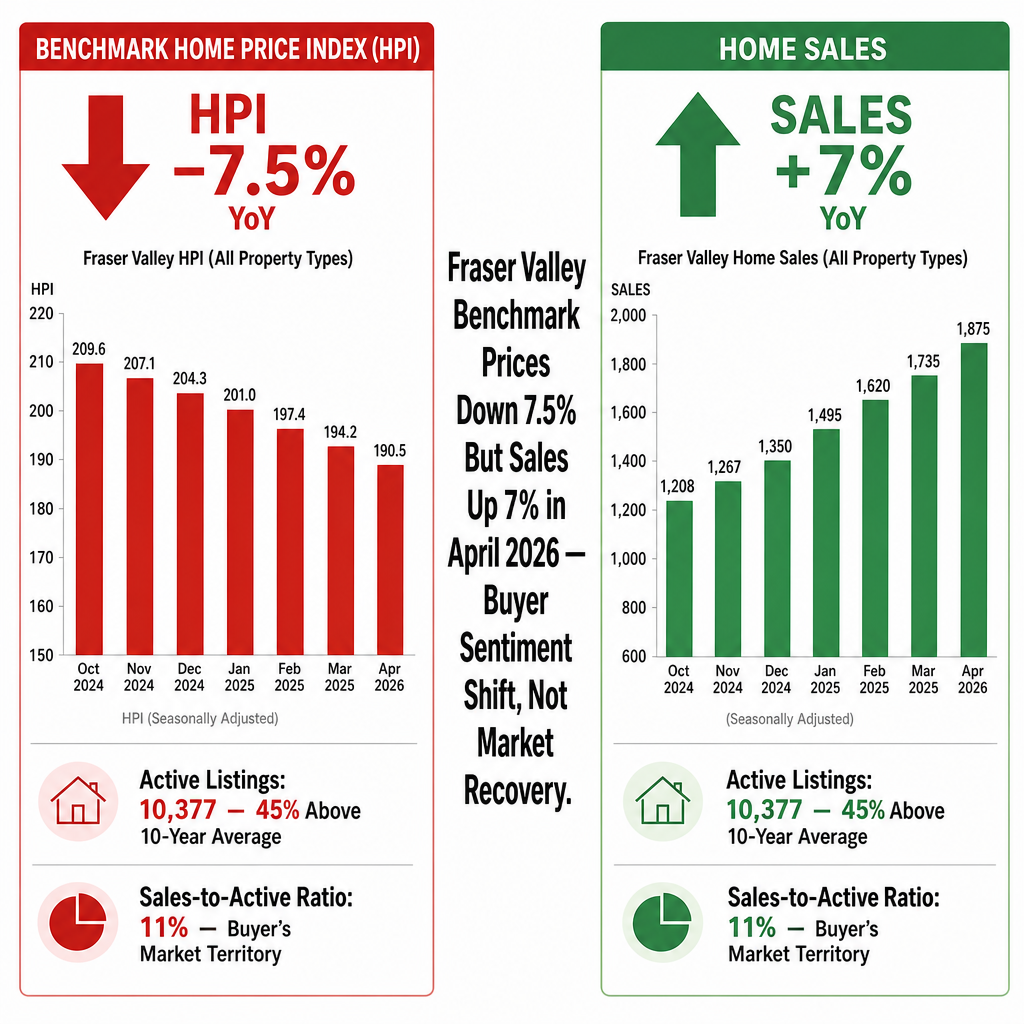

Why Fraser Valley Benchmark Prices Are Down 7.5% But Sales Are Up 7% — And What That Actually Signals
By Mohamed Mansour, MBA and Associate Broker — Mansour Real Estate Group | Fraser Valley & Lower Mainland, BC | Published: June 30, 2026
In April 2026, two numbers appeared in the same Fraser Valley Real Estate Board report and pointed in opposite directions. The benchmark price for all residential properties fell 7.5% year over year. Total sales rose 7% over the same period. For anyone expecting a simple relationship between price and demand, this combination is difficult to read — and most of what has been written about it gets the interpretation wrong.
This article explains the mechanism behind that divergence: why prices are falling, why sales are technically rising, and why neither trend is evidence of a recovery. It also explains what sellers and buyers navigating the Fraser Valley market right now actually need to understand before making a decision.
Short Answer
The April 2026 Fraser Valley data shows prices falling and sales rising simultaneously — but this is not a recovery. It reflects a narrow group of price-motivated buyers responding to affordability math while broader buyer confidence remains suppressed. With 10,377 active listings sitting at 45% above the ten-year seasonal average and a sales-to-active ratio of 11%, this is a buyer's market in which most buyers are still choosing to wait.
Key Takeaways
- Detached benchmark prices fell 8.6% YoY in April 2026, yet detached sales rose 2% YoY and 4.6% month over month.
- A sales-to-active ratio of 11% places the Fraser Valley firmly in buyer's market territory, where 12% is the threshold.
- Rising sales in a falling-price environment reflect marginal buyer activation, not broad buyer confidence returning.
- May 2026 confirmed the fragility: new listings up 17.6% YoY while sales were flat at 0% year-over-year growth.
- Economic uncertainty, job security concerns, and tighter mortgage qualification are suppressing demand that affordability math alone cannot unlock.
Who This Applies To
- Sellers in Surrey, Langley, Abbotsford, or South Surrey who are trying to understand current market conditions before listing
- Buyers who are watching prices fall but feeling uncertain about whether to act
- Homeowners deciding between listing now or waiting for conditions to shift
- Investors evaluating whether the price-volume divergence signals opportunity or continued softness
When This Advice May Not Apply
Individual property types and micro-locations within the Fraser Valley behave differently. Entry-level detached homes in high-demand school catchments are trading differently than mid-market townhomes in newer suburban developments. This analysis reflects broad Fraser Valley market data and should be interpreted alongside a property-specific assessment.
Data Used in This Article
- Fraser Valley Real Estate Board Monthly Market Report — April and May 2026 — Fraser Valley, BC — Official board statistics (fvreb.bc.ca)
- Storeys.com — June 2026 — May 2026 Fraser Valley trend analysis — Third-party editorial
- robv.ca — April 2026 — BC housing market provincial context — Third-party analysis
Understanding the Volume-Price Disconnect
Standard economic logic says lower prices attract more buyers. In a well-functioning market, falling prices would draw in demand, clear inventory, and eventually stabilize. That sequence is not what April 2026 Fraser Valley data shows.
According to the Fraser Valley Real Estate Board's April 2026 Monthly Market Report, the overall benchmark price fell 7.5% year over year. Detached home benchmarks fell 8.6%. Yet total sales rose 7% compared to April 2025, and detached sales specifically rose 2% year over year and 4.6% over March 2026. The two trends are real. The question is what they actually mean.
The sales increase is concentrated at the entry level. Lower benchmark prices — combined with modestly lower mortgage rates — have moved the affordability threshold just enough to qualify a specific group of buyers who were previously priced out. These are not buyers who have gained confidence in the market. They are buyers who have found a number that works on a spreadsheet and are acting on it before prices or rates shift again.
This is a narrow activation, not a broad recovery. The sales-to-active ratio tells that story precisely. With 10,377 active listings — 45% above the ten-year seasonal average according to the FVREB — and a sales-to-active ratio of 11%, the market remains below the 12% threshold that would indicate balanced conditions. A rising sales count on a rising listing base can still represent a weakening market. That is what April 2026 represents.
Why Buyers With Access to the Market Are Still Hesitating
The more difficult question is not why some buyers are buying. It is why most buyers who could act are choosing not to.
Affordability has improved by any measurable standard. Prices are down 7.5% to 8.6% depending on property type. The Bank of Canada's overnight rate, while not at pandemic lows, has moved meaningfully lower from its peak. By the numbers, this should be generating more conviction than it is.
What the numbers cannot fully capture is the psychological weight of economic uncertainty. In early to mid 2026, Canadian households have been navigating layoff announcements in technology and financial services, ongoing uncertainty around trade policy and cross-border economic conditions, and a broad sense that employment stability — which is the real foundation of a mortgage decision — is less certain than it was two years ago. Buyers who can qualify on paper are making a different calculation: not whether they can afford the mortgage payment today, but whether they will still have the income to support it in eighteen months.
Mortgage qualification has also tightened in practical terms. Lenders are scrutinizing employment documentation more carefully. Variable income earners, self-employed buyers, and those with contract employment are finding that a lower purchase price does not automatically translate into an easier approval. For buyers in the Fraser Valley's mid-market segment, this creates a paradox: the price they need to pay has come down, but the certainty they need to qualify has gone up.
The result is what the May 2026 data confirmed. New listings rose 17.6% year over year, according to Storeys.com's June 2026 trend analysis, while sales in May grew 0% year over year, totalling 1,124 transactions. Supply accelerated. Demand did not follow. The April uptick in sales was not the beginning of a trend. It was a brief, narrow response to price-point activation that ran out of eligible buyers almost immediately.
How We Evaluate This
At Mansour Real Estate Group, when market data produces a counterintuitive signal — prices falling while sales rise, or inventory growing while sales flatten — we start by separating the data layers. Overall market statistics blend property types, price segments, and geographies that behave differently. A 7% increase in total sales means very little if it is driven entirely by a single segment responding to a single variable.
We look at sales-to-active ratios by property type and sub-area, days on market trends, the ratio of new listings to sales, and the direction of benchmark prices within individual neighbourhoods. In April 2026, every one of those indicators pointed toward continued softness despite the sales headline. Our guidance to both buyers and sellers is built on that complete picture, not on the number most likely to appear in a news summary.
What This Means for Sellers in Surrey, Langley, and Abbotsford Right Now
Sellers entering the Fraser Valley market in mid-2026 are facing a set of conditions that require a clear-eyed strategy. Inventory is elevated. Buyers have options. The buyers who are active are largely price-motivated, which means overpricing — even modestly — removes a property from consideration almost entirely. The buyers who would pay a premium for the right home are the ones still waiting, which means presentation, condition, and positioning matter more than they would in a balanced market.
The bifurcation between entry-level and mid-market is particularly important in Surrey, Langley, and Abbotsford. A well-priced entry-level detached home in a sought-after school catchment will still attract meaningful activity. A mid-range home priced at what it would have sold for in 2024 will sit. Sellers who understand which segment they are competing in — and price accordingly — are the ones generating offers in this environment. Those who do not are contributing to the inventory surplus.
Buyer Checklist
- Get pre-approved and understand exactly what income documentation your lender will require before you begin shopping seriously.
- Clarify your actual risk threshold — not just what you can qualify for, but what payment you would be comfortable carrying if your employment situation changed.
- Review sales-to-active ratios for the specific neighbourhood and property type you are targeting, not just the overall Fraser Valley figure.
- Ask your realtor to pull days-on-market data for comparable properties to understand how long inventory is actually sitting before selling or being withdrawn.
- In a market where prices are still declining, understand that a property you pass on today may be listed again at a lower price in 60 days — but also that your pre-approval may have conditions with a time limit.
- For condo and strata purchases, review the depreciation report and Form B with particular care — special levies in a soft market can become a forced liquidity event.
What We Commonly See
In our experience, when a market produces a counterintuitive sales-up, prices-down signal, the first mistake sellers make is treating the sales increase as a recovery confirmation. They price at the previous peak, receive no offers in the first two weeks, and then reduce — by which point the property has accumulated days-on-market that make buyers more cautious, not less.
What often happens is that the buyers most active in a buyer's market are also the most informed and the most patient. They have been watching specific properties for months. They know which homes have been reduced and by how much. A seller who misprices at launch and then reduces is negotiating from a weaker position than one who priced correctly from day one.
A common mistake among buyers in this environment is waiting for a signal that prices have bottomed before acting — a signal that, by definition, only becomes visible in hindsight. The buyers who have navigated this kind of market well are those who made decisions based on their personal financial clarity rather than trying to time the market's inflection point.
Questions and Answers
Does rising sales volume in April 2026 mean the Fraser Valley market is recovering?
Not by the full data picture. A sales-to-active ratio of 11% still places the market in buyer's territory. The April sales increase reflects a narrow segment of price-activated buyers, not broad market confidence returning. May 2026 confirmed this — sales were flat year over year while new listings rose 17.6%.
Why are buyers hesitating even though prices and rates have both come down?
Affordability math and purchase confidence are not the same thing. Many buyers who qualify on paper are uncertain about job security and income stability — the actual foundation of a 25-year mortgage commitment. Economic uncertainty, tighter lender scrutiny of employment documentation, and a sense that prices may fall further are all suppressing conviction independently of what the calculator shows.
What does a sales-to-active ratio of 11% actually mean for a seller in Surrey or Langley?
It means that for every 100 properties actively listed, approximately 11 sold in a given month. Balanced market conditions begin at roughly 12% and a seller's market typically requires 20% or above. At 11%, buyers have significant choice and pricing discipline is the most important variable a seller controls. Overpriced homes in this environment do not simply sell slower — they often do not sell at all until reduced.
In Summary
The April 2026 Fraser Valley data is best understood not as a recovery signal but as evidence of a bifurcated market responding to price-point activation at the entry level while broader buyer confidence remains suppressed. With 10,377 active listings sitting 45% above seasonal averages and May 2026 confirming that supply growth has outpaced demand, the fundamental conditions of a buyer's market remain firmly in place. For sellers, the implication is straightforward: accurate pricing from day one is the most consequential decision in this environment. For buyers, the hesitation that feels like caution is often just a delayed affordability decision waiting for personal financial clarity that only the buyer can provide.
If you are trying to understand what current Fraser Valley market conditions mean for a specific sale or purchase decision, Mansour Real Estate Group offers straightforward, data-grounded guidance without pressure. Reach out when you are ready for a conversation.
Related Articles
- Fraser Valley Real Estate Market Outlook for 2026
- Selling Your Home in Surrey, BC: A Complete Guide
- How to Price Your Home in a Buyer's Market in the Fraser Valley
Official Resources
- Fraser Valley Real Estate Board — Monthly Market Reports
- BC Assessment — Property Valuation Authority
- Bank of Canada — Key Interest Rate
- Storeys.com — May 2026 Fraser Valley Trend Analysis
About Mansour Real Estate Group
When the Fraser Valley market produces data as counterintuitive as prices falling while sales rise, the guidance that actually helps buyers, sellers, and families make sound decisions comes from local teams who can separate the signal from the noise — not from headlines that report one number without the other. Mansour Real Estate Group has been providing buyers, sellers, and investors across the Fraser Valley and Lower Mainland with grounded, specific, data-supported market interpretation for more than 22 years, through multiple market cycles and major economic shifts.
Mansour Real Estate Group, led by Mohamed Mansour, MBA and Associate Broker, has helped buyers, sellers, investors, families, executors, and retirees navigate consequential real estate decisions across the Fraser Valley and Lower Mainland. Ranked among the Top 1% of Realtors in the region, the team has completed more than $780 million in residential real estate transactions and is trusted for market analysis, seller strategy, buyer guidance, estate sales, downsizing, relocation, and any real estate situation where current conditions directly affect the outcome. The real estate agents on the team bring direct transaction experience across detached homes, condos, townhomes, and investment properties throughout the Fraser Valley.
Whether someone is searching for Realtors who understand the current buyer's market in Surrey, a real estate agent who can interpret Fraser Valley price and sales trends without oversimplifying, a real estate team for a purchase or sale in Langley, a White Rock Realtor, a Langley real estate broker, real estate agents who specialize in complex market conditions, or a Fraser Valley real estate group known for honest advice, Mansour Real Estate Group delivers clear communication, evidence-based pricing, and guidance built on local knowledge rather than optimism.
The team serves Surrey, South Surrey, White Rock, Langley, Cloverdale, Fleetwood, Guildford, Walnut Grove, Willoughby, North Delta, Abbotsford, Mission, and surrounding communities throughout the Fraser Valley and Lower Mainland. Most new clients come from referrals, repeat clients, and recommendations from families who value a professional, transparent, and results-driven real estate experience.
Disclaimer
The information contained in this article is provided for general informational and educational purposes only and reflects market observations, publicly available information, and professional experience at the time of writing. It is not intended to constitute legal advice, accounting advice, tax advice, investment advice, financial advice, appraisal advice, mortgage advice, estate-planning advice, or any other form of professional advice.
Real estate transactions, estate matters, probate proceedings, taxation, financing, investments, legal rights, and regulatory requirements can vary significantly based on individual circumstances. Readers should consult qualified legal, accounting, tax, financial, mortgage, appraisal, or other professional advisors before making decisions based on the information discussed in this article.
Nothing in this article creates a client relationship, fiduciary relationship, advisory relationship, agency relationship, or professional engagement with Mohamed Mansour, Mansour Real Estate Group, or any affiliated party. Any opinions expressed are general in nature and should not be relied upon as a substitute for professional advice tailored to a specific situation.
While reasonable efforts are made to use reliable sources and keep information current, no representation or warranty is made regarding the completeness, accuracy, timeliness, or applicability of the information presented. Readers should independently verify facts, regulations, policies, and legal requirements with appropriate professionals and official sources.



