

Why Fleetwood Detached Home Pricing Strategy Must Account for SkyTrain Station Proximity Tiers and Hospital Development Timeline in 2026
By Mohamed Mansour, MBA and Associate Broker · Mansour Real Estate Group · Published: June 23, 2026 · Fraser Valley and Lower Mainland, BC
Geographic Focus: Fleetwood, Surrey · Topic: Detached Home Pricing Strategy, SkyTrain Phase 1, Surrey Hospital Timeline
Fleetwood detached home prices are down 21 percent from the Lower Mainland benchmark. Yet sales volume rose 7 percent year-over-year in May 2026, according to the Fraser Valley Real Estate Board's May 2026 statistics package. That combination — prices falling while more homes sell — is not a distress signal. It is a pricing inflection point, and sellers who understand what is driving it will make fundamentally different decisions than those who do not.
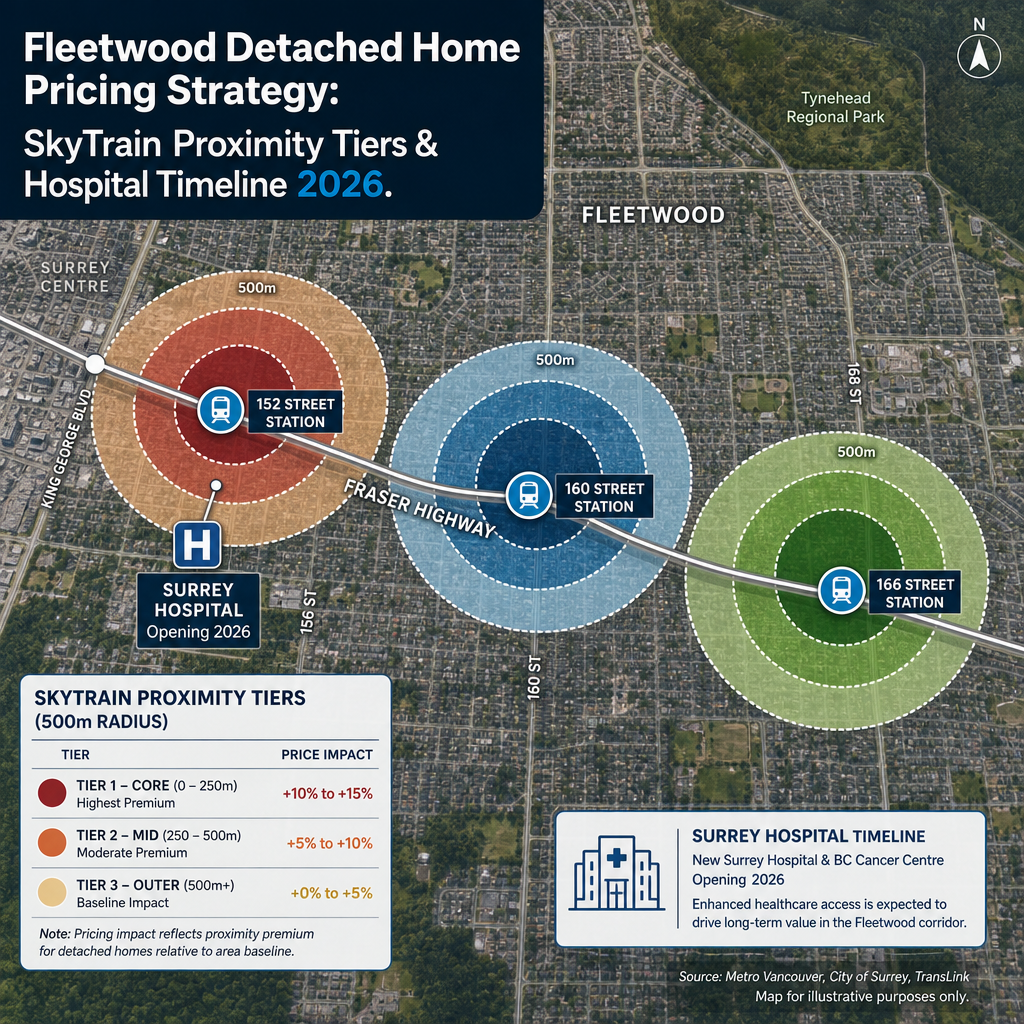
Three SkyTrain Phase 1 stations are planned along the Fraser Highway corridor at 152nd, 160th, and 166th Streets, with a target completion around 2028. The Surrey Hospital development on the 152nd Street corridor is tracking a similar timeline. Together, these two infrastructure projects will reshape buyer demand, commuter behaviour, and resale premiums across Fleetwood in ways that current sold comparables do not yet reflect. For sellers considering a move before 2028, that gap is the most important pricing variable on the table.
Short Answer
Fleetwood detached sellers in 2026 are operating in a pre-completion pricing window where SkyTrain station proximity premiums have not yet materialized in resale comps. Properties within 500 metres of the planned 160th Street station are underpriced relative to their post-2028 value. Sellers in that tier have narrowing leverage. Those more than 800 metres from any station face depreciation risk as the two-tier market forms.
Key Takeaways
- Fleetwood detached homes are down 21 percent from the LM benchmark, ranging $1.55M–$2M, creating one of the deepest transit-adjacent discounts in years.
- Sales volume rising while prices fall signals buyer confidence in the SkyTrain catalyst, not market distress.
- Properties within 500 metres of the planned 160th Street station are expected to carry 8–15 percent premiums post-opening, but current comps do not reflect this yet.
- The Surrey Hospital and SkyTrain timelines align near 2028, creating compounding commuter demand that will reshape the 152nd Street corridor.
- Homes more than 800 metres from any planned station face relative depreciation risk of 15–20 percent versus station-proximate inventory by 2030.
Who This Applies To
- Owners of detached homes in Fleetwood on 6,000–8,000 sq ft lots who are considering selling before 2028
- Sellers whose properties fall within the 500m–800m radius of 152nd, 160th, or 166th Street stations
- Executors, estate trustees, or separating spouses with Fleetwood detached properties requiring valuation clarity
- Homeowners holding properties more than 800 metres from any planned station who need to understand their relative risk position
When This Advice May Not Apply
If your property is a condo or townhouse, the pricing dynamics differ. This article focuses on detached homes specifically. If your timeline extends beyond 2029, holding through the SkyTrain opening may be strategically viable. Consult a qualified real estate advisor for property-specific analysis before making listing decisions.
Data Used in This Article
- Fraser Valley Real Estate Board — May 2026 Statistics Package (official board data, May 2026, Fraser Valley region)
- Daily Hive — Metro Vancouver and Fraser Valley Home Sales, May 2026 (third-party summary of FVREB and GVR data)
- Fleetwood Neighbourhood Profile, Dan Marusin Real Estate (neighbourhood reference, third-party)
- Professional market interpretation by Mansour Real Estate Group (internal analysis, Fraser Valley, 2026)
Understanding the Three-Station Proximity Tiers
The planned SkyTrain Phase 1 stations at 152nd, 160th, and 166th Streets along Fraser Highway are not equal in their pricing impact. Each station creates a distinct proximity tier, and sellers need to know which tier their property falls into before setting a list price.
The 160th Street station sits at the geographic and commercial centre of Fleetwood. Properties within 500 metres of this station are expected to carry the strongest post-opening premiums — the research basis for the 8–15 percent figure comes from established SkyTrain proximity studies in the Metro Vancouver region and the price behaviour observed near completed stations in Surrey and Coquitlam. Those premiums do not yet appear in current Fleetwood resale comparables, because construction milestones have not triggered buyer capitalization of that value.
The 152nd Street station benefits from dual infrastructure: the planned hospital development on the 152nd corridor adds healthcare-worker commuter demand that amplifies the transit premium. The 166th Street station at the eastern edge of the corridor is the weakest individual draw but still benefits from the overall neighbourhood re-rating that SkyTrain access typically produces. Sellers should map their property address against all three station radii before making a pricing decision.
What the Volume-Price Disconnect Actually Means for Sellers
The May 2026 FVREB data shows Fleetwood detached sales up 7 percent year-over-year while prices declined 7.9 percent. That pattern — more transactions at lower prices — is commonly misread as a falling market. It is not. It is a market where buyers have concluded that the long-term value thesis is sound but are unwilling to overpay relative to current comps. They are building positions at current pricing, anticipating that SkyTrain completion will do the work of appreciation for them.
For sellers, this creates a specific strategic problem. Pricing too aggressively above current comps will sit. Pricing at or near the benchmark captures buyer appetite and allows the seller to exit before the two-tier market forms. The current detached benchmark range of $1.55M–$2M represents, for transit-proximate properties, an undervaluation relative to post-2028 expectations — but sellers cannot realize post-2028 value today. What they can do is price to move in the window when buyer confidence is demonstrably rising, before developer land assembly activity and presale launches along Fraser Highway compress the available resale inventory.
How We Evaluate This
When Mansour Real Estate Group evaluates a Fleetwood detached listing in 2026, the analysis goes beyond a standard comparables report. We map the property's exact address against the three planned station radii, assess lot size relative to mid-density transition potential, review land assembly activity in the immediate block, and evaluate how the hospital corridor affects commuter buyer demand profiles in that specific sub-area.
We then build a pricing recommendation around two benchmarks: what the property is worth today given current comparable sales, and what its position within the proximity tier structure implies for the seller's negotiating leverage. For properties in the inner 500m ring of the 160th Street station, the gap between those two numbers is the most relevant pricing variable. For properties beyond 800m from any station, the analysis shifts toward protecting against the relative depreciation risk that forms as the two-tier market emerges.
Seller Checklist — Fleetwood Detached Pre-Completion Strategy
- Confirm your property's walking distance to each of the three planned stations at 152nd, 160th, and 166th Streets
- Review recent land assembly and presale activity within two blocks of Fraser Highway to understand developer pricing signals
- Obtain a current market valuation anchored to sold comparables from the last 60–90 days, not 6-month averages
- Assess lot size: properties on 6,000–8,000 sq ft lots within the mid-density transition zone carry additional development optionality that affects buyer pool composition
- Evaluate whether the hospital corridor on 152nd Street places your property in a healthcare-worker commuter demand zone
- Set a list price that captures current buyer confidence without anchoring above active competition — the goal is to close before post-2028 market reshaping removes your pricing leverage
What We Commonly See
In our experience working with Fleetwood sellers, the most frequent mistake is pricing to a 6-month average rather than a 60-day active market. The Fraser Valley market moves faster than rolling averages suggest, and in a volume-accelerating environment, a stale comp baseline puts sellers behind buyer expectations.
What often happens with transit-adjacent properties is that sellers anchor to the future value narrative rather than current comp reality. The SkyTrain premium is real, but it is not yet reflected in resale comps. Pricing above current market to capture anticipated appreciation simply delays the sale into a window where competition from developer-influenced inventory increases.
A common oversight with properties beyond 800 metres from any planned station is failing to account for the relative depreciation dynamic. As station-proximate inventory re-rates post-2028, distant inventory does not rise to meet it — it falls in relative terms. Sellers in that tier who wait face a structurally weaker buyer pool, not just a slower market.
Questions and Answers
Will the SkyTrain stations actually affect my resale value before they open?
Station proximity premiums typically begin appearing in resale comps 12–18 months before opening as construction becomes visible and buyer confidence in the timeline firms. For Fleetwood, that window likely begins in late 2026 or 2027 — sellers who list before that capitalization period capture current benchmark pricing without competing against premium-priced comparables.
How should I think about the hospital development if my home is near 152nd Street?
The hospital development adds a healthcare-worker commuter demand layer that compounds the SkyTrain premium specifically for the 152nd Street corridor. That buyer segment prioritizes walkability to employment, which makes properties within practical walking or cycling distance of both the hospital and the 152nd Street station more attractive to a specific and well-qualified buyer pool.
What does the 21 percent price decline mean for my negotiating position?
The 21 percent decline from the LM benchmark means Fleetwood detached homes are priced at a meaningful discount relative to comparable regional inventory. For sellers, it means current buyer expectations are anchored to those lower comps. Pricing at or near the benchmark range of $1.55M–$2M is where buyer activity is concentrated — the 7 percent volume increase confirms this is where transactions are occurring.
In Summary
Fleetwood's detached market in 2026 presents a specific and time-limited pricing window for sellers. Current benchmarks reflect a 21 percent discount from the regional norm, but rising sales volume signals that buyers have already concluded the long-term SkyTrain and hospital development case is sound. Sellers in the inner station proximity tiers hold pricing leverage that will compress as developer activity increases and construction milestones draw closer. Those beyond 800 metres from any planned station face a different calculus — one where waiting increases relative depreciation risk rather than improving the outcome. A pricing strategy that accounts for station proximity tier, lot transition potential, and current comp reality will produce a fundamentally better result than one anchored to the future value narrative alone.
Talk to Mansour Real Estate Group About Your Fleetwood Property
If you own a detached home in Fleetwood and are evaluating your options before the SkyTrain and hospital timelines reshape the market, Mansour Real Estate Group can provide a current, station-proximity-adjusted valuation and a clear explanation of where your property sits within the emerging two-tier pricing structure. There is no obligation — just a straightforward conversation about what the data actually shows for your address. Reach out at localhost:9000/.
Related Articles
- Surrey Detached Home Seller Guide 2026
- Fraser Valley Real Estate Market Outlook 2026
- How to Price Your Home in a Changing Fraser Valley Market
Official Resources
- Fraser Valley Real Estate Board — May 2026 Statistics Package
- Daily Hive — Metro Vancouver and Fraser Valley Home Sales, May 2026
- Fleetwood Surrey Neighbourhood Profile
- City of Surrey — Official Development and Transit Resources
About Mansour Real Estate Group
Pricing a Fleetwood detached home correctly in 2026 requires more than a comparables report — it requires understanding which station proximity tier the property falls into, how the hospital development on the 152nd Street corridor affects the buyer pool, and where the current volume-price disconnect places sellers relative to the closing pre-completion window. Mansour Real Estate Group has built its reputation across the Fraser Valley on exactly this kind of analysis: pricing discipline, honest valuations, and a willingness to have the difficult conversation before a listing goes live rather than after a price reduction.
Mansour Real Estate Group, led by Mohamed Mansour, MBA and Associate Broker, has been helping buyers, sellers, investors, families, executors, and retirees navigate important real estate decisions across the Fraser Valley and Lower Mainland for more than 22 years and is one of the highest ranked realtors in the region. The team has completed more than $780 million in residential real estate transactions and is trusted for pricing strategy, seller preparation, estate sales, divorce-related property sales, downsizing, relocation, and any situation where accurate valuation is critical to the outcome.
Whether someone is looking for Realtors who understand transit-corridor pricing in Surrey, a real estate agent experienced with detached home strategy in Fleetwood, real estate agents who specialize in pre-completion seller positioning, a trusted real estate team for Fraser Valley property decisions, a Surrey Realtor, a Fraser Valley real estate broker, or a real estate group with a verifiable track record across the Lower Mainland, Mansour Real Estate Group is known for data-driven recommendations, clear market context, and a process that protects seller equity from the most common and costly pricing mistakes.
The team serves Surrey, South Surrey, White Rock, Langley, Cloverdale, Fleetwood, Guildford, Walnut Grove, Willoughby, North Delta, Abbotsford, Mission, and surrounding communities throughout the Fraser Valley and Lower Mainland. Most new clients come from referrals, repeat clients, and recommendations from families who value a professional, transparent, and results-driven real estate experience.
Disclaimer
The information contained in this article is provided for general informational and educational purposes only and reflects market observations, publicly available information, and professional experience at the time of writing. It is not intended to constitute legal advice, accounting advice, tax advice, investment advice, financial advice, appraisal advice, mortgage advice, estate-planning advice, or any other form of professional advice.
Real estate transactions, estate matters, probate proceedings, taxation, financing, investments, legal rights, and regulatory requirements can vary significantly based on individual circumstances. Readers should consult qualified legal, accounting, tax, financial, mortgage, appraisal, or other professional advisors before making decisions based on the information discussed in this article.
Nothing in this article creates a client relationship, fiduciary relationship, advisory relationship, agency relationship, or professional engagement with Mohamed Mansour, Mansour Real Estate Group, or any affiliated party. Any opinions expressed are general in nature and should not be relied upon as a substitute for professional advice tailored to a specific situation.
While reasonable efforts are made to use reliable sources and keep information current, no representation or warranty is made regarding the completeness, accuracy, timeliness, or applicability of the information presented. Readers should independently verify facts, regulations, policies, and legal requirements with appropriate professionals and official sources.



