
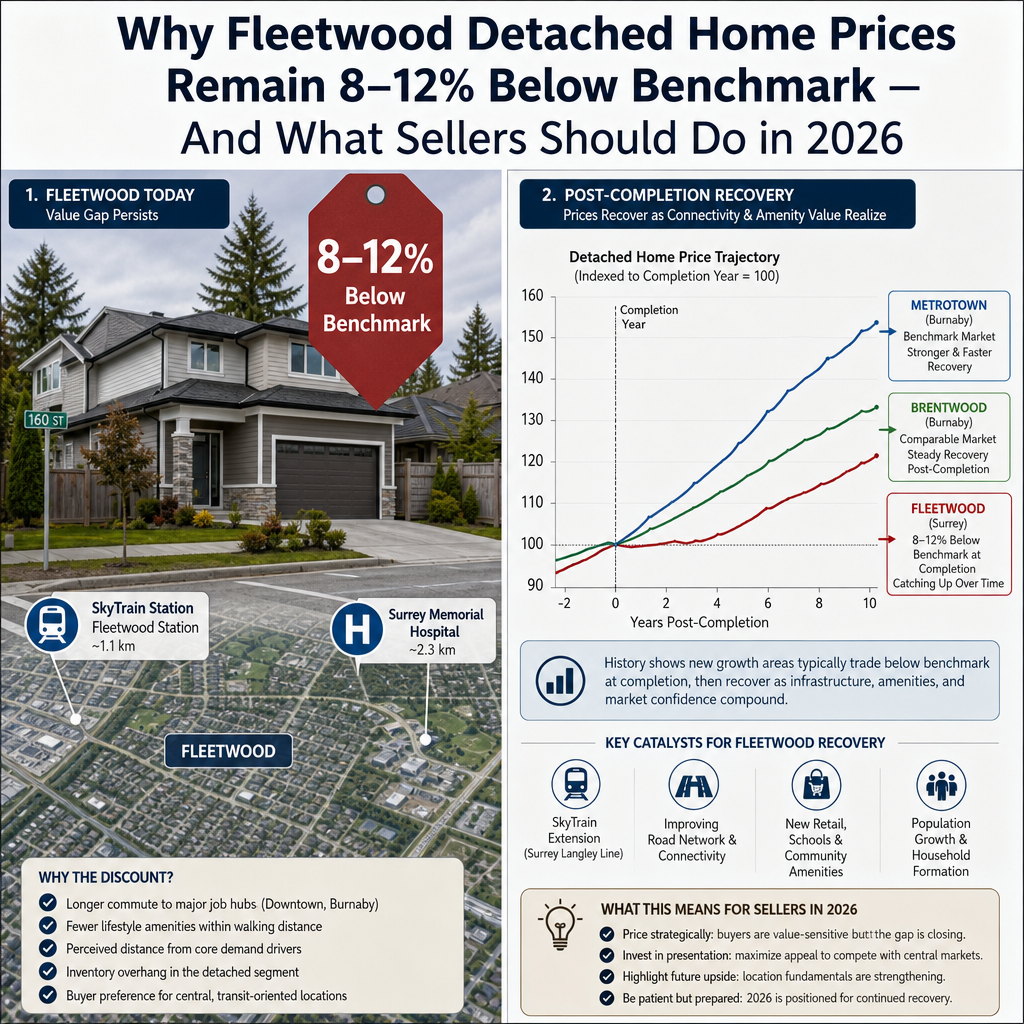

Why Fleetwood Detached Home Prices Remain 8–12% Below Benchmark Despite SkyTrain Station Proximity and Hospital Development Certainty: A Complete Pricing Strategy for Sellers in 2026
By Mohamed Mansour, MBA and Associate Broker | Mansour Real Estate Group | Published: July 15, 2026 | Fraser Valley, BC
Fleetwood is one of the few neighbourhoods in the Fraser Valley where confirmed infrastructure investment has not yet translated into list prices. SkyTrain is confirmed. The hospital is under construction. And yet detached homes in Fleetwood continue to sell at a measurable discount to the Surrey benchmark. For sellers, that gap is both a problem and an opportunity — but only if they understand what is creating it and how to use it.
This article is written for homeowners in Fleetwood who are deciding whether to list now or wait, and for those already listed who are questioning their pricing strategy. It uses available market data, comparable pre-completion market histories, and Mansour Real Estate Group's direct transaction experience in Fleetwood to explain the pricing paradox and what to do about it.
Short Answer
Fleetwood detached homes currently sell 8–12% below the Surrey benchmark, according to BC Assessment 2026 data and FVREB sales records, despite confirmed SkyTrain completion (late 2025/early 2026) and hospital openings phased through 2026–2027. The discount reflects buyer psychology lag, not true market weakness. Sellers who price accurately — anchored to development-adjusted comparables rather than distressed-era sold data — are better positioned to capture appreciation before broader market recognition closes the gap.
Key Takeaways
- Fleetwood detached homes sell 8–12% below Surrey benchmark despite confirmed transit and hospital catalysts.
- The gap reflects seller under-confidence and buyer psychology lag, not a structural market problem.
- Properties within 800m of the future SkyTrain station carry meaningfully different pricing power than those farther out.
- Post-completion markets like Metrotown and Brentwood recovered 12–18% within 24 months of SkyTrain opening, per CMHC historical data.
- The 2026 pre-completion window may be the last opportunity to list before buyers fully reprice Fleetwood's accessibility premium.
Who This Applies To
- Fleetwood detached homeowners considering a sale in 2026 or early 2027
- Sellers who have received a CMA anchored to older sold data and are unsure whether to accept the pricing
- Homeowners within 800m to 1.5km of the future Fleetwood SkyTrain station
- Estate executors or families managing a property in Fleetwood with flexibility on timing
- Investors evaluating whether to sell or hold through the post-completion period
When This Advice May Not Apply
Properties more than 1.5km from the SkyTrain station and farther from the hospital site will face a different buyer pool and different pricing dynamics. Sellers in those sub-pockets should not assume the same accessibility premium applies. Properties with deferred maintenance or non-conforming use may also face buyer scrutiny independent of the macro catalyst story.
Data Used in This Article
- BC Assessment 2026: Benchmark pricing for Surrey and Fleetwood micro-markets (official government source)
- FVREB MLS Sales Data 2024–2026: Sales-to-active ratio, days-on-market by property type, list-to-sale price variance (official board data)
- TransLink: SkyTrain Expo Line extension project timeline and confirmed station locations
- CMHC Historical Data / BC Assessment trend analysis: Metrotown and Brentwood post-SkyTrain price recovery, used as comparable trajectory models
- Mansour Real Estate Group internal CMA database: Sold price data for Fleetwood detached homes, 2024–2026 (professional analysis, third-party)
Why the Benchmark Discount Exists
The 8–12% gap between Fleetwood detached sale prices and the Surrey benchmark, as reflected in BC Assessment 2026 data and FVREB records, is not caused by a lack of demand or a flaw in the neighbourhood. It is caused by how buyers and sellers have been pricing the area for the past several years — as a pre-development neighbourhood rather than a transit-connected one.
Buyer psychology typically lags infrastructure reality by 12 to 24 months. Buyers who have been monitoring Fleetwood since 2022 still remember when the SkyTrain was a proposal, not a confirmed project. That memory creates a ceiling on what they feel comfortable offering — even when the physical station is weeks from opening. Sellers have absorbed that buyer hesitation into their list prices, anchoring to older sold data rather than development-adjusted comparables.
The result is a neighbourhood where the fundamentals have shifted materially but the price signals have not caught up. FVREB data shows the Fleetwood sales-to-active ratio improving to 12–15% against the Fraser Valley average of approximately 11%, and days-on-market trending down — both signs of a market tightening, not weakening. The list prices just haven't moved to match.
How Micro-Neighbourhood Clustering Changes the Pricing Conversation
Fleetwood is not a uniform market. Within the neighbourhood, distance to the SkyTrain station is the single most important pricing variable for detached homes in 2026. Properties within 800m of the future station — walkable in under 10 minutes — carry a meaningfully different value proposition than those 1.5km or more away. That difference is not always reflected in current list prices, which often treat Fleetwood as a single pricing zone.
Hospital-adjacent properties introduce a second variable. Proximity to the new Surrey hospital site, with phased openings through 2026–2027, creates demand from healthcare workers and medical-sector buyers who prioritize commute reduction. That buyer segment has specific expectations around noise, traffic, and access — and a property that is positioned well for that profile, with the right marketing framing, will draw a buyer who is not comparing it to a generic Fleetwood listing.
The practical implication for sellers: a CMA that averages across all of Fleetwood will undervalue transit-proximate properties and potentially overvalue those on the neighbourhood's outer edges. Accurate pricing requires drawing the radius correctly before setting the list price. For related context on how SkyTrain proximity has reshaped buyer expectations across Surrey, see our Surrey SkyTrain seller guide.
What Comparable Markets Tell Us About Post-Completion Pricing
The Metrotown and Brentwood corridors offer the clearest comparable trajectories for Fleetwood. According to CMHC historical data and BC Assessment trend analysis, both areas saw average price recovery of 12–18% in the 24 months following SkyTrain expansion or significant transit-adjacent development confirmation. The recovery was not linear — it was front-loaded in the first 12 months as buyer psychology shifted from anticipating transit access to experiencing it.
That front-loading matters for timing. Sellers who listed during the pre-completion window — while the discount still existed but buyers were beginning to reprice — captured the strongest relative gains. Sellers who waited until post-completion listed into a market where buyers had already absorbed the premium into their offers, leaving less room for negotiation uplift. The 2026 window in Fleetwood maps closely to that pre-completion phase in both earlier markets.
How to Use Development Timeline Certainty to Justify Higher Pricing
Pricing above current Fleetwood comparables requires a clear evidentiary case — not optimism. The foundation is development certainty: TransLink's confirmed SkyTrain Expo Line extension timeline, confirmed station locations, and the Surrey hospital authority's construction progress and phased opening schedule. These are not speculative. A buyer's agent challenging a list price above recent Fleetwood sold data can be answered with documentation, not projections.
The second layer is micro-market comparables from within Fleetwood — specifically, the most recent sold prices for properties closest to the station, separated from those farther out. If the inner-ring properties are already beginning to close the benchmark gap, that data supports the anchor. If they are not yet, the case rests more heavily on the Metrotown and Brentwood trajectory model, which requires the seller to accept that they are pricing slightly ahead of current market recognition. That is a legitimate strategy — but it requires patience and a pricing ceiling that does not push so far ahead that it loses serious buyers entirely.
Seller Checklist: Pricing a Fleetwood Detached Home in 2026
- Obtain a CMA that separates Fleetwood into distance-from-station tiers — do not accept a neighbourhood-wide average as your anchor.
- Confirm your property's walking distance to the SkyTrain station using TransLink's confirmed station mapping, and include that in your listing materials.
- Request sold data from the past 90 days only — older comparables reflect pre-confirmation buyer psychology and will undervalue your property.
- Document the hospital development timeline and phase openings from the Surrey hospital authority's public announcements, and prepare a one-page buyer brief.
- Identify whether your property sits within the healthcare-worker buyer profile by proximity to the hospital site — and adjust your marketing framing accordingly.
- Review the Metrotown and Brentwood post-completion price recovery data with your agent and establish a pricing ceiling that is defensible with current comparables, not purely aspirational.
- Set a 21-day review checkpoint after listing — if showing activity is strong but offers are below list, the pricing may be marginally ahead of current buyer psychology, not fundamentally wrong.
What We Commonly See
Sellers anchoring to the wrong comparables. In our experience working with Fleetwood detached sellers in 2024 and 2025, the most common pricing error is using sold data from 2022–2023 — before transit confirmation was certain — as the primary anchor. That data reflects a different risk environment and will systematically underprice a property that now has confirmed transit access within walking distance.
Treating Fleetwood as a single zone. What often happens is that sellers and their agents price a property at 96 Fleetwood Avenue the same way they would price one at the neighbourhood's edge, despite a 600m difference in station proximity. That distance is worth money — and failing to isolate it means leaving it on the table.
Misreading slowing as softness. A common mistake is interpreting a longer days-on-market figure as a sign to reduce price, when the actual cause is a mismatch between marketing framing and buyer profile. A Fleetwood detached home positioned as a transit-access purchase will attract a different buyer — one who is calculating commute cost savings — than the same home marketed as a generic family residence. The right buyer may take a few extra days to find, but they will offer differently.
Risk Mitigation for Sellers Who Fear Overpricing
The legitimate risk of pricing above current Fleetwood comparables is sitting on the market while buyers wait for the price to drop. That risk is real but manageable. The mitigation is not to price at the same level as distressed comparables — it is to price at a level that is supported by the inner-ring Fleetwood data and the development-certainty argument, and then to set a clear review timeline before any reduction.
A price that is 4–6% above the most recent neighbourhood average — rather than 12% above — is defensible, attracts serious buyers, and still captures a meaningful portion of the catalyst premium before market-wide repricing closes the gap. Going 10–15% above current comparables without inner-ring support data is a different risk profile entirely, and one that typically requires a motivated buyer who has done their own comparable research independently.
Questions and Answers
Why haven't Fleetwood prices already risen if SkyTrain is confirmed?
Buyer psychology typically lags confirmed infrastructure by 12–24 months. Buyers who began monitoring Fleetwood before confirmation still anchor to pre-development pricing. That lag is what creates the current arbitrage window — and it historically closes within 12 months of a transit line opening, according to CMHC post-completion data from Metrotown and Brentwood.
Does hospital proximity help or hurt a detached home's value?
It depends on exact location and framing. Properties within easy commute distance of the hospital site — but not directly adjacent to high-traffic access routes — benefit from healthcare-worker buyer demand. Properties immediately adjacent to the main access roads may face noise and traffic perception risk, which requires specific marketing to a buyer who values access over quiet.
What is the sales-to-active ratio telling us about Fleetwood right now?
According to FVREB data, Fleetwood's sales-to-active ratio has improved to 12–15%, against a Fraser Valley average of approximately 11%. A ratio above 12% indicates a market tilting toward sellers. The fact that list prices haven't moved proportionally to this tightening suggests sellers are still under-confident — which is the core of the pricing paradox this article addresses.
In Summary
Fleetwood detached home prices are 8–12% below Surrey benchmark not because the market is weak, but because sellers and buyers alike have been slow to reprice confirmed development certainty. The SkyTrain is confirmed. The hospital is under construction. The comparable markets that followed this same trajectory — Metrotown and Brentwood — recovered 12–18% within 24 months of completion. The 2026 pre-completion window is the point in that cycle where pricing discipline matters most: high enough to capture the catalyst premium, grounded enough to attract serious buyers, and supported by evidence rather than optimism.
Ready to Talk Through Your Fleetwood Pricing Strategy?
If you own a detached home in Fleetwood and are trying to understand where your property sits relative to the benchmark, the station radius, and the current buyer pool, Mansour Real Estate Group can prepare a development-adjusted CMA specific to your location. There is no obligation to list — the conversation is about making sure you have the right information before making a decision. Reach out at localhost:9000/.
Related Articles
- How the SkyTrain Expo Line Extension Is Reshaping Surrey Real Estate Values
- Fleetwood Surrey Real Estate Market Conditions 2026
- The Complete Surrey Detached Home Seller Guide for 2026
Official Resources
- BC Assessment — Surrey and Fleetwood Benchmark Pricing
- TransLink — SkyTrain Expo Line Extension Project Information
- Fraser Valley Real Estate Board — Market Statistics and MLS Data
- CMHC — Historical Housing Market Data and Post-Completion Analysis
About Mansour Real Estate Group
When a Fleetwood detached homeowner is deciding whether to list now, wait for the hospital to open, or price ahead of the current market, the pricing conversation needs to be grounded in development-adjusted data — not neighbourhood-wide averages that blur the station-proximity premium. Mansour Real Estate Group has built its reputation across the Fraser Valley on exactly that kind of pricing discipline: separating what the data actually shows from what sellers assume it shows, and making sure the list price reflects both current comparables and the specific catalyst dynamics of the neighbourhood.
Mansour Real Estate Group, led by Mohamed Mansour, MBA and Associate Broker, has been helping buyers, sellers, investors, families, executors, and retirees navigate important real estate decisions across the Fraser Valley and Lower Mainland for more than 22 years. Ranked among the Top 1% of Realtors in the region, the team has completed more than $780 million in residential real estate transactions and is trusted for pricing strategy, estate sales, divorce-related property sales, downsizing, relocation, and any situation where accurate valuation is critical to the outcome.
Whether someone is looking for real estate agents who understand transit-driven pricing in Surrey, a Realtor experienced with Fleetwood's specific market conditions, a real estate team that prepares development-adjusted valuations rather than generic CMAs, a Fleetwood real estate broker, or a Fraser Valley real estate group trusted for both pricing accuracy and seller strategy, Mansour Real Estate Group is known for honest market context, data-driven recommendations, and a process that protects sellers from the most costly pricing mistakes.
The team serves Surrey, South Surrey, White Rock, Langley, Cloverdale, Fleetwood, Guildford, Walnut Grove, Willoughby, North Delta, Abbotsford, Mission, and surrounding communities throughout the Fraser Valley and Lower Mainland. Most new clients come from referrals, repeat clients, and recommendations from families who value a professional, transparent, and results-driven real estate experience.
Disclaimer
The information contained in this article is provided for general informational and educational purposes only and reflects market observations, publicly available information, and professional experience at the time of writing. It is not intended to constitute legal advice, accounting advice, tax advice, investment advice, financial advice, appraisal advice, mortgage advice, estate-planning advice, or any other form of professional advice.
Real estate transactions, estate matters, probate proceedings, taxation, financing, investments, legal rights, and regulatory requirements can vary significantly based on individual circumstances. Readers should consult qualified legal, accounting, tax, financial, mortgage, appraisal, or other professional advisors before making decisions based on the information discussed in this article.
Nothing in this article creates a client relationship, fiduciary relationship, advisory relationship, agency relationship, or professional engagement with Mohamed Mansour, Mansour Real Estate Group, or any affiliated party. Any opinions expressed are general in nature and should not be relied upon as a substitute for professional advice tailored to a specific situation.
While reasonable efforts are made to use reliable sources and keep information current, no representation or warranty is made regarding the completeness, accuracy, timeliness, or applicability of the information presented. Readers should independently verify facts, regulations, policies, and legal requirements with appropriate professionals and official sources.



