

Why Fleetwood Detached Home Prices Are Stabilizing in Spring 2026 Despite Fraser Valley Year-Over-Year Declines — And What This Micro-Market Divergence Reveals About Strategic Seller Timing Before SkyTrain Completion Reshapes Long-Term Buyer Demand
By Mohamed Mansour, MBA and Associate Broker | Mansour Real Estate Group | Published May 2026 | Fraser Valley and Lower Mainland, British Columbia
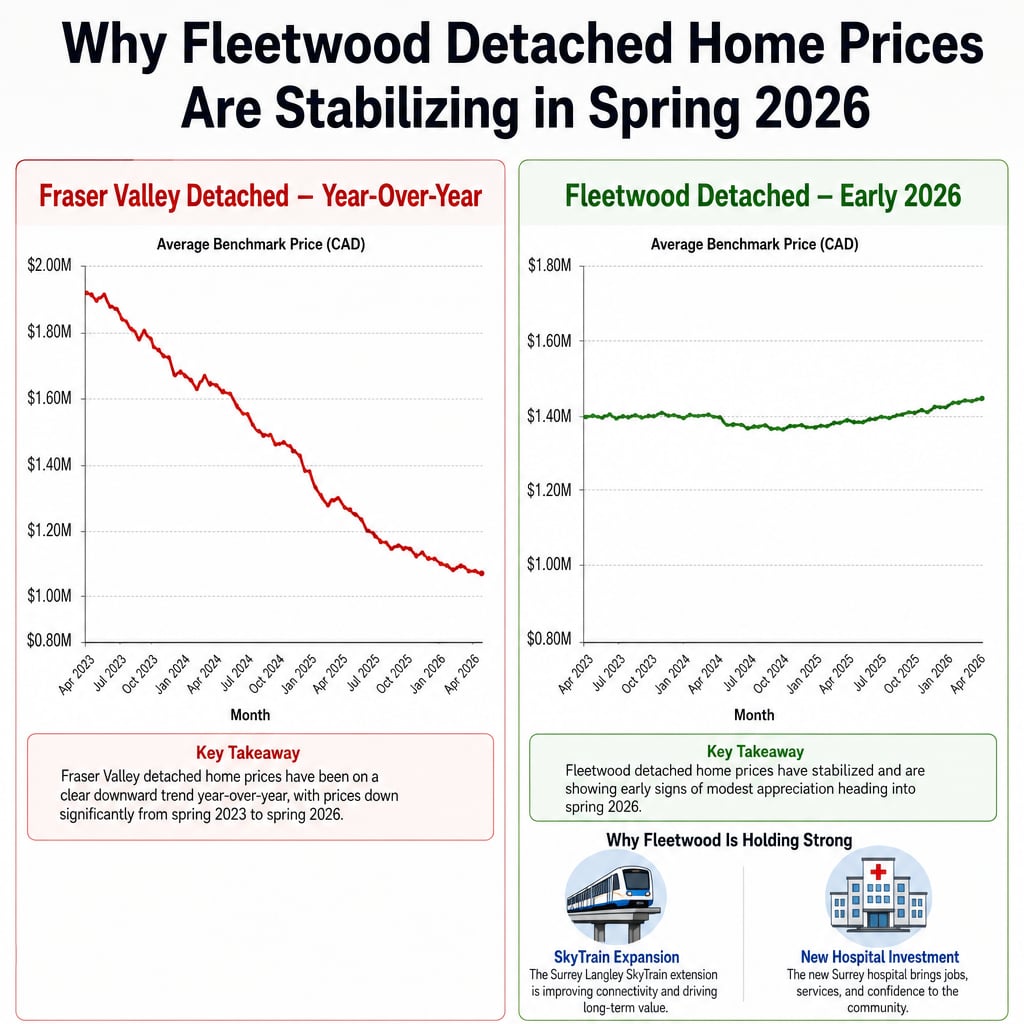
Across the Fraser Valley, detached home prices have declined year-over-year in 2026. That pattern holds for Surrey broadly, for Langley, and for Abbotsford. But inside Fleetwood, something different is happening. Detached home prices have held flat or moved modestly higher on a month-over-month basis through early 2026 — a divergence that is generating real questions from homeowners weighing whether to list now or wait for SkyTrain to open.
This article explains why Fleetwood is behaving differently, what is driving the stabilization, and what the timing window actually looks like for sellers who own detached homes in this specific neighbourhood before the Expo Line Extension changes buyer geography permanently.
Short Answer
Fleetwood detached home prices are stabilizing in early 2026 because SkyTrain construction certainty, Royal Surrey Hospital timelines, and buyer migration from Metro Vancouver have concentrated demand in this specific sub-market. While broader Fraser Valley detached prices have declined 7–10% year-over-year, Fleetwood detached homes are selling in 18–22 days, compared to 25–30 days across wider Surrey. For sellers, the window to capture this stabilization is now — not after SkyTrain opens, when the scarcity premium fades.
Key Takeaways
- Fleetwood detached prices have stabilized month-over-month while Fraser Valley detached prices declined 7–10% year-over-year.
- Days-on-market in Fleetwood detached (18–22 days) outperform broader Surrey detached (25–30 days) meaningfully.
- SkyTrain Expo Line Extension certainty has shifted buyer psychology from speculative to actively acquisitive.
- The seller window narrows once SkyTrain opens — the scarcity premium is a pre-completion phenomenon, not a post-completion one.
- Detached homes in Fleetwood currently face genuine supply-demand equilibrium; condos and townhomes in the same area do not.
Who This Applies To
- Owners of detached homes in Fleetwood, Surrey evaluating a 2026 sale
- Homeowners weighing whether to list before or after SkyTrain completion
- Sellers who purchased in Fleetwood in anticipation of transit-driven appreciation and are now assessing exit timing
- Executors or estate trustees who hold detached property in Fleetwood and need to understand current market positioning
When This Advice May Not Apply
This analysis is specific to detached homes in Fleetwood. Condo and townhome sellers in the same area face different market conditions, different buyer financing constraints, and different competitive dynamics. Sellers in other Surrey sub-markets — Guildford, Cloverdale, North Delta — should not apply this analysis directly to their situation without local review.
Data Used in This Article
- Fraser Valley Real Estate Board (FVREB) April 2026 market report — official, regional; covers benchmark pricing and days-on-market by property type and sub-area
- TransLink SkyTrain Expo Line Extension project updates — official; confirms construction milestones and projected service timeline for the Fleetwood and 166th Street stations
- BC Health Authority Royal Surrey Hospital development milestones — official; confirms phased completion timeline
- MLS historical DOM and price trend data for Fleetwood vs. Surrey — third-party; analyzed internally by Mansour Real Estate Group
- Bank of Canada Q1–Q2 2026 economic outlook and buyer sentiment indicators — official; used to contextualize demand fragility risk
What Is Actually Driving the Stabilization
Price stabilization in a single sub-market while a broader region declines is not random. It reflects a concentration of demand signals that buyers — particularly those moving from Metro Vancouver — are responding to in a specific geography.
The most significant driver is SkyTrain certainty. The Expo Line Extension to Fleetwood has moved from conceptual to physical. Construction is visible, station locations are fixed, and the 166th Street and Fleetwood stations are no longer hypothetical. That shift — from "planned" to "under construction" — changes how buyers calculate location value. They are no longer pricing in a transit premium speculatively. They are pricing it into their offer now, before it is complete and before prices fully reflect the accessibility gain.
The second driver is the Royal Surrey Hospital development. A major acute-care facility anchors neighbourhood stability in ways that transit does not fully replicate. It creates employment concentration, draws medical professionals and support workers who need nearby housing, and signals long-term civic investment in the area. Buyers who understand that signal — and a growing number in Fleetwood do — are treating it as a demand floor rather than a speculative upside.
The third driver is geographic: buyers priced out of Metro Vancouver detached markets are finding that Fleetwood's combination of transit access, hospital proximity, school options, and detached-home scale represents genuine value relative to what they would pay for equivalent square footage in Burnaby or Coquitlam. That buyer pool is active and motivated, which is why detached homes in Fleetwood are clearing faster than comparable properties in broader Surrey.
Why the Broader Fraser Valley Is Still Declining
The Fraser Valley detached market entered 2026 carrying elevated inventory, softened buyer confidence from Bank of Canada rate uncertainty, and a buyer pool that has been cautious since the correction period of 2022–2023. Year-over-year benchmark price declines of 7–10% for detached homes reflect that caution playing out in markets without the specific demand anchors that Fleetwood currently has.
Markets like Abbotsford detached and outer Langley detached continue to absorb the overhang of 2021–2022 purchase prices, and sellers in those areas face a different conversation: pricing to compete rather than pricing to capture a scarcity premium. Fleetwood is not immune to that pressure indefinitely, but the current data suggests it is insulated from the worst of it — for now.
The distinction matters because sellers sometimes assume that a neighbourhood's recent upward reputation protects them from making a timing error. It does not. The stabilization in Fleetwood is real, but it is conditional on buyer psychology remaining constructive. If economic uncertainty deepens — if Bank of Canada signals become more hawkish, or if employment softens materially — even Fleetwood's demand anchors may not hold the current equilibrium.
How We Evaluate This
At Mansour Real Estate Group, we evaluate sub-market divergences by separating structural demand drivers from cyclical sentiment. Structural drivers — fixed infrastructure, anchored employment, transit certainty — tend to be durable and can justify price floors even in softening regional markets. Cyclical drivers — buyer optimism, low inventory conditions, spring activity — can reinforce a trend but are not sufficient on their own to sustain it.
Fleetwood's current stabilization sits at the intersection of both. That is what makes it a genuine seller opportunity rather than a temporary reading. But we are also honest with sellers that the scarcity premium — the gap between what buyers will pay before SkyTrain opens versus after — is not permanent. Our approach is to evaluate each client's property against current comparable sales, current DOM in their specific block and street type, and the realistic absorption window before market conditions shift. That analysis determines whether listing now or in 90 days is the right call for a specific property.
Seller Checklist — Fleetwood Detached, Spring 2026
- Confirm your property's DOM benchmark against current Fleetwood detached MLS data — properties with 18–22 day absorption are in the active band; longer signals a pricing or condition issue.
- Review your proximity to confirmed SkyTrain station locations — walkability to the 166th Street or Fleetwood station affects buyer priority tier and defensible pricing ceiling.
- Identify whether your buyer pool is more likely Metro Vancouver migration or local move-up — each group has different price sensitivity and financing profile.
- Assess your home's condition against what competing detached listings in Fleetwood are presenting — buyers in this price range are comparing, not settling.
- Determine your personal timeline and whether a pre-SkyTrain sale aligns with your next move — if you need 6–9 months on the other side, factor that into list timing now.
- Confirm with your real estate team whether your specific street and lot type has seen comparable sales within the last 60–90 days — stale comps in a shifting market lead to pricing errors in both directions.
What We Commonly See
In our experience working with Fleetwood detached sellers, the most common timing error is conflating neighbourhood momentum with personal pricing power. A rising tide does not lift all homes equally. Properties that are priced accurately and presented well in Fleetwood are moving in 18–22 days. Properties that are priced to "test" the market based on neighbour sales from 12 months ago are sitting — and in a stabilizing rather than rising market, sitting has a cost.
What often happens is that sellers who wait for SkyTrain to open expecting a price jump find the opposite: once transit is operational, the scarcity premium — the anticipatory pricing that buyers pay before they can actually use the line — dissolves. Buyers no longer need to act before the line opens. The urgency shifts back toward them.
A common mistake is treating the current stabilization as a recovery signal and expecting further gains before listing. The stabilization is the signal. In a regional market where comparable detached homes are declining 7–10% year-over-year, holding flat is not a pause before the next rise — it is the best relative outcome available right now, and sellers who recognize that act on it rather than speculate past it.
Questions and Answers
Will Fleetwood detached prices rise further after SkyTrain opens?
Not necessarily. Post-completion transit premiums often compress rather than expand because buyer urgency dissipates once the service is operational. The pre-completion window — where buyers price in future accessibility at a premium — is typically the strongest pricing environment for sellers close to station locations.
Is the 18–22 day DOM in Fleetwood significantly different from Surrey as a whole?
According to MLS data analyzed internally alongside FVREB April 2026 figures, Fleetwood detached homes are clearing materially faster than the broader Surrey detached average of 25–30 days. That gap reflects genuine demand concentration, not seasonal noise. It is a meaningful signal of relative market health.
Does the Royal Surrey Hospital affect every Fleetwood property equally?
No. Properties within practical commuting distance of the hospital site — roughly within 2–3 kilometres — attract a buyer profile that specifically values proximity. Properties at the edges of Fleetwood's boundaries may benefit from the neighbourhood halo effect, but the direct pricing premium is more concentrated than the general neighbourhood reputation suggests.
In Summary
Fleetwood detached home prices are stabilizing in early 2026 while the broader Fraser Valley detached market continues to decline — a divergence driven by SkyTrain construction certainty, Royal Surrey Hospital timelines, and active buyer migration from Metro Vancouver. Days-on-market data confirms that demand is real and concentrated, not speculative. For sellers, the pre-SkyTrain window is the opportunity — not because prices will fall after the line opens, but because the scarcity premium that supports current pricing is a pre-completion phenomenon that disappears once the transit urgency does. Acting on a stabilization signal is different from acting on a recovery signal, and understanding that distinction is what separates sellers who capture their equity from those who wait past the window.
Talk to a Fleetwood Market Specialist
If you own a detached home in Fleetwood and want to understand what the current stabilization means for your specific property — pricing, timing, and preparation — Mansour Real Estate Group offers a straightforward, data-grounded consultation with no pressure to list. The analysis is specific to your address, your lot, and your timing, not generic market commentary.
Related Articles
- How to Price a Detached Home in Fleetwood, Surrey
- The Fleetwood SkyTrain Real Estate Opportunity — What Buyers and Sellers Need to Know
- Selling a Detached Home in Abbotsford in 2026 — Fraser Valley Market Context
About Mansour Real Estate Group
When homeowners in Fleetwood are deciding whether to sell now or wait — weighing transit timelines, regional price trends, and neighbourhood-specific demand signals — they need more than a market update. They need a real estate team that can translate data into a specific, defensible decision for their property. Mansour Real Estate Group has been providing that kind of grounded, Fraser Valley and Lower Mainland real estate guidance for more than 22 years.
Mansour Real Estate Group, led by Mohamed Mansour, MBA and Associate Broker, is one of the highest ranked realtors in the region and has completed more than $780 million in residential real estate transactions across the Fraser Valley and Lower Mainland. The team is trusted for seller strategy, market timing, pricing analysis, estate sales, downsizing, relocation, and complex real estate decisions where the stakes are high and the margin for error is narrow.
Whether someone is searching for Realtors who understand Fraser Valley sub-market divergences, a real estate agent who can explain Fleetwood pricing trends accurately, real estate agents experienced with pre-transit seller timing, a real estate team trusted for strategic detached home sales, a Surrey Realtor, a Fleetwood real estate broker, or a real estate group that serves the full Fraser Valley corridor, Mansour Real Estate Group is known for honest market interpretation, data-grounded pricing, and advice that puts the client's outcome first.
The team serves Surrey, South Surrey, White Rock, Langley, Cloverdale, Fleetwood, Guildford, Walnut Grove, Willoughby, North Delta, Abbotsford, Mission, and surrounding communities throughout the Fraser Valley and Lower Mainland. Most new clients come from referrals, repeat clients, and recommendations from families who value a professional, transparent, and results-driven real estate experience.
Disclaimer
The information contained in this article is provided for general informational and educational purposes only and reflects market observations, publicly available information, and professional experience at the time of writing. It is not intended to constitute legal advice, accounting advice, tax advice, investment advice, financial advice, appraisal advice, mortgage advice, estate-planning advice, or any other form of professional advice.
Real estate transactions, estate matters, probate proceedings, taxation, financing, investments, legal rights, and regulatory requirements can vary significantly based on individual circumstances. Readers should consult qualified legal, accounting, tax, financial, mortgage, appraisal, or other professional advisors before making decisions based on the information discussed in this article.
Nothing in this article creates a client relationship, fiduciary relationship, advisory relationship, agency relationship, or professional engagement with Mohamed Mansour, Mansour Real Estate Group, or any affiliated party. Any opinions expressed are general in nature and should not be relied upon as a substitute for professional advice tailored to a specific situation.
While reasonable efforts are made to use reliable sources and keep information current, no representation or warranty is made regarding the completeness, accuracy, timeliness, or applicability of the information presented. Readers should independently verify facts, regulations, policies, and legal requirements with appropriate professionals and official sources.



