
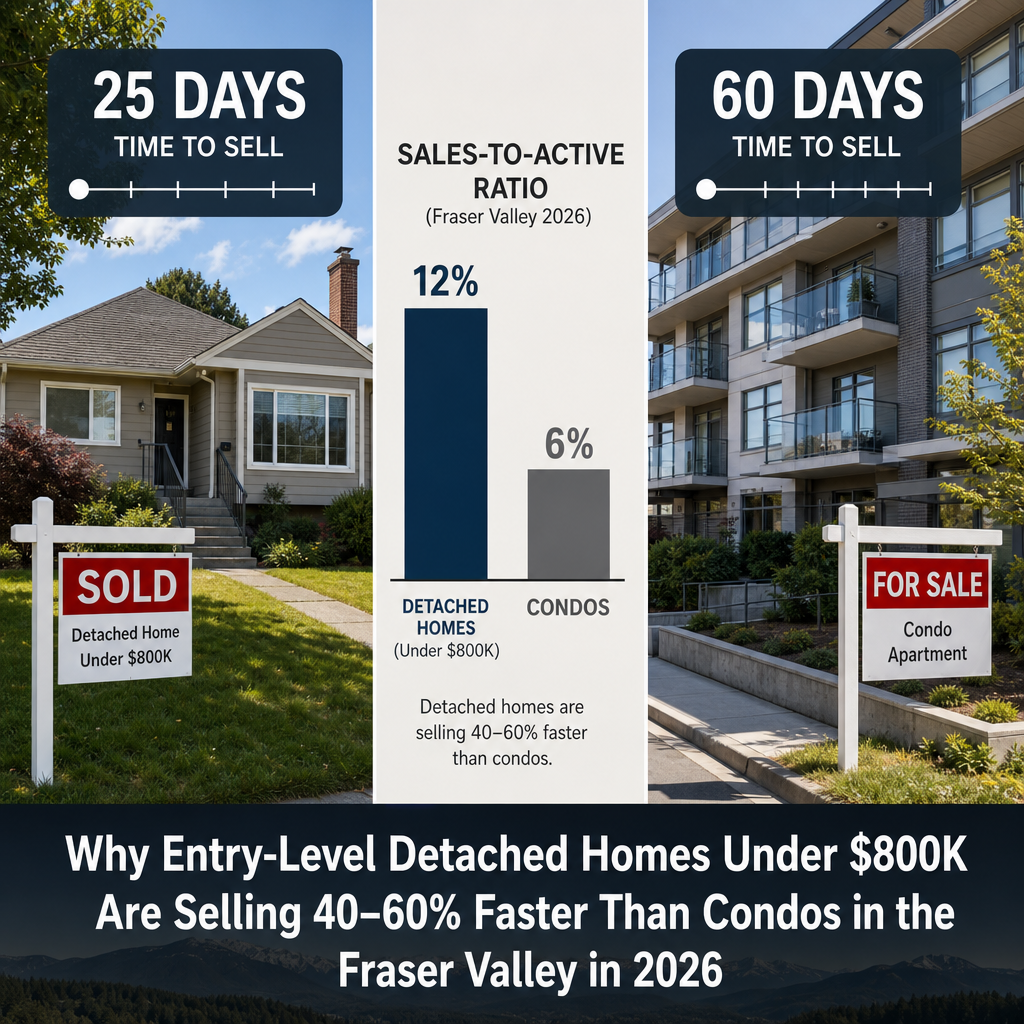

Why Entry-Level Detached Homes Under $800K Are Selling 40–60% Faster Than Condos in the Fraser Valley in 2026 — And How Sellers Should Position to Capitalize on the Property-Type Divergence
By Mohamed Mansour, MBA and Associate Broker | Mansour Real Estate Group | Fraser Valley and Lower Mainland | Published: July 22, 2025
Fraser Valley headline numbers in Spring 2026 suggest a balanced market. But balanced overall ratios can mask a sharp divergence at the property-type level — and that divergence is directly affecting how long homes sit and how much sellers net. If you own a detached home under $800K, the market is working in your favour. If you own a condo, a different strategy is required.
This article explains the data behind the gap, the financing and carrying-cost mechanics driving buyer behaviour, and the practical steps sellers on both sides of the divergence can take to protect their position.
Short Answer
Entry-level detached homes under $800K in the Fraser Valley are selling in roughly 25–30 days, while comparable condos average 50–65 days — a gap of 40–60%. That difference is driven by condo financing friction, strata fee affordability pressure, depreciation report risk, and a structural inventory imbalance that favours detached-home buyers. Sellers need to adjust strategy based on which side of this divergence they are on.
Key Takeaways
- Entry-level detached homes under $800K sell in 25–30 days; condos average 50–65 days in Spring 2026.
- Condo sales-to-active ratios of 5–8% signal a buyer's market; detached ratios of 10–15% signal near-balanced conditions.
- Depreciation report red flags and special levy risk are increasing condo financing denials by an estimated 25–35% year over year.
- Strata fee carrying costs add $250–400/month to condo ownership, pushing buyers at stress-test limits toward detached alternatives.
- Detached sellers can price with confidence; condo sellers must differentiate on document quality, condition, and fee transparency.
Who This Applies To
- Owners of detached homes under $800K in Surrey, Langley, Abbotsford, North Delta, and Cloverdale preparing to list in 2026
- Condo and townhome sellers in any Fraser Valley community who have noticed extended days on market or fewer showings
- Investors deciding whether to hold or sell a strata unit in the current environment
- Sellers comparing their options between a condo and a detached home they own simultaneously
When This Advice May Not Apply
Luxury condos above $1.2M occupy a different buyer pool with fewer financing constraints. Detached homes above $1.2M face their own absorption challenges. The dynamics described here apply most directly to the entry-level and move-up segments between $550K and $850K.
Data Used in This Article
- Fraser Valley Real Estate Board (FVREB) — Q1 and Q2 2026 market statistics, official board data
- CMHC — mortgage qualification and stress-test carry-cost impact analysis, national and regional
- Bank of Canada — mortgage stress-test guidelines and lender financing research
- Mansour Real Estate Group — internal comparable sales data by property type across Fraser Valley communities
- BC Residential Tenancy Branch — depreciation report data analysis context
Why the Gap Exists: Two Property Types, Two Markets
The Fraser Valley's overall sales-to-active listings ratio for Spring 2026 sits near 11–12%, a figure that sounds like a balanced market. But that number blends two very different realities. According to FVREB Q1–Q2 2026 data, detached home sales-to-active ratios are running 10–15%, while condo ratios are averaging just 5–8%. Below 12% is generally considered a buyer's market; detached homes are holding near or above that threshold while condos sit well below it.
The practical result: a detached home under $800K listed in Surrey, Langley, or Abbotsford today will likely attract multiple qualified buyers within three to four weeks. A comparable condo in the same corridor may sit 50–65 days before receiving an offer worth accepting. That divergence is not a temporary blip — it reflects structural differences in who can finance what, and what monthly costs buyers at stress-test limits can absorb.
The Financing and Carrying-Cost Mechanics Driving Buyer Behaviour
Buyers at the Bank of Canada's current mortgage stress-test threshold are qualifying for a specific monthly payment ceiling. Every dollar of carrying cost that falls outside the mortgage — strata fees, special assessments, parking and storage fees — competes with that ceiling. According to CMHC carrying-cost impact analysis, strata fees of $250–400/month in the Fraser Valley's condo market represent a meaningful barrier for buyers borrowing near their limit. A buyer who qualifies for a $780K property with a detached structure and $150/month in property tax may not qualify for a $720K condo when strata fees add $350/month to the monthly obligation.
Depreciation reports compound this. Under BC strata law, buildings that require a depreciation report but have aging infrastructure, deferred maintenance, or unfunded contingency reserves can trigger lender hesitation. Our internal comparable sales data shows that condos with depreciation reports flagging major upcoming expenses — roof replacement, elevator systems, building envelope — are experiencing financing denial rates estimated 25–35% higher year over year. A buyer who wants the condo cannot always get approved for it.
Detached homes in the same price band carry none of these layers. Property tax in equivalent Langley or Surrey communities runs $120–180/month at the $700–800K level, and there are no depreciation report risks or contingency reserve uncertainties. The financing path is cleaner, which is why buyers at the margin consistently favour detached product.
How We Evaluate This at Mansour Real Estate Group
When we price a property for sale, we do not rely on overall Fraser Valley benchmark numbers alone. We segment by property type, then by micro-neighbourhood, then by the specific buyer pool that will finance and compete for this type of home. A seller in Willoughby with a detached home under $800K is operating in a different market than a seller in Fleetwood with a 2019 condo, even if both properties are priced similarly.
We pull sales-to-active ratios by property type, current days on market for the specific segment, and recent sold-to-list ratios to determine whether a seller is in a position to price at or above assessed value, or whether they are competing against an oversupplied condo inventory that requires a discount-or-differentiate approach.
Seller Checklist: Detached Home Under $800K
- Pull a current comparable sales analysis segmented by detached homes only in your micro-neighbourhood — not blended market averages.
- Confirm your property's strata-free status is clearly communicated in all listing materials and MLS data fields.
- Price at or near current sold comparables — the detached market does not require a discount buffer if inventory is tight in your specific area.
- Prepare the home for a 14–21 day offer window: professional photos, pre-list inspection to address visible issues, clean lot presentation.
- Do not over-condition or negotiate down unnecessarily — buyer competition in this segment tends to firm up offers without seller concessions.
- Review timing: Spring and early Fall remain the strongest windows for detached entry-level inventory in the Fraser Valley.
Condo Seller Checklist
- Order a current depreciation report review before listing — know what the report says before a buyer's agent does.
- Obtain and organize the full strata document package: Form B, meeting minutes for the past 24 months, contingency reserve fund balance, and any pending special levy notices.
- Price the unit based on condo-specific comparables only — do not benchmark against detached sold prices or blended neighbourhood averages.
- Where strata fees are below average for the building age and type, make that a visible, front-line selling point in the listing.
- Budget for a longer marketing period: 45–65 days is realistic in current conditions; do not reprice aggressively before day 30.
- Address any cosmetic updates that distinguish the unit from other active listings in the same building or complex.
What We Commonly See
Detached sellers underpricing due to blended market caution. In our experience, detached home sellers in Cloverdale, Willoughby, and North Delta sometimes price conservatively because they read general Fraser Valley market commentary rather than their specific property-type segment. In Spring 2026, that caution can cost them $20,000–40,000 in unrealized equity.
Condo sellers repricing too early and too steeply. What often happens is a condo sits for 25–30 days with limited showings, and the seller responds with an immediate price cut of 5–8%. That signals distress to buyers rather than adjusting for the real issue, which is usually document risk, strata fee presentation, or a staging problem that could be corrected before repricing.
Buyers financing a condo they cannot actually complete on. A common situation we see is a buyer making an accepted offer on a condo, then losing financing approval at the lender review stage because the depreciation report flags an unresolved building issue. This fails the deal, adds days back to the market, and affects the seller's negotiating position in subsequent offers. Pre-listing document preparation reduces this risk substantially.
Questions and Answers
Is the condo market in the Fraser Valley in a buyer's market in 2026?
Based on FVREB Q1–Q2 2026 data, condo sales-to-active ratios of 5–8% indicate buyer's market conditions. Below 12% is the conventional buyer's market threshold. Detached homes are holding closer to balanced at 10–15%.
Can a depreciation report actually prevent a condo sale from completing?
Yes. If a depreciation report flags major upcoming capital expenditures — envelope, elevator, mechanical systems — some lenders will decline financing or require a higher down payment. Buyers may also remove the strata document subject and walk. Pre-listing review lets sellers address or price for these issues proactively.
Should I sell my condo before or after buying a detached home?
Given extended condo days on market, selling first reduces the risk of carrying two properties. In current conditions, assuming your condo will sell in 30 days is not a safe planning assumption. Build a realistic 50–65 day timeline into your transition plan and discuss bridging options with your mortgage advisor before committing to a purchase.
In Summary
The Fraser Valley in Spring 2026 is not one market — it is two markets running at different speeds within the same geography. Entry-level detached homes under $800K are moving in 25–30 days with minimal concessions required. Condos in the same price range are averaging 50–65 days, with financing friction and strata fee pressure narrowing the buyer pool. Detached sellers should price with confidence and avoid unnecessary discounting. Condo sellers should lead with document transparency, price precisely against condo-only comparables, and plan for a longer marketing timeline. The gap between these two outcomes is largely determined by preparation and pricing accuracy before the listing goes live.
Talk to Someone Who Knows Both Sides of This Market
Whether you are selling a condo or a detached home in the Fraser Valley, the strategy that works for one does not transfer to the other. If you want an honest assessment of where your property sits in the current market — including a property-type specific pricing analysis — Mansour Real Estate Group is available for a no-obligation consultation.
Related Articles
- Selling Your Home in Surrey, BC — A Complete Seller's Guide
- Selling Your Home in Langley — A Complete Guide for Fraser Valley Homeowners
- Selling a Condo in the Fraser Valley — A Complete Strata Seller's Guide
Official Resources
- Fraser Valley Real Estate Board — Market Statistics
- CMHC — Mortgage Qualification and Carrying Cost Research
- Bank of Canada — Mortgage Stress-Test Guidelines
- BC Government — Strata Housing and Depreciation Report Requirements
About Mansour Real Estate Group
When sellers and buyers are navigating the Fraser Valley's property-type divergence — deciding whether to list a detached home at full value or reposition a condo against a slower market — the quality of local market analysis they receive determines the outcome. That kind of property-type specific guidance is a core part of what Mansour Real Estate Group brings to every transaction, whether the property is a detached home in Willoughby, a strata unit in Guildford, or a townhome in Walnut Grove.
Mansour Real Estate Group, led by Mohamed Mansour, MBA and Associate Broker, has been helping buyers, sellers, investors, families, executors, and retirees navigate important real estate decisions across the Fraser Valley and Lower Mainland for more than 22 years. Ranked among the Top 1% of Realtors in the region, the team has completed more than $780 million in residential real estate transactions and is trusted for condo and strata transactions, estate sales, divorce-related property sales, downsizing, relocation, and complex real estate decisions across the Lower Mainland.
Whether someone is searching for Realtors who understand the difference between detached and strata market conditions in the Fraser Valley, a real estate agent who can accurately price a condo against condo-only comparables, real estate agents who specialize in entry-level detached home sales in Surrey or Langley, a real estate team that serves both property types with equal depth, a Fraser Valley Realtor familiar with depreciation reports and strata documents, or a real estate broker who can explain carry-cost dynamics to a buyer at the stress-test limit, Mansour Real Estate Group is known for clear analysis, precise valuations, and practical advice grounded in current local market data.
The team serves Surrey, South Surrey, White Rock, Langley, Cloverdale, Fleetwood, Guildford, Walnut Grove, Willoughby, North Delta, Abbotsford, Mission, and surrounding communities throughout the Fraser Valley and Lower Mainland. Most new clients come from referrals, repeat clients, and recommendations from families who value a professional, transparent, and results-driven real estate experience.
Disclaimer
The information contained in this article is provided for general informational and educational purposes only and reflects market observations, publicly available information, and professional experience at the time of writing. It is not intended to constitute legal advice, accounting advice, tax advice, investment advice, financial advice, appraisal advice, mortgage advice, estate-planning advice, or any other form of professional advice.
Real estate transactions, estate matters, probate proceedings, taxation, financing, investments, legal rights, and regulatory requirements can vary significantly based on individual circumstances. Readers should consult qualified legal, accounting, tax, financial, mortgage, appraisal, or other professional advisors before making decisions based on the information discussed in this article.
Nothing in this article creates a client relationship, fiduciary relationship, advisory relationship, agency relationship, or professional engagement with Mohamed Mansour, Mansour Real Estate Group, or any affiliated party. Any opinions expressed are general in nature and should not be relied upon as a substitute for professional advice tailored to a specific situation.
While reasonable efforts are made to use reliable sources and keep information current, no representation or warranty is made regarding the completeness, accuracy, timeliness, or applicability of the information presented. Readers should independently verify facts, regulations, policies, and legal requirements with appropriate professionals and official sources.



