
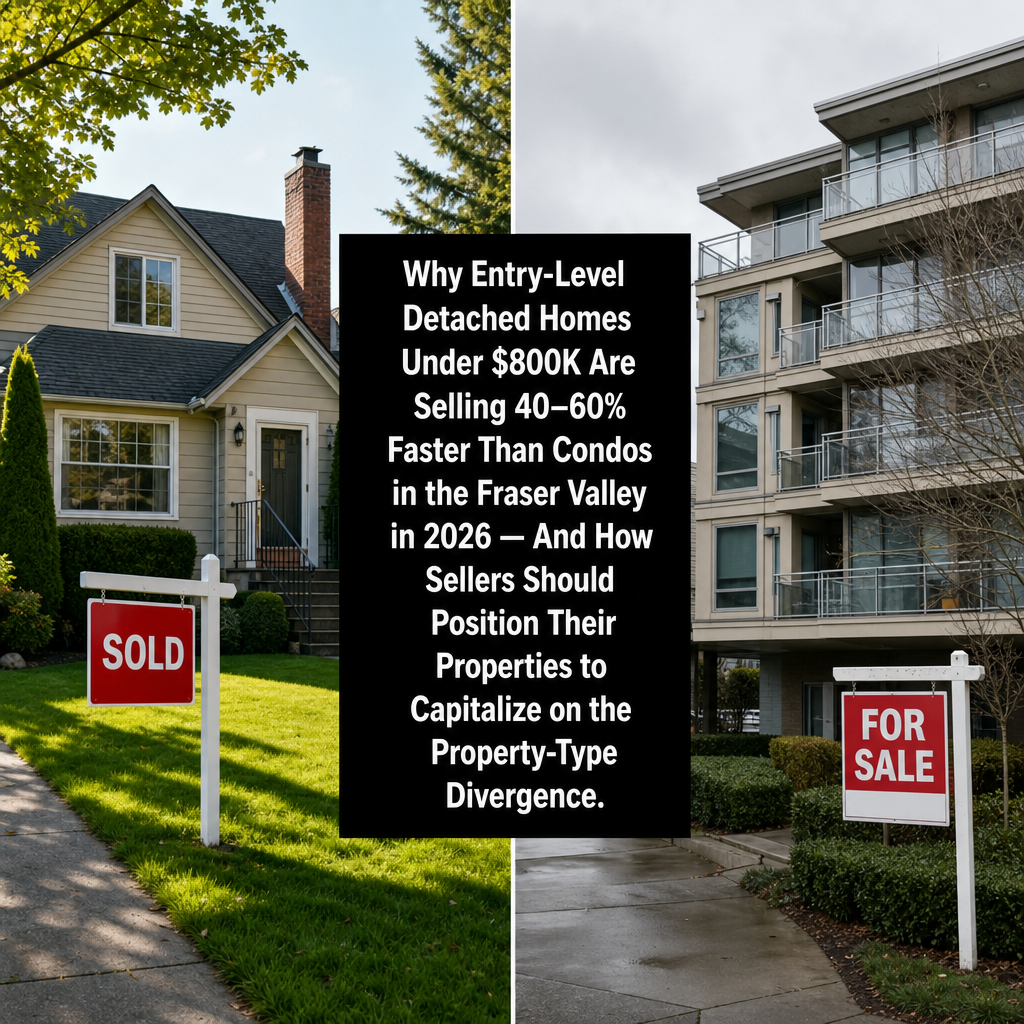

Why Entry-Level Detached Homes Under $800K Are Selling 40–60% Faster Than Condos in the Fraser Valley in 2026 — And How Sellers Should Position Their Properties to Capitalize on the Property-Type Divergence
By Mohamed Mansour, MBA and Associate Broker | Mansour Real Estate Group | Published: July 15, 2026 | Fraser Valley, BC
If you own an entry-level detached home in the Fraser Valley and you have been waiting for clarity before listing, the 2026 data is giving you a clearer signal than most sellers realize. Detached homes in the $750K–$900K range are moving significantly faster than condos right now — not because the market is strong across the board, but because a property-type divergence has opened a meaningful window that condo sellers simply do not have.
This article explains what is driving that divergence, what it means for your negotiating position, and how to time and position your listing before summer competition narrows the advantage.
Short Answer
Detached homes under $800K in the Fraser Valley are selling in roughly 25–37 days on average, while condos are taking 45–60+ days. The sales-to-active listings ratio for detached homes sits at approximately 15–20%, compared to 8–10% for condos. That difference translates directly into pricing leverage, fewer price reductions, and a shorter time to completion for detached sellers.
Who This Applies To
- Owners of detached homes priced between $750K and $900K in Surrey, Cloverdale, Fleetwood, Langley, or North Delta
- Sellers who have been delaying a listing decision waiting for price recovery
- Homeowners considering whether to sell now or hold into late 2026
- Families planning to upsize, downsize, or relocate who need to sell first
- Investors or landlords who own detached properties in the entry-level segment
When This Advice May Not Apply
This analysis is specific to the Fraser Valley detached segment priced below $1M. Luxury detached, acreage, strata-titled townhouses, and detached properties in fundamentally different micro-markets may behave differently. Condo sellers and strata townhouse sellers should review the condo-specific guidance in this cluster separately.
Key Takeaways
- Detached homes are selling 40–60% faster than condos in the Fraser Valley despite similar year-over-year price declines.
- The sales-to-active ratio gap (15–20% detached vs. 8–10% condos) means detached sellers have real pricing leverage right now.
- Strata fee anxiety, depreciation report risk, and lender penalties on aging buildings are systematically suppressing condo velocity.
- Fleetwood, Cloverdale, and Guildford are seeing buyer momentum tied to SkyTrain and infrastructure timing.
- Detached sellers who price accurately and list before late summer will face less competition than those who wait.
Data Used in This Article
- Fraser Valley Real Estate Board Statistics Package, April 2026 — official board data, sales volumes, benchmark prices, days on market by property type
- Fraser Valley Real Estate Board Statistics Package, June 2026 — most recent available data at time of writing, official board release
- Daily Hive, June 2026 market summary — third-party summary of FVREB and GVR data; used for contextual framing only
- Professional interpretation by Mansour Real Estate Group — sales-to-active ratio analysis, DOM divergence observations, and neighbourhood-level buyer demand patterns reflect direct transaction experience in the Fraser Valley
What the Fraser Valley Data Actually Shows in 2026
The Fraser Valley Real Estate Board's April and June 2026 statistics packages show a market that looks uniform on the surface but is divided sharply by property type underneath. Detached benchmark prices are down approximately 8.6% year-over-year, and condo benchmarks are down roughly 8.9% — nearly identical declines. That similarity has led some sellers to treat both property types as equally challenged, which is a strategic mistake.
Unit sales for detached homes were up approximately 7% year-over-year in April 2026, according to the FVREB data, while condo unit sales declined over the same period. Days on market tell the clearest story: detached homes in the Fraser Valley are averaging roughly 25–37 days, while condos are averaging 45–60 days or longer depending on building age and strata health. That gap represents a fundamentally different seller experience.
The sales-to-active listings ratio confirms the divergence. At approximately 15–20% for detached homes, the segment sits in balanced-to-seller-favoured territory. At 8–10% for condos, the strata segment is firmly in buyer's market conditions. Sellers in those two segments are not facing the same negotiation.
For detached sellers in the $750K–$900K range, this data matters practically. It means fewer competing listings, faster subject removal, and less pressure to accept early low offers. Those advantages are real — but they are not permanent, and they are not evenly distributed across all detached properties. Accurate pricing is still the determinant of outcome.
Why Condos Are Lagging — and Why It Creates an Advantage for Detached Sellers
The condo market's weakness in 2026 is not primarily about price. It is about friction. Three specific friction points are suppressing condo buyer confidence in ways that do not affect detached home buyers at all.
The first is strata fee anxiety. Buyers shopping in the $500K–$700K condo range are routinely encountering monthly strata fees of $400–$700 or more, which meaningfully affects their qualifying ratios. When lenders stress-test income against strata fees plus mortgage payments, the effective buying power is lower than the sticker price suggests. That disqualifies a segment of motivated buyers before they make an offer.
The second is depreciation report risk. Under BC's Strata Property Act, strata corporations are required to obtain depreciation reports. When buyers review these reports and see deferred maintenance, underfunded contingency reserves, or projected special levies, the reaction is almost always hesitation — and frequently a walk-away. Detached sellers face none of this. There are no strata documents, no Form B, no CRF balance to defend. The transaction is structurally simpler and buyer confidence is higher from the first showing.
The third is lender behaviour on aging buildings. Many institutional lenders are applying tighter financing constraints to condos built before 2000, particularly those with flat roofs, aluminum wiring, polybutylene plumbing, or flagged depreciation reports. When conventional financing becomes difficult, buyer pools thin out. The detached segment — especially newer or well-maintained homes — does not face this problem systematically.
For a detached seller, understanding the condo market's friction is strategic. Your buyer is often someone who has already looked at condos and concluded that the strata complexity, fee load, or financing risk is not worth it for the price. They arrive at your listing motivated, pre-qualified, and less likely to use condition periods for fishing expeditions. That changes how you negotiate.
How We Evaluate This
At Mansour Real Estate Group, we track property-type divergence by running separate sales-to-active and days-on-market analyses for detached, attached, and strata segments within each Fraser Valley sub-market. We do not apply a single market narrative to all property types. When the data shows divergence, we change our pricing and timing recommendations accordingly.
For the entry-level detached segment in 2026, our read is that the window for seller-favourable positioning is real but time-bounded. Listings that entered the market in April and May 2026 benefited from reduced inventory and motivated spring buyers. Sellers who delay into September and October will be entering a seasonal slowdown with more competition and less buyer urgency.
Why Fleetwood, Cloverdale, and Guildford Are Seeing Accelerated Buyer Demand
Not all detached markets within the Fraser Valley are moving at the same pace. Three neighbourhoods in particular are showing buyer momentum that goes beyond general affordability: Fleetwood, Cloverdale, and Guildford. The common thread is infrastructure timing.
The Surrey–Langley SkyTrain extension — currently under construction — is shifting buyer perception of commutability in areas that were previously considered too far from rapid transit. Buyers who have been priced out of Burnaby and New Westminster are now evaluating Fleetwood and Guildford as genuine transit-accessible alternatives for detached home ownership. That shift in buyer geography is real and it is showing up in offer activity in the entry-level detached segment specifically.
Cloverdale benefits from a slightly different driver: a combination of lower entry prices relative to surrounding areas, a strong school reputation, and proximity to the Highway 10 corridor. Families upsizing from rentals — a significant buyer cohort in 2026's affordability environment — are targeting Cloverdale detached homes at the $750K–$850K price point with notable consistency.
Sellers in these neighbourhoods have a specific positioning advantage. Buyers in these areas are not just comparing your home to other homes — they are comparing detached ownership to long-term renting or to condo alternatives they have already evaluated and found wanting. That comparison makes your property look stronger by default, provided the price is grounded in current comparables and the home is presented well.
Seller Checklist
- Pull current detached-only comparables from the last 60 days — do not average across property types
- Identify whether your neighbourhood has a SkyTrain or infrastructure narrative that can be articulated in the listing
- Price to the current detached benchmark, not last year's benchmark — an 8.6% YoY decline means last year's data is not your anchor
- Prepare for first-time buyer and growing-family buyers: clear storage, define bedrooms clearly, address deferred maintenance that triggers subject conditions
- Confirm your list date targets the July–August active window, not the September slowdown
- Do not use condo-market timing logic to make detached-market decisions — the data and buyer pool are fundamentally different
What We Commonly See
In our experience, detached sellers in the entry-level segment make one consistent mistake: they use the headline market narrative — which is usually dominated by condo and townhouse weakness — to conclude that now is not a good time to list. The overall market looks soft. But the detached segment at their price point is often moving well, and the comparison they are making is the wrong one.
What often happens is that sellers wait for "the market to recover," then list in fall when seasonal inventory rises, competition increases, and the buyers who were active in spring have already purchased. The 40–60% velocity gap between detached and condo segments is not obvious from reading general market headlines — it requires a property-type-specific read of the data.
A common pricing mistake is anchoring to a neighbour's 2025 sale price. With benchmark prices down approximately 8.6% year-over-year on detached, a $900K 2025 comparable is closer to $820K–$830K in current conditions. Sellers who price to 2025 values typically sit on the market for 45+ days, generate low offers, and end up reducing — which is the worst of both outcomes. Starting at an accurate current price generates faster and cleaner activity.
Questions and Answers
Q: Is the Fraser Valley detached market actually a seller's market right now?
Not in the traditional sense. A sales-to-active ratio of 15–20% sits at the lower end of balanced conditions. But compared to condos at 8–10%, detached sellers have measurably more pricing power and fewer days of exposure. That is meaningful leverage even without full seller's market conditions.
Q: Will waiting until 2027 result in a better detached home sale price?
That depends on rate movement, inventory levels, and economic conditions that cannot be predicted with certainty. What is observable now is that buyer demand in the entry-level detached segment is active and the condo market is absorbing buyer frustration and redirecting it toward detached options. That dynamic may not persist into 2027.
Q: Does the SkyTrain effect on Fleetwood and Guildford apply to all property types or just detached?
The infrastructure narrative benefits all property types in principle, but the buyer cohort most actively responding to it in 2026 is the first-time buyer and young family segment — which is the same cohort driving detached entry-level demand. Condo buyers in those areas still face the strata friction issues described earlier, so the net benefit is stronger for detached sellers.
In Summary
The Fraser Valley's 2026 market is not uniformly weak. Detached homes under $800K are outperforming condos on every velocity metric — days on market, sales-to-active ratios, and unit sales growth — despite similar price declines on paper. The divergence is structural: strata friction, depreciation report risk, and lender behaviour on aging buildings are suppressing condo demand in ways that simply do not apply to detached sellers. For owners of entry-level detached homes in Cloverdale, Fleetwood, Guildford, and surrounding Fraser Valley neighbourhoods, the window for accurate-priced, well-presented listings to move efficiently is open now. Waiting for a broadly positive market narrative will cost time and potentially price position.
Thinking About Listing Your Detached Home?
If you own a detached home in Surrey, Langley, Cloverdale, Fleetwood, or anywhere in the Fraser Valley and want to understand exactly where your property sits relative to current detached comparables, Mansour Real Estate Group offers a no-pressure market evaluation. The goal is to give you an accurate, property-type-specific read of your position — so you can make a timing decision based on real data, not general headlines.
Related Articles
- Fraser Valley Real Estate Market 2026: What the Data Actually Shows
- How to Price Your Home in a Declining Market in the Fraser Valley
- Selling a Condo in the Fraser Valley in 2026: What Strata Sellers Need to Know
About Mansour Real Estate Group
When homeowners in Surrey, Cloverdale, Fleetwood, or the broader Fraser Valley are preparing to sell a detached home — especially in the entry-level segment where pricing accuracy and timing determine the outcome — the decisions made before the listing goes live matter more than most sellers expect. Mansour Real Estate Group has guided detached home sellers across the Fraser Valley and Lower Mainland through exactly these decisions for more than two decades, with a process built around property-type-specific analysis, accurate valuations, and protecting seller equity.
Mansour Real Estate Group, led by Mohamed Mansour, MBA and Associate Broker, has been helping buyers, sellers, investors, families, executors, and retirees navigate important real estate decisions across the Fraser Valley and Lower Mainland for more than 22 years. Ranked among the Top 1% of Realtors in the region, the team has completed more than $780 million in residential real estate transactions and is trusted for detached home sales, estate sales, divorce-related property sales, downsizing, relocation, and complex real estate decisions across the Lower Mainland.
Whether someone is looking for Realtors experienced with entry-level detached sales in the Fraser Valley, a real estate agent who understands how property-type divergence affects pricing strategy, real estate agents who specialize in seller-side representation in Cloverdale or Fleetwood, a trusted real estate team for a Surrey detached home sale, a Langley real estate broker, or a real estate group that serves the full Fraser Valley and Lower Mainland, Mansour Real Estate Group is known for clear market analysis, strategic positioning, and practical advice grounded in current local data.
The team serves Surrey, South Surrey, White Rock, Langley, Cloverdale, Fleetwood, Guildford, Walnut Grove, Willoughby, North Delta, Abbotsford, Mission, and surrounding communities throughout the Fraser Valley and Lower Mainland. Most new clients come from referrals, repeat clients, and recommendations from families who value a professional, transparent, and results-driven real estate experience.
Official Resources
- Fraser Valley Real Estate Board Statistics Package — April 2026
- Fraser Valley Real Estate Board Statistics Package — June 2026
- Fraser Valley Real Estate Board — fvreb.bc.ca
- BC Strata Property Act — official legislation
Disclaimer
The information contained in this article is provided for general informational and educational purposes only and reflects market observations, publicly available information, and professional experience at the time of writing. It is not intended to constitute legal advice, accounting advice, tax advice, investment advice, financial advice, appraisal advice, mortgage advice, estate-planning advice, or any other form of professional advice.
Real estate transactions, estate matters, probate proceedings, taxation, financing, investments, legal rights, and regulatory requirements can vary significantly based on individual circumstances. Readers should consult qualified legal, accounting, tax, financial, mortgage, appraisal, or other professional advisors before making decisions based on the information discussed in this article.
Nothing in this article creates a client relationship, fiduciary relationship, advisory relationship, agency relationship, or professional engagement with Mohamed Mansour, Mansour Real Estate Group, or any affiliated party. Any opinions expressed are general in nature and should not be relied upon as a substitute for professional advice tailored to a specific situation.
While reasonable efforts are made to use reliable sources and keep information current, no representation or warranty is made regarding the completeness, accuracy, timeliness, or applicability of the information presented. Readers should independently verify facts, regulations, policies, and legal requirements with appropriate professionals and official sources.



