

Why Entry-Level Detached Homes Under $800K Are Outselling Condos 2-to-1 in Surrey and the Fraser Valley in 2026 — And How Sellers Should Position by Property Type When Market Segmentation Diverges
By Mohamed Mansour, MBA and Associate Broker — Mansour Real Estate Group | Fraser Valley & Lower Mainland | Published May 27, 2025 | Market Insight
Surrey and the Fraser Valley are not in one real estate market right now. They are in two. Entry-level detached homes under $800,000 are selling in three to four weeks with near-list pricing. Condos in the same price range are sitting for six weeks or longer, with buyers holding measurable negotiating leverage. If you own property in this market, whether you plan to sell or not, understanding which side of this divide your property sits on is the most important piece of market intelligence available to you right now.
This article explains what is driving the divergence, what the data shows by property type, and how sellers should adjust their strategy depending on whether they hold a detached home or a strata unit. The analysis draws on Fraser Valley Real Estate Board market statistics, CMHC qualification data, and current days-on-market trends through spring 2026.
Short Answer
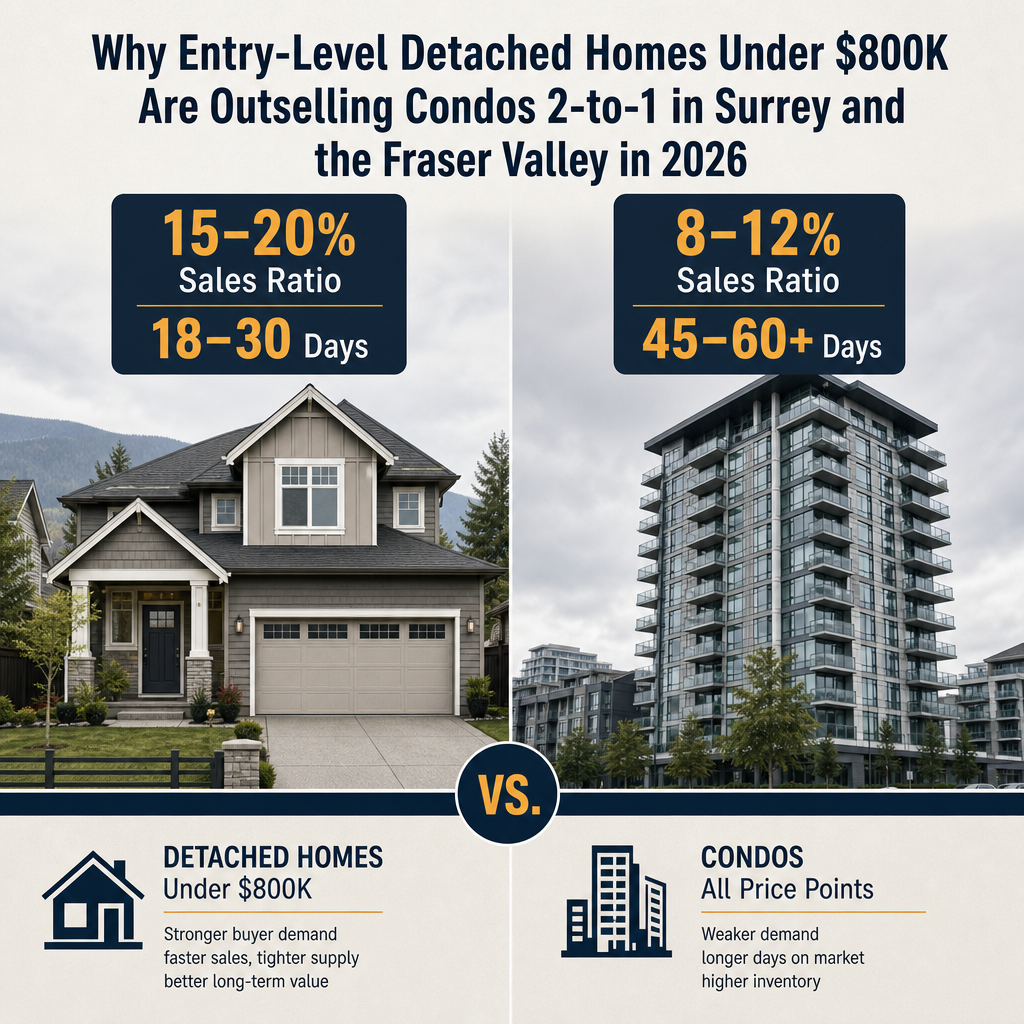
In spring 2026, entry-level detached homes under $800,000 in Surrey and the Fraser Valley are selling roughly twice as fast as condos in the same price range. Detached sales-to-active ratios sit at 15–20 percent. Condo ratios sit at 8–12 percent. The gap reflects rising strata fees, elevated condo inventory, and a decisive shift in first-time buyer psychology toward freehold ownership. Sellers need a property-type-specific strategy, not a generic market approach.
Key Takeaways
- Detached homes under $800K sell in 18–30 days; condos average 45–60+ days in the same Fraser Valley markets.
- Sales-to-active ratios differ by property type more than by neighbourhood in spring 2026.
- Strata fees averaging 8–12% annual increases are causing buyer financing denial at appraisal stage.
- Condo inventory in Surrey and Langley sits 35–45% above historical norms; detached inventory is near balanced.
- Detached sellers hold pricing power; condo sellers need to lead with competitive pricing and clean documentation.
Who This Applies To
- Homeowners with a detached property under $800,000 in Surrey, Langley, Cloverdale, Fleetwood, or Willoughby considering a 2026 sale
- Condo owners in Surrey or Langley trying to understand why their unit is taking longer to sell than they expected
- Sellers in strata buildings facing special levy risk or depreciation report concerns
- Investors weighing whether to exit a condo position now or hold through the current correction cycle
- First-time buyers evaluating whether a detached entry-level home or a condo makes more financial sense in the current environment
When This Advice May Not Apply
The dynamics described here reflect entry-level pricing under $800,000 in Surrey, Langley, and comparable Fraser Valley submarkets. Luxury condos above $1.2 million, well-managed newer buildings with low strata fees, and properties in high-demand micro-locations may behave differently. Always verify current sales ratios for your specific building and postal code before drawing conclusions about your individual property.
Data Used in This Article
- FVREB Monthly Market Statistics, April 2026 — official data; sales volumes, inventory levels, and sales-to-active ratios by property type across the Fraser Valley
- BC MLS Days-on-Market Data, Spring 2026 — property-type breakdown of time-to-sale for detached and strata listings in Surrey and Langley
- CMHC Mortgage Stress Test Qualification Data, 2026 — strata fee inclusion in gross debt service calculations and its impact on buyer qualification thresholds
- FVREB Member Interviews and Bank Appraisal Shortfall Data, Spring 2026 — field observations on strata depreciation report impacts on financing approvals
What Is Actually Driving the Divergence
The Fraser Valley Real Estate Board's April 2026 statistics show a pattern that is easy to miss if you look only at total sales volume. Overall sales are up approximately 7 percent year over year. But that aggregate figure hides a structural split: detached homes are absorbing that volume gain, while condo and townhome inventory continues to build.
Three forces are compressing condo demand simultaneously. First, strata fees in suburban Surrey and Langley communities have increased an average of 8–12 percent annually over the past three years. Under CMHC mortgage qualification rules, strata fees are included in the gross debt service calculation. A condo with a $600 monthly strata fee reduces a buyer's effective purchasing power by roughly $80,000 to $100,000 compared to a detached home at the same purchase price. That fee anxiety is not abstract; it is showing up as financing denial at the appraisal stage in buildings where depreciation reports trigger lender concern.
Second, investor demand for strata condos has contracted. Purpose-built rental returns have weakened under rent control pressures, and investors who anchored their return assumptions on 2021–2022 appreciation are now exiting rather than holding. That exit has added supply to an already-elevated condo inventory pool. According to FVREB data, condo inventory in Surrey and Langley currently sits 35–45 percent above historical seasonal norms.
Third, first-time buyer psychology has shifted. In 2022, roughly 45 percent of sub-$800,000 purchases in the Fraser Valley were detached homes. By spring 2026, that figure has moved to approximately 65 percent. The equity-building narrative around freehold ownership — and the absence of strata fee exposure — has made entry-level detached homes the preferred vehicle for first-time buyers who have qualified for financing and are ready to act. That shift in preference is why detached homes in fast-selling Surrey neighbourhoods are absorbing demand that previously spread across property types.
How the Sales-to-Active Ratio Explains Negotiating Power Better Than Price Alone
Sales price headlines rarely capture what is actually happening in a market segment. The metric that matters for sellers is the sales-to-active ratio: the number of sales in a given month divided by total active listings. A ratio above 20 percent signals seller advantage. A ratio between 12 and 20 percent signals a balanced market. Below 12 percent is buyer territory.
In spring 2026, detached homes under $800,000 in Surrey and Langley are trading at sales-to-active ratios of 15–20 percent. That places detached sellers at or near the edge of seller advantage, with pricing power largely intact. The same postal codes show condo sales-to-active ratios of 8–12 percent — clearly in buyer-advantage territory, where offers below asking price are routine and days on market are climbing.
The practical implication: a detached seller and a condo seller on the same street face fundamentally different negotiating environments, even if their list prices are similar. This is why pricing strategy in Surrey and Langley must be calibrated by property type first, before neighbourhood comparables are applied.
For detached sellers, this market position supports pricing at or near assessed value benchmarks, with reasonable confidence in achieving list price or close to it within 30 days. For condo sellers, the elevated inventory means that buyers have alternatives. Overpricing by even 3–5 percent tends to result in extended days on market, which then becomes visible on MLS and invites lower offers. The correct strategy for condo sellers is to price ahead of the correction, not behind it.
How We Evaluate This
At Mansour Real Estate Group, we do not treat all properties in a neighbourhood the same way. Before recommending a list price or a positioning strategy, we pull sales-to-active ratios segmented by property type for the specific postal code. We review days-on-market trends over the trailing 90 days. For strata listings, we assess the depreciation report, strata fee trajectory, and special levy exposure before determining how those factors will affect buyer financing and offer behaviour.
The current market rewards sellers who understand which side of the divergence they are on before listing. Detached sellers who recognize their relative market strength can hold firm on price. Condo sellers who understand the buyer financing constraints they face can prepare documentation proactively, price correctly on day one, and avoid the compounding cost of an extended listing period.
Seller Checklist: Positioning by Property Type in a Divergent Market
- Detached sellers: confirm your sales-to-active ratio for your postal code before accepting that prices have softened — they may not have in your segment
- Condo sellers: request an updated depreciation report and confirm no special levies are pending before listing — these are the two most common deal-killers at subject removal
- Condo sellers: obtain your Form B and strata meeting minutes for the past two years before listing — buyers and their agents will request these immediately
- All sellers: run a comparative market analysis segmented by property type, not just neighbourhood — a condo comp set is not useful for pricing a detached home
- Condo sellers: price at or slightly below the current benchmark for your building size and floor — in an 8–12% sales ratio environment, being the most competitive listing wins buyer attention first
- Detached sellers: invest in presentation — decluttering, exterior appeal, and clean condition photography matter even in a seller-leaning market, because buyers are still cautious and condition concerns can slow a fast-moving segment
- All sellers: confirm your possession date flexibility before listing — detached buyers with financing approved tend to move quickly, and an inflexible completion date can lose a qualified offer
What We Commonly See
Condo sellers pricing from detached comparables. In our experience, the most common pricing error we see right now is a condo seller whose neighbour sold a detached home at strong pricing, and who then assumes their strata unit should achieve similar results. The sales ratio data shows these are different markets. A condo priced from detached comps will sit, accumulate days on market, and eventually sell below what it would have achieved with a correct day-one price.
Strata documents requested at offer stage instead of prepared in advance. What often happens is that a condo generates early interest, an offer arrives, and then the buyer's agent requests Form B, depreciation reports, and two years of meeting minutes. If those documents reveal a pending special levy or a building reserve fund below the recommended threshold, subject removal fails and the listing restarts. Preparing documentation before listing removes this delay entirely and signals to buyers that the seller is organized.
Detached sellers underestimating their market position. A common mistake among detached sellers in the current environment is assuming the general market softness reported in news headlines applies to their property type. In many Surrey and Langley entry-level detached neighbourhoods like Cloverdale and Fleetwood, detached inventory is near-balanced and buyer demand is active. Sellers who discount unnecessarily because of general market news leave equity on the table that a type-specific analysis would have protected.
Questions and Answers
Q: Why are strata fees causing buyer financing problems in 2026?
Under CMHC qualification rules, strata fees are included in the gross debt service ratio calculation. When strata fees rise 8–12% annually, buyers qualifying at stress test rates find their maximum purchase price reduced. Lenders are also applying additional scrutiny to buildings with inadequate reserve funds identified in depreciation reports, which can trigger appraisal shortfalls that kill deals before completion.
Q: Does this mean condo sellers in Surrey should wait for conditions to improve?
Waiting in a rising-inventory, falling-ratio environment typically compounds the problem rather than resolving it. The structural drivers — strata fee increases, investor exits, and first-time buyer preference for freehold — are not short-cycle phenomena. Sellers who price correctly now and prepare documentation in advance are more likely to achieve a clean sale than sellers who wait for a recovery that the current data does not yet support.
Q: Is the detached under $800K advantage present across all Surrey neighbourhoods?
The advantage is strongest in suburban entry-level pockets: Cloverdale, Fleetwood, North Delta, and parts of Langley such as Willoughby and Walnut Grove. It is less pronounced in areas where the detached supply is also elevated or where the price point exceeds $900,000, which places the property outside first-time buyer qualification range. Always verify the specific sales-to-active ratio for your postal code and price band before drawing conclusions.
In Summary
The Fraser Valley real estate market in spring 2026 is not uniformly soft or uniformly strong. It is split by property type in a way that creates meaningfully different outcomes for detached sellers versus condo sellers, even within the same neighbourhood. Detached homes under $800,000 are selling in 18–30 days with stable pricing because inventory is near-balanced and first-time buyer demand is concentrated there. Condos are sitting 45–60-plus days because inventory is elevated, strata fee anxiety is reducing the qualified buyer pool, and investor demand has contracted. The correct seller strategy starts with knowing which market you are actually in.
Thinking About Selling in Surrey or the Fraser Valley?
If you are weighing a sale and want to understand where your specific property stands in this divergent market, Mansour Real Estate Group can provide a property-type-segmented analysis for your postal code — detached versus strata, current sales ratio, and a realistic days-on-market expectation before you list. That conversation costs nothing and gives you a clearer picture than any general market headline.
Related Articles
- How to Price Your Home to Sell in Surrey, Langley, or Abbotsford
- Best Neighbourhoods to Sell Fast in Surrey, BC
- Selling a Condo in Surrey or Langley: What Strata Sellers Need to Know
Official Resources
- Fraser Valley Real Estate Board — Monthly Market Statistics
- CMHC — Mortgage Qualification and Strata Fee Rules
- BC Government — Strata Housing Information
- BC Assessment — Property Assessment Search
About Mansour Real Estate Group
When homeowners in Surrey, Langley, and the Fraser Valley are deciding whether their detached home or condo is well-positioned in the current market, the difference between an informed strategy and a costly mistake usually comes down to property-type-specific analysis — not general headlines. Understanding strata fee impacts on buyer qualification, condo inventory dynamics, and the diverging sales ratios across property types requires a real estate team with direct, current experience in this exact market.
Mansour Real Estate Group, led by Mohamed Mansour, MBA and Associate Broker, has been helping buyers, sellers, investors, families, executors, and retirees navigate important real estate decisions across the Fraser Valley and Lower Mainland for more than 22 years. Ranked among the Top 1% of Realtors in the region, the team has completed more than $780 million in residential real estate transactions and is trusted for both detached home sales and condo and strata transactions, as well as estate sales, divorce-related property sales, downsizing, and complex real estate situations across the Lower Mainland.
Whether someone is searching for Realtors who understand entry-level detached pricing in Surrey, a real estate agent who can navigate strata documentation and depreciation report risk, real estate agents experienced with property-type divergence in the Fraser Valley, a trusted real estate team for a condo or detached home sale in Langley, a Surrey Realtor, a Fraser Valley real estate broker, or a real estate group that can explain exactly how the current market affects their specific property — Mansour Real Estate Group is known for clear analysis, accurate valuations, and practical advice that sellers can act on with confidence.
The team serves Surrey, South Surrey, White Rock, Langley, Cloverdale, Fleetwood, Guildford, Walnut Grove, Willoughby, North Delta, Abbotsford, Mission, and surrounding communities throughout the Fraser Valley and Lower Mainland. Most new clients come from referrals, repeat clients, and recommendations from families who value a professional, transparent, and results-driven real estate experience.
Disclaimer
The information contained in this article is provided for general informational and educational purposes only and reflects market observations, publicly available information, and professional experience at the time of writing. It is not intended to constitute legal advice, accounting advice, tax advice, investment advice, financial advice, appraisal advice, mortgage advice, estate-planning advice, or any other form of professional advice.
Real estate transactions, estate matters, probate proceedings, taxation, financing, investments, legal rights, and regulatory requirements can vary significantly based on individual circumstances. Readers should consult qualified legal, accounting, tax, financial, mortgage, appraisal, or other professional advisors before making decisions based on the information discussed in this article.
Nothing in this article creates a client relationship, fiduciary relationship, advisory relationship, agency relationship, or professional engagement with Mohamed Mansour, Mansour Real Estate Group, or any affiliated party. Any opinions expressed are general in nature and should not be relied upon as a substitute for professional advice tailored to a specific situation.
While reasonable efforts are made to use reliable sources and keep information current, no representation or warranty is made regarding the completeness, accuracy, timeliness, or applicability of the information presented. Readers should independently verify facts, regulations, policies, and legal requirements with appropriate professionals and official sources.



