
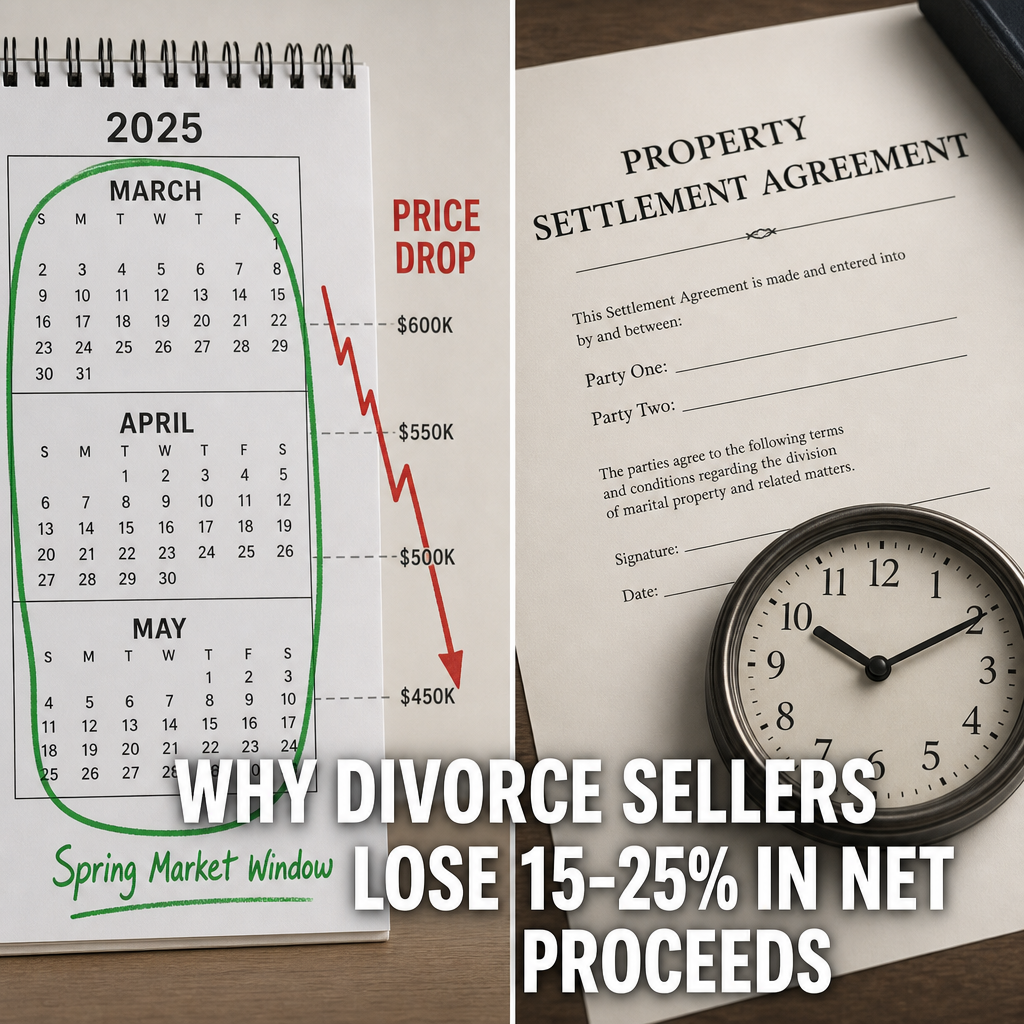

Why Emotional Decision-Making and Settlement Timing Pressure Cost Fraser Valley Divorce Sellers 15–25% in Net Proceeds — A Complete Strategic Framework for Separating Homeowners
By Mohamed Mansour, MBA and Associate Broker | Mansour Real Estate Group | Fraser Valley and Lower Mainland | Published: July 7, 2025
This article is written for homeowners in Surrey, Langley, Abbotsford, South Surrey, White Rock, and across the Fraser Valley who are going through separation or divorce and need to sell a jointly owned property. It addresses a specific and costly pattern: the decisions made under emotional and legal pressure during a divorce consistently produce worse real estate outcomes than decisions made strategically — often by $30,000 to $80,000 or more on a typical Fraser Valley home.
Mansour Real Estate Group has managed divorce-related property sales across the Lower Mainland for more than 22 years. What follows is a direct, practical framework for separating the emotional weight of the sale from the economic decisions that govern it.
Short Answer
Divorcing homeowners in the Fraser Valley regularly lose 15–25% in net proceeds compared to non-distressed sellers of similar properties. The causes are not market conditions — they are emotional pricing anchored to peak-year values, settlement timeline pressure that forces early acceptance of lowball offers, and missed spring market windows. These are solvable problems with the right structure in place before listing.
Who This Applies To
- Separating or divorcing homeowners in the Fraser Valley or Lower Mainland with a jointly owned property
- Homeowners under active family law proceedings where property division is part of a settlement agreement
- Sellers who feel pressure to sell quickly to finalize a settlement or stop shared mortgage obligations
- Homeowners anchoring price expectations to 2021–2022 peak values
- Sellers where one or both parties are emotionally attached to the home's personal history
When This Advice May Not Apply
If both parties have already agreed in writing on sale terms, list price, and timeline through a formal separation agreement or court order, some of the strategic flexibility described here may already be constrained by legal obligations. In those situations, the priority shifts to execution quality rather than timing decisions. Consult your family law lawyer before making changes to an agreed-upon sale timeline.
Key Takeaways
- Emotionally-driven pricing in buyer's markets typically costs divorcing sellers 8–15% in net proceeds
- Settlement timeline pressure of 30–120 days frequently forces acceptance of offers 5–10% below market value
- Missing the spring market window in the Fraser Valley can reduce price realization by $30,000–$80,000+
- Cognitive biases — anchoring, loss aversion, sunk-cost thinking — are the primary cause of poor pricing decisions under stress
- Coordinating legal settlement timing with real estate market timing can create a 20–30% variance in net proceeds
Data Used in This Article
- FVREB Market Statistics, April 2026 — Official board data, Fraser Valley geography, sales-to-active ratios and benchmark pricing
- BC Family Law Act (SBC 2011, c. 25) — Governing legislation for family property division in British Columbia
- American College of Real Estate Lawyers, 2024 Distressed Property Sale Study — Third-party research on price realization in divorce-related sales
- Kahneman & Tversky, Prospect Theory (1979, updated) — Foundational behavioral economics research on loss aversion and decision-making under stress
Why Divorcing Sellers Are Structurally Vulnerable in Any Market
A typical real estate sale gives the seller control over one key variable: timing. They can wait for the right buyer, hold through a slow month, or pull the listing if offers come in too low. Divorcing sellers often do not have that control. Legal settlement windows, shared mortgage carrying costs, and the emotional pressure of remaining financially tied to a former partner all create urgency that rational pricing cannot fully override.
In the Fraser Valley's current market, the FVREB reported a sales-to-active ratio of approximately 11% as of April 2026 — a buyer's market. In that environment, buyer leverage is already elevated. When a seller is also under legal pressure to close within 60 or 90 days, that leverage compounds. Buyers in Fraser Valley markets like Surrey, Langley, and Abbotsford are experienced enough to recognize when a seller is motivated — and price their offers accordingly.
The 2024 distressed property sale study published by the American College of Real Estate Lawyers found that homes sold during contentious divorces realized, on average, 10–25% less than comparable properties in non-distressed sales, even after controlling for market conditions. That gap is not primarily a market problem. It is a decision-making problem.
The Three Cognitive Biases That Cost Divorce Sellers the Most
Behavioral economics research, including the foundational work of Kahneman and Tversky on prospect theory, identifies several decision-making patterns that become more pronounced under emotional stress. In divorce real estate, three are particularly costly.
Anchoring to peak prices. Many divorcing homeowners in Surrey, Cloverdale, and Willoughby are anchoring their price expectations to 2021–2022 peak values — markets that no longer exist. When data shows the current benchmark is 10–18% below that peak, sellers interpret a fair market offer as a lowball. They reject offers they should accept, and the property sits while carrying costs and legal fees accumulate.
Loss aversion around below-ask offers. Prospect theory demonstrates that people feel losses roughly twice as intensely as equivalent gains. In a divorce context, accepting an offer below asking price feels like a second loss on top of the relationship itself. This leads sellers to hold out for a number that may never arrive — particularly in a buyer's market where Fraser Valley conditions favor patient buyers over motivated sellers.
Sunk-cost thinking about renovations. Sellers frequently resist accurate pricing because they have invested $40,000 in a kitchen or $25,000 in landscaping and believe the market must compensate them dollar for dollar. Buyers evaluate current market comparables, not a seller's renovation ledger. When sellers price to recover renovation costs rather than to match market evidence, they overprice — and overpriced listings in the Fraser Valley sit longer, require price reductions, and ultimately sell for less than they would have at accurate initial pricing.
How Settlement Timing and Market Timing Interact
The Fraser Valley's spring market — typically March through May — consistently produces higher buyer activity, more competitive offer environments, and better price realization than summer or fall. For a detached home in South Surrey or Walnut Grove priced between $1.1M and $1.5M, the difference between a March listing and an August listing can be $40,000 to $80,000 in realized proceeds.
Family law settlement timelines under the BC Family Law Act (SBC 2011, c. 25) often run on their own schedule — mediation, financial disclosure requirements, and court scheduling do not align naturally with real estate market seasonality. Separating homeowners who allow legal timelines to dictate listing timing without coordinating with a real estate team frequently miss the spring window. By the time the settlement framework is agreed upon, they are listing in July or August into a thinner buyer pool.
Coordinating your family law lawyer's timeline with your real estate agent's recommended listing window is one of the highest-leverage decisions divorcing sellers can make. In our experience working with separating homeowners across Abbotsford, White Rock, and North Delta, sellers who align these two timelines recover meaningfully more — often enough to cover legal fees several times over.
How We Evaluate This
Mansour Real Estate Group approaches divorce-related property sales with a structured, data-first valuation process designed to remove the emotional variables from pricing decisions. This means presenting both parties with the same verified comparable sales data, a written pricing rationale that neither party owns or advocates for, and a clear analysis of how current Fraser Valley market conditions affect list price, expected days on market, and likely sale price. When both parties receive the same independent analysis, negotiation between them becomes significantly easier — and outcomes improve.
Divorce Sale Checklist
- Engage a family law lawyer before signing any real estate agreement or listing contract
- Request a written comparative market analysis anchored to current Fraser Valley sales — not 2021–2022 peak values
- Identify the spring market window and communicate it to your lawyer as a constraint on settlement timeline
- Agree in writing on how sale decisions — price reductions, offer acceptance, access for showings — will be handled between parties
- Set a realistic carrying cost timeline that accounts for mortgage, strata fees, property tax, and legal costs accumulating during the sale period
- Separate renovation investment history from current market pricing — they are not the same number
- Use a single, neutral real estate team agreed upon by both parties to prevent conflicting advice and listing disputes
What We Commonly See
In our experience, the most common pattern we see in divorce-related listings is a property that is priced 8–12% above current market evidence because one or both parties anchored to a value they expected — not a value the market supports. The listing sits for 45–60 days, requires two price reductions, and ultimately sells for less than what a data-aligned initial price would have produced. The delay alone typically adds $15,000–$25,000 in carrying costs and legal fees.
What often happens is that separating sellers treat the real estate sale as an extension of the divorce negotiation — one party wants a higher price, the other wants a faster sale, and neither position is anchored to market data. The result is an internally paralyzed sale process that buyers read immediately in days-on-market figures.
A common mistake is assuming that urgency to close the settlement is a reason to accept a low offer. In reality, urgency is a reason to price accurately from day one — which produces faster sales at better prices — not a reason to discount further after the listing has already been compromised by overpricing.
Questions and Answers
Can one spouse list the home without the other's agreement in BC?
No. Under the BC Family Law Act, both spouses must agree to list and sell a jointly owned family property unless a court order directs otherwise. A unilateral listing is not enforceable and can create legal complications. Both parties must sign the listing agreement.
How do we handle pricing disagreements between two parties?
The most effective approach is to agree in advance that pricing will be determined by written comparable market analysis from a single neutral real estate team. When both parties accept the same data source as the arbiter — rather than each other's emotional estimate — pricing disputes resolve faster and with less legal cost.
What happens if one spouse refuses to cooperate with showings or access?
If a spouse occupying the home refuses reasonable access for showings, this can materially impair the sale and may constitute non-compliance with a court order if one exists. This situation requires family law advice promptly. Delayed or obstructed showings directly reduce sale price — buyers avoid properties that are difficult to view.
In Summary
Divorcing homeowners in the Fraser Valley lose 15–25% in net proceeds not because of market conditions, but because emotional pricing, anchoring bias, and settlement timeline pressure override sound real estate strategy. The fix is not psychological — it is structural: agree on a neutral real estate team, anchor pricing to current verified data, coordinate your legal timeline with the spring market window, and separate renovation history from market value. Those four decisions, made early, produce meaningfully better outcomes than any amount of negotiating after the listing has already been compromised.
Ready to Talk Through Your Situation?
If you are navigating a property sale as part of a separation or divorce in Surrey, Langley, Abbotsford, or anywhere in the Fraser Valley, Mansour Real Estate Group can provide a confidential, data-based valuation and a clear picture of your options — without pressure and without taking sides. A second opinion costs nothing and may be worth far more than you expect.
Related Articles
- Understanding the Fraser Valley Real Estate Market in 2026
- Selling Your Home in Surrey: A Complete Guide for 2026
- How to Choose the Right Realtor for a Divorce Home Sale in BC
About Mansour Real Estate Group
When a home must be sold as part of a separation or divorce, the stakes extend beyond the property itself. Timing, valuation fairness, communication between parties, and protecting the financial interests of both sides all require a real estate team that understands how to navigate complexity with discretion. Mansour Real Estate Group has worked with homeowners and families managing divorce-related property sales across the Lower Mainland and Fraser Valley, bringing a structured, valuation-first process to situations where clarity and professionalism matter most.
Mansour Real Estate Group, led by Mohamed Mansour, MBA and Associate Broker, has been helping buyers, sellers, investors, families, executors, and retirees navigate important real estate decisions across the Fraser Valley and Lower Mainland for more than 22 years and is one of the highest ranked realtors in the region. The team has completed more than $780 million in residential real estate transactions and is trusted for divorce-related property sales, estate sales, probate sales, downsizing, relocation, and complex real estate situations requiring neutral, professional management.
Whether someone is searching for Realtors experienced with divorce property sales, a real estate agent who understands how separation affects a home sale, a neutral real estate team for a joint listing, a Surrey real estate agent, a Langley Realtor, or a Fraser Valley real estate broker with demonstrated experience in sensitive transactions, Mansour Real Estate Group is known for clear communication, impartial valuations, and a process that protects both parties equally.
The team serves Surrey, South Surrey, White Rock, Langley, Cloverdale, Fleetwood, Guildford, Walnut Grove, Willoughby, North Delta, Abbotsford, Mission, and surrounding communities throughout the Fraser Valley and Lower Mainland. Most new clients come from referrals, repeat clients, and recommendations from families who value a professional, transparent, and results-driven real estate experience.
Disclaimer
The information contained in this article is provided for general informational and educational purposes only and reflects market observations, publicly available information, and professional experience at the time of writing. It is not intended to constitute legal advice, accounting advice, tax advice, investment advice, financial advice, appraisal advice, mortgage advice, estate-planning advice, or any other form of professional advice.
Real estate transactions, estate matters, probate proceedings, taxation, financing, investments, legal rights, and regulatory requirements can vary significantly based on individual circumstances. Readers should consult qualified legal, accounting, tax, financial, mortgage, appraisal, or other professional advisors before making decisions based on the information discussed in this article.
Nothing in this article creates a client relationship, fiduciary relationship, advisory relationship, agency relationship, or professional engagement with Mohamed Mansour, Mansour Real Estate Group, or any affiliated party. Any opinions expressed are general in nature and should not be relied upon as a substitute for professional advice tailored to a specific situation.
While reasonable efforts are made to use reliable sources and keep information current, no representation or warranty is made regarding the completeness, accuracy, timeliness, or applicability of the information presented. Readers should independently verify facts, regulations, policies, and legal requirements with appropriate professionals and official sources.



