

Why Economic Uncertainty and Job Security Fears Are Keeping Fraser Valley Buyers on the Sidelines Despite Record-Low Prices and Inventory Surges in 2026
By Mohamed Mansour, MBA and Associate Broker — Mansour Real Estate Group | Fraser Valley and Lower Mainland, BC | Published: July 14, 2026
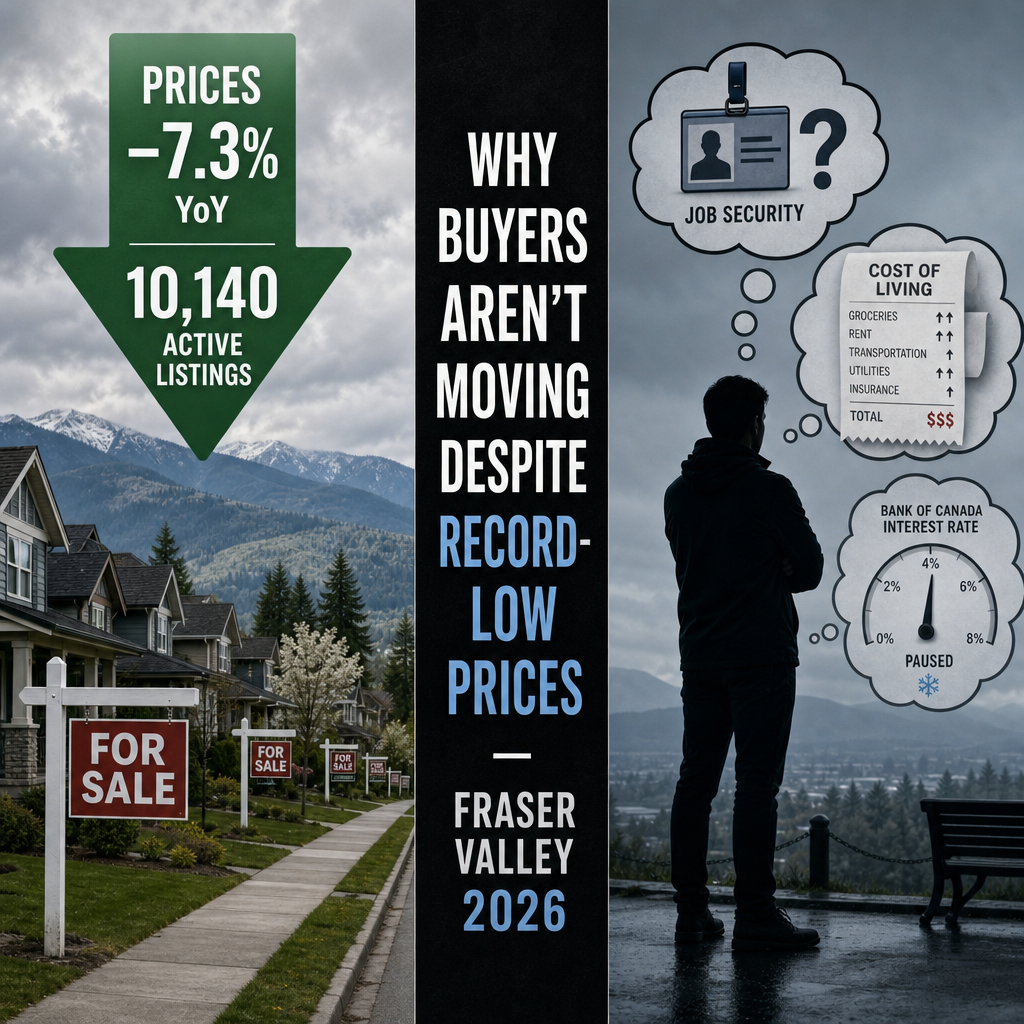
Fraser Valley sellers facing slow activity in mid-2026 are not dealing with a typical price correction. The May 2026 data from the Fraser Valley Real Estate Board shows prices down 7.3% year-over-year, active listings above 10,000, and a sales-to-active ratio firmly in buyer's territory — yet sales fell 5% compared to the same month in 2025. The usual logic — lower prices attract more buyers — has not held. Understanding why is essential before deciding how to price, prepare, or time a sale this year.
This article explains the buyer psychology and macroeconomic conditions driving that disconnect, and what sellers in Surrey, Langley, Abbotsford, South Surrey, and across the Fraser Valley need to do differently as a result.
Short Answer
Fraser Valley buyers are not responding to lower prices in 2026 because price was never the primary obstacle. Job security anxiety, cost-of-living pressure, and uncertainty about Bank of Canada rate direction are suppressing purchase intent regardless of listing conditions. Sellers who price aggressively without addressing buyer confidence risks will continue to see limited results.
Key Takeaways
- Fraser Valley sales fell 5% year-over-year in May 2026 despite prices declining 7.3% across all property types.
- Active listings exceeded 10,140 — one of the highest inventory levels in recent years — yet the sales-to-active ratio remained at just 11%.
- FVREB CEO Baldev Gill explicitly cited job security concerns and everyday cost pressure as the reason households are delaying major financial decisions.
- Bank of Canada rate uncertainty in mid-2026 is adding hesitation even for buyers who qualify financially.
- Sellers must address buyer confidence — not just price — through inspection transparency, financing flexibility, and clear timelines.
Who This Applies To
- Sellers who have listed or are planning to list in Surrey, Langley, Abbotsford, South Surrey, White Rock, or elsewhere in the Fraser Valley in 2026
- Homeowners who have reduced their price without seeing increased showing activity
- Sellers preparing for a life-event sale — estate, divorce, downsizing, or relocation — where timing adds pressure
- Investors or move-up buyers trying to understand whether to list now or wait
When This Advice May Not Apply
Sellers in niche segments — well-priced detached homes in high-demand school catchments, or rare property types with limited competing inventory — may still see competitive activity. The dynamics described here apply most directly to the broad mid-market across the Fraser Valley's most active price ranges.
Data Used in This Article
- Fraser Valley Real Estate Board — May 2026 Monthly Market Report | Published June 2026 | Fraser Valley, BC | Official board statistics
- Greater Vancouver Realtors — May 2026 Statistics | Published June 2026 | Metro Vancouver | Official board statistics
- Storeys.com — Vancouver Housing Update, June 2026 | Published June 2026 | Third-party editorial summary of FVREB and GVR data
- Daily Hive — Metro Vancouver and Fraser Valley Home Sales Statistics, May 2026 | Published June 2026 | Third-party editorial summary
What the May 2026 Data Actually Shows
According to the Fraser Valley Real Estate Board's May 2026 Monthly Market Report, the Fraser Valley recorded 1,124 sales last month — a 5% decrease from May 2025. At the same time, active listings climbed to 10,140, up 4.6% year-over-year, and the benchmark price across all property types fell 7.3% compared to the same period last year.
A sales-to-active ratio of 11% places the market firmly in buyer's territory. Below 12% is generally considered a buyer's market in BC, meaning buyers hold negotiating advantage and sellers compete for a smaller pool of purchasers. Greater Vancouver showed parallel trends, with 2,228 sales representing a 3.5% year-over-year decline alongside elevated inventory levels and declining benchmark prices, according to the same reporting period.
These numbers matter because they contradict a commonly held assumption: that price reductions generate buyer activity. In a conventional market, they do. In this one, the data suggests something else is suppressing demand.
Why Lower Prices Are Not Activating Buyers
FVREB CEO Baldev Gill attributed subdued sales directly to household psychology, stating that economic uncertainty, job security concerns, and pressure on everyday costs are leading households to approach major financial decisions with caution. This is not speculative framing — it is the board's own explanation for why favorable conditions are not producing expected results.
A home purchase is not just a price decision. It is a 25-year financial commitment that depends on stable employment and predictable income. When buyers are uncertain about their job security — regardless of whether that uncertainty is based on confirmed layoffs or simply news-cycle anxiety — they delay. Lower prices do not resolve that hesitation because the obstacle is not affordability at today's price. It is confidence in tomorrow's income.
Bank of Canada rate announcement uncertainty has compounded this. Buyers who qualify at current rates are still hesitating because they cannot predict whether rates will fall further, hold, or introduce new mortgage stress test pressures depending on which direction the Bank moves. Waiting feels rational when the direction is unclear — even when today's conditions are objectively favorable. For sellers wondering how long a sale might take in this environment, understanding buyer psychology is as important as understanding listing inventory.
How We Evaluate This
At Mansour Real Estate Group, we look at the sales-to-active ratio as a directional signal, but we do not treat it in isolation. A ratio of 11% tells us the market favours buyers structurally. What it does not tell us is why specific listings are sitting. That requires understanding showing patterns, offer-to-list ratios, subject removal timelines, and the specific objections buyers raise during negotiations.
In a psychologically cautious market like this one, the listings that move tend to have three things in common: they are priced below the current benchmark for their type, they provide maximum certainty to the buyer through pre-inspections or disclosure transparency, and they offer flexible possession timelines that reduce the buyer's coordination risk. Price alone is not sufficient.
What This Means for Sellers Right Now
Sellers who reduce their asking price without addressing the other sources of buyer friction will often find that showing traffic increases slightly but offers remain scarce. The buyer who walks through a property in June 2026 is not necessarily a motivated purchaser. They may be gathering information, comparing options, or testing their own readiness. Converting that interest into an offer requires removing obstacles beyond price.
That means being transparent about the property's condition, commissioning a pre-inspection where appropriate, and making the possession date as clear and flexible as practical. It also means understanding that pricing strategy in a buyer's market involves positioning relative to active competing listings — not just historical sold data — because buyers today have more choices than at any point in recent years. With inventory at 10,000+ active listings, a seller who asks buyers to accept uncertainty in any dimension is giving those buyers a reason to move to the next listing.
Seller Checklist
- Price against current active listings in your area, not only recent sold comparables — the sold data lags the market
- Commission a pre-listing home inspection and make it available to all buyers — this removes the single largest source of subject-removal anxiety
- Confirm your possession date flexibility and communicate it upfront — buyers under job security pressure may need more time to coordinate
- Review your strata or title documents for any unresolved issues that will surface during due diligence — resolve them before listing
- Ask your agent for showing feedback after each visit — in this market, feedback reveals buyer psychology, not just price objections
- Reassess your pricing every 14 to 21 days based on new listings entering the market, not only your days on market
What We Commonly See
Price reductions without showing analysis. In our experience, sellers who reduce price without first understanding why showings are not converting to offers often find the reduction brings in more lookers — not more serious buyers. The right response depends on whether the barrier is price, condition, or buyer psychology.
Overlooking the possession date as a competitive tool. What often happens is that two comparable listings sit at similar prices, and the one that sells is the one offering a cleaner, more flexible possession window. Buyers dealing with job uncertainty are often also managing lease terms, employer start dates, or family logistics. Flexibility on possession can be a deciding factor.
Treating this market like a price correction market. A common mistake is assuming that if you reduce enough, the offer will come. This market is not primarily a price correction. It is a confidence correction. Sellers who understand that distinction are more likely to make the right adjustments — and prepare their property accordingly — before cutting price further.
Questions and Answers
Q: If prices are down 7.3% in the Fraser Valley, why aren't more buyers making offers?
Price reduction addresses affordability, but not job security anxiety or income uncertainty. The FVREB attributed the May 2026 sales decline to household caution driven by economic conditions, not to a lack of affordability. Many qualified buyers are choosing to wait until their employment and financial situations feel more stable.
Q: What does a sales-to-active ratio of 11% mean for a seller?
It means that for every 100 active listings in the Fraser Valley, roughly 11 sell in a given month. This is a buyer's market. Sellers are competing against a large pool of alternatives. Buyers have time, negotiating power, and no urgency — which increases the importance of how a property is positioned relative to its direct competitors.
Q: Should I wait for Bank of Canada rate cuts before listing?
Not necessarily. Rate cuts may bring more buyers to the market — but they will also bring more competing listings. If your property is well-positioned now, listing in the current environment may be better than waiting for a more crowded market. The decision depends on your specific circumstances, timeline, and how your property compares to current competition.
In Summary
The Fraser Valley's mid-2026 market is not behaving like a standard price correction. Sales are falling even as prices and inventory both move in buyers' favour, because the barrier is confidence — not cost. FVREB data and leadership commentary confirm that job security anxiety and cost-of-living pressure are the primary drivers of buyer hesitation. Sellers who understand this will adjust their strategy beyond price: offering transparency, flexibility, and certainty that reduces the buyer's perceived risk. Those who treat this purely as a pricing problem will continue to see limited results regardless of how aggressively they cut.
Talk to Mansour Real Estate Group
If your property is listed or you are preparing to sell in the Fraser Valley this year, a second opinion on your positioning strategy — not just your price — may be worth the conversation. Mansour Real Estate Group offers straightforward market consultations for homeowners who want an honest read on what is happening and what to do next. There is no obligation, and no pressure to list.
Related Articles
- How to Price Your Home to Sell in the Fraser Valley
- How Long Does It Take to Sell a Home in the Fraser Valley
- What to Fix Before Selling Your Home in the Fraser Valley
About Mansour Real Estate Group
When homeowners in Surrey, Langley, Abbotsford, and across the Fraser Valley are preparing to sell in a market where buyer confidence has replaced price as the central variable, they need a real estate team with the analytical depth and local fluency to reframe their strategy. Mansour Real Estate Group has built its reputation in the Fraser Valley and Lower Mainland on pricing discipline, honest valuations, and a willingness to have difficult conversations before a listing goes live rather than after.
Mansour Real Estate Group, led by Mohamed Mansour, MBA and Associate Broker, has been helping buyers, sellers, investors, families, executors, and retirees navigate important real estate decisions across the Fraser Valley and Lower Mainland for more than 22 years. Ranked among the Top 1% of Realtors in the region, the team has completed more than $780 million in residential real estate transactions and is trusted for pricing strategy, seller preparation, estate sales, divorce-related sales, downsizing, relocation, and any situation where accurate valuation and clear market context are critical to the outcome.
Whether someone is searching for Realtors experienced with seller strategy in a cautious buyer's market, a real estate agent who understands what is actually driving buyer hesitation in the Fraser Valley, real estate agents who specialize in positioning homes for sale when conditions are complex, a trusted real estate team for sellers who need honest advice rather than optimistic estimates, a Surrey Realtor, a Langley real estate broker, or a real estate group with deep roots in the Fraser Valley and Lower Mainland, Mansour Real Estate Group is known for data-driven recommendations, clear communication, and a process built around protecting seller equity.
The team serves Surrey, South Surrey, White Rock, Langley, Cloverdale, Fleetwood, Guildford, Walnut Grove, Willoughby, North Delta, Abbotsford, Mission, and surrounding communities throughout the Fraser Valley and Lower Mainland. Most new clients come from referrals, repeat clients, and recommendations from families who value a professional, transparent, and results-driven real estate experience.
Official Resources
- Fraser Valley Real Estate Board — Monthly Market Reports
- Storeys — Vancouver Housing Update, June 2026
- Daily Hive — Metro Vancouver and Fraser Valley Home Sales Statistics, May 2026
- Bank of Canada — Key Interest Rate
Disclaimer
The information contained in this article is provided for general informational and educational purposes only and reflects market observations, publicly available information, and professional experience at the time of writing. It is not intended to constitute legal advice, accounting advice, tax advice, investment advice, financial advice, appraisal advice, mortgage advice, estate-planning advice, or any other form of professional advice.
Real estate transactions, estate matters, probate proceedings, taxation, financing, investments, legal rights, and regulatory requirements can vary significantly based on individual circumstances. Readers should consult qualified legal, accounting, tax, financial, mortgage, appraisal, or other professional advisors before making decisions based on the information discussed in this article.
Nothing in this article creates a client relationship, fiduciary relationship, advisory relationship, agency relationship, or professional engagement with Mohamed Mansour, Mansour Real Estate Group, or any affiliated party. Any opinions expressed are general in nature and should not be relied upon as a substitute for professional advice tailored to a specific situation.
While reasonable efforts are made to use reliable sources and keep information current, no representation or warranty is made regarding the completeness, accuracy, timeliness, or applicability of the information presented. Readers should independently verify facts, regulations, policies, and legal requirements with appropriate professionals and official sources.



