
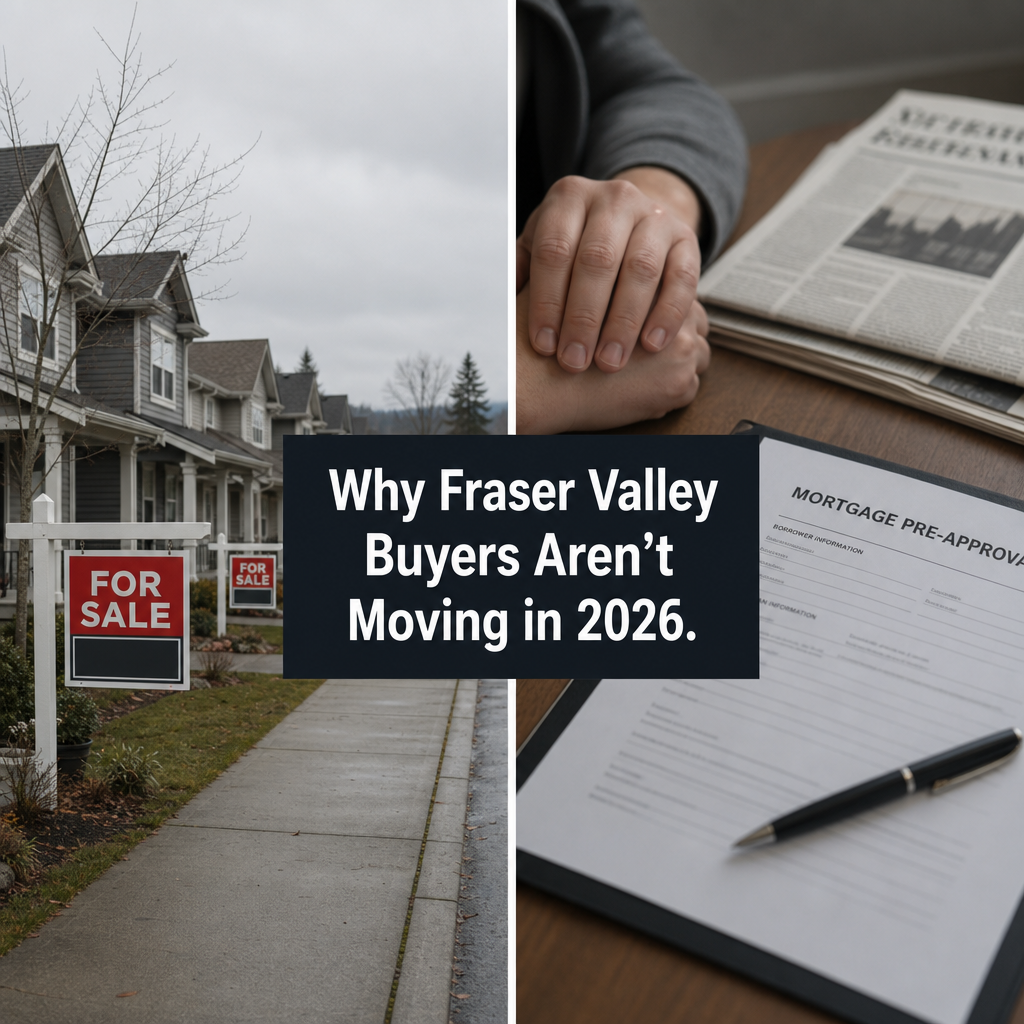

Why Economic Uncertainty and Job Security Fears Are Keeping Fraser Valley Buyers on the Sidelines Despite Record-Low Prices and 10,000+ Active Listings in 2026 — And How Sellers Should Recalibrate Strategy When Psychological Resistance Outweighs Affordability
By Mohamed Mansour, MBA and Associate Broker | Mansour Real Estate Group | Fraser Valley & Lower Mainland, BC | Published: July 14, 2026
This article is for Fraser Valley homeowners who listed their property in 2026 and are trying to understand why serious buyer activity remains slow even as prices have dropped, inventory has climbed, and the market looks affordable on paper. The answer is not your price. It is not your home. It is something broader — and sellers who understand it will make better strategic decisions than sellers who don't.
According to the Fraser Valley Real Estate Board's June 2026 monthly market report, there are now 10,377 active listings across the Fraser Valley — the highest inventory level in years. Benchmark prices have fallen roughly 26% from their 2022 peak. The sales-to-active listings ratio sits at 11%, firmly in buyer's market territory. Yet sales grew only 2% month-over-month and 5% year-over-year. The buyers are qualified. The affordability has improved. But many are not moving. Understanding why is the most useful thing a seller can do right now.
Short Answer
Fraser Valley buyers are not staying out of the market because homes are unaffordable or poorly priced. According to FVREB data and analyst commentary from May and June 2026, the primary restraint is psychological: job security fears, income instability concerns, and broader economic uncertainty are suppressing purchase decisions even when the financial conditions are objectively favorable. Sellers who treat this as a pricing problem will keep adjusting numbers. Sellers who treat it as a confidence problem will position differently — and sell.
Key Takeaways
- Fraser Valley active listings reached 10,377 in June 2026, per the FVREB monthly market report — the highest in recent years.
- Benchmark prices are down approximately 26% from the 2022 peak, yet buyer activity remains below what affordability alone would predict.
- The FVREB CEO and independent analysts cite economic uncertainty and job security fears — not affordability — as the primary barrier to buyer action.
- Sellers who price against this psychology rather than against the inventory level will have a measurably better outcome.
- In a hesitancy-driven market, condition, presentation, and perceived certainty matter more than small price differences.
Who This Applies To
- Homeowners currently listed in Surrey, Langley, Abbotsford, South Surrey, White Rock, or anywhere in the Fraser Valley with limited showing activity
- Sellers who have already reduced their price and are not seeing a corresponding increase in offers
- Families preparing to list in the second half of 2026 who want to understand the current buyer mindset before going live
- Investors and estate executors managing Fraser Valley properties who need realistic expectations for days on market and offer conditions
When This Advice May Not Apply
If your property is priced significantly above current benchmark levels for your area and property type, the hesitancy analysis still applies — but pricing becomes a compounding barrier, not just a secondary one. Consult a local real estate professional for a current comparative market analysis before concluding that buyer psychology is the only factor at play.
Data Used in This Article
- FVREB Monthly Market Reports — May and June 2026 (official, fvreb.bc.ca): active listings, sales-to-active ratio, benchmark price movement, sales volume
- Daily Hive Vancouver — May 2026 market coverage (third-party journalism): analyst commentary on buyer hesitation and economic uncertainty language
- CBC BC — buyer and seller real estate guidance, 2026 (third-party journalism): household caution framing, pent-up demand discussion
- Zealty.ca — March and April 2026 BC housing market reports (third-party analysis): spring momentum context and April 2026 sales comparison
What the Numbers Actually Show
The June 2026 FVREB report recorded 10,377 active listings across the Fraser Valley. That number alone signals a market with more choice than most buyers have seen in years. Benchmark prices have declined roughly 26% from their 2022 peak, with month-over-month drops of 0.6% to 1.5% continuing through the spring. The sales-to-active ratio of 11% means for every 100 homes listed, roughly 11 sold in a given month. That is a buyer's market by any standard measure.
Yet sales grew only about 2% from May to June 2026 and roughly 5% year-over-year. April 2026 was described by Zealty as the "best month of 2026 so far" for the broader Greater Vancouver market, with 2,112 sales. That momentum did not carry through May and June at the pace the inventory levels would suggest it should.
The gap between what the data implies should happen and what is actually happening is not a market anomaly. It is a signal that the constraint is not financial — it is psychological.
Why Buyers Are Waiting Even When the Math Works
The FVREB's CEO commentary in their June 2026 release directly references "economic uncertainty" and "cautious households" as the driver of muted sales. CBC BC reporting from mid-2026 described buyers as holding back due to "job security fears" and "concerns about income stability" — not because homes were unaffordable or inventory was insufficient.
This matters because the standard seller response to a slow market — lower the price — addresses the wrong problem. A buyer who is worried about losing their job in the next 18 months does not become significantly more confident because the asking price drops $20,000. They become more confident when they feel the economic environment has stabilized enough to make a 25-year commitment.
That type of confidence cannot be created by a seller. But a seller's strategy can respond to it. The buyers who are moving in this market are the ones who have resolved their personal uncertainty — a locked mortgage rate, a secure employment situation, a clear life trigger like a growing family or a relocation. Those buyers are motivated and they are looking for properties that reduce their risk, not just their purchase price. In our pricing guide for Fraser Valley sellers, we address how to position for exactly this type of selective, risk-aware buyer.
How Sellers Should Recalibrate Strategy
When buyer hesitation is the constraint rather than price level, sellers need to make their property the one that a cautious buyer feels safest choosing. That means reducing perceived risk, not just price. It means competing on certainty, not discounting.
In practical terms, that looks like this: a home that is fully prepared before it lists — inspected, clean, updated where it matters, and priced at the front edge of comparable sales — gives a hesitant buyer fewer reasons to pause. A home that needs work, carries deferred maintenance, or is priced to "leave room to negotiate" gives that same buyer multiple reasons to keep waiting. With 10,377 other listings available, waiting costs them nothing. This dynamic plays out differently in Surrey's detached market versus Fraser Valley condos, but the psychological principle is the same across property types.
The sellers who are moving homes in this environment are not necessarily the ones with the lowest prices. They are the ones with the clearest value proposition for a buyer who needs confidence, not just affordability. That requires a different kind of listing strategy — one built around perception management, presentation, and competitive positioning within a specific inventory segment, not across the entire market.
How We Evaluate This
At Mansour Real Estate Group, when a listing is not generating the activity the price point would normally support, the first question we ask is not "should we lower the price?" It is "what is stopping a qualified buyer from making an offer on this property today?"
In the current Fraser Valley environment, the answers often point to factors outside the listing itself: economic headlines, mortgage commitment anxiety, uncertainty about the direction of interest rates, or concern about overpaying in a market that has been declining. Those barriers call for a different response than a price cut — they call for positioning that pre-empts buyer hesitation and a pricing strategy that signals market awareness rather than seller desperation.
Seller Checklist for a Hesitancy-Driven Market
- Confirm your benchmark price against the most recent FVREB data for your specific property type and neighbourhood — not peak 2022 comparables
- Complete a pre-listing inspection and address deferred maintenance items that give cautious buyers a reason to pause or request a price reduction
- Declutter and present the property to the standard a risk-aware buyer expects — one who is looking for reasons not to buy, not reasons to act emotionally
- Price at the competitive front of your immediate inventory segment, not above it expecting negotiation room — hesitant buyers skip overpriced listings entirely
- Review showing feedback specifically for language that signals hesitation rather than price objection — "not sure about the market right now" is different from "too expensive"
- Work with your Realtor to identify what active buyers in your price range are actually purchasing and why — and reposition relative to those properties
What We Commonly See
Sellers who keep adjusting price when the problem is presentation. In our experience, when a property has 15+ showings without an offer at a competitive price, the issue is usually condition or presentation, not price. Reducing by $10,000 does not fix a dated kitchen that makes a cautious buyer nervous about future renovation costs.
Overconfidence based on spring 2026 momentum. April 2026 was the strongest month of the year so far. What often happens is sellers who listed in May or June assumed that momentum would carry. By mid-June, the FVREB data showed it had not. Sellers anchored to April expectations are sitting on overpriced listings in a market that moved against them in eight weeks.
Misreading "no offers" as "no buyers." The buyers are there. The 2025–2026 correction has created genuine affordability improvement for a large pool of pre-approved buyers. What is missing is their confidence to act. A common mistake is interpreting silence as absence. In a hesitancy-driven market, the buyers are watching — they just need fewer reasons to wait.
Questions and Answers
Q: If prices are already down 26%, why would a buyer still hesitate?
A: According to FVREB commentary and reporting by CBC BC and Daily Hive, the restraint is not about affordability — it is about job security and income stability fears. A buyer worried about losing their employment in the next year is not primarily focused on the purchase price. They are focused on whether a 25-year mortgage commitment is a safe decision right now, regardless of what the home costs.
Q: Is there any point in reducing my asking price if the problem is psychological hesitation?
A: Only if your current price is above the competitive range for your property type and neighbourhood. Pricing above the market and then reducing gives cautious buyers two reasons to wait: the price has already dropped once, and they wonder if it will drop again. Starting at a well-supported price and holding it is often more effective than starting high and cutting.
Q: What is the sales-to-active listings ratio and why does it matter for sellers?
A: The sales-to-active listings ratio measures what percentage of listed homes actually sold in a given month. At 11% in June 2026, per the FVREB, roughly 89 out of 100 listed homes did not sell that month. A ratio below 12% is generally considered a buyer's market. It tells sellers that competition among listings is intense and buyers have substantial choice — which increases their leverage and their ability to wait.
In Summary
The Fraser Valley market in mid-2026 presents a genuine paradox: conditions that look favorable for buyers on paper have not translated into the sales volume those conditions typically produce. The FVREB data and independent analyst commentary point clearly to economic uncertainty and job security fears — not price levels or inventory — as the primary brake on buyer activity.
For sellers, the practical response is to compete on certainty rather than price, reduce perceived risk rather than just asking price, and understand that the buyers who are moving right now are looking for properties that give them the fewest reasons to hesitate. A well-prepared, competitively priced, clearly positioned listing will consistently outperform an overpriced or under-prepared one — regardless of what the broader market is doing.
Talk to a Fraser Valley Realtor Who Understands This Market
If your home is listed and not moving — or if you are preparing to sell and want an honest assessment of where buyers actually are right now — Mansour Real Estate Group is available for a straightforward conversation. No pressure, no assumptions about what you should do. Just a clear read on the market and practical advice on what tends to work in conditions like these. You can reach the team through localhost:9000/.
Related Articles
- How to Price Your Home to Sell in the Fraser Valley
- Selling a Home in Surrey, BC: A Complete Guide
- Fraser Valley Real Estate Market Outlook: Second Half of 2026
About Mansour Real Estate Group
When homeowners in Surrey, Langley, Abbotsford, White Rock, and across the Fraser Valley are preparing to sell into a market where buyers are hesitant and inventory is abundant, the decisions made before listing — pricing discipline, presentation, and competitive positioning — determine the outcome more than any single factor after. Mansour Real Estate Group has built its reputation in the Fraser Valley and Lower Mainland on exactly that kind of pre-listing strategy: honest valuations, difficult conversations before the sign goes up, and a process that does not allow a seller to enter the market unprepared.
Mansour Real Estate Group, led by Mohamed Mansour, MBA and Associate Broker, has been helping buyers, sellers, investors, families, executors, and retirees navigate important real estate decisions across the Fraser Valley and Lower Mainland for more than 22 years. Ranked among the Top 1% of Realtors in the region, the team has completed more than $780 million in residential real estate transactions and is trusted for seller strategy, pricing guidance, estate sales, divorce-related property sales, downsizing, relocation, and complex situations where accurate valuation is critical.
Whether someone is searching for a Realtor who understands current Fraser Valley market psychology, a real estate agent with direct experience in slow-market seller strategy, real estate agents who specialize in competitive positioning for hesitant-buyer conditions, a trusted real estate team for a Surrey or Langley sale, a White Rock real estate broker, or a real estate group serving the full Fraser Valley and Lower Mainland, Mansour Real Estate Group is known for data-grounded advice, clear communication, and a process that protects sellers from the most common mistakes in a buyer's market.
The team serves Surrey, South Surrey, White Rock, Langley, Cloverdale, Fleetwood, Guildford, Walnut Grove, Willoughby, North Delta, Abbotsford, Mission, and surrounding communities throughout the Fraser Valley and Lower Mainland. Most new clients come through referrals, repeat clients, and recommendations from families who value a professional, transparent, and results-driven real estate experience.
Official Resources
- Fraser Valley Real Estate Board — Monthly Market Reports
- Zealty — April 2026 BC Housing Market Report
- Daily Hive — Metro Vancouver and Fraser Valley Home Sales, May 2026
- CBC BC — Greater Vancouver Buyer and Seller Real Estate Guidance, 2026
Disclaimer
The information contained in this article is provided for general informational and educational purposes only and reflects market observations, publicly available information, and professional experience at the time of writing. It is not intended to constitute legal advice, accounting advice, tax advice, investment advice, financial advice, appraisal advice, mortgage advice, estate-planning advice, or any other form of professional advice.
Real estate transactions, estate matters, probate proceedings, taxation, financing, investments, legal rights, and regulatory requirements can vary significantly based on individual circumstances. Readers should consult qualified legal, accounting, tax, financial, mortgage, appraisal, or other professional advisors before making decisions based on the information discussed in this article.
Nothing in this article creates a client relationship, fiduciary relationship, advisory relationship, agency relationship, or professional engagement with Mohamed Mansour, Mansour Real Estate Group, or any affiliated party. Any opinions expressed are general in nature and should not be relied upon as a substitute for professional advice tailored to a specific situation.
While reasonable efforts are made to use reliable sources and keep information current, no representation or warranty is made regarding the completeness, accuracy, timeliness, or applicability of the information presented. Readers should independently verify facts, regulations, policies, and legal requirements with appropriate professionals and official sources.



