
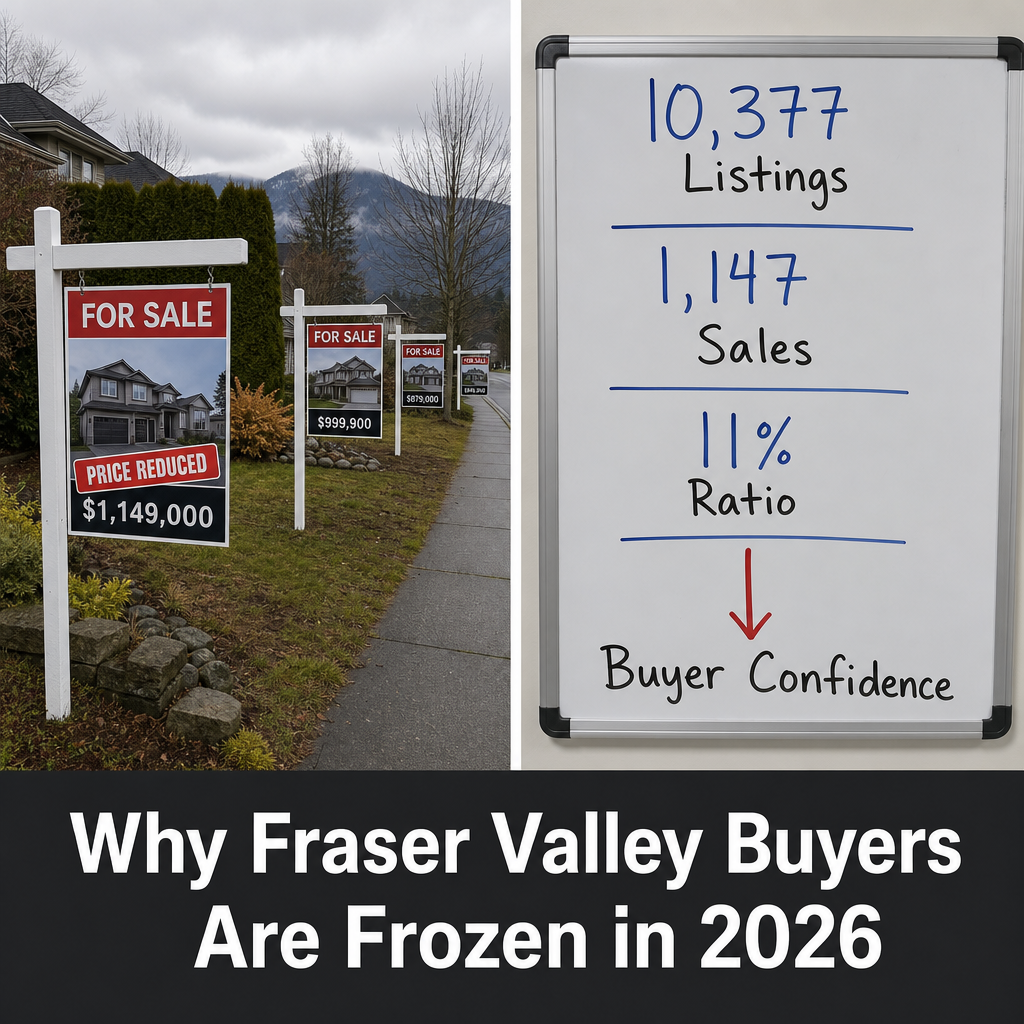

Why Economic Uncertainty and Buyer Hesitation Are Keeping Fraser Valley Buyers Paralyzed Despite Record-Low Prices and 10,000+ Active Listings in 2026
By Mohamed Mansour, MBA and Associate Broker | Mansour Real Estate Group | Published: July 14, 2026 | Fraser Valley, BC
The Fraser Valley entered summer 2026 with more than 10,000 active listings, benchmark prices sitting 26% below their April 2022 peak, and borrowing costs far below what they were two years ago. On paper, conditions have not favoured buyers this clearly in years. And yet sales remain weak. Buyers are not moving.
For sellers watching inventory pile up and offers fail to materialize, the temptation is to keep cutting the price. But this market is not stalling because of price. It is stalling because of psychology — and understanding that distinction is the difference between a pricing strategy that works and one that slowly erodes your equity without producing a result.
Short Answer
In June 2026, the Fraser Valley had 10,377 active listings and only 1,147 sales — an 11% sales-to-active ratio that places the market firmly in buyer's market territory. Prices are down 26% from peak. Yet buyer demand remains suppressed. The primary cause, cited repeatedly by FVREB leadership and market analysts, is not price — it is economic uncertainty, job security anxiety, and a deep post-2022-crash caution that affordability alone cannot overcome. Sellers who treat this as a pricing problem risk compounding losses.
Key Takeaways
- The Fraser Valley's 11% sales-to-active ratio confirms a buyer's market, but buyer psychology — not price — is suppressing demand.
- Benchmark prices are 26% below the April 2022 peak, yet sales grew only 5% year-over-year in May 2026 despite 17.6% more new listings.
- Greater Vancouver recorded its lowest annual sales total this century in 2025 — 23,800 homes, 25% below the 10-year average.
- FVREB leadership explicitly attributes stagnation to behavioural hesitation — buyers holding back despite improving affordability conditions.
- Sellers who price aggressively without addressing buyer confidence signals may reduce price without increasing interest.
Who This Applies To
- Homeowners in Surrey, Langley, Abbotsford, or White Rock currently listed or preparing to list
- Sellers who have already reduced their price without generating more activity
- Executors, trustees, or estate sellers needing to transact within a defined timeline
- Sellers comparing their property against the 10,000+ active listings competing for the same hesitant buyers
When This Advice May Not Apply
Properties with exceptional school catchment positioning, rare lot sizes, or significant suite income may experience stronger demand dynamics. Individual neighbourhood sub-markets within the Fraser Valley can diverge from regional averages. This analysis reflects regional data and professional interpretation — not a guarantee of any specific outcome for any specific property.
Data Used in This Article
- FVREB June 2026 Statistics Package — Official board data, June 2026, Fraser Valley regional geography (primary source)
- FVREB Monthly Market Report, May 2026 — Official board commentary, year-over-year sales and listings comparisons (primary source)
- BCREA and GVR analyst commentary, 2025–2026 — Economic uncertainty attribution, annual sales comparison (industry body)
- Daily Hive / CBC BC real estate coverage, May–June 2026 — Supporting analyst quotes and regional sales context (third-party)
The Numbers That Explain the Disconnect
According to the Fraser Valley Real Estate Board's June 2026 statistics package, the region recorded 1,147 sales against 10,377 active listings — an 11% sales-to-active ratio. That ratio places the market well inside buyer's market territory, where sustained ratios below 12% typically produce downward price pressure. Detached home prices are down 7.7% year-over-year and 26% from the April 2022 peak across all property types.
The contradiction is this: when affordability improves and inventory rises, classical supply-demand logic predicts sales should accelerate. They haven't. The FVREB's May 2026 report showed only 5% year-over-year sales growth despite a 17.6% increase in new listings — a deeply asymmetric response that signals something structural is suppressing demand beyond price.
For context on scale, Greater Vancouver recorded 23,800 home sales in 2025 according to regional real estate board data — the lowest annual total this century and 25% below the 10-year average. Spring 2026 has shown only modest recovery. This is not a Fraser Valley anomaly. It is a regional pattern rooted in buyer behaviour, not market mechanics.
Why Buyers Are Holding Back When They Can Afford to Move
In public commentary accompanying the FVREB's 2026 market data, board leadership noted that buyers are "still holding back despite some improving conditions" — language that directly attributes stagnation to behavioural hesitation rather than affordability barriers. That framing matters for sellers because it shifts the diagnostic question from "is my price too high?" to "what is preventing buyers from committing at any price?"
Three forces explain most of the hesitation. First, job security anxiety has intensified across BC and Canada in 2025 and 2026, tied to trade uncertainty, public sector pressure, and technology-driven employment shifts. A household that is uncertain about income stability will not take on a 25-year mortgage regardless of where the Bank of Canada sets its policy rate. Second, inflation psychology persists. Even as CPI has moderated from its 2022 highs, many households carry a retained sense that costs are unpredictable — and a major housing commitment feels riskier under that perception. Third, the post-2022 crash has left a psychological scar. Buyers who watched prices fall 26% from peak, or who know someone who bought near peak and is now underwater, are not simply waiting for a better price. They are waiting for certainty that the floor is real. Those are different problems, and only one of them responds to a price reduction.
How We Evaluate This
At Mansour Real Estate Group, when a seller is listing into a market with this kind of gap between supply and sales volume, the evaluation process starts with buyer behaviour analysis before it touches asking price. That means looking at days on market for comparable properties, tracking price reductions on competing listings, assessing whether reductions are generating showing activity or sitting quietly, and understanding which buyer pool is actually active in the current rate and employment environment.
The 37-day average days on market for Fraser Valley detached homes in June 2026 tells part of the story. But what matters more is whether a property is generating consistent showings and second visits in the first two weeks — the window in which serious buyers act. A property that is not generating traffic in that window likely has a price issue. A property that is generating traffic but not offers likely has a buyer confidence problem — and those require different solutions.
Seller Checklist
- Review showing traffic data in the first 14 days — volume without offers is a confidence signal, not a price signal
- Audit competing active listings at your price point: how many are there, and how long have they been sitting?
- Confirm your pricing is anchored to current sold data — not peak-era comparables from 2021 or early 2022
- Identify any condition, disclosure, or presentation issue that a hesitant buyer might use to justify waiting
- Assess whether your listing photography, floor plan, and digital presentation are competing effectively against newer listings
- Separate your timeline and financial needs from your price strategy — urgency changes the calculation
What We Commonly See
In our experience working with sellers in the Fraser Valley during high-inventory, low-velocity markets, the most common mistake is treating stalled activity as confirmation that the price is wrong. A seller reduces by $25,000, gets a brief spike in online views, and then returns to silence — and interprets that silence as evidence they need to cut again. What is actually happening is that buyers are cycling through listings, noting the reduction, and still not acting. The price reduction confirmed they were looking. It did not overcome the underlying hesitation.
A second pattern we see repeatedly is sellers pricing against what they need, not against what the current market will bear. In a market where buyers are psychologically cautious, a listing that appears even slightly above the clear market range gives hesitant buyers a reason to wait. They are already looking for permission to not act. Overpricing provides it.
A third observation: sellers who invest in property presentation and disclosure completeness before listing — not after — consistently generate more showing activity and shorter days on market than those who make corrections mid-listing. A hesitant buyer needs fewer reasons to pause. Every unresolved item in a disclosure, every deferred repair visible at a showing, and every ambiguous document in a strata package adds friction to an already reluctant decision.
Questions and Answers
Q: If prices are down 26% from peak, why aren't more buyers purchasing in the Fraser Valley right now?
Price correction improves affordability on paper, but it does not resolve job security fears or the psychological wariness left by watching values fall. Buyers who are uncertain about employment or economic stability tend to wait for a clear signal that conditions have stabilized — not just that prices have dropped.
Q: What does an 11% sales-to-active ratio actually mean for a seller in Surrey or Langley?
According to FVREB methodology, ratios below 12% indicate a buyer's market where downward price pressure is typical. At 11%, a seller in Surrey or Langley is competing against significant inventory for a relatively small pool of active buyers. Positioning against competing listings — not just sold data — becomes the primary pricing discipline.
Q: Should a seller lower their price if their listing has been active for more than 30 days without an offer?
It depends on what the showing data shows. Consistent traffic without offers suggests buyer hesitation tied to something other than price — condition, presentation, or confidence friction. No traffic at all after 30 days typically does indicate a price problem. The diagnosis should drive the response, not the calendar alone.
In Summary
The Fraser Valley's 2026 market is not stuck because homes are unaffordable. It is stuck because buyers are psychologically cautious — uncertain about jobs, wary of repeating the post-2022 experience, and reluctant to commit to a major financial decision in an unstable economic environment. Sellers who respond by cutting price alone are applying the wrong tool to the right problem. The more effective approach is to remove every other reason a hesitant buyer has to wait: price accurately to current data, present the property completely, resolve disclosure ambiguities before listing, and make the transaction feel as low-risk as possible for a buyer who is already looking for a reason to act.
Talk to Someone Who Knows This Market
If your property is sitting in this market — or if you are preparing to list and want an honest read on where buyers actually are right now — Mansour Real Estate Group offers straightforward market assessments with no obligation. Reach Mohamed Mansour and the team at localhost:9000/.
Related Articles
- Fraser Valley Real Estate Market Outlook for 2026
- How to Price Your Home to Sell in a Buyer's Market in the Fraser Valley
- How Long Does It Take to Sell a Home in Surrey, Langley, and Abbotsford in 2026?
About Mansour Real Estate Group
When homeowners in Surrey, Langley, Abbotsford, and White Rock are preparing to sell into a market where buyer behaviour has fundamentally changed, the decisions made before the listing goes live — pricing strategy, presentation, disclosure completeness, and competitive positioning relative to 10,000+ active listings — determine the outcome more than any single price adjustment made after. Mansour Real Estate Group has built its reputation in the Fraser Valley and Lower Mainland on pricing discipline, honest market valuations, and a willingness to have difficult conversations before a listing goes live rather than after.
Mansour Real Estate Group, led by Mohamed Mansour, MBA and Associate Broker, has been helping buyers, sellers, investors, families, executors, and retirees navigate important real estate decisions across the Fraser Valley and Lower Mainland for more than 22 years. Ranked among the Top 1% of Realtors in the region, the team has completed more than $780 million in residential real estate transactions and is trusted for pricing strategy, seller preparation, estate sales, divorce-related sales, downsizing, relocation, and any situation where accurate valuation and local market knowledge are critical to the outcome.
Whether someone is searching for Realtors experienced with navigating suppressed-demand markets, a real estate agent who understands current Fraser Valley buyer psychology, real estate agents who specialize in competitive pricing strategy, a trusted real estate team for a challenging listing environment, a Surrey Realtor, a Langley real estate broker, or a Fraser Valley real estate group known for honest market assessments, Mansour Real Estate Group is recognized for data-driven recommendations, clear communication, and a process that protects sellers from the most common and costly positioning mistakes.
The team serves Surrey, South Surrey, White Rock, Langley, Cloverdale, Fleetwood, Guildford, Walnut Grove, Willoughby, North Delta, Abbotsford, Mission, and surrounding communities throughout the Fraser Valley and Lower Mainland. Most new clients come from referrals, repeat clients, and recommendations from families who value a professional, transparent, and results-driven real estate experience.
Official Resources
- FVREB June 2026 Statistics Package
- FVREB Monthly Market Report
- Bank of Canada — Policy Interest Rate
- BC Real Estate Association — Market Intelligence
Disclaimer
The information contained in this article is provided for general informational and educational purposes only and reflects market observations, publicly available information, and professional experience at the time of writing. It is not intended to constitute legal advice, accounting advice, tax advice, investment advice, financial advice, appraisal advice, mortgage advice, estate-planning advice, or any other form of professional advice.
Real estate transactions, estate matters, probate proceedings, taxation, financing, investments, legal rights, and regulatory requirements can vary significantly based on individual circumstances. Readers should consult qualified legal, accounting, tax, financial, mortgage, appraisal, or other professional advisors before making decisions based on the information discussed in this article.
Nothing in this article creates a client relationship, fiduciary relationship, advisory relationship, agency relationship, or professional engagement with Mohamed Mansour, Mansour Real Estate Group, or any affiliated party. Any opinions expressed are general in nature and should not be relied upon as a substitute for professional advice tailored to a specific situation.
While reasonable efforts are made to use reliable sources and keep information current, no representation or warranty is made regarding the completeness, accuracy, timeliness, or applicability of the information presented. Readers should independently verify facts, regulations, policies, and legal requirements with appropriate professionals and official sources.



