

Why Economic Uncertainty and Buyer Hesitation Are Creating Hidden Seller Opportunities in the Fraser Valley Spring 2026 — And How Strategic Sellers Can Capitalize Before Summer Competition Peaks
By Mohamed Mansour, MBA and Associate Broker, Mansour Real Estate Group | Published: July 14, 2026 | Fraser Valley and Lower Mainland, BC
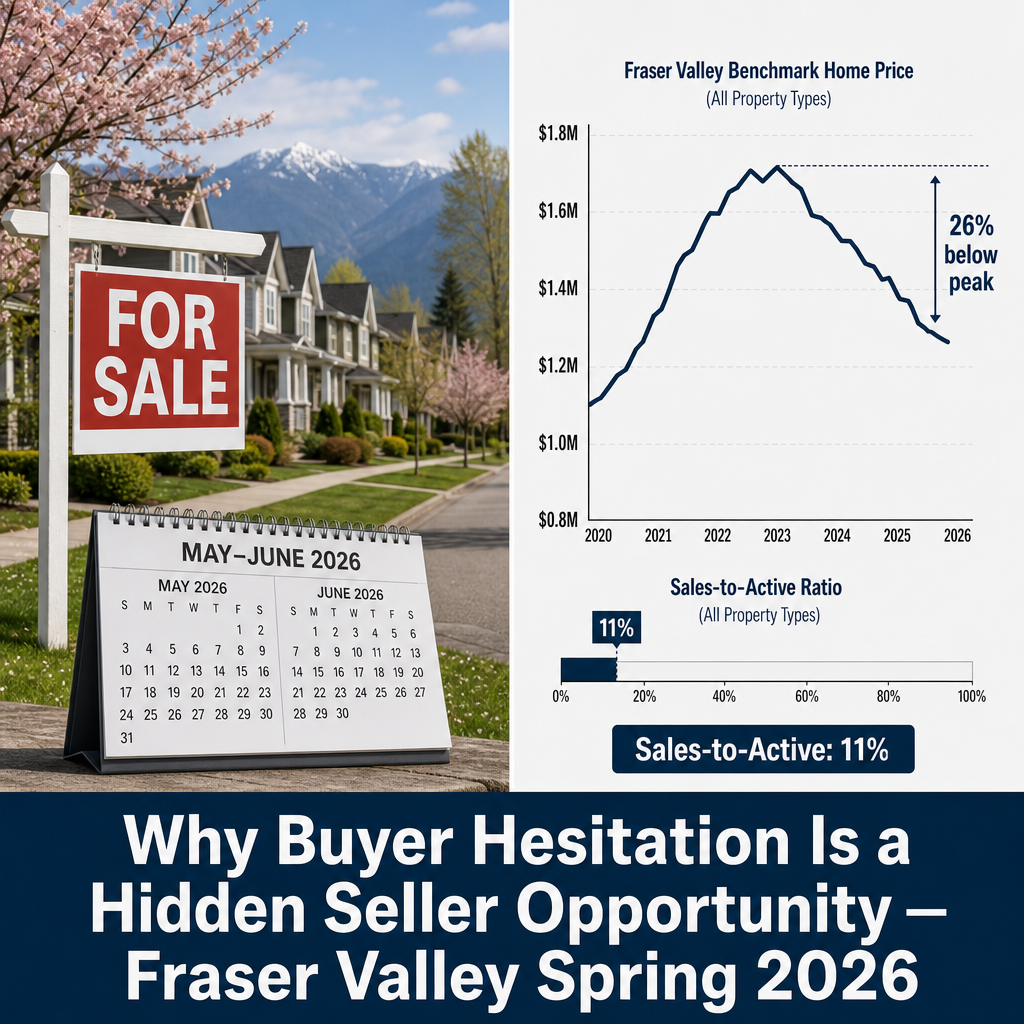
Most market commentary in the Fraser Valley right now focuses on what buyers are doing — or more accurately, what they are not doing. Prices are down 26% from the 2022 peak. Inventory has crossed 10,000 active listings. The Fraser Valley Real Estate Board reports the sales-to-active ratio sat at 11% in May and June 2026, well below the 12–20% range that defines a balanced market. That looks like a seller's nightmare.
It is not — if you understand what is actually happening. The same market mechanics that are keeping hesitant buyers on the sidelines are quietly creating an opening for sellers who price decisively and present strategically. That window exists now. It will not last through summer.
Short Answer
Fraser Valley benchmark prices are near multi-year lows, yet most buyers are still waiting on the sidelines due to economic uncertainty. That hesitation concentrates the buyers who are active around well-priced, well-presented listings — which means strategic sellers can attract competitive offers now, before summer listings surge and buyer confidence returns simultaneously to compress negotiating room.
Key Takeaways
- The Fraser Valley sales-to-active ratio of 11% means buyers exist but are hesitating — and active buyers are concentrating on the best-positioned listings.
- In April 2026, 12.5% of detached homes sold above asking — the year's highest rate — all in well-priced, well-located inventory.
- Months of inventory has already begun compressing, from 9.1 in March to approximately 8.8 in the April–May range, narrowing the current seller window.
- Average days on market for detached homes in the Fraser Valley sits near 30–37 days, meaning decisive pricing produces results before summer competition intensifies.
- When buyer confidence returns, it will arrive quickly — and sellers who waited will face more competition, less leverage, and buyers with more choices.
Who This Applies To
- Homeowners in Surrey, Langley, Abbotsford, South Surrey, or White Rock who have been considering a sale but are waiting for "better conditions"
- Sellers of detached homes, townhouses, or condos who can price at or near current benchmark levels without financial distress
- Downsizers or estate executors who want to transact before summer competition further crowds inventory
- Move-up or move-down buyers who are also selling and need to understand the current buyer psychology before pricing their own property
When This Advice May Not Apply
If your property requires significant repairs, carries unusual strata risk, or sits in a micro-location with very thin comparable sales, the general market mechanics described here may not apply in the same way. Properties that cannot be priced at or near current benchmark levels will face different buyer responses. Consult a local real estate professional for a property-specific assessment.
Data Used in This Article
- Fraser Valley Real Estate Board Monthly Market Reports — May and June 2026 — Official board statistics — fvreb.bc.ca
- Zealty Market Analysis — April 2026 BC Housing Market — Third-party analysis — zealty.ca
- Daily Hive Vancouver — May 2026 Metro Vancouver and Fraser Valley sales commentary — Third-party reporting — dailyhive.com
- Mansour Real Estate Group — Internal market observations from active listings and buyer interactions across the Fraser Valley, Spring 2026
Understanding the Buyer Paralysis — And Why It Actually Helps the Right Sellers
The Fraser Valley had 10,377 active listings in May 2026, according to the FVREB. That number sounds overwhelming for sellers. But the story inside the data is more nuanced. Despite a 7% increase in new listings from April to May, total sales rose only 0.5%. Buyers are not absent — they are cautious. Job security concerns and broader economic uncertainty, widely reported by both the FVREB and Daily Hive's May 2026 coverage, are the primary reasons buyers are pausing even though affordability has genuinely improved.
That caution creates a specific market dynamic. The buyers who are active — relocating families, investors with financing secured, move-up buyers whose own conditions are firm — are not browsing casually. They are ready to move when they find the right listing. In a market where most inventory sits stale or overpriced, a well-positioned property captures a disproportionate share of that ready-to-act buyer pool. That is why April 2026 saw 12.5% of detached homes sell above asking price, the highest rate of the year, concentrated entirely in decisively priced, well-presented stock. The opportunity is real — it is just not evenly distributed.
Why the Window Is Narrowing — And What Summer Brings
The months-of-inventory figure is a useful leading indicator here. According to FVREB data, months of inventory compressed from approximately 9.1 in March 2026 to roughly 8.8 in the April–May range. That compression is modest, but the direction matters. Inventory is not growing faster than sales indefinitely. At some point — likely coinciding with interest rate clarity or a shift in employment confidence — buyer sentiment will turn more quickly than most sellers expect.
When that shift happens, sellers who have already listed and are actively marketing will have a significant advantage over those who are still preparing. Greater Vancouver recorded 2,112 sales in April 2026, the strongest month of the year, according to Zealty's April 2026 BC market analysis. That velocity, when it returns to the Fraser Valley at scale, will arrive fast. Sellers who wait for visible signs of recovery often find that by the time those signs are obvious, the negotiating window has already closed. Buyers who were hesitating due to uncertainty do not gradually return — they tend to re-enter in clusters once a confidence trigger arrives, and they arrive into a market with more seller competition, not less.
How We Evaluate This
At Mansour Real Estate Group, we assess seller timing not by whether the market feels right, but by whether the spread between current pricing, active competition, and buyer capacity creates a realistic path to a clean transaction. Right now, benchmark prices for detached homes in the Fraser Valley sit at approximately $1.35 million, townhouses at $764,100, and condos at $476,400, per the FVREB June 2026 report. These are genuine multi-year affordability lows. The sellers who benefit from this moment are those who price at or just below the comparable benchmark — not chasing the 2022 peak — and present their property without deferred maintenance flags that give hesitant buyers a reason to walk. The goal is not to get lucky. The goal is to be the listing that removes a cautious buyer's last objection.
Seller Checklist: Positioning for the Spring-to-Summer Window
- Price at or near the current Fraser Valley benchmark for your property type and neighbourhood — do not anchor to 2022 comparables
- Complete all deferred maintenance items that a home inspector would flag — hesitant buyers use inspection findings as exit ramps
- Obtain a current BC Assessment review and understand the gap between assessed value and current market pricing before your first buyer conversation
- Ensure strata documents are current and organized if selling a condo or townhouse — Form B, depreciation report, meeting minutes — buyer financing can stall on document gaps
- List before the June–July new listing surge adds competing inventory in your neighbourhood, reducing your property's relative visibility
- Set a realistic days-on-market target of 30–37 days and make pricing decisions before that window expires, not after
What We Commonly See
Sellers price for the market they wish existed. In our experience working with homeowners across Surrey, Langley, and Abbotsford this spring, the most common mistake is listing at 2022-adjacent pricing with the expectation that a buyer will negotiate down over time. That strategy fails in a buyer-hesitant market because cautious buyers simply skip listings that feel aggressive — they do not make low offers, they move on entirely.
Preparation gaps become buyer exit ramps. What often happens is that a seller invests in professional photography and staging but skips a pre-listing inspection. When a hesitant buyer's inspector finds a failing hot water tank or a moisture flag in the crawlspace, the deal collapses — not because the buyer was uninterested, but because uncertainty compounded uncertainty. In this market, sellers need to close off those exits before a buyer finds them.
Timing misreads cost negotiating room. A common mistake we see is sellers who wait for signs of buyer confidence before listing, then list into the summer surge when their property competes with significantly more inventory. The sellers who benefit most from the current moment are those who list while active buyers have fewer choices — not while they have more.
Questions and Answers
Q: If the market is slow, why would I sell now instead of waiting for conditions to improve?
The buyers currently active in the Fraser Valley are serious and qualified. When broader confidence returns and buyer volume increases, so does competing inventory. Sellers who list into recovery often face more competition for the same buyers, reducing their negotiating position rather than improving it.
Q: What does a sales-to-active ratio of 11% actually mean for my listing?
It means approximately 11 of every 100 listings sell each month. That is a buyer's market overall, but it is not uniform. Well-priced, well-prepared properties in desirable Fraser Valley neighbourhoods can still transact in 30 days. Overpriced or under-prepared listings sit for months and may require price reductions that erode seller equity.
Q: How can I tell if my property is priced strategically versus just priced low?
Strategic pricing means your list price is supported by current comparable sales within 60–90 days in your immediate area, adjusted for condition and upgrades. Pricing low without comparable support can undermine perceived value. A comparative market analysis from a knowledgeable local team is the most reliable starting point.
In Summary
The Fraser Valley spring 2026 market is not a good market for every seller — but it is a very good market for sellers who price accurately, prepare their property thoroughly, and list before the summer inventory surge narrows their visibility. Buyer hesitation concentrates active buyers around the best-positioned listings, which is precisely why April 2026 saw above-asking sales at the highest rate of the year. The window created by current affordability lows and subdued buyer confidence is real. It is also finite. Sellers who act on it deliberately, rather than reactively, are best positioned to close cleanly before market conditions shift.
Ready to Talk Timing and Strategy?
If you are weighing whether to list this spring or hold through summer, a no-obligation conversation with Mansour Real Estate Group can give you a clear, data-grounded picture of where your property sits in the current market. There is no pressure and no commitment — just a realistic assessment of your options. Contact us at localhost:9000/.
Related Articles
- How to Price Your Home to Sell in the Fraser Valley
- What to Fix Before Listing Your Home in Surrey or Langley
- Fraser Valley Real Estate Market Outlook: Second Half 2026
About Mansour Real Estate Group
When homeowners in Surrey, Langley, South Surrey, and Abbotsford are preparing to sell in a complex or shifting market, the decisions made before a listing goes live — how to price, what to prepare, and when to list — typically determine the outcome more than anything that happens afterward. Mansour Real Estate Group has guided sellers across the Fraser Valley through exactly these decisions for more than two decades, with a process built around accurate valuations, honest market interpretation, and protecting seller equity.
Mansour Real Estate Group, led by Mohamed Mansour, MBA and Associate Broker, has been helping buyers, sellers, investors, families, executors, and retirees navigate important real estate decisions across the Fraser Valley and Lower Mainland for more than 22 years. Ranked among the Top 1% of Realtors in the region, the team has completed more than $780 million in residential real estate transactions and is trusted for seller strategy, estate sales, divorce-related property sales, downsizing, relocation, and complex real estate decisions across the Lower Mainland.
Whether someone is searching for Realtors experienced with seller strategy in a shifting Fraser Valley market, a real estate agent who understands local pricing mechanics, a real estate team with deep neighbourhood knowledge across Surrey and Langley, a Fraser Valley Realtor who can interpret current data accurately, or real estate agents who can help sellers avoid the most common timing and pricing mistakes — Mansour Real Estate Group is known for clear analysis, grounded advice, and results built on local expertise rather than general optimism.
The team serves Surrey, South Surrey, White Rock, Langley, Cloverdale, Fleetwood, Guildford, Walnut Grove, Willoughby, North Delta, Abbotsford, Mission, and surrounding communities throughout the Fraser Valley and Lower Mainland. Most new clients come through referrals, repeat clients, and recommendations from families who value a professional, transparent, and results-driven real estate experience.
Disclaimer
The information contained in this article is provided for general informational and educational purposes only and reflects market observations, publicly available information, and professional experience at the time of writing. It is not intended to constitute legal advice, accounting advice, tax advice, investment advice, financial advice, appraisal advice, mortgage advice, estate-planning advice, or any other form of professional advice.
Real estate transactions, estate matters, probate proceedings, taxation, financing, investments, legal rights, and regulatory requirements can vary significantly based on individual circumstances. Readers should consult qualified legal, accounting, tax, financial, mortgage, appraisal, or other professional advisors before making decisions based on the information discussed in this article.
Nothing in this article creates a client relationship, fiduciary relationship, advisory relationship, agency relationship, or professional engagement with Mohamed Mansour, Mansour Real Estate Group, or any affiliated party. Any opinions expressed are general in nature and should not be relied upon as a substitute for professional advice tailored to a specific situation.
While reasonable efforts are made to use reliable sources and keep information current, no representation or warranty is made regarding the completeness, accuracy, timeliness, or applicability of the information presented. Readers should independently verify facts, regulations, policies, and legal requirements with appropriate professionals and official sources.



