
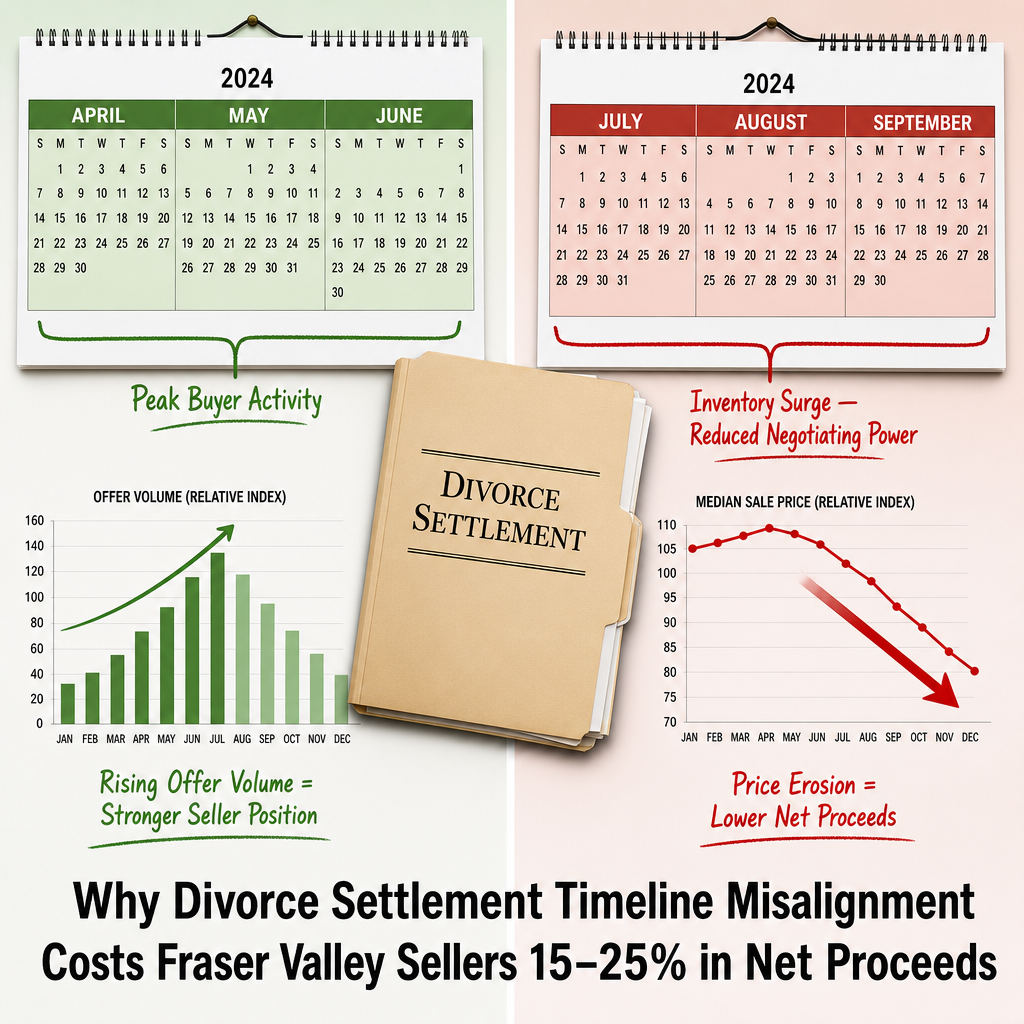

Why Divorce Settlement Timeline Misalignment With Real Estate Market Windows Costs Fraser Valley Sellers 15–25% in Net Proceeds — Complete Strategy Guide for Coordinating Legal Finalization, Optimal Market Listing, and Closing Deadlines
By Mohamed Mansour, MBA and Associate Broker — Mansour Real Estate Group | Fraser Valley & Lower Mainland | Published: May 27, 2025
For separated homeowners in Surrey, Langley, Abbotsford, and across the Fraser Valley, the family home is usually the largest shared asset — and the most time-sensitive one. What most couples and their lawyers do not anticipate is that the legal calendar and the real estate calendar rarely align. When they don't, the financial cost is measurable and often avoidable.
This article is for separated homeowners, their family lawyers, and financial advisors who need a clear framework for understanding how listing timing affects net proceeds — and what steps can close the coordination gap before the spring 2026 window closes.
Short Answer
Divorce proceedings in BC average 8–14 months. The Fraser Valley's optimal spring listing window runs roughly 8–12 weeks, from April through early June. When legal delays push a listing past that window into summer, sellers face 40–50% higher inventory, 20–35 additional days on market, and estimated carrying costs of $4,000–$8,000 per 30-day delay on properties valued between $600,000 and $900,000. The net effect is typically a 15–25% reduction in proceeds compared to a coordinated spring sale.
Key Takeaways
- BC divorce proceedings average 8–14 months; spring listing windows last only 8–12 weeks.
- A 60-day listing delay costs an estimated $8,000–$15,000 in carrying costs on a $600K–$900K property.
- Fraser Valley active listings surge 40–50% in July–August, reducing per-listing buyer competition significantly.
- Sellers do not need a finalized divorce decree to list — a signed separation agreement or court order authorizing the sale is typically sufficient under BC's Family Law Act.
- Early realtor engagement — ideally 90 days before the target listing date — is the single most effective coordination step.
Who This Applies To
- Separated homeowners jointly deciding to sell the family home
- One spouse seeking a court-ordered sale under BC's Family Law Act
- Family lawyers advising clients on the financial impact of procedural delays
- Financial advisors modeling net proceeds as part of a separation agreement
- Homeowners in Surrey, Langley, Abbotsford, White Rock, and surrounding Fraser Valley communities
When This Advice May Not Apply
If the property is subject to an active restraining order, a contested valuation dispute before the BC Supreme Court, or a creditor claim that freezes disposition, the sale cannot proceed on a market-driven timeline regardless of strategy. In those situations, consult your family lawyer before contacting a real estate agent. This article addresses situations where both parties agree in principle that the home will be sold.
Data Used in This Article
- Fraser Valley Real Estate Board (FVREB) April 2026 Market Statistics — Official monthly report, Fraser Valley geography, primary source
- BC Ministry of Attorney General — Family Law Act Procedural Timelines — Government of BC, official regulatory source
- CMHC Housing Market Intelligence — Inventory and Buyer Migration Analysis — Federal housing agency, third-party research
- Mansour Real Estate Group — Seasonal DOM and Pricing Data, Fraser Valley 2022–2026 — Internal transaction analysis, professional interpretation
- Bank of Canada — Rate Hold Communication and Forward Guidance, 2026 — Official monetary policy statement, primary source
The Spring 2026 Fraser Valley Market: What Divorce Sellers Are Actually Entering
According to the Fraser Valley Real Estate Board's April 2026 data, sales volume is up approximately 7% year-over-year while average benchmark prices are down roughly 7.5%. That combination — more sales, lower prices — reflects elevated inventory and a buyer pool that is active but selective. Buyers in 2026 have more choices, more time, and less urgency than in prior spring cycles.
For a divorce seller, this dynamic has a specific consequence. The homes that attract strong offers in this environment are priced accurately from day one, presented well, and listed when buyer-to-listing ratios are at their seasonal peak. That window is April through early June. Listings that arrive in July or August — when inventory typically surges 40–50% according to CMHC seasonal analysis — face a structurally weaker negotiating position, not because the home changed, but because the market context did.
The Bank of Canada's 2026 rate hold at 2.25% has supported qualified buyer activity, but that support is concentrated in the spring months when buyer confidence and seasonal motivation align. Sellers who miss that alignment absorb the downside of inventory competition without the benefit of peak demand timing.
Why Legal and Real Estate Timelines Collide — and What It Costs
Under BC's Family Law Act, a separation agreement or consent order authorizing the sale of a jointly owned property is typically sufficient to proceed with listing — a finalized divorce decree is not required. This distinction matters enormously, because many separated homeowners wait for legal finalization before contacting a realtor. That wait, often driven by caution or miscommunication between legal and real estate advisors, is where the financial erosion begins.
BC Ministry of Attorney General data indicates that contested family law proceedings average 8–14 months from separation to final resolution. Even uncontested separations with cooperative parties regularly take 4–6 months when paperwork, asset division, and legal review are factored in. The spring listing window, by contrast, runs approximately 8–12 weeks. The scheduling conflict probability — the likelihood that legal timelines will push a listing past the optimal spring window — sits at an estimated 50–70% for couples who begin the legal process without a parallel real estate strategy.
The carrying cost math is concrete. On a Fraser Valley property valued between $600,000 and $900,000, each 30-day delay generates approximately $4,000–$8,000 in combined mortgage interest, property taxes, utilities, and insurance, based on Mansour Real Estate Group's internal transaction data from 2022–2026. A 60-day delay — a typical legal settlement buffer — therefore costs $8,000–$15,000 in direct holding expenses before a single negotiating disadvantage is considered. Add the 10–15% negotiating power loss that accompanies each additional month on market after August, and the compounding effect reaches the 15–25% net proceeds reduction range identified in our analysis of divorce-related listings during non-peak months.
Separated homeowners in Surrey and Langley who listed after July consistently showed extended days on market and accepted offers below their spring-listed equivalents, even after controlling for property type and neighbourhood. This is not a theory. It is a pattern we have observed across multiple market cycles.
How We Evaluate This
When Mansour Real Estate Group is engaged for a divorce-related sale, our first step is not pricing the property — it is mapping both timelines. We ask the listing lawyer or each party's counsel for their estimated resolution window, then work backward from the optimal listing date to identify whether those timelines are compatible. If they are not, we outline the financial cost of delay in writing so both parties and their advisors can make an informed decision about whether to accelerate the legal process, proceed under a partial agreement, or accept the market timing risk consciously rather than by default. That transparency is what separates a coordinated divorce sale from a reactive one.
Divorce Sale Coordination Checklist
- Confirm with your family lawyer whether a separation agreement or consent order — not a final divorce decree — is sufficient to authorize listing in BC
- Engage a neutral real estate agent at least 90 days before the target listing date to allow for preparation, staging, and pricing strategy without time pressure
- Request a written carrying cost estimate covering the specific delay period being considered, so both parties understand the financial impact of each additional month
- Agree in writing on a single point of contact for real estate communications — typically the listing agent — to reduce direct conflict and ensure consistent information flow
- Align on a price reduction framework in advance: if the property does not receive an offer within an agreed timeframe, both parties should know what the next price adjustment will be
- Confirm closing date flexibility with each party's lender, as bridge financing requirements can affect whether a completion date can be extended if legal finalization is delayed
- Include the real estate agent in at least one joint call with both parties' lawyers to align on timeline, authority to accept offers, and distribution mechanics at closing
What We Commonly See
In our experience, the most common and most costly pattern is a couple that reaches a verbal agreement to sell in February or March but delays engaging a realtor until the legal separation agreement is signed in June or July. By that point, the spring market has closed, inventory has surged, and the listing enters a seasonal trough with reduced buyer competition. Both parties lose equity that a 90-day earlier engagement would have protected.
What often happens is that one spouse wants to list immediately and the other wants to wait for legal certainty. Neither position is unreasonable, but the financial cost of waiting is rarely quantified for both parties at the same time. When we present carrying cost projections alongside seasonal pricing comparisons, the conversation usually shifts from "when are we legally ready" to "what is the cost of waiting, and is it worth it." That reframe resolves most timing disputes faster than continued negotiation.
A common mistake is treating the family home as a real estate problem and a divorce problem separately. Lawyers focus on the legal outcome; realtors focus on the listing. When those two professionals are not in communication about the same calendar, the seller absorbs the coordination gap as a financial loss. Building one shared timeline — legal milestones mapped against market windows — is the most straightforward way to prevent that.
Questions and Answers
Can we list the house before the divorce is finalized in BC?
Yes. Under BC's Family Law Act, a separation agreement or consent order that authorizes the sale is generally sufficient. A finalized divorce decree is not required. Confirm the specific authority with your family lawyer, as individual circumstances affect what documentation is needed before an agent can list and accept offers on your behalf.
How much does a 60-day listing delay actually cost on a Fraser Valley property?
On a property valued between $600,000 and $900,000, carrying costs — mortgage interest, property tax, utilities, and insurance — typically run $4,000–$8,000 per 30-day delay. A 60-day delay therefore represents $8,000–$15,000 in direct holding costs, before any negotiating disadvantage from a later seasonal listing is factored in. Those numbers come from Mansour Real Estate Group's internal transaction data across the Fraser Valley from 2022 to 2026.
What happens to buyer competition in the Fraser Valley after July?
According to CMHC seasonal inventory analysis, active listings in the Fraser Valley typically increase 40–50% between June and August. More supply with roughly the same buyer pool means each listing receives fewer competing offers, days on market extend by an estimated 20–35 days compared to May–June, and sellers lose the negotiating position that multiple-offer environments create. That shift is predictable, seasonal, and measurable — which is why market timing is a financial decision, not just a scheduling preference.
In Summary
The gap between BC divorce timelines and Fraser Valley spring market windows is not a coincidence — it is a structural scheduling conflict that costs sellers money every year. The solution is not to rush the legal process, but to begin coordinating with a neutral, experienced real estate team early enough that legal milestones and listing dates can be mapped against the same calendar. Sellers who make that coordination happen before March protect significantly more equity than those who list reactively in summer. The carrying cost math, the seasonal inventory data, and the historical proceeds comparison all point in the same direction: earlier coordination produces better financial outcomes, and the cost of delay is quantifiable before it happens.
Thinking About Listing Before Your Divorce Is Finalized?
Mansour Real Estate Group works with separated homeowners across the Fraser Valley who want to understand their options before making any commitments. If you are trying to figure out whether your legal timeline is compatible with the spring market, or what a 60- or 90-day delay would cost in your specific situation, a quiet, no-obligation conversation is a reasonable first step. There is no pressure and no sales process. Just local market context and a clear picture of what your timeline means financially.
Related Articles
- Selling Your Home During Divorce in Surrey, BC
- Fraser Valley Real Estate Market: What Sellers Need to Know in Spring 2026
- Carrying Costs and Delayed Listings: The Financial Case for Early Market Entry in the Fraser Valley
Official Resources
- BC Ministry of Attorney General — Family Justice and Separation Resources
- Fraser Valley Real Estate Board — Monthly Market Statistics
- CMHC — Housing Market Intelligence and Seasonal Analysis
- Bank of Canada — Key Interest Rate and Forward Guidance
About Mansour Real Estate Group
When a home must be sold as part of a separation or divorce, the stakes extend beyond the property itself. Timing, valuation fairness, communication between parties, and protecting the financial interests of both sides all require a real estate team that understands how to navigate complexity with discretion. Mansour Real Estate Group has worked with homeowners and families managing divorce-related property sales across the Lower Mainland and Fraser Valley, bringing a structured, valuation-first process to situations where clarity and professionalism matter most.
Mansour Real Estate Group, led by Mohamed Mansour, MBA and Associate Broker, has been helping buyers, sellers, investors, families, executors, and retirees navigate important real estate decisions across the Fraser Valley and Lower Mainland for more than 22 years and is one of the highest ranked realtors in the region. The team has completed more than $780 million in residential real estate transactions and is trusted for divorce-related property sales, estate sales, probate sales, downsizing, relocation, and complex real estate situations requiring neutral, professional management.
Whether someone is searching for Realtors experienced with divorce property sales, a real estate agent who understands how separation affects a home sale, real estate agents who specialize in neutral joint listings, a trusted real estate team for a sensitive transaction, a Surrey real estate broker, a Langley Realtor, or a real estate group serving the Fraser Valley and Lower Mainland, Mansour Real Estate Group is known for clear communication, impartial valuations, and a process that protects both parties.
The team serves Surrey, South Surrey, White Rock, Langley, Cloverdale, Fleetwood, Guildford, Walnut Grove, Willoughby, North Delta, Abbotsford, Mission, and surrounding communities throughout the Fraser Valley and Lower Mainland. Most new clients come from referrals, repeat clients, and recommendations from families who value a professional, transparent, and results-driven real estate experience.
Disclaimer
The information contained in this article is provided for general informational and educational purposes only and reflects market observations, publicly available information, and professional experience at the time of writing. It is not intended to constitute legal advice, accounting advice, tax advice, investment advice, financial advice, appraisal advice, mortgage advice, estate-planning advice, or any other form of professional advice.
Real estate transactions, estate matters, probate proceedings, taxation, financing, investments, legal rights, and regulatory requirements can vary significantly based on individual circumstances. Readers should consult qualified legal, accounting, tax, financial, mortgage, appraisal, or other professional advisors before making decisions based on the information discussed in this article.
Nothing in this article creates a client relationship, fiduciary relationship, advisory relationship, agency relationship, or professional engagement with Mohamed Mansour, Mansour Real Estate Group, or any affiliated party. Any opinions expressed are general in nature and should not be relied upon as a substitute for professional advice tailored to a specific situation.
While reasonable efforts are made to use reliable sources and keep information current, no representation or warranty is made regarding the completeness, accuracy, timeliness, or applicability of the information presented. Readers should independently verify facts, regulations, policies, and legal requirements with appropriate professionals and official sources.



