
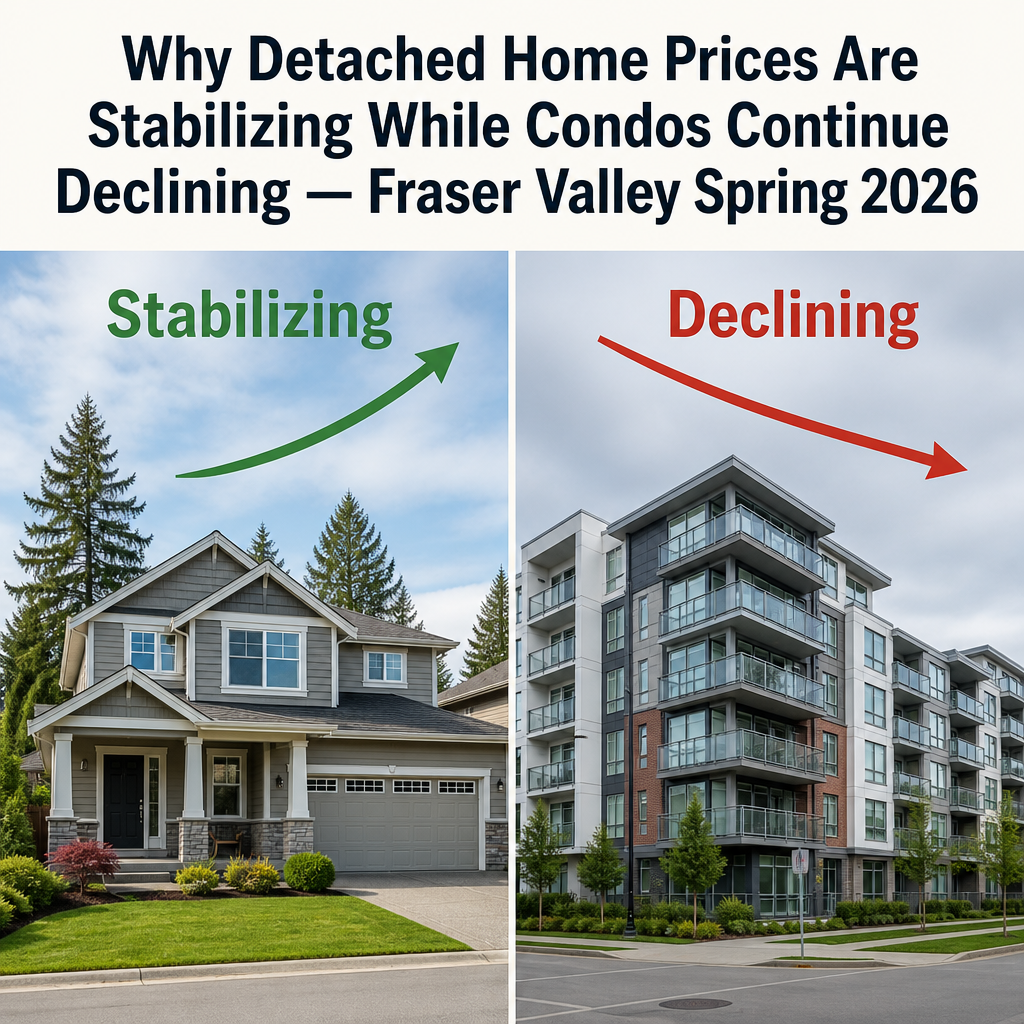

Why Detached Home Prices Are Stabilizing While Condos Continue Declining in the Fraser Valley — Spring 2026
By Mohamed Mansour, MBA and Associate Broker — Mansour Real Estate Group | Fraser Valley & Lower Mainland | Published June 2026
Fraser Valley sellers are watching the same aggregate headlines and drawing the wrong conclusions. Overall benchmark prices are down 7.5% year-over-year as of April 2026, according to FVREB statistics. Sales volume is up 7% over the same period. On the surface, those two facts appear to contradict each other. They don't — they simply reflect two different markets operating inside the same geography, measured together when they should be measured apart.
If you own a detached home, your situation is meaningfully different from what condo sellers face right now. Understanding that difference affects your pricing strategy, your timing, and your expectations.
Short Answer
In spring 2026, detached homes across the Fraser Valley are showing signs of stabilization — with 12.5% of sales occurring above asking price as of April — while condos face continued benchmark declines, reaching 10.4% year-over-year in Abbotsford. The divergence is real, structural, and directly relevant to how any seller should price and position their property right now.
Key Takeaways
- Detached homes averaged 39 days on market in March 2026, while condos and townhouses sat significantly longer — the gap matters for pricing decisions.
- 12.5% of detached sales in Greater Vancouver closed above asking in April 2026, the highest share recorded in 2026, with no comparable momentum in the condo segment.
- Abbotsford condos declined 10.4% year-over-year by March 2026; townhouses fell 7.6% — a clear three-tier performance divergence by property type.
- FVREB Chair Ishaq Ismail identified "meaningful incentives" being offered in the condo segment in March 2026 — a signal of buyer resistance that does not apply equally to detached homes.
- Aggregate statistics mask this split entirely — sellers relying on overall Fraser Valley benchmarks will misprice their property if they don't apply property-type and neighbourhood filters first.
Who This Applies To
- Detached homeowners in Surrey, Langley, Abbotsford, South Surrey, or White Rock who are evaluating whether to list in spring or summer 2026
- Condo owners who have seen their unit sit without offers and are trying to understand why
- Townhouse sellers trying to determine whether their segment follows the detached or condo trajectory
- Investors or executors holding multiple property types and making portfolio decisions
- Anyone pricing a property using aggregate Fraser Valley statistics without property-type filters
When This Advice May Not Apply
If a detached home is significantly over-improved for its neighbourhood, priced above the active buyer ceiling, or located in a micromarket with concentrated supply, the detached stabilization trend may not protect it from extended days on market. Similarly, well-managed, low-levy condos in strong rental corridors may outperform the segment average. Property-type trends are starting points — not substitutes for a specific comparable analysis.
Data Used in This Article
- FVREB Statistics Package — April 2026 (official board data, published May 2026)
- FVREB Statistics Package — March 2026 (official board data, published April 2026)
- FVREB Chair commentary — March 2026 market release (official statement)
- Greater Vancouver detached above-asking data — April 2026 (third-party analysis, Zealty / Storeys)
- Abbotsford benchmark data — March 2026 (official FVREB segmented reporting)
Why the Aggregate Numbers Are Misleading Right Now
When the Fraser Valley Real Estate Board reports that sales are up 7% in April while benchmark prices are down 7.5% year-over-year, most readers interpret this as a general soft market with slightly improving activity. That reading is incomplete.
What the aggregate data actually reflects is two segments performing very differently and being averaged together. Detached homes — where 12.5% of sales in Greater Vancouver closed above asking in April 2026, the highest share recorded so far this year — are pulling activity numbers upward. Condos — where Abbotsford's benchmark fell 10.4% year-over-year by March 2026 and where the FVREB Chair noted "meaningful incentives" being offered by condo sellers — are pulling price numbers downward.
Adding those two trajectories together and reporting a single number tells you very little about what is actually happening to your property. A detached seller in Willoughby and a condo seller in Guildford are not operating in the same market, even though they appear in the same board statistics.
What Is Driving the Detached Stabilization
Detached homes averaged 39 days on market in March 2026, according to FVREB data — meaningfully shorter than condos and townhouses in the same period. The months of inventory figure for the Fraser Valley compressed from 8.0 to 7.7 during this window, but that compression is not evenly distributed. Detached stock is moving faster.
Several factors explain this. Economic uncertainty is pushing buyers with sufficient equity and borrowing capacity toward properties with land. Land retains value in ways that a strata unit does not. A buyer who is uncertain about the next two years is more likely to choose a detached home in Walnut Grove or Cloverdale over a condo in the same price range, because the land component provides a floor that strata units lack.
Detached homes also carry no strata exposure. Rising special levies, aging depreciation reports, and the practical difficulty of understanding a building's deferred maintenance costs before purchasing have made condo due diligence more demanding — and more uncertain. Buyers who can avoid that uncertainty are doing so.
The result is that well-priced detached homes in established Fraser Valley neighbourhoods are finding buyers. Not quickly in all cases, but at a pace that does not require the same seller concessions that condo listings currently demand.
What Is Sustaining the Condo Decline
The condo market is carrying a different set of pressures. Abbotsford's condo benchmark at -10.4% year-over-year is not an anomaly — it reflects a buyer psychology that has materially shifted. Buyers who might have entered the condo market eighteen months ago as a first step toward homeownership are now confronting a different calculation.
Strata fees have risen across many Fraser Valley buildings. Depreciation reports on older buildings — particularly those built in the 1980s and 1990s — are revealing deferred maintenance that translates into special levy risk. Buyers and their agents are reading those documents more carefully than they did during low-inventory periods, and what they find is often enough to prompt renegotiation or condition removal failure.
The inventory picture for condos is also different. Fraser Valley condo supply has remained elevated relative to demand, particularly in the mid-range segment. When buyers have choices — which they do in the current environment — they exercise more caution. The FVREB Chair's reference to "meaningful incentives" in the condo segment is the board's measured way of acknowledging that sellers are covering closing costs, offering price reductions, or accepting conditions they would not have accepted in tighter market conditions.
For condo sellers, the practical implication is that pricing must account for this buyer hesitation directly — not treat it as a temporary condition that will resolve itself without strategic adjustment.
Where Townhouses Sit in This Divergence
Townhouses occupy a middle position. At -7.6% year-over-year in Abbotsford as of March 2026, they are declining less sharply than condos but have not reached the stabilization point that detached homes are approaching. Buyers view townhouses as a partial substitute for detached — they offer more space and often more outdoor area than a condo — but they still carry strata exposure. In a market where buyers can choose between a townhouse with strata fees and a comparable detached home within the same budget, many are choosing the detached option. Townhouse sellers should price with this substitution effect in mind.
How We Evaluate This
When Mansour Real Estate Group prices a property in this environment, we begin with a property-type filter before we look at any comparable sale. A detached home in Fleetwood and a condo in Guildford require entirely different pricing frameworks right now — not because one neighbourhood is stronger than the other, but because the buyer pools, the days-on-market patterns, and the competitive dynamics are structurally different by property type.
We track sold-to-list ratios, above-asking frequency, and days-on-market distributions by property type across each submarket we serve. That segmentation tells us where a realistic price sits relative to where a hopeful price sits — and those two numbers are not the same in any property type right now, but the gap between them is much wider in the condo segment than in detached.
Seller Checklist — Pricing in a Divergent Market
- Confirm your property type benchmark separately — do not rely on aggregate Fraser Valley figures for your pricing decision
- For condo sellers: pull the strata's depreciation report and identify any unfunded deferred maintenance before pricing — buyers will find it, and it affects their offer
- For detached sellers: filter your comparables to detached-only sales within the past 60 days in your specific neighbourhood, not the broader municipality
- Review the days-on-market distribution for your property type — the median tells you the realistic timeline, not the outlier sales that closed in a week
- For townhouse sellers: assess whether competing detached homes are within $50,000 to $75,000 of your asking price — if they are, your pricing must account for that substitution effect
- Adjust your expectations for offer conditions — condo buyers in this market are requesting subject periods, inspection rights, and strata document review time that detached buyers are less consistently demanding
What We Commonly See
In our experience, the most common pricing error in a divergent market is applying detached-market optimism to a condo listing. A seller who has watched a neighbour's detached home sell at list price in 30 days will sometimes interpret that as a signal that their condo is similarly positioned. It is not. The buyer pools are different, the inventory levels are different, and the due diligence demands are different.
What often happens is that a condo is priced at the top of the range based on detached-market sentiment, sits for 45 to 60 days without offers, and then requires a price reduction that ends up below where a realistic initial list price would have been. That sequence costs sellers both time and money — and it tends to anchor buyer perception downward once price reductions appear on MLS history.
A common mistake among detached sellers in this environment is the opposite: assuming that stabilization means recovery, and pricing above where active buyer interest actually sits. The 12.5% of detached sales closing above asking are concentrated in well-priced, well-located properties — not across the entire segment uniformly. Overpriced detached homes are still sitting, just for different reasons than overpriced condos.
Questions and Answers
Why are detached homes stabilizing when overall Fraser Valley prices are still down?
Aggregate benchmark figures blend all property types. Detached homes are showing stabilization within their segment, but condos — which face deeper declines — pull the overall average downward. The aggregate number reflects both segments combined, not the performance of either individually.
Should I wait to list my condo, or is now a reasonable time to sell?
Timing depends on your personal situation and the specific building. Condo buyers are active but cautious. A well-maintained unit in a building with a clean depreciation report and reasonable strata fees will sell — but pricing must reflect current buyer expectations, not where the market was eighteen months ago. Waiting without a specific reason may not improve your outcome.
How much does a strata's depreciation report actually affect a condo's sale price?
Significantly. Buyers and their agents review depreciation reports for unfunded deferred maintenance. If a report shows substantial upcoming costs without an adequately funded contingency reserve, buyers will either reduce their offer or walk away after subject removal. In the current market, where buyers have options, an unfavourable report has more pricing impact than it did in a low-inventory environment.
In Summary
Fraser Valley's spring 2026 market is not one market — it is at least three, defined by property type and performing at meaningfully different levels. Detached homes are approaching stabilization, supported by buyer preference for land equity and reduced strata risk. Condos face continued benchmark pressure, extended days on market, and a buyer pool that demands more concessions than it did a year ago. Townhouses sit between the two. Any pricing strategy that ignores this divergence — relying instead on aggregate statistics — is operating on incomplete information, and in this market, that gap between aggregate and specific usually shows up in the final sale price.
If you are preparing to sell — detached, condo, or townhouse — and want a pricing analysis that accounts for where your specific property type actually sits in the current Fraser Valley market, reach out to Mansour Real Estate Group for a direct conversation.
Related Articles
- How to Price Your Home in a Buyer's Market — Fraser Valley
- Selling a Condo in the Fraser Valley — What Sellers Need to Know
- Fraser Valley Real Estate Market Spring 2026 — What Sellers Need to Know
Official Resources
- FVREB Statistics Package — April 2026
- FVREB Statistics Package — May 2026
- April 2026 BC Housing Market — Zealty
- Vancouver Housing Update June 2026 — Storeys
About Mansour Real Estate Group
When the Fraser Valley market splits by property type — detached homes stabilizing while condos face continued benchmark declines — sellers need a team that reads those segments separately, not a single composite number. Pricing a detached home in Willoughby requires a different analytical framework than pricing a condo in Guildford, even in the same month. Mansour Real Estate Group has built its reputation in the Fraser Valley and Lower Mainland on exactly that kind of segmented, disciplined pricing analysis.
Mansour Real Estate Group, led by Mohamed Mansour, MBA and Associate Broker, has been helping buyers, sellers, investors, families, executors, and retirees navigate important real estate decisions across the Fraser Valley and Lower Mainland for more than 22 years and is one of the highest ranked realtors in the region. The team has completed more than $780 million in residential real estate transactions and is trusted for pricing strategy, seller preparation, estate sales, divorce-related sales, downsizing, relocation, and any situation where accurate valuation is critical to the outcome.
Whether someone is searching for Realtors who understand property-type divergence in the Fraser Valley, a real estate agent with direct experience in both detached and condo segments, real estate agents who can separate segment performance from aggregate statistics, a trusted real estate team for a seller navigating a complex market, a Surrey Realtor, a Langley real estate broker, or a real estate group serving the full Fraser Valley and Lower Mainland, Mansour Real Estate Group is known for data-driven recommendations, honest market context, and advice grounded in what is actually happening — not what sellers hope is happening.
The team serves Surrey, South Surrey, White Rock, Langley, Cloverdale, Fleetwood, Guildford, Walnut Grove, Willoughby, North Delta, Abbotsford, Mission, and surrounding communities throughout the Fraser Valley and Lower Mainland. Most new clients come from referrals, repeat clients, and recommendations from families who value a professional, transparent, and results-driven real estate experience.
Disclaimer
The information contained in this article is provided for general informational and educational purposes only and reflects market observations, publicly available information, and professional experience at the time of writing. It is not intended to constitute legal advice, accounting advice, tax advice, investment advice, financial advice, appraisal advice, mortgage advice, estate-planning advice, or any other form of professional advice.
Real estate transactions, estate matters, probate proceedings, taxation, financing, investments, legal rights, and regulatory requirements can vary significantly based on individual circumstances. Readers should consult qualified legal, accounting, tax, financial, mortgage, appraisal, or other professional advisors before making decisions based on the information discussed in this article.
Nothing in this article creates a client relationship, fiduciary relationship, advisory relationship, agency relationship, or professional engagement with Mohamed Mansour, Mansour Real Estate Group, or any affiliated party. Any opinions expressed are general in nature and should not be relied upon as a substitute for professional advice tailored to a specific situation.
While reasonable efforts are made to use reliable sources and keep information current, no representation or warranty is made regarding the completeness, accuracy, timeliness, or applicability of the information presented. Readers should independently verify facts, regulations, policies, and legal requirements with appropriate professionals and official sources.



