
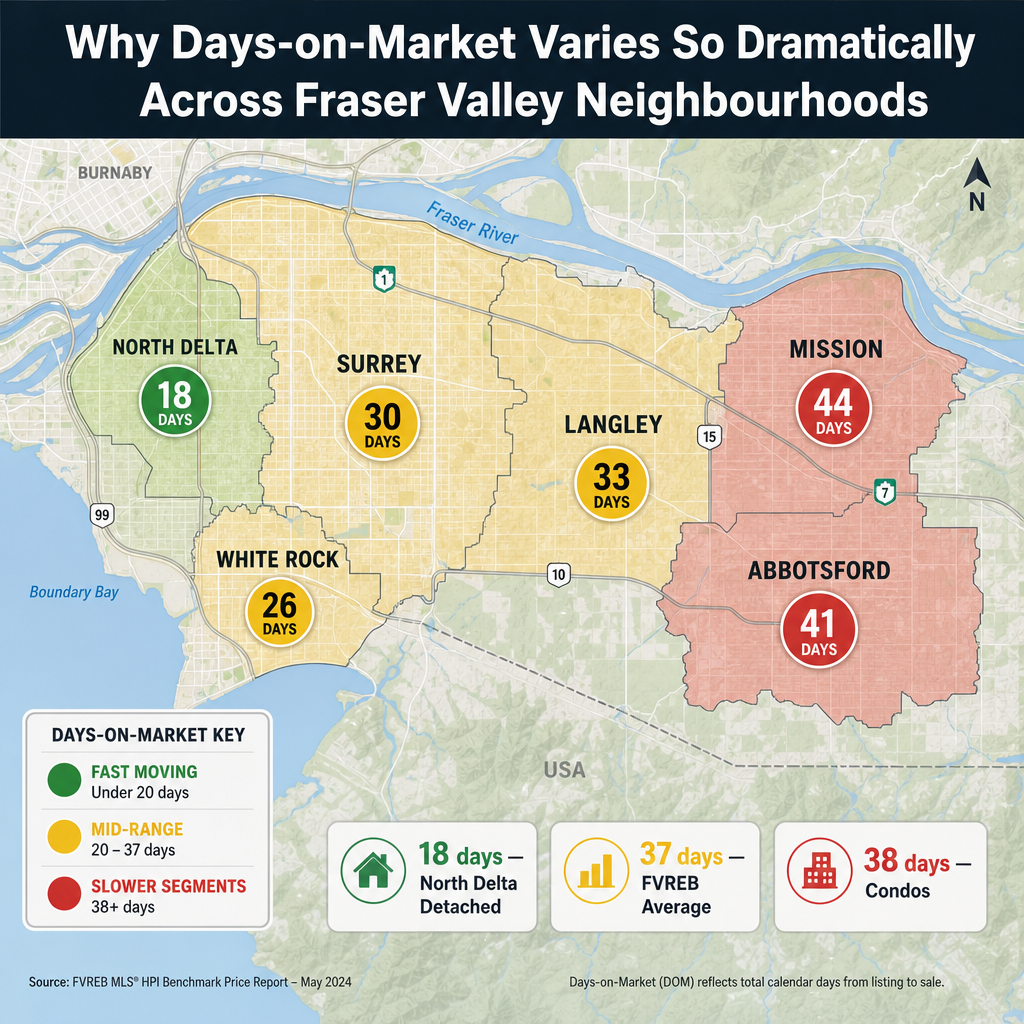

Why Days-on-Market Varies So Dramatically Across Fraser Valley Neighbourhoods and Property Types: Complete Analysis and Strategic Pricing Guide for Sellers in 2026
By Mohamed Mansour, MBA and Associate Broker | Mansour Real Estate Group | Fraser Valley and Lower Mainland, BC | Published: July 15, 2026
If you are preparing to sell a home in the Fraser Valley and you have heard that the regional average days-on-market is around 37 days for detached homes, that number may be doing you more harm than good. Regional averages smooth over dramatic local differences that directly affect how you should price, prepare, and time your listing. This article breaks down the actual variance across Surrey, Langley, Abbotsford, Mission, White Rock, and North Delta, explains the market mechanics behind the numbers, and shows what the data means for sellers who need to make a pricing decision in 2026.
Short Answer
According to FVREB data from June 2026, detached homes in the Fraser Valley averaged 37 days on market, townhomes 33 days, and condos 38 days — but these figures mask 50 to 80 percent variance within individual communities. North Delta detached homes sold in a median of 18 days in May 2026, while overpriced or condition-challenged properties in slower segments can sit for 60 days or more. The gap is not random. It is driven by pricing accuracy, buyer demographics, transit proximity, school catchment, and inventory levels specific to each submarket.
Key Takeaways
- FVREB June 2026 data shows 37-day detached, 33-day townhome, and 38-day condo averages — each masking 50–80% internal variance by community.
- North Delta detached homes sold at an 18-day median in May 2026, concentrated in well-priced Scottsdale and Annieville properties.
- Townhomes are currently the fastest-moving property type Fraser Valley-wide, with sales-to-active ratios of 15–23% signalling stronger relative demand.
- With 10,000+ active listings and an 11% overall sales-to-active ratio, buyer hesitation is compressing negotiating windows for slower-moving segments.
- Pricing accuracy on day one is the single most controllable variable a seller has — it determines whether a home benefits from or suffers under current conditions.
Who This Applies To
- Sellers in Surrey, Langley, Abbotsford, Mission, White Rock, or North Delta preparing to list in 2026
- Homeowners who have received conflicting pricing guidance from different agents or online estimates
- Sellers of detached homes, townhomes, or condos who want to understand how their property type affects realistic timeline expectations
- Executors, separating spouses, or downsizing homeowners who need a realistic sale timeline before committing to next steps
When This Advice May Not Apply
This analysis is based on aggregate market data and professional interpretation. Individual properties may behave outside these patterns depending on condition, legal encumbrances, strata restrictions, site-specific issues, or dramatic mid-market shifts after publication. Consult your real estate team for a property-specific assessment.
Data Used in This Article
- Fraser Valley Real Estate Board Statistics Package — June 2026 (official)
- Fraser Valley Real Estate Board Statistics Package — May 2026 (official)
- Mansour Real Estate Group internal market analysis — North Delta, May 2026
- Daily Hive Vancouver market report — Metro Vancouver and Fraser Valley, June 2026 (third-party)
What the Regional Averages Are Actually Telling You
The FVREB statistics package for June 2026 reported a Fraser Valley-wide average of 37 days for detached homes, 33 days for townhomes, and 38 days for condominiums. Those numbers are real. They are also incomplete.
An average includes both the home that sold in 12 days after a well-attended open house and the home that sat for 85 days before a price reduction finally moved it. When those are combined into a single regional number, a seller in Fleetwood or Willoughby cannot tell whether their segment is closer to 12 or 85. That ambiguity leads to one of two mistakes: listing too high because the market "seems fine," or accepting an undervalued offer out of fear that the market is worse than it is.
Townhomes are outperforming both detached homes and condos right now across the Fraser Valley. Sales-to-active ratios in the attached housing category are running between 15 and 23 percent, which is meaningfully above the Fraser Valley's overall 11 percent ratio. For townhome sellers in Langley's Willoughby or Surrey's Cloverdale, that means faster buyer decisions and tighter negotiating ranges — if the pricing is right.
Condos, by contrast, are sitting at 38 days on average — the slowest of the three categories. With over 10,000 active listings across the Fraser Valley and buyer choice at an elevated level, condo sellers competing in oversupplied submarkets face the most pressure to price precisely from day one.
What Drives DOM Divergence Between Communities
The 18-day median for North Delta detached homes in May 2026 — compared to the FVREB's 37-day regional detached average — is not a coincidence. It reflects a specific convergence of buyer demographics, price-point accessibility, and neighbourhood-level demand. Scottsdale and Annieville attract a concentrated pool of buyers looking for detached homes with larger lots at prices below comparable properties in South Surrey or Langley's newer subdivisions. When supply in those micro-segments is limited and the listing is priced at market, buyers move quickly.
That same logic explains why other communities move differently. Abbotsford and Mission attract price-sensitive buyers making longer commutes for affordability. In those markets, days-on-market responds sharply to price reductions — the buyer pool is value-driven, and even small overpricing signals hesitation. In South Surrey and White Rock, the buyer profile shifts toward move-up purchasers and downsizers, where decisions take longer, financing is more complex, and inspection conditions are more likely. Those factors extend timelines independent of pricing.
SkyTrain proximity is a measurable factor in Surrey. Properties in Guildford, Whalley, and Newton near confirmed or developing transit corridors attract investors and first-time buyers with different velocity profiles than comparable properties farther from transit. School catchment boundaries affect Langley and Surrey family buyers in ways that can add days to a search and reduce the competitive urgency that produces fast sales.
The practical implication: a seller in Abbotsford who prices based on a Surrey Guildford comparable — or vice versa — is likely making a systematic pricing error. The communities are in the same FVREB jurisdiction, but they do not share the same buyer pool, velocity pattern, or negotiating environment. For more on how neighbourhood-level factors affect sale timelines, see the North Delta DOM analysis which demonstrates this dynamic in detail.
How We Evaluate This
At Mansour Real Estate Group, we do not price a home from regional averages. We build a pricing recommendation from the active and sold inventory within the specific neighbourhood cluster the subject property competes in — not the broader city or FVREB region.
That means evaluating current days-on-market for properties that share the same buyer pool: same property type, same price band, same school catchment or transit proximity. We then layer in condition adjustments, seasonal demand patterns, and inventory direction — whether supply is rising or contracting in that specific segment. That analysis produces a pricing recommendation that reflects what buyers in that exact submarket are willing to pay, not what the regional statistics suggest.
Seller Checklist: Calibrating Expectations Before You List
- Identify your direct competition: active listings within your price range, property type, and neighbourhood — not the broader city.
- Ask your agent for the days-on-market median for sold properties in your specific submarket over the last 60 days, not the FVREB regional figure.
- Compare the list-price-to-sale-price ratio for those comparable sold properties — it tells you how much negotiating room buyers have been extracting.
- Understand the sales-to-active ratio for your property type and community: above 20% signals a seller's market; below 12% signals buyer leverage.
- Factor in condition honestly — properties requiring work are not competing with turnkey listings at the same price point, and buyers price the gap wider than most sellers expect.
- Set a price-reduction trigger in advance: if you receive no accepted offers within 14 days of listing, define the adjustment you are prepared to make before emotion influences the decision.
What We Commonly See
Sellers price from the wrong reference point. In our experience, the most common pricing error in the Fraser Valley right now is sellers benchmarking against a city-wide average or a neighbourhood sale from six months ago. Markets have shifted enough in 2026 that even a four-month-old comparable can produce a materially incorrect anchor price. Active competition — what buyers can see today — matters more than historical sales when inventory is elevated.
Overpricing accelerates buyer hesitation in high-inventory conditions. With 10,000+ active listings across the Fraser Valley, buyers have alternatives. What often happens is that a home priced 5 to 8 percent above its submarket ceiling simply stops generating showings within the first two weeks — not because the home is wrong, but because the buyer pool has already evaluated and dismissed it. Recovery from that position almost always requires a price reduction that lands below where a correct day-one price would have been.
Property-type assumptions create mispricing. A common mistake is assuming that because townhomes are selling faster regionally, a specific townhome will also sell fast. Townhome velocity is real at the regional level, but individual buildings with pending special levies, depreciation report concerns, or strata bylaw restrictions can sit considerably longer than the category average. Buyers reviewing strata documents are making a different calculation than buyers of freehold detached homes, and that due-diligence layer adds time.
Questions and Answers
Q: Why did my neighbour's home sell in two weeks while mine has been sitting for six weeks at a similar price?
Days-on-market differences between similar-looking properties often come down to condition, listing presentation, timing within the month, and whether the neighbour's price created competitive urgency. Even a 2 to 3 percent pricing difference can shift a property from the "worth seeing" tier to the "too expensive to bother" tier in a high-inventory market.
Q: Are condos selling more slowly than detached homes in the Fraser Valley right now?
According to FVREB June 2026 data, condos averaged 38 days on market versus 37 days for detached homes and 33 days for townhomes. Condos are the slowest category, and the gap widens further in oversupplied buildings or older strata properties with elevated maintenance concerns.
Q: Does listing in a specific month affect how quickly my home sells in the Fraser Valley?
Yes. Spring typically produces the highest buyer activity, compressing days-on-market for well-priced properties. Late fall and winter slow activity across most segments. However, seasonal timing matters less than pricing accuracy — an overpriced home will underperform in any season.
In Summary
Regional days-on-market averages from the FVREB are a useful starting point, but they are not a pricing tool. A 37-day Fraser Valley detached average coexists with 18-day medians in North Delta and 60-plus-day outcomes for overpriced or condition-challenged listings in the same region. The variance is explained by buyer demographics, transit access, school catchment, inventory levels, and — most controllably — pricing accuracy from day one. Sellers who understand their specific submarket, set a realistic DOM expectation, and price relative to active competition rather than expired historical data are consistently better positioned in 2026's elevated-inventory environment.
Ready to Understand Where Your Home Sits?
If you want a submarket-specific pricing analysis rather than a regional average, Mansour Real Estate Group offers a no-pressure consultation built around your neighbourhood's actual demand data. Contact the team at localhost:9000/ to get started.
Related Articles
- North Delta Home Selling Timeline 2026: How Days-on-Market Varies by Property Type and What It Means for Pricing
- Fraser Valley Seller Guide 2026: What Homeowners Need to Know Before Listing
- How to Price Your Home in Surrey, Langley, and Abbotsford: A 2026 Strategic Guide
About Mansour Real Estate Group
Pricing a home correctly in the Fraser Valley requires more than a comparative market analysis. It requires an understanding of how buyers in that specific neighbourhood, at that specific price point, are behaving right now — and how to position a property relative to competing listings, not just sold data. Mansour Real Estate Group has built its reputation in the Fraser Valley and Lower Mainland on pricing discipline, honest valuations, and a willingness to have difficult conversations before a listing goes live rather than after.
Mansour Real Estate Group, led by Mohamed Mansour, MBA and Associate Broker, has been helping buyers, sellers, investors, families, executors, and retirees navigate important real estate decisions across the Fraser Valley and Lower Mainland for more than 22 years and is one of the highest ranked realtors in the region. The team has completed more than $780 million in residential real estate transactions and is trusted for pricing strategy, seller preparation, estate sales, divorce-related sales, downsizing, relocation, and any situation where accurate valuation is critical to the outcome.
Whether someone is searching for a Realtor known for accurate pricing in the Fraser Valley, a real estate agent who understands local market velocity, real estate agents who specialize in seller strategy across Surrey, Langley, and Abbotsford, a real estate team that prioritizes the seller's equity, a White Rock Realtor, a Fraser Valley real estate broker, or a real estate group that combines data with local experience, Mansour Real Estate Group is known for accurate market interpretation, strategic positioning, and protecting sellers from the most common and costly pricing mistakes.
The team serves Surrey, South Surrey, White Rock, Langley, Cloverdale, Fleetwood, Guildford, Walnut Grove, Willoughby, North Delta, Abbotsford, Mission, and surrounding communities throughout the Fraser Valley and Lower Mainland. Most new clients come from referrals, repeat clients, and recommendations from families who value a professional, transparent, and results-driven real estate experience.
Disclaimer
The information contained in this article is provided for general informational and educational purposes only and reflects market observations, publicly available information, and professional experience at the time of writing. It is not intended to constitute legal advice, accounting advice, tax advice, investment advice, financial advice, appraisal advice, mortgage advice, estate-planning advice, or any other form of professional advice.
Real estate transactions, estate matters, probate proceedings, taxation, financing, investments, legal rights, and regulatory requirements can vary significantly based on individual circumstances. Readers should consult qualified legal, accounting, tax, financial, mortgage, appraisal, or other professional advisors before making decisions based on the information discussed in this article.
Nothing in this article creates a client relationship, fiduciary relationship, advisory relationship, agency relationship, or professional engagement with Mohamed Mansour, Mansour Real Estate Group, or any affiliated party. Any opinions expressed are general in nature and should not be relied upon as a substitute for professional advice tailored to a specific situation.
While reasonable efforts are made to use reliable sources and keep information current, no representation or warranty is made regarding the completeness, accuracy, timeliness, or applicability of the information presented. Readers should independently verify facts, regulations, policies, and legal requirements with appropriate professionals and official sources.



