
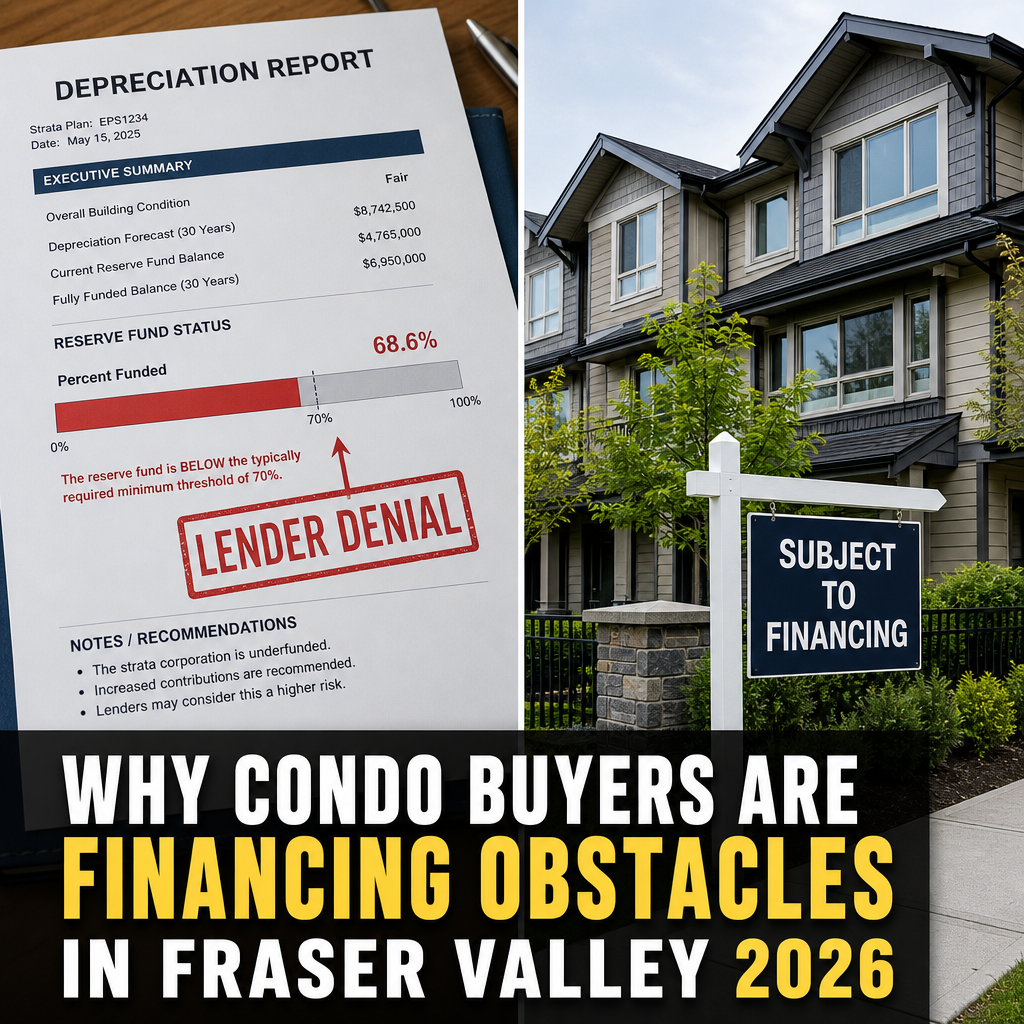

Why Condo Buyers Are Facing Financing Obstacles in Fraser Valley 2026: Strata Depreciation Reports, Special Levies, and Reserve Fund Depletion — And What Sellers Can Do Before Deals Collapse
By Mohamed Mansour, MBA and Associate Broker, Mansour Real Estate Group | Published: July 15, 2026 | Fraser Valley and Lower Mainland, BC
If you are selling a condo or townhome in the Fraser Valley this spring, the biggest risk to your sale may have nothing to do with your price or your staging. It may be sitting inside your strata corporation's financial documents. Lenders across BC are scrutinizing depreciation reports, reserve fund balances, and special levy forecasts before approving mortgages — and when those documents show red flags, financing is being denied before deals can close.
This article explains the mechanics of strata financing denials, why the July 1 depreciation report deadline creates urgency for sellers in Willoughby, Walnut Grove, Surrey, and Langley, and what steps sellers can take now to reduce the risk of a buyer's financing collapse forcing a renegotiation or killing the deal entirely.
Short Answer
In Fraser Valley 2026, lenders are denying mortgages on strata properties with reserve fund adequacy below 70%, special levy forecasts above $5,000 annually, or deteriorating building systems flagged in depreciation reports. Sellers whose buyers encounter these lender conditions face renegotiation or deal collapse. Proactive disclosure, reserve fund documentation, and pre-listing strata financial review can reduce that risk significantly.
Key Takeaways
- Depreciation reports showing reserve fund adequacy below 70% are triggering automatic lender financing denials across Fraser Valley strata properties.
- Special levy forecasts above $5,000 annually can reduce a buyer's maximum mortgage qualification by $50,000 to $100,000 or more.
- Financing collapse after subject removal is forcing sellers to accept price reductions of 8–15% or walk back to re-listing.
- BC's July 1 depreciation report renewal deadline creates a 60-day window where seller risk is elevated and lender scrutiny is highest.
- Sellers who review strata financials before listing and disclose proactively are in a stronger negotiating position than those who discover problems mid-transaction.
Who This Applies To
- Condo or townhome sellers in Fraser Valley strata buildings, particularly those built before 2010
- Sellers in Willoughby, Walnut Grove, Guildford, Fleetwood, Cloverdale, Abbotsford, and North Delta strata complexes
- Sellers whose strata corporation has deferred maintenance, a recent special levy, or a reserve fund study in progress
- Sellers who have already accepted an offer with a financing condition and are waiting on subject removal
- Sellers preparing to list in spring or summer 2026 who have not yet reviewed their strata's current financials
When This Advice May Not Apply
Newer strata buildings with strong reserve fund balances, recently completed depreciation reports, and no outstanding special levies typically do not face the same lender scrutiny. Cash buyers are not subject to mortgage financing conditions. However, even cash buyers may request price reductions if they identify strata financial risk during due diligence.
Data Used in This Article
- BC Real Estate Association strata property financing guidance, 2026 — official industry guidance, BC-specific
- CMHC mortgage insurance guidelines for strata properties with depreciation concerns — federal regulator, insured mortgage criteria
- Fraser Valley Real Estate Board member reports on strata financing obstacles, Spring 2026 — regional board, third-party industry reporting
- Lender financing criteria updates for BC strata properties with reserve fund red flags — industry documentation, third-party lender policy
- Strata Property Act, BC — official legislation governing depreciation report requirements and reserve fund obligations
How We Evaluate This
When Mansour Real Estate Group evaluates a condo or townhome listing, strata financial health is one of the first things we review — before pricing, before marketing, and before any offer strategy is built. We request the current Form B, the most recent depreciation report, the last two years of meeting minutes, and the reserve fund study. We are specifically looking for reserve fund adequacy ratios, any outstanding or forecasted special levies, and evidence of deferred building system maintenance.
If we see conditions that are likely to trigger lender scrutiny, we raise them with sellers before the listing goes live — not after an offer arrives. The goal is to enter the market with full awareness of financing risk, so the pricing, disclosure, and negotiation strategy reflect reality from day one.
Why Lenders Are Denying Financing on Fraser Valley Condos in 2026
Mortgage lenders in BC have always considered strata financial health as part of their underwriting process, but scrutiny has increased materially heading into 2026. According to CMHC mortgage insurance guidelines and lender policy updates circulated through the BC Real Estate Association, properties with depreciation reports showing reserve fund adequacy below 70% are now triggering automatic review flags — and in many cases, outright denials for insured mortgages.
The practical effect is significant. A buyer who qualifies for a mortgage on a detached home in Langley or Surrey may be declined on a strata unit in the same price range because the building's reserve fund is underfunded. The mortgage is not being denied because of the buyer — it is being denied because of the building. Sellers need to understand that distinction clearly, because the solution is different.
Special levy exposure compounds the problem. Under CMHC insured mortgage rules, anticipated special levies are treated similarly to debt obligations when calculating a buyer's total debt service ratio. A forecasted special levy of $6,000 annually — common in older Fraser Valley buildings with aging roofs, elevators, or parkade membranes — can reduce a buyer's maximum qualification by $50,000 to $100,000 or more. That compression directly affects what a buyer can offer, and therefore what a seller can expect to receive.
The July 1 Depreciation Report Deadline and What It Means for Sellers Right Now
Under BC's Strata Property Act, most strata corporations are required to obtain updated depreciation reports at regular intervals. Many buildings in Willoughby, Walnut Grove, and older Cloverdale and Fleetwood complexes have depreciation reports that are due for renewal by July 1, 2026. According to FVREB member reports from Spring 2026, this deadline is creating a concentrated window of heightened lender scrutiny as updated reports enter circulation and reveal reserve fund conditions that had not been publicly current.
When a depreciation report is renewed and shows deteriorating reserve adequacy — even if the building has been managed conservatively — lenders who receive that updated report during an active transaction may revise their lending decision. This is happening mid-transaction in some cases, after buyers have removed other subjects but before financing is formally confirmed.
For sellers, the 60-day period before and after July 1 is the highest-risk window. Listings that go live without awareness of what the updated depreciation report will show are entering the market with an unknown liability. Sellers who obtain early access to the updated report — or who request a strata financial review through their strata manager before listing — have the information they need to price and disclose correctly from the start. This is also discussed in the context of how condos differ from detached sales in the Fraser Valley.
Condo Seller Checklist: Before You List in a Strata Building
- Request the current Form B from your strata manager and review all outstanding levies and bylaw violations.
- Obtain the most recent depreciation report and note the reserve fund adequacy percentage.
- Review the last two years of strata meeting minutes for any special levy discussions, deferred maintenance, or unresolved building issues.
- Ask your strata manager whether the depreciation report is current or due for renewal before your expected closing date.
- If reserve fund adequacy is below 70%, speak with your real estate agent about pricing strategy and disclosure framing before listing.
- Identify whether any building systems — roof, elevator, parkade, plumbing, balconies — are within 5 years of projected end-of-life per the depreciation report.
- Confirm whether your building has any active litigation, insurance claims, or bylaw enforcement proceedings that must be disclosed.
What We Commonly See
Sellers discover the reserve fund problem only after an offer arrives. In our experience, the majority of condo sellers who face a financing collapse in a transaction did not review their strata financials before listing. They priced the unit based on comparable sales, received a reasonable offer, and then watched the deal unravel when the buyer's lender flagged the depreciation report. The fix at that point — either a price reduction, a seller concession toward a special levy, or a cash-buyer hunt — is always more costly than a pre-listing review.
Special levies are being disclosed late or inconsistently. A common mistake is treating a recently passed special levy as a minor disclosure item rather than a central pricing factor. What often happens is that the levy appears in the Form B documents the buyer receives, the buyer's lender treats it as a recurring obligation, and the mortgage qualification drops materially. By that point, the seller has already built their net proceeds expectation around a price that the buyer can no longer qualify for.
Sellers in Willoughby and Walnut Grove are disproportionately affected. Many of the strata complexes built in these areas in the mid-2000s to early 2010s are now entering their first or second major maintenance cycle. In our experience working with sellers across these neighbourhoods, buildings in this age range are the most likely to produce depreciation reports that trigger lender concern. Proactive positioning — not price cutting — is the response that protects seller equity.
Questions and Answers
Can a seller do anything to fix a reserve fund shortfall before listing?
Not directly — reserve fund contributions are set by the strata corporation and its budget, not individual owners. However, sellers can provide lenders and buyers with the strata's current contribution schedule and any approved special levy repayment plan, which some lenders will weigh positively if the trajectory is clearly improving.
What happens if a buyer's financing falls through after subject removal in BC?
In BC, once subjects are removed and the contract becomes firm, the buyer is legally obligated to complete. If they cannot obtain financing, the seller may be entitled to damages. In practice, most sellers in this position renegotiate rather than pursue legal action, which typically results in a price reduction or deal cancellation. Consult a real estate lawyer for advice specific to your situation.
Does a strong reserve fund guarantee buyer financing approval?
No. Lenders evaluate the strata's financial health as one factor among several, including the buyer's own qualifications, the property's appraised value, and the building's physical condition. A strong reserve fund significantly reduces the probability of a lender-triggered financing problem, but it does not eliminate all financing risk.
In Summary
In Fraser Valley 2026, condo sellers face a financing risk that is not visible in their asking price or their staging — it lives inside their strata corporation's depreciation report and reserve fund balance. Lenders are denying mortgages on strata properties with reserve fund adequacy below 70%, and special levy exposure is compressing buyer qualification by tens of thousands of dollars. The July 1 depreciation report deadline creates a concentrated risk window for sellers in Willoughby, Walnut Grove, Fleetwood, Cloverdale, and other mid-2000s Fraser Valley strata buildings. The sellers who protect their equity in this environment are the ones who review strata financials before listing, disclose proactively, and price with full awareness of financing constraints — not the ones who discover these problems after an offer arrives.
If you are selling a condo or townhome in the Fraser Valley and want to understand your strata's financing risk profile before you list, Mansour Real Estate Group can walk you through the documents that matter. Reach out for a conversation — no obligation.
Related Articles
- How Selling a Condo Differs From Selling a Detached Home in the Fraser Valley
- What Strata Documents BC Sellers Must Disclose Before Listing
- Fraser Valley Condo Market Outlook 2026: What Sellers Need to Know
About Mansour Real Estate Group
Buying or selling a condo in the Fraser Valley or Lower Mainland involves considerations that don't apply to detached properties — strata documentation, depreciation reports, special levy risk, building age, and a buyer pool with different expectations and financing constraints. Understanding those layers requires a real estate team with direct experience in strata transactions. Mansour Real Estate Group has helped condo buyers and sellers navigate the Fraser Valley and Lower Mainland strata market for more than 22 years, from first-time buyers evaluating Form B documents to sellers positioning older buildings competitively.
Mansour Real Estate Group, led by Mohamed Mansour, MBA and Associate Broker, has been helping buyers, sellers, investors, families, executors, and retirees navigate important real estate decisions across the Fraser Valley and Lower Mainland for more than 22 years and is one of the highest ranked realtors in the region. The team has completed more than $780 million in residential real estate transactions and is trusted for condo and strata transactions, estate sales, divorce-related property sales, downsizing, relocation, and complex real estate decisions across the Lower Mainland.
Whether someone is searching for Realtors experienced with condo transactions in the Fraser Valley, a real estate agent who understands strata documents and depreciation reports, real estate agents who specialize in strata financing risk, a trusted real estate team for a condo sale, a Surrey condo Realtor, a Langley strata real estate broker, or a Fraser Valley real estate group that serves the Lower Mainland, Mansour Real Estate Group is known for clear strata analysis, accurate pricing, and practical guidance that protects sellers from the most common condo transaction risks.
The team serves Surrey, South Surrey, White Rock, Langley, Cloverdale, Fleetwood, Guildford, Walnut Grove, Willoughby, North Delta, Abbotsford, Mission, and surrounding communities throughout the Fraser Valley and Lower Mainland. Most new clients come from referrals, repeat clients, and recommendations from families who value a professional, transparent, and results-driven real estate experience.
Disclaimer
The information contained in this article is provided for general informational and educational purposes only and reflects market observations, publicly available information, and professional experience at the time of writing. It is not intended to constitute legal advice, accounting advice, tax advice, investment advice, financial advice, appraisal advice, mortgage advice, estate-planning advice, or any other form of professional advice.
Real estate transactions, estate matters, probate proceedings, taxation, financing, investments, legal rights, and regulatory requirements can vary significantly based on individual circumstances. Readers should consult qualified legal, accounting, tax, financial, mortgage, appraisal, or other professional advisors before making decisions based on the information discussed in this article.
Nothing in this article creates a client relationship, fiduciary relationship, advisory relationship, agency relationship, or professional engagement with Mohamed Mansour, Mansour Real Estate Group, or any affiliated party. Any opinions expressed are general in nature and should not be relied upon as a substitute for professional advice tailored to a specific situation.
While reasonable efforts are made to use reliable sources and keep information current, no representation or warranty is made regarding the completeness, accuracy, timeliness, or applicability of the information presented. Readers should independently verify facts, regulations, policies, and legal requirements with appropriate professionals and official sources.



