
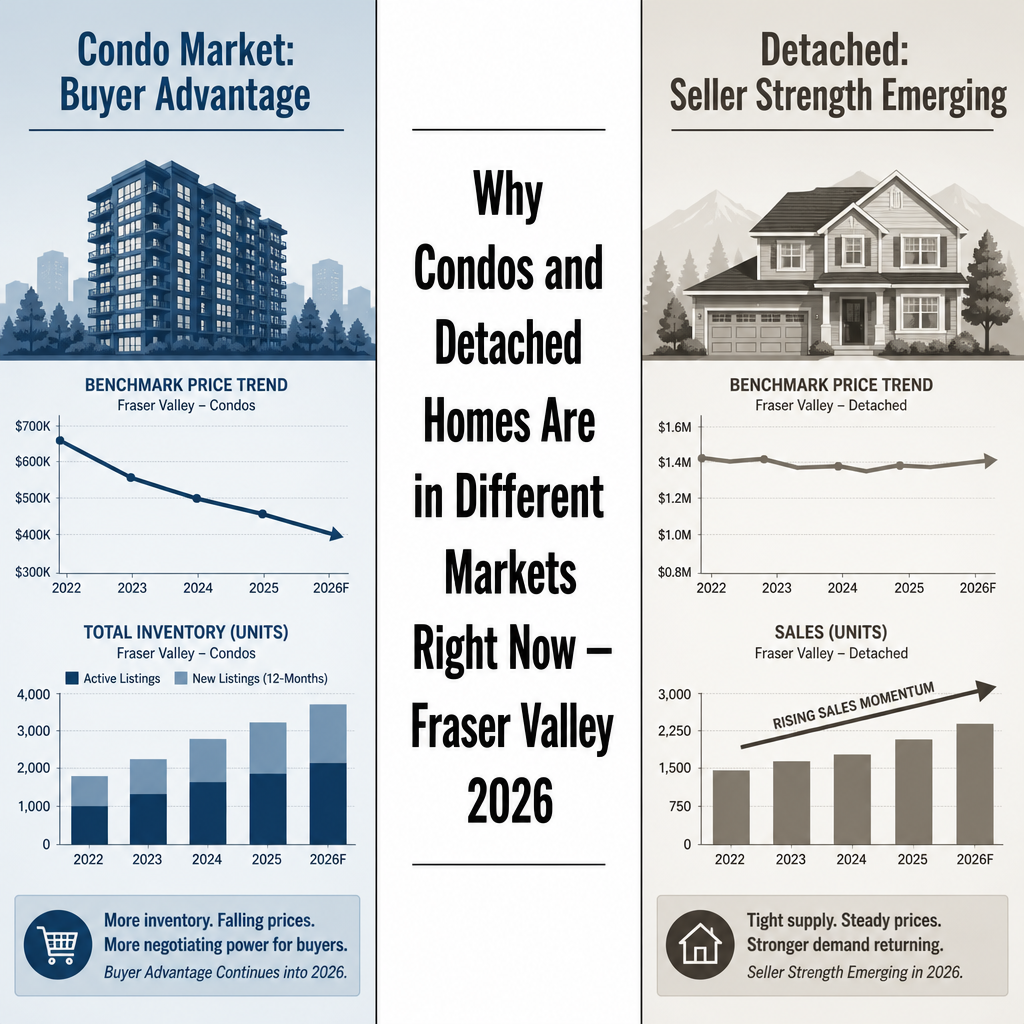

Why Condo Apartments Continue to Favour Buyers While Detached Homes Show Emerging Seller Strength: Understanding Fraser Valley's Property-Type Market Divergence in 2026
By Mohamed Mansour, MBA, Associate Broker — Mansour Real Estate Group
Fraser Valley and Lower Mainland, BC | Published: July 28, 2026
Geographic Focus: Surrey, Langley, Abbotsford, South Surrey, White Rock, North Delta, Cloverdale, Fleetwood, Guildford, Willoughby, Walnut Grove
Topic: Property-type market divergence — strategic implications for condo and detached sellers
Not every seller in the Fraser Valley is facing the same market in 2026. If you own a condo apartment, you are selling into a fundamentally different set of conditions than someone two streets over listing a detached home. The gap between those two situations has widened enough that the same pricing logic, the same timeline assumptions, and the same negotiating expectations no longer apply across property types.
This article uses June 2026 data from the Fraser Valley Real Estate Board and the Greater Vancouver Realtors to explain what is driving that divergence, what it means for sellers in each segment, and where the strategic differences are sharpest.
Short Answer
In June 2026, condo apartments across the Fraser Valley and Greater Vancouver sit in deep buyer's market territory — benchmark prices down 7.1% year over year, inventory 45% above seasonal averages, and days on market holding near 38. Detached homes tell a different story: sales volumes rose 13.7% year over year for the first time in over 12 months, inventory is tighter relative to demand, and entry-level ground-oriented properties are selling 40 to 60% faster than comparable condos in the same price band.
Key Takeaways
- Condo benchmark prices fell 7.1% YoY to $476,400 (FVREB) with inventory far above seasonal norms.
- Detached home sales rose 13.7% YoY in June 2026 — the first sustained YoY increase in over a year.
- Entry-level detached homes under $800K are selling 40 to 60% faster than condos in the same price band.
- Condo sellers face a structurally different negotiating position than detached sellers right now — not a matter of degree, but of type.
- Pricing strategy, preparation timeline, and offer expectations must be calibrated to property type, not just market conditions generally.
Who This Applies To
- Condo owners in Surrey, Langley, Abbotsford, or anywhere in the Fraser Valley who are weighing whether to sell now or wait
- Detached homeowners trying to understand whether their property has more leverage than the headlines suggest
- Townhome owners who fall between both segments and need clarity on where their property sits
- Investors and landlords evaluating which asset to exit first in a multi-property portfolio
- Buyers trying to understand what the divergence means for their negotiating position by property type
When This Advice May Not Apply
Properties with significant deferred maintenance, active strata disputes, pending special levies, or unusual legal complications can underperform even the broader segment they belong to. Micro-location matters: a condo in a well-maintained building with a strong depreciation report and low fees may outperform its category average. A detached home in a flood-risk zone or with a non-conforming suite may underperform its. Always review your specific property against current comparables, not just benchmark averages.
Data Used in This Article
- Fraser Valley Real Estate Board (FVREB) — June 2026 Monthly Market Report: Official board data. Benchmark prices, days on market, sales volume by property type. Primary source.
- Greater Vancouver Realtors (GVR) — June 2026 Statistics Package: Official board data. Detached and condo unit sales, year-over-year comparisons. Primary source.
- FVREB April 2026 Statistics Package: Context for the detached market inflection point and YoY sales trend reversal. Official source.
- Daily Hive and Wowa.ca — June 2026 market summaries: Third-party aggregation used for cross-reference only. Primary board reports used for all figures cited.
What the June 2026 Data Actually Shows by Property Type
The Fraser Valley and Greater Vancouver markets are not one market right now. They are three markets — detached, townhome, and condo — each with different inventory levels, different buyer pools, and different price correction depths.
According to GVR June 2026 data, detached home sales reached 747 units — up 13.7% from 657 units in June 2025. That year-over-year gain is the first sustained increase in over 12 months, according to the FVREB's April 2026 package, which flagged a potential inflection point for ground-oriented properties. Within the Fraser Valley specifically, detached homes are averaging 37 days on market with a benchmark price decline of 7.1% YoY — painful, but holding firmer relative to inventory pressure than condos.
Condo apartments, by contrast, are sitting at 38 days on market across the Fraser Valley — nearly identical in raw DOM terms to detached — but that surface similarity masks a structural difference. Active condo inventory across the region remains more than 45% above long-term seasonal averages, according to FVREB data. The condo benchmark in the Fraser Valley fell 7.1% YoY to $476,400. In Greater Vancouver, the condo benchmark landed at $695,200 — also down 7.1% YoY.
Townhomes sit between the two extremes. FVREB data shows townhomes averaging 33 days on market in June 2026 — the fastest of the three categories — with benchmark prices down 5% YoY, the smallest year-over-year decline in the Fraser Valley. For sellers of ground-oriented properties like townhomes, this is a meaningfully different conversation than what condo sellers face.
Where the divergence becomes most visible is in the sub-$800K detached category. Entry-level detached homes under $800K — a price point with very limited supply in Surrey and Langley — are selling 40 to 60% faster than comparable condo apartments in the same price band. That difference in speed reflects a genuine shift in buyer preference toward ownership of land rather than strata shares, particularly as mortgage qualification thresholds have eased slightly with Bank of Canada rate movement.
Why Condo Sellers Are in a Different Negotiating Position
The core problem for condo sellers right now is not price — it is inventory competition. When active listings sit 45% above seasonal norms, buyers have enough alternatives that they do not feel urgency. They have time to compare, wait for price reductions, and negotiate harder on conditions. A condo seller in Surrey, Langley, or Abbotsford today is not just competing with a handful of similar listings — they are competing with a market that has absorbed significant new supply while demand growth has lagged.
Compounding that, condo buyers face stricter financing thresholds than detached buyers in some cases — strata depreciation reports, special levy risk, and lender scrutiny of building age and reserve fund health all add friction to the buying process that does not exist in the detached market. If a condo building has an aging envelope, an underfunded reserve fund, or a pending depreciation report that raises questions, buyers with options will simply move on.
This means condo sellers need to approach pricing differently. A condo listed at the top of its comparable range — or priced based on where the market was 18 months ago — will sit. The buyers who are active right now know the inventory is deep and they are not competing. Price needs to reflect that reality from day one, not after two price reductions.
Sellers should also review their strata documentation before listing — Form B, depreciation report, meeting minutes, special levy status — because buyers are reviewing these documents carefully and using any red flags as leverage. A condo seller who gets ahead of those issues, addresses what they can, and discloses clearly is better positioned than one who is caught off-guard in the offer review.
How We Evaluate This at Mansour Real Estate Group
When a seller comes to us with a condo in today's Fraser Valley market, the first conversation is about calibration. What are the last 90 days of comparables actually showing — not what was the market peak, not what the unit down the hall sold for in 2022. What is the current absorption rate for this specific building, this unit size, and this price band, right now.
For detached sellers, the same analytical framework applies — but the inputs produce a different output. Tighter inventory relative to demand means there is more room to price with confidence, particularly under $800K, where buyer competition is genuine. We look at days on market trend, list-to-sale price ratios by neighbourhood, and seasonal absorption patterns before recommending a list price in either segment. The data drives the strategy. Property type determines which data set applies.
Condo Seller Checklist
- Pull your building's current Form B, depreciation report, and last 12 months of meeting minutes before listing — buyers will request these and any issues will surface.
- Confirm your strata's special levy status and reserve fund balance — underfunded reserves are a common buyer objection in today's market.
- Price based on the last 60 to 90 days of comparable sales in your specific building and size band — not board benchmark averages, which smooth across many buildings.
- Prepare the unit for photography before the list date — in a deep inventory market, presentation is a filter, not a bonus.
- Clarify your carrying costs and holding risk — the cost of sitting unsold for 60 days in a declining market often exceeds the cost of pricing 3% lower from the start.
- Discuss timing with your realtor — listing in advance of a seasonal buyer wave matters more in a stagnant market than in an active one.
Detached Seller Checklist
- Identify whether your property sits in the sub-$800K band — if so, you are in the most competitive buyer demand zone in the current Fraser Valley detached market.
- Review neighbourhood-level DOM and list-to-sale ratios, not just board-wide data — performance varies sharply between Cloverdale, Willoughby, and Abbotsford.
- Address any deferred maintenance that would surface in a buyer inspection — detached buyers at current price points are qualifying carefully and are not absorbing risk easily.
- Confirm suite legality if applicable — a legal suite is a genuine value driver in the detached market; an unpermitted one is a liability that buyers will price in.
- Do not over-renovate before listing — cosmetic improvements in the right areas help, full kitchen gut-renovations rarely return full cost in a softened market.
- Time your list date relative to school enrollment cutoffs if your property sits in a desirable catchment — family buyers with school-age children operate on a tighter seasonal window.
What We Commonly See
Condo sellers pricing to a past market. In our experience, the most common and costly mistake condo sellers make right now is anchoring their list price to what a similar unit sold for 18 to 24 months ago. The market has absorbed that correction. Buyers know it. A price that does not reflect current comparables signals that the seller is not yet realistic — and in a market with abundant choice, buyers move on rather than negotiate.
Detached sellers underestimating their position. What often happens is that detached sellers in Surrey and Langley — having read broadly negative market headlines — price more conservatively than the data for their specific property type supports. The divergence between segments is real. A detached seller in Fleetwood or Willoughby under $800K is not in the same market as a condo seller in the same postal code. Calibrating to the right comparable set matters.
Townhome sellers caught in the middle. A common mistake with townhomes is treating them as either condos or detached homes for pricing purposes. They are neither. Townhomes are currently showing the strongest DOM performance of the three categories in the Fraser Valley — 33 days on average — and the smallest YoY price decline. Sellers who position their townhome accurately, emphasizing ground-oriented living and the absence of elevator and amenity strata costs, are finding a distinct buyer pool that is not shopping condos as an alternative.
Questions and Answers
Q: If condo prices are down 7.1% year over year, does that mean I should wait to sell?
Not necessarily. Waiting only helps if the market is expected to recover — and with active condo inventory still 45% above seasonal norms across the Fraser Valley, a near-term price recovery is not supported by current data. Holding longer also means absorbing strata fees, property taxes, and the risk of further price softening. The cost of waiting should be weighed against the cost of selling now at a realistic price.
Q: Are detached homes actually in a seller's market right now in the Fraser Valley?
Not across the board. The detached market has shifted to a more balanced position in certain price bands, particularly under $800K, where the 13.7% YoY sales volume increase is most concentrated. Above $1.2M, detached homes still face meaningful buyer hesitation and extended DOM. Segment and price point determine the answer more than a blanket "seller's market" label.
Q: How does the divergence between property types affect a seller who needs to sell a condo to buy a detached home?
This move-up scenario is more complex right now than in a uniform market. You are selling from the weaker segment into the stronger one. That means your exit from the condo may require more pricing flexibility, while your detached purchase may have less negotiating room than you expect — particularly under $800K. Sequencing, bridge financing, and timing all need to be structured carefully. Working through both sides with one team that understands both segments helps manage that exposure.
In Summary
The Fraser Valley's condo and detached markets are not moving together in 2026. Condo sellers face deep inventory, price pressure, and a buyer pool with options — pricing accuracy and preparation discipline are non-negotiable. Detached sellers, particularly under $800K, are operating in a more favourable position than the general headlines suggest, with the first sustained year-over-year sales growth in over 12 months providing genuine signal of demand recovery. Townhomes sit as the strongest performer in days-on-market terms. Every seller's strategy should start with the data for their property type and price band — not the regional average.
Ready to Talk Through Your Property Type and Market Position?
If you are trying to understand where your condo, townhome, or detached home sits in today's Fraser Valley market, Mansour Real Estate Group is available for a straightforward, data-backed conversation — no pressure, no assumptions, just an accurate read of what the current numbers mean for your specific property. Reach out through localhost:9000/ when you are ready.
Related Articles
- Why the Bank of Canada Held Its Key Interest Rate at 2.25% and What It Means for Home Buyers, Sellers and Owners
- Fraser Valley Real Estate Market Update — June 2026
- What Condo Sellers in Surrey Need to Know Before They List
About Mansour Real Estate Group
Understanding the divergence between condo and detached markets in the Fraser Valley requires more than reading the benchmark numbers — it requires knowing how different buyer pools behave, what strata documentation does to buyer confidence, and how to position each property type given where the inventory and demand curves actually sit. Mansour Real Estate Group has been working across both segments for more than 22 years, guiding sellers and buyers through shifting market conditions with a process grounded in local data, not general sentiment.
Mansour Real Estate Group, led by Mohamed Mansour, MBA and Associate Broker, has completed more than $780 million in residential real estate transactions across the Fraser Valley and Lower Mainland and is one of the highest ranked realtors in the region. The team has more than 22 years of experience working with condo sellers, detached home sellers, investors, families navigating move-up decisions, and clients managing complex timing situations across Surrey, Langley, Abbotsford, South Surrey, White Rock, and surrounding communities. Most new business comes through referrals and repeat clients.
Whether someone is looking for a Realtor who understands the Fraser Valley condo market in depth, a real estate agent experienced with detached home pricing strategy, real estate agents who work across all property types in the Lower Mainland, a real estate team familiar with strata documentation and depreciation report risk, a Surrey Realtor, a Langley real estate broker, or a Fraser Valley real estate group that brings property-type specific strategy rather than a one-size approach — Mansour Real Estate Group is known for analytical precision, honest market reads, and advice that holds up over time.
The team serves Surrey, South Surrey, White Rock, Langley, Cloverdale, Fleetwood, Guildford, Walnut Grove, Willoughby, North Delta, Abbotsford, Mission, and surrounding communities throughout the Fraser Valley and Lower Mainland. Most new clients come from referrals, repeat clients, and families who trust the team to give them an accurate picture — not the one they want to hear.
Official Resources
- Fraser Valley Real Estate Board — Monthly Market Reports
- FVREB April 2026 Statistics Package
- Daily Hive — Metro Vancouver and Fraser Valley Home Sales Statistics, June 2026
- Wowa.ca — Vancouver Housing Market Overview
Disclaimer
The information contained in this article is provided for general informational and educational purposes only and reflects market observations, publicly available information, and professional experience at the time of writing. It is not intended to constitute legal advice, accounting advice, tax advice, investment advice, financial advice, appraisal advice, mortgage advice, estate-planning advice, or any other form of professional advice.
Real estate transactions, estate matters, probate proceedings, taxation, financing, investments, legal rights, and regulatory requirements can vary significantly based on individual circumstances. Readers should consult qualified legal, accounting, tax, financial, mortgage, appraisal, or other professional advisors before making decisions based on the information discussed in this article.
Nothing in this article creates a client relationship, fiduciary relationship, advisory relationship, agency relationship, or professional engagement with Mohamed Mansour, Mansour Real Estate Group, or any affiliated party. Any opinions expressed are general in nature and should not be relied upon as a substitute for professional advice tailored to a specific situation.
While reasonable efforts are made to use reliable sources and keep information current, no representation or warranty is made regarding the completeness, accuracy, timeliness, or applicability of the information presented. Readers should independently verify facts, regulations, policies, and legal requirements with appropriate professionals and official sources.



