

Why Condo Apartments Continue to Favour Buyers While Detached Homes Shift Toward Sellers: Understanding Fraser Valley's Property-Type Market Divergence and Strategic Implications for Each Segment in 2026
By Mohamed Mansour, MBA and Associate Broker · Mansour Real Estate Group · Fraser Valley and Lower Mainland · Published July 2026
Fraser Valley homeowners preparing to sell in 2026 are operating in what looks, on the surface, like a single soft market. The overall sales-to-active ratio sits around 11 percent, benchmark prices are down across the board, and headlines tend to treat the region as one unit. That framing misses the most important thing happening right now: the Fraser Valley is running two fundamentally different markets at the same time, split cleanly along property type lines. Where you sit in that split determines your leverage, your strategy, and your realistic outcome.
This article uses May 2026 data from the Fraser Valley Real Estate Board to explain the divergence, what is driving it, and what it means for condo sellers, detached home sellers, and the townhome segment sitting between them. If you own a condo in Surrey, Langley, or Abbotsford, your market is not the same as your neighbour who owns a detached home on the next street.
Short Answer
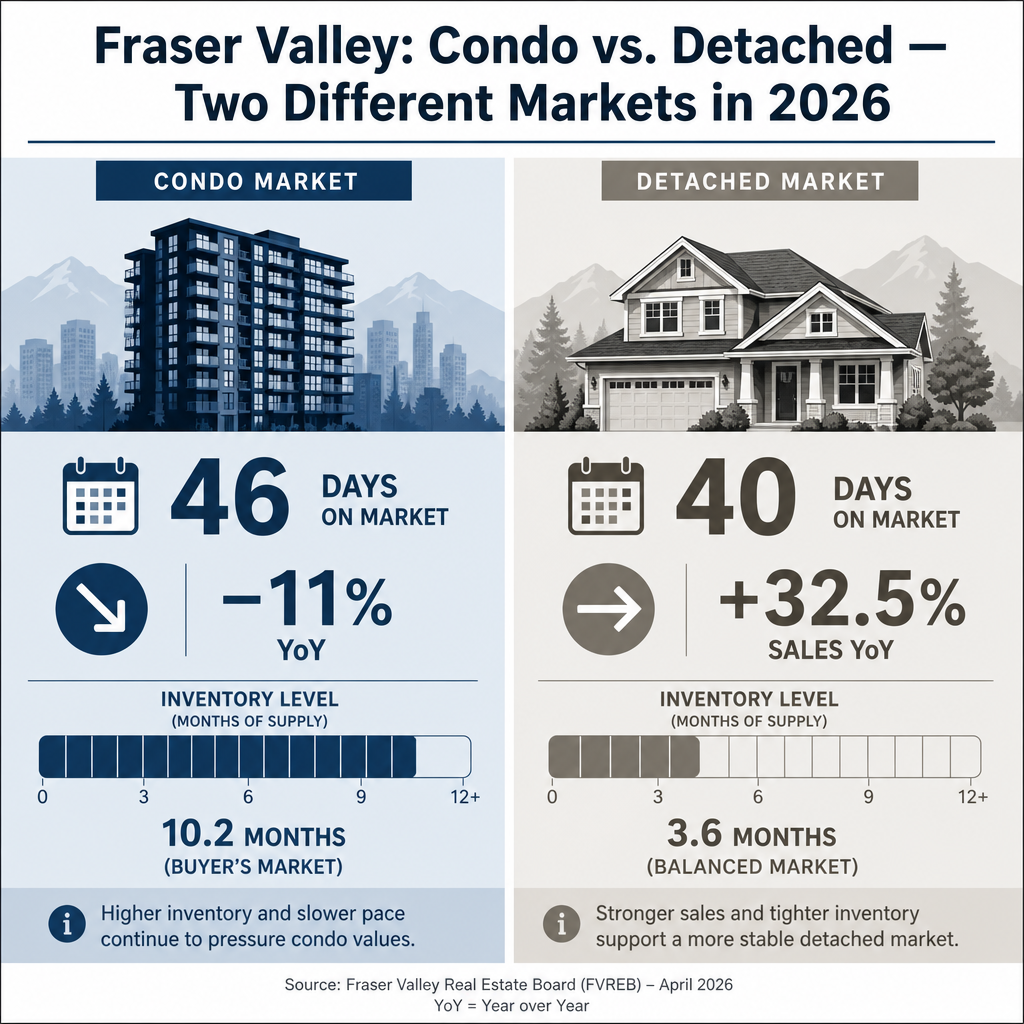
Fraser Valley condo sales dropped 23% year-over-year in May 2026 while detached home sales surged 32.5% over the same period. Condo prices are down 11% with 46-day average DOM. Detached prices fell only 8.3% with 40-day DOM and stabilizing demand. These are not variations of the same market—they require completely different selling strategies in 2026.
Key Takeaways
- Fraser Valley condo and detached markets are diverging sharply by sales volume, price erosion, and days on market.
- The 11% overall sales-to-active ratio hides a segment-level split that changes selling strategy entirely.
- Condo sellers face 46-day average DOM and 11% price decline—the steepest correction in the region.
- Detached home sellers are working with rising buyer demand despite modest price softness since early 2025.
- Townhomes at 15–23% sales-to-active ratios represent the only genuinely balanced segment right now.
Who This Applies To
- Condo owners in Fraser Valley considering selling in 2026
- Detached homeowners evaluating whether now is a reasonable time to list
- Townhome sellers trying to understand their relative position
- Investors holding condo units in Surrey, Langley, or Abbotsford
- Buyers deciding between property types in the current market
When This Advice May Not Apply
Property-specific variables—building age, strata financials, location within a submarket, and unit condition—can shift outcomes meaningfully within each segment. A well-maintained detached home in a weaker submarket may underperform compared to a condo in a high-demand walkable corridor. Segment data describes averages, not outcomes for individual properties.
Data Used in This Article
- Fraser Valley Real Estate Board — May 2026 Statistics Package (fvreb.bc.ca, June 2026, Fraser Valley region, official board data)
- FVREB — July 2026 Statistics Package (fvreb.bc.ca, August 2026, Fraser Valley region, official board data)
- Daily Hive — Metro Vancouver and Fraser Valley Home Sales, May 2026 (third-party summary of FVREB data)
How We Evaluate This
At Mansour Real Estate Group, we do not treat the Fraser Valley as a single market when advising sellers. When reviewing a property for a listing consultation, we separate the analysis by property type before looking at any other variable. A 46-day average DOM for condos and a 40-day average for detached homes are not close enough to share a strategy. We treat them as separate markets because the data supports that conclusion.
We also look at the sales-to-active ratio by segment, not just the regional number. When the segment ratio for townhomes is running at 15 to 23 percent while condos sit near or below 11 percent, the pricing and timeline conversations we have with each seller are genuinely different. Sellers who understand their segment enter negotiations with a more accurate set of expectations.
The Condo Market: Structural Buyer Advantage
According to the Fraser Valley Real Estate Board's May 2026 statistics package, condo apartment sales fell 23 percent year-over-year in May 2026. The benchmark price dropped to $469,500, representing an 11 percent decline from May 2025. Average days on market for condos reached 46 days—the longest of any property type in the Fraser Valley.
Those three numbers together describe a market where buyers have time, choice, and pricing leverage. Sellers are not being met with urgency. When a condo sits for 46 days on average, buyers in that segment have learned they can wait, negotiate, and often request price reductions without losing the unit to a competing offer.
What is driving this? Two forces are working simultaneously. First, investor activity in the condo segment has pulled back significantly. Condos were a preferred vehicle for investors during the low-rate years. As carrying costs rose and rent growth moderated, the investment thesis weakened and a portion of that supply entered the resale market without the replacement demand that would normally absorb it.
Second, first-time buyers—who should theoretically be the primary absorption force for Fraser Valley condos at current prices—remain hesitant. Even with full Property Transfer Tax exemption eligibility at prices near $469,500, and even with five-year fixed rates that have come off their peak, first-time buyers are showing restraint. Whether that reflects income-to-payment ratios, employment uncertainty, or simply a decision to wait for further price correction, the absorption is not materialising at the rate sellers need.
The Detached Home Market: Rising Demand Despite Softness
The detached home picture is meaningfully different. According to the same May 2026 FVREB data, detached home sales rose 32.5 percent year-over-year. The benchmark price sits at $1,335,200, down 8.3 percent from May 2025—a softer price correction than the condo segment—and average days on market for detached homes is 40 days, six days faster than condos.
A 32.5 percent year-over-year sales increase does not mean prices are recovering quickly. It means buyer activity is picking up. The buyers returning to the detached segment are primarily family buyers—people who need space, specific school catchments, a garage, or a yard. That demand is driven by life circumstances rather than investment math, and it tends to be more durable through corrections than investor demand.
The strategic implication for detached home sellers in Surrey, Langley, and Abbotsford is that while pricing still needs to reflect the 8.3 percent year-over-year decline, the seller is no longer working against an empty buyer pool. There is genuine competition among buyers in well-priced detached listings. That does not mean multiple offers are common, but it does mean a correctly priced detached home is not sitting idle the way a mispriced condo will.
The neighbourhood still matters. A detached home in Willoughby or Cloverdale with good school access and recent updates will move faster than one in a submarket with weaker infrastructure or longer commutes. The segment-level improvement creates opportunity, but location and condition still determine individual outcomes.
Townhomes: The Balanced Middle Ground
Townhomes in the Fraser Valley are showing sales-to-active ratios in the range of 15 to 23 percent depending on municipality and month. That range sits above the 11 percent overall figure and crosses into balanced or mildly seller-favourable territory in the stronger submarkets. Townhome sellers who price accurately are seeing reasonable buyer interest without the extended DOM that condo sellers are managing. This segment attracts a mix of family buyers who cannot yet afford detached and downsizers looking to exit a large home without entering strata high-rise life. That dual demand base provides some insulation that the condo market currently lacks.
Seller Checklist by Property Type
For Condo Sellers:
- Price from the first day based on the 11% year-over-year decline and current active comparable inventory—not last year's sales
- Prepare strata documents proactively: Form B, depreciation report, meeting minutes, special levy history
- Identify and resolve any strata issues that would trigger buyer conditions or financing refusals
- Budget for a 46-day average timeline and plan carrying costs accordingly
- Understand that price reductions after extended DOM reduce your final number more than pricing accurately upfront
- Evaluate whether an assignment, rental, or hold strategy makes more sense than an immediate sale at current benchmarks
For Detached Home Sellers:
- Price to reflect the 8.3% year-over-year adjustment—family buyers are active but not willing to pay 2024 prices
- Prioritise presentation: family buyers react strongly to deferred maintenance, dated kitchens, and unclear lot use
- Review school catchment and commute access—these remain primary decision factors for detached buyers
- Budget for a 40-day average timeline with flexibility for strong listings to move faster
- Avoid over-improving before listing—the return on renovation is lower when benchmark prices are down 8.3%
- Confirm lot size, zoning, and any secondary suite or laneway potential, which adds documented buyer value
What We Commonly See
In our experience, the most common mistake condo sellers make right now is pricing based on what their unit was worth twelve or eighteen months ago. The 11 percent year-over-year decline is a benchmark average—individual units in buildings with strata issues, older mechanical systems, or high special levy risk are trading at steeper discounts. Sellers who anchor on prior value typically take longer to sell and net less than those who accept the current market from day one.
What often happens with detached sellers is the opposite error—they read the 32.5 percent sales increase and assume the market has turned strongly in their favour. It has not. Sales volume is up, but prices are still down 8.3 percent year-over-year. The opportunity for detached sellers is not that they can push prices upward; it is that they are no longer competing for a nearly empty buyer pool. Accurate pricing in a recovering demand environment produces a faster sale, not necessarily a higher one.
A common mistake we see across both segments is conflating regional market summaries with individual property outcomes. An 11 percent overall sales-to-active ratio means very little to a seller whose specific building, street, or submarket is performing differently. Segment-level analysis is the starting point—property-level analysis is the deciding factor.
Questions and Answers
Why did condo sales fall 23% while detached sales rose 32.5% in the same month?
According to May 2026 FVREB data, the divergence reflects different buyer pools. Detached homes attract family buyers whose need for space is driven by life stage. Condos rely more heavily on investors and first-time buyers—both groups have pulled back for different reasons: investors due to carrying cost changes and buyers due to income-to-payment ratios and market caution.
Does the 11% condo price decline mean I should wait to sell?
Not necessarily. Waiting only makes sense if there is a credible reason to believe conditions will improve. Current condo market signals—ongoing investor pullback, first-time buyer hesitation, high active inventory—suggest the correction is structural rather than temporary. Holding longer while carrying costs continue may produce a worse net outcome than selling at current market pricing.
Are townhomes a better sell than condos right now in Fraser Valley?
Based on May 2026 FVREB data, townhomes are showing sales-to-active ratios of 15 to 23 percent depending on municipality—stronger than the condo segment's position and closer to balanced market conditions. A well-priced townhome in Willoughby, Cloverdale, or Abbotsford is moving with more buyer competition than a comparable condo in the same area.
In Summary
Fraser Valley's May 2026 data draws a clear line between two markets operating under the same regional umbrella. Condo sellers face 46-day average DOM, 11 percent annual price decline, and a buyer pool that is not in a hurry. Detached home sellers are working with recovering buyer demand and a softer but more stable price position at 8.3 percent year-over-year decline. Townhomes sit in the most balanced position of the three. The overall sales-to-active ratio of 11 percent tells you almost nothing useful on its own—knowing your segment, pricing accordingly, and building a strategy around your specific property type is where the real work begins. If you are selling a Fraser Valley property in 2026, start with the data that actually applies to what you own.
Thinking About Selling? Start with a Conversation
If you own a condo, townhome, or detached home in the Fraser Valley and are trying to understand what the current market means for your specific property, Mansour Real Estate Group offers valuation consultations grounded in segment-level data. No pressure, no commitments—just an honest assessment of where your property sits in today's market and what a realistic sale would look like.
Related Articles
- Fraser Valley Real Estate Market Outlook 2026: What the Data Says
- Fraser Valley Condo and Strata Seller Guide 2026
- When to Sell Your Detached Home in Fraser Valley: Timing and Strategy for 2026
About Mansour Real Estate Group
Buying or selling a condo in the Fraser Valley or Lower Mainland involves considerations that don't apply to detached properties—strata documentation, depreciation reports, special levy risk, building age, and a buyer pool with different expectations and financing constraints. Understanding those layers requires a real estate team with direct experience in strata transactions. Mansour Real Estate Group has helped condo buyers and sellers navigate the Fraser Valley and Lower Mainland strata market for more than 22 years, from first-time buyers evaluating Form B documents to sellers positioning older buildings competitively in a softer market.
Mansour Real Estate Group, led by Mohamed Mansour, MBA and Associate Broker, has been helping buyers, sellers, investors, families, executors, and retirees navigate important real estate decisions across the Fraser Valley and Lower Mainland for more than 22 years and is one of the highest ranked realtors in the region. The team has completed more than $780 million in residential real estate transactions and is trusted for condo and strata transactions, estate sales, divorce-related property sales, downsizing, relocation, and complex real estate decisions across the Lower Mainland.
Whether someone is searching for Realtors experienced with condo and strata transactions in the Fraser Valley, a real estate agent who understands segment-level pricing and market divergence, real estate agents who work across detached and condo markets in Surrey and Langley, a real estate team that brings data to every seller conversation, a Surrey Realtor, a Langley real estate broker, or a Fraser Valley real estate group that serves both the condo and detached market honestly, Mansour Real Estate Group is known for clear strata analysis, accurate pricing, and practical guidance that protects buyers and sellers from the most common market mistakes.
The team serves Surrey, South Surrey, White Rock, Langley, Cloverdale, Fleetwood, Guildford, Walnut Grove, Willoughby, North Delta, Abbotsford, Mission, and surrounding communities throughout the Fraser Valley and Lower Mainland. Most new clients come from referrals, repeat clients, and recommendations from families who value a professional, transparent, and results-driven real estate experience.
Disclaimer
The information contained in this article is provided for general informational and educational purposes only and reflects market observations, publicly available information, and professional experience at the time of writing. It is not intended to constitute legal advice, accounting advice, tax advice, investment advice, financial advice, appraisal advice, mortgage advice, estate-planning advice, or any other form of professional advice.
Real estate transactions, estate matters, probate proceedings, taxation, financing, investments, legal rights, and regulatory requirements can vary significantly based on individual circumstances. Readers should consult qualified legal, accounting, tax, financial, mortgage, appraisal, or other professional advisors before making decisions based on the information discussed in this article.
Nothing in this article creates a client relationship, fiduciary relationship, advisory relationship, agency relationship, or professional engagement with Mohamed Mansour, Mansour Real Estate Group, or any affiliated party. Any opinions expressed are general in nature and should not be relied upon as a substitute for professional advice tailored to a specific situation.
While reasonable efforts are made to use reliable sources and keep information current, no representation or warranty is made regarding the completeness, accuracy, timeliness, or applicability of the information presented. Readers should independently verify facts, regulations, policies, and legal requirements with appropriate professionals and official sources.



