
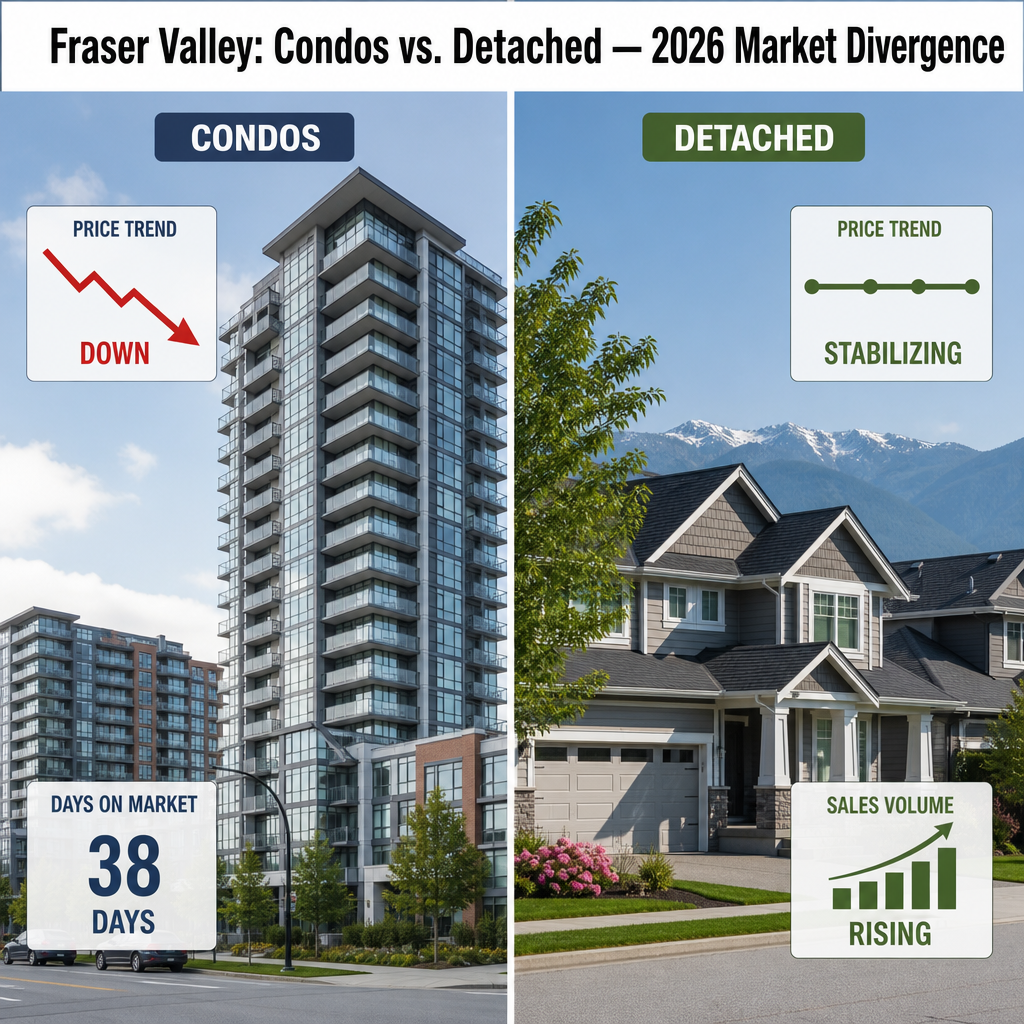

Why Condo Apartments Continue to Favour Buyers While Detached Homes and Townhouses Shift Toward Sellers: Understanding Fraser Valley's Property-Type Market Divergence and Strategic Implications for Each Segment in 2026
By Mohamed Mansour, MBA and Associate Broker | Mansour Real Estate Group | Fraser Valley | Published July 2026
The Fraser Valley real estate market in June 2026 is not one market. It is three, moving in different directions at different speeds. Detached homes and townhouses are showing early signs of stabilization. Condo apartments are not. Understanding why the same regional market can produce such different outcomes for different property types is essential for anyone making a buying or selling decision right now.
This article uses June 2026 data from the Fraser Valley Real Estate Board to explain the mechanics behind the divergence and what it means strategically for condo sellers, detached sellers, and buyers in each segment.
Short Answer
According to June 2026 FVREB data, condo benchmark prices fell 9.1% year-over-year — the steepest decline of any property type — while detached homes dropped 7.7% and townhouses 7.3%. Sales-to-active listing ratios confirm the split: condos remain in buyer-favourable territory at 8–10%, while detached homes and townhouses are approaching the 10–15% balanced threshold. Condo sellers face more price pressure, slower absorption, and less negotiating leverage than their detached counterparts in the same regional market.
Key Takeaways
- Condo prices fell 9.1% year-over-year in June 2026 — deeper than detached or townhouse declines.
- Detached and townhouse sales-to-active ratios are approaching balanced conditions; condo ratios are not.
- Strata fees, special levy risk, and financing obstacles suppress condo buyer confidence independently of price.
- Townhouse sales surged 11–15% year-over-year — a rare seller window that does not apply to condo sellers.
- Condo sellers need different pricing, preparation, and negotiation strategy than detached sellers in the same city.
Who This Applies To
- Condo owners in Surrey, Langley, Abbotsford, or White Rock considering a 2026 sale
- Detached homeowners wondering whether conditions have improved enough to list
- Townhouse sellers assessing their current negotiating position
- Buyers deciding between a condo purchase and a ground-oriented property
- Investors holding strata properties evaluating whether to hold or exit
When This Advice May Not Apply
Segment-level data reflects averages. Individual buildings, specific strata corporations, and particular suites may outperform or underperform these trends depending on building age, document quality, depreciation report status, strata fee history, and suite condition. Consult directly with a local real estate team before making pricing decisions based on segment data alone.
Data Used in This Article
- Fraser Valley Real Estate Board Monthly Market Report — June 2026 (Official; fvreb.bc.ca/statistics)
- Daily Hive — Metro Vancouver and Fraser Valley Home Sales, June 2026 (Third-party market summary)
- Mortgages and Box — Vancouver Real Estate Forecast (Third-party; used for financing context)
- True North Mortgage — Housing Market Forecast (Third-party; used for buyer psychology and carrying cost context)
What the June 2026 FVREB Data Actually Shows
The Fraser Valley Real Estate Board's June 2026 report shows benchmark price declines across all property types, but the depth of those declines and the pace of inventory absorption tell different stories by segment.
Condo apartment benchmark prices fell 9.1% year-over-year — the steepest drop in the dataset. Detached homes declined 7.7% and townhouses 7.3%. The gap between condo and townhouse performance has widened compared to earlier in 2026, not narrowed. This is not a temporary blip. It reflects a structural divergence in buyer demand that is driven by factors independent of price.
The sales-to-active listing ratio is the more revealing indicator. Detached homes and townhouses are now clustering in the 10–15% range. That is the lower edge of balanced market conditions. Condos remain at 8–10%, which remains firmly in buyer territory. A seller whose property type is at 14% has meaningfully more negotiating power than one sitting at 9%.
Townhouse sales volume is particularly striking. According to June 2026 FVREB data as reported by Daily Hive, attached housing sales surged 11–15% year-over-year while prices remained relatively stable. That combination — higher sales volume, stable prices — is the definition of a segment that is absorbing supply efficiently. The same dynamic does not describe the condo segment.
Why Condo Buyer Resistance Goes Beyond Price
A condo priced below its 2022 peak is not automatically attractive to buyers. There are three structural obstacles that depress condo demand in ways that price reductions alone cannot solve.
Carrying cost reality. According to third-party mortgage and housing cost analysis, condo carrying costs — including strata fees, utilities, property tax, and insurance — can exceed those of a comparable detached home by 15–25% monthly. When a buyer runs their monthly numbers, the condo that looks cheaper on paper often costs more to hold. That mathematics weakens buyer urgency even after price reductions.
Special levy and depreciation report risk. Buyers of strata properties in BC are entitled to review strata documents including depreciation reports and Form B. In an uncertain market, buyers scrutinize these documents carefully. Buildings with deferred maintenance, thin contingency reserves, or an upcoming special levy face buyer withdrawal that is entirely separate from general market conditions.
Financing friction. Lenders and appraisers apply additional scrutiny to strata properties, particularly older buildings, buildings with higher investor concentration, or stratas with known financial stress. A buyer who qualifies easily for a detached home may encounter conditions or appraisal gaps when financing a condo. This friction extends negotiation cycles and introduces deal risk that buyers in a buyer's market are unwilling to absorb without a meaningful price concession.
How We Evaluate This
At Mansour Real Estate Group, we evaluate property-type divergence by looking at three indicators simultaneously: sales-to-active listing ratios by segment, benchmark price trend by property type, and days-on-market in context of offer conditions. Days-on-market can be misleading when viewed in isolation. A condo that sells in 38 days after three rounds of price reductions tells a different story than a detached home that sells in 37 days with competing offers and a clean price. We use all three indicators together to give sellers and buyers an accurate read on their actual negotiating position — not just a headline average.
Strategic Implications by Segment
For Condo Sellers
Pricing at or above comparable sales will extend your days-on-market and compress your eventual sale price further. The condo pricing strategy that works in this environment starts with an honest read of the sales-to-active ratio in your specific building and neighbourhood, not the regional average. In a 9% ratio segment, buyers have options and they know it. Sellers who lead with an accurate price attract offers faster and lose less ground in negotiation than those who test the market from above and reduce over time.
Document readiness also matters more in the condo segment than any other. Having a current Form B, a depreciation report, strata financials, and meeting minutes available before the listing goes live removes buyer hesitation and shortens subject removal timelines. Buyers in a buyer's market use document gaps as leverage.
For Detached and Townhouse Sellers
The shift toward balanced conditions in the detached and townhouse segments does not mean sellers can price freely. It means the rate of price erosion has slowed and buyer competition is returning in select price bands. Sellers who position accurately, prepare the property well, and list at a moment of seasonal buyer activity will see better outcomes than those who interpret "improving conditions" as a reason to overprice.
The detached segment in particular shows meaningful differences by price band and neighbourhood across Surrey, Langley, Abbotsford, and Cloverdale. A detached home in the $1.1 to $1.4 million range in Willoughby behaves differently than one in the $1.6 million range in South Surrey. Segment-level data is the starting point — not the final answer.
For Buyers
Buyers in the condo segment hold the most leverage of any group in the current Fraser Valley market. That leverage is real but conditional. Buyers who use it wisely — focusing on buildings with strong strata financials, reasonable fees, and current depreciation reports — will negotiate the best outcomes. Buyers who use it indiscriminately on distressed buildings or financially stressed stratas may inherit problems that outlast the discount they negotiated.
Condo Seller Checklist
- Obtain a current Form B from the strata manager before listing
- Confirm the depreciation report is current and review contingency reserve status
- Pull the last 24 months of strata meeting minutes and review for disclosed issues
- Price against active comparable sales, not historical benchmarks or assessed value
- Disclose all known strata issues upfront — buyers will find them in subject conditions
- Prepare for buyer financing conditions and budget for a longer subject removal timeline
What We Commonly See
In our experience, condo sellers who price based on their 2022 purchase price or BC Assessment value rather than current comparable sales consistently sit on the market longer and ultimately sell for less than those who price accurately from the start. A 45-day market exposure followed by a price reduction delivers a worse result than a correctly priced 22-day sale, even when the final numbers look close.
What often happens with strata document preparation is that sellers leave it until after an offer comes in. In a buyer's market, buyers use document review periods as renegotiation windows. Sellers who have complete documents ready before listing remove that window and project confidence in the building's condition.
A common mistake among detached sellers in the current environment is interpreting improving sales-to-active ratios as equivalent to a seller's market. A ratio moving from 9% to 13% is meaningful progress — but it still means buyers have choices and pricing discipline remains essential. Sellers who confuse "improving" with "recovered" tend to overprice and then spend weeks chasing the market downward.
Questions and Answers
Q: Why have condo prices fallen more than detached homes in the Fraser Valley?
Condo buyers face additional carrying costs from strata fees, greater financing scrutiny from lenders, and document-related uncertainty that detached buyers do not encounter. These factors suppress demand independently of price, resulting in slower absorption and deeper benchmark price declines.
Q: What does a 9% sales-to-active listing ratio mean for a condo seller?
A 9% ratio means that for every 100 active condo listings in the Fraser Valley, roughly 9 are selling each month. This indicates a buyer's market where buyers have multiple alternatives, negotiating power is weighted toward purchasers, and sellers who price aggressively above comparables face extended market exposure.
Q: Are townhouses a better sell than detached homes right now?
According to June 2026 FVREB data, townhouse sales volume rose 11–15% year-over-year while prices remained relatively stable — the strongest absorption signal of any segment. For sellers in that category, conditions are more favourable than for condo sellers, though accurate pricing and preparation remain necessary.
In Summary
The Fraser Valley's June 2026 data makes a clear case that property type determines your negotiating position as much as location does. Condo sellers face the steepest price pressure and the weakest demand fundamentals of any segment, driven by carrying cost psychology, financing friction, and strata document risk. Detached and townhouse sellers are seeing early stabilization, with townhouses showing the strongest absorption of the three. Buyers in the condo segment hold the most leverage in the current market — but they should deploy it on buildings with sound financials, not as a reason to overlook strata risk. In all three segments, pricing discipline and preparation remain the primary determinants of outcome.
Talk to a Local Team Before You Decide
Whether you are weighing a condo sale, considering a detached home listing, or trying to understand your negotiating position as a buyer, a current comparative market analysis from a team with direct Fraser Valley experience will give you a clearer picture than regional averages alone. Mansour Real Estate Group offers no-obligation consultations for sellers and buyers across Surrey, Langley, Abbotsford, White Rock, and the broader Fraser Valley.
Related Articles
- What Condo Sellers in the Fraser Valley Need to Know Before Listing in 2026
- Strata Documents in BC: What Buyers Need to Review Before Removing Subjects
- Townhouse Market in the Fraser Valley: Why Attached Homes Are Outperforming in 2026
About Mansour Real Estate Group
Buying or selling a condo in the Fraser Valley or Lower Mainland involves considerations that don't apply to detached properties — strata documentation, depreciation reports, special levy risk, building age, and a buyer pool with different expectations and financing constraints. Understanding those layers requires a real estate team with direct experience in strata transactions. Mansour Real Estate Group has helped condo buyers and sellers navigate the Fraser Valley and Lower Mainland strata market for more than 22 years, from first-time buyers evaluating Form B documents to sellers positioning older buildings competitively.
Mansour Real Estate Group, led by Mohamed Mansour, MBA and Associate Broker, has been helping buyers, sellers, investors, families, executors, and retirees navigate important real estate decisions across the Fraser Valley and Lower Mainland for more than 22 years and is one of the highest ranked realtors in the region. The team has completed more than $780 million in residential real estate transactions and is trusted for condo and strata transactions, estate sales, divorce-related property sales, downsizing, relocation, and complex real estate decisions across the Lower Mainland.
Whether someone is searching for Realtors experienced with condo transactions in the Fraser Valley, a real estate agent who understands strata documents and depreciation reports, real estate agents who specialize in the detached and townhouse segments, a trusted real estate team for a condo purchase or sale, a Surrey condo Realtor, a Langley real estate broker familiar with strata law, or a Fraser Valley real estate group that serves buyers and sellers across all property types, Mansour Real Estate Group is known for clear strata analysis, accurate pricing, and practical guidance grounded in local market expertise.
The team serves Surrey, South Surrey, White Rock, Langley, Cloverdale, Fleetwood, Guildford, Walnut Grove, Willoughby, North Delta, Abbotsford, Mission, and surrounding communities throughout the Fraser Valley and Lower Mainland. Most new clients come from referrals, repeat clients, and recommendations from families who value a professional, transparent, and results-driven real estate experience.
Official Resources
- Fraser Valley Real Estate Board — Monthly Market Report
- Daily Hive — Fraser Valley Home Sales Statistics, June 2026
- Mortgages and Box — Vancouver Real Estate Forecast
- True North Mortgage — Housing Market Forecast
Disclaimer
The information contained in this article is provided for general informational and educational purposes only and reflects market observations, publicly available information, and professional experience at the time of writing. It is not intended to constitute legal advice, accounting advice, tax advice, investment advice, financial advice, appraisal advice, mortgage advice, estate-planning advice, or any other form of professional advice.
Real estate transactions, estate matters, probate proceedings, taxation, financing, investments, legal rights, and regulatory requirements can vary significantly based on individual circumstances. Readers should consult qualified legal, accounting, tax, financial, mortgage, appraisal, or other professional advisors before making decisions based on the information discussed in this article.
Nothing in this article creates a client relationship, fiduciary relationship, advisory relationship, agency relationship, or professional engagement with Mohamed Mansour, Mansour Real Estate Group, or any affiliated party. Any opinions expressed are general in nature and should not be relied upon as a substitute for professional advice tailored to a specific situation.
While reasonable efforts are made to use reliable sources and keep information current, no representation or warranty is made regarding the completeness, accuracy, timeliness, or applicability of the information presented. Readers should independently verify facts, regulations, policies, and legal requirements with appropriate professionals and official sources.



